VideoDeconstructor of Fun
How to Catch the Next Big Fish with Laura Taranto of Big Fish Games
15 Mar 202429 min video
Oh yeah, Ollie. I know it. Your way is like he's like a The notes are not aligned at the slide. So, this is one ahead than this one.
Cool. All right. So, in the current climate, which we heard a lot about this morning, how do you start when your goal is to make the next mobile hit game? We were tasked with this, so I'm going to the process we used. And frankly, actually, if you use this process, it's
one way that you can actually develop a game thesis, which Phil just went through. I think it comes down to three areas. There's no formula, but there are techniques you can use to dwindle kind of a large ocean to something more of a manageable river. And it's three areas. You're looking at data, you're looking at sentiment, and you're looking at domain expertise. Many companies use one or two of these parts, but realistically, you need all three to approach making a game in today's waters. And uh Mishka called it out this morning about failing fast. I I actually still think you need to prepare to fail quite a bit, but I think you want to fail early. So, a little bit of context about who we are and our our situation. So, Big Fish is known initially, I mean, it's been around about 20 years, for premium hidden object games. Uh we released Gummy Drop in 2014, which is a match-three game. And then our last game was Evermerge, which was released in 2020, and it's a camp uh camp merge game. Now, we wanted to continue to ride this
wave, so it meant we needed more new games. We had We first thing we did is we set a North Star. Um we had this big hairy audacious goal, restarting the new games pipeline to make two $100 games in 2 years. To put some context around this, that's about a top 15 match game or a top five merge game or about a top 30 puzzle game, depending on how you slice the categories. I actually think kind of these big goals work because product leaders and creative visionaries need a healthy combination of hunger, curiosity, and a bit of delusion. So, what did we do first? We knew we would have a lot of these failures, so we wanted to understand what we thought our failure rate would be. How many concepts did we think we needed to hit to basically one big game? And this was for two reasons. One, we wanted to set alignment within the team, and we also wanted to set alignment with our stakeholders to understand that this was going to take some time. We were going
to fail a lot before we came up with something great. And just to give a little explanation on concept, a concept here is one idea. If we Like if we had an engine and we had significantly changed that engine, we counted that as a second concept. What we did do is we actually went through we measured as we worked how we how we landed it against our initial estimates. We were pretty much on point. The only thing we completely overestimated was how many games we thought we could reach in limited basically a limited market test. We thought it would be 10, we ended up only at three. So, we've aligned on the odds, and knowing games become a lot more expensive the further down the pipeline you go, we wanted to spend a significant amount of time in research and exploration. Um so, narrowing down the space, we kind of wanted to focus on three key questions. What did the data tell us about the opportunity space? What was the sentiment of players in the market? And where was the majority of our collective domain expertise?
You can work this in any order. I'm going to go through it in in this order. So, instead of looking at that like a list, if you put it into a Venn diagram, it makes it really clear what you want your target to be. You kind of want to end up in the middle of all of these three things. So, starting with data. I cast a wide net for an example here, but we I started to look at basically estimated sub-genre downloads, revenue, and ARPDAU. Um one thing that that I will note about this graph is that this is worldwide. If you're going to be looking at a game and you have an idea of what markets what targets you want to hit in terms of markets, you'll want to actually focus on those markets. But I wanted for this example, I wanted to spread wide and look look very clearly. Um starting with downloads, I usually use downloads as a proxy for appeal. Um and by the top sub genres for this were basically arcade, puzzle, and sim. Same with revenue. This is a worldwide view. It was where were the dolphins, whales, and minnows spending their money
or see value in the market. If I map downloads to appeal, then I use uh basically revenue as a proxy for how much do the players love the game. Um So, the top ones we were looking at here were RPG, strategy, casino, and puzzle. ARPDAU is a funny one. That's average revenue per daily active user. It's very hard to look at this metric in isolation because depending on whether the numerator, denominator moves, can really wildly change your outcome. So, I would say we did look at this. We want to see generally where where the ARPDAU was, and again it was a casino, RPG, and strategy. And you can start to see a pattern in what sub genres were coming to the top. So, what are the key takeaways? Winners tend to stay winners, especially by subgenre. There is movement. There's some growth and decline, but it's not frequent. Downloads don't always map to spend, and spend does not always map to downloads. Certain subgenres are appeal-capped, and I'll go into this a little bit later. And one thing about these charts is that
they tend to generate more questions than actually give you answers. So, digging into things like looking at appeal caps uh requires another layer of analysis. Um subgenres tend to differ differ heavily in terms of monetization and design, as well as how many games are in each category themselves. And again, these tend to generate more questions. So, I'm going to give an example of um kind of a deeper dive into two segments. Okay, these charts are a little intense, but the way I the way I tried to structure this was I wanted to look at the top games by match and merge filtered by those that have made more than 100 million in their lifetime revenue. This also this view also shows what percent of the revenue store pie that they take. Immediately you can see between match and merge, there are many more great games that earn that kind of a hundred million dollar threshold in match than in merge in the last five to seven years. While merge had less competition, it is also more difficult to reach the bigger revenue numbers. And
to be fair, looking at this chart, match looks a bit scary. But what it also tells me is that, kind of like the subgenres themselves, winners tend to stay winners. If you have a game and you can surpass that hundred million dollar threshold, you have a good chance of staying. Um and there's also something conflicting, and again Mishka referenced this in his keynote this morning. Playing these games, and I put the ones that we looked at at the bottom, merge, they're pretty they're pretty different. You have Merge Mansion, which is a grid-style merge game. You have uh Merge Dragons, which is a camp-style with a level level set. You have Evermerge, also camp. But then they're they're completely different in terms of how those games work. When you play match, you actually start to notice that there are a lot more similarities than there are differences between the games. That might make you think, "Wow, okay, I just need to make a small incremental incremental change to a match game and woo, hundred million dollars." But that's that's not actually the case. Um we'll go into this a little bit when we talk about sentiment, but I don't think any more that one or two small innovations are going to get you where
you want to go. It's actually looking at market is actually looking for bigger swings. So another way to look at those charts is we want to see we looked at like kind of how they took over the revenue for the for their subgenre, what percent they they carried. But if you look at it in terms of um just in terms of over time, you can see these also behave differently, which is partially to be expected because um match is significantly more mature than merge. For merge, what I thought was interesting is that this chart makes it seem like the the segment itself is not growing to due to the incumbents. Um because I know that because when I look at merges overall revenue by the sub category, it's growing. But you would not think about it looking at the first chart, which makes which tends to imply that it's actually the newer games that are driving more of the revenue for the segment. Match on the other hand, you have the incumbents that are that are staying winners and they're driving revenue for that for for the overall revenue of the subgenre. Um, this also means it's incredibly more
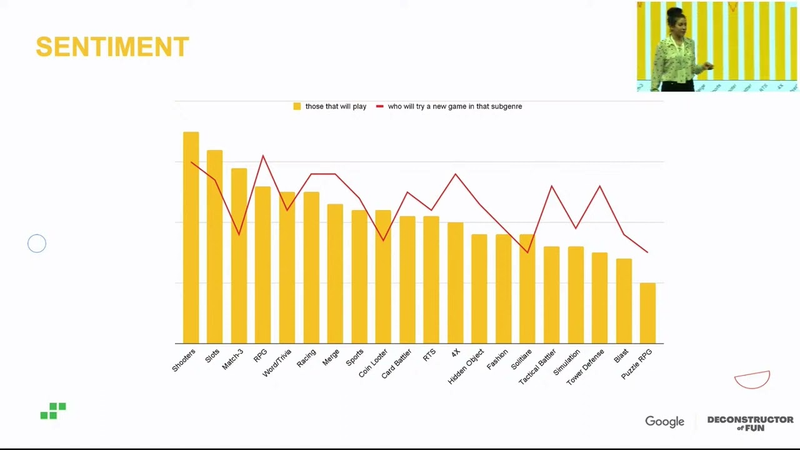
competitive. So, this is where player sentiment needs to add color to this data. So, this is an example chart. Um, this is basically showing sentiment by what players are saying they want to play, what they're currently playing, and what they're open to playing to next. I highly recommend you work with one of these data sets if and basically an external agency can create this for you. You can buy a data set and create it yourself. Again, this is an example one. Um, if you can't afford either of those, then what if you have a game live, you can use an in you basically you can use like a survey, get players an opt-in survey to answer questions. But this is not like playtesting. You're looking for you want basically two to 3,000 people to opt-in on to into this uh to collect data on. It's not like a 15 to 50-person playtesting set. Um, and again, by itself, it only tells part of the story. I'm going to dig into a few examples of how to use this, um but I'm going to focus on this area because to me, this is high sentiment where players are
interested in in either learning a new uh they're open to trying any new game in the market, um and they're also very engaged with the subgenre itself. One important note, I find that if you're looking to create something entirely new, again, I was saying, take a big swing. You might be inclined to disregard sentiment entirely because it only looks at what currently exists. Sentiment is still useful because no matter what you make, there is going to be a game that the players you you to target are already playing. So, you are looking at overlapping audiences, and that will start to give you an idea of how you can if you're developing a new engine, how you can tailor your engine for that. So, I'm going to look at match. Match has a high inclination to play, and we know that because there's a ton of match games that are doing very well. And as you would expect, there's low inclination to try a new game. Therefore, if you're going to go into match, you probably need a mastery of the fundamentals. Existing games hold the advantage in both data and
sentiments. And as I mentioned before, incremental innovation is unlikely to convince players to play your game. So, back to bigger swings. And as you can see here, the data is actually in the player comments of the survey. How you phrase your questions is incredibly important. They can't be too leading, or they can't be too vague. Players are great at saying what they want and what they like, but they can't tell you what to do next. Merge. High for present engagement. Players are liking what they're playing, but they're not so interested in trying new games. It's higher than um We know that it's it's a higher in future interest, though, than in match three. I'm jumping out a little bit, but I think this is where we get into You need to know about You need to have good domain expertise into where you're exploring because part of what forms sentiment is their current frustrations that they're experiencing with the games themselves. I know from working on merge games, and it it spans both camp merge
games like Evermerge and grid merge games like grid uh Merge Mansion, is that you have to know what their frustrations are. And one frustration that spans both merge types is the long merge chain. So, if I assume most of you have played a merge game, when you start merging up these little pieces, eventually you get that final piece. And that can feel so good, but then realizing you have to go back and make another one, and you're starting from zero leads to a lot of frustration. You You sometimes suss that out in player surveys, but it's much easier if you're already know enough about the space. Hidden object is relatively low in current interest, but high in desire for new games. I'm cheating a little bit here, too, because I'm a little I'm familiar with hidden object. Um despite falling kind of in the middle of the chart, I actually think there's a good opportunity in hidden object because there's not as many game launches as you find in other uh casual sub uh subgenres. And I think I would read into this. So, Playrix has a has attempted to disrupt this space with Manor Matters, which is
a game that came out not so long ago. And what they did is they took match-three gameplay elements, put it into a hidden object core, and then wrapped it in the like a decoration mystery-solving meta. So, I imagine they saw an opportunity to say, "How can we add something to hidden object that we know uh players that have affinity toward hidden object, so those that play puzzle games, would like?" Blast is one of the most interesting areas since a few games have done exceptionally well, Toy and Tomb Blast, but recent games have stumbled to the point where some developers are completely running from this engine. It's a little bit you need a little bit of interpretation to understand what I I think what players want next. Players cite wanting to play more strategically without adding difficulty to the game. So, I would interpret this as if you want to make an interesting game, doing something like making the love just making the games harder by reducing the number of moves is not the right move here. Rather, you want to start exploring how you can how you can
manipulate the engine to craft an experience that it that creates new ways to solve the puzzle or level. An early iteration of Wonder Blast by Good Job Games dabbled in this, and I thought that it was super interesting. I liked the direction they were going in because they changed how the specials and combos worked that was unique to the blast segments. So, RPG was an interesting one because despite sharing character collection story, RPG is split between action and puzzle and they have different player sentiments. Players want more RPGs, but again the RPG is quite important. Squad RPG sentiment is high, puzzle RPG sentiment is low. Action RPGs incredibly competitive because Mihoyo crosses into this space and we all know Genshin Impact has done very, very well. RPG appears primed for new games. However, like match three, you want strong foundational knowledge before you're going to enter this space. I was a little bit curious about puzzle RPG, so I took a I took a look at the top games by revenue. Um
Monster Strike, the top one right now, was released in 2014. Puzzles and Dragons, 2015. Empires and Puzzles, 2017. While puzzle RPG sentiment is low, the top games are over five years old. And this is where domina- domain expertise comes into play. Data and sentiment are mixed. Puzzle RPG shows really good numbers, um but low appeal. This could be due to the lack of new entrants. Again, we haven't seen a top game in five years. If I was confident I could make a puzzle RPG game that solved what players wanted and addressed any frustrations they have, I would weigh those points appropriately and use the lack of new games as an opportunity to take market share. So, data and sentiment are great for what already exists. I think domain expertise is a key part of this framework since so much of what's required today is creating something that doesn't yet exist. It might be presented third, but it's as important as the first two.
So, taking data sentiment, then I should be pitching RPG games, right? Absolutely not. I would have laughed myself out of the room. My team, myself included, had virtually no experience making an RPG game. Um this now granted this wasn't I think if you were like 10 to 12 years ago, I don't think it would have mattered as much. It wasn't as competitive of a space, but no matter where you look across most sub genres, there's a lot of competition. Also, players have very specific expectations of what they want since they are already playing similar games. So, you have to be able to meet those expectations. So, now domain expertise is a key part of the process approaching new games. I think where And this is a little bit in terms of we talk about this a lot, but you have to play to your strengths. Um, to understand what players want next, you need to be very You need to have a very good understanding of what they're doing now and what they're playing now because whatever you make,
it is a prediction of the next wave. A common theme we see from sentiment is that players do cite that they want new games. And this it's the games that feel new and fresh. We want to avoid anything that feels derivative. And this is I think the best part of game making is taking what taking what's super familiar and what players are used to and presenting it in a way that feels super different even if more than 50% of the game is already exists in market. And I've tried to show that here. We have Wizard of Oz, which a match three game, Harry Potter Puzzles and Spells, same company, same engine, completely different feel. And then we have two different ones, two different companies. Um, very similar engines. This is a basically tile match, completely different feel. And if I I wish I'd thought of it earlier, but another one I would have put up here is two different companies. Would it be um Scopely and Moon Active. If you look at Coin Master and you look at Monopoly Go, they have similar engines, completely
different feels. So, there is a way to do it. I think worth mentioning is like what I've heard this term thrown around a lot is red ocean versus blue ocean. Red Red ocean is filled market space, blue ocean is open market space, and most people want to play in blue ocean and I totally get it. But, I really think the worst an ocean can be is purple. It's only red if you're completely unfamiliar with the territory or you have severe limitations on your time to research and your time to experiment. Um the the like what we see is that the demand for novelty is really high. Um and looking at what's already kind of broken through the molds and what players are saying is that there is a desire for for new games. It's this exactly explains why domain expertise is so important. Um games that reach these high levels of success in the last 5 years have built on what they already know and they built in spaces where they were to their strengths. So, I did a little exercise. This was actually super fun. I pulled up three
examples where I think that developers use this technique well. The first is my favorite, which is Dream. They launched Royal Match in 2020, but the company was only founded in 2019. That's about 12 months. That that is a that is a very difficult thing to achieve. They came from Peak, so they have over 10 years experience in the puzzle space. Toy and Toon Blast are billion-dollar games and it wasn't until I put these three games together to I I truly realized they built on what they know. They completely played to their strengths. Another favorite of mine is Century Games. They started with Frozen City, about a $50 a year game before their Whiteout Survival success, over $400 a year. Frozen City soft launched November 2021, hard launched in December the following year. Data.ai reports the first release of Whiteout Survival was in June 2022. That is 7 months between soft launches. You can if you play both games, you'll realize they built on what they know. They took the game Frozen City that was incredibly sticky. They added a 4X loop to it and then they created basically
two experiences that they feel super familiar, but they are entirely differentiated. Okay, this is also really fun one. So, Playrix has a ton of titles, but I'm I'm particularly intrigued by Township right now. Um it's a it's a $2 billion game where 50% of their revenue roughly has come in the last 3 years. And keep in mind they launched in 2011. We're working on a longer analysis that's in progress. Um but what I want to why I call this out here is I think Playrix has shown us they have a very rich history of understanding the space and reacting, pivoting, and adapting appropriately where they excel. So, again, Township came out in 2011. It's a farming sim game. That's all it was just farming sim. Then they released Gardens and Homescapes in 2016 and 2017. And then using what they know about the match space, they started updating Township between 2020 and 2022 to have the game it is now. It is a farming sim game with a puzzle-rich events loop that has a full match-three engine, a full
grid merge engine, looped into their seasonal events. It's massive. Phil references this in his talk. Um but no matter what you do, you need a solid unique selling point, also a differentiator. This process I walked through is one way to craft that compelling reason to download and play your game. Um so in the case of restarting the new games pipeline at Big Fish, we we focused on match three and merge because the data, combined with what we thought players would want next, combined with our experience suggested that we could craft a compelling game despite the red ocean crowded market. So, the last part, measuring. How do you know if you're going in the right direction? If there's one point to take away, it's that you need to remember that the landscape is dynamic. So, you must stay on top of the market as you build. There's no It's not like the market's this way one way and it's going to stay that way. It's going to be changing all the time and you're probably going to have to pivot at some point.
And cutting games is also part of the journey. So, when our merge bet, we followed what players were doing, saying, feeling, and noticed a distinct shift in the merge they basically in the merge space within styles of play. Initially, most of the games merge games were kind of similar to Evermerge in that it was this camp style merge game or similar to Evermerge or Merge Dragons. Grid merge, which was a new style of merge, was taking most of the market share starting from well, it was growing from 2021 through 2023. So, if we wanted to continue down the path and we wanted to make a merge game, we had to bring a lot to the table. We either needed to make a very distinctly different camp style merge game or we needed to pivot, make a grid merge game, and then go head-to-head with the likes of Merge Mansion and Gossip Harbor. Neither of those really worked within our timeline, and this is adding one more dimension to the mix, which is the business. Your company needs to be ready and willing to embrace pivots and cancellations. This is why we talk about
failure and aligning with stakeholders early. It's unlikely that you're going to hard launch a hit in 12 months or less. I just think it's it's incredibly difficult. Um and you need to know where your business stands from quality, speed, and budget. If it's cheap and high quality, it's going to be slow. If it's fast and high quality, it's going to be expensive. If it's fast and cheap, it's probably not going to be good. And knowing where your business stands when you start absolutely needs to be outlined. So, swimming back upstream to my merge example, we knew we had to deliver this massive game um that simply did not fit within with our goals. We wanted 100 million in two and basically under two years. We would have had to develop a very, very large game. The market was shifting, expectations were rising for merge players, and for some companies it would have been fine. You just, you know, expand the scope, delay launch, keep going, and you would have just kept going. We actually had to make a decision strategically, Does this fall in line with what we want to achieve
right now? If it's a business question, the answer was this was not making this change was not the right move. Sentiment was moving too quickly and we were not prepared to invest over 2 years into a game. However, we were also looking at match and the market hadn't suggested the same pivot, so we were able to keep going. So again, how do you know if you're going in the right direction? This kind of ties back to your data sentiment expertise. I was really anchoring down on the point that you need to deliver big changes. So how do you create benchmarks in those cases? You'll want to compare with your closest competitors, even if there's not a direct comparison. Are you thinking of something that you're going to build an engine that matches items? How many are you going to match? You're going to match two? You're going to match three? You're going to match more? How are you looking to match them? Swipe, collapse, merge, uh tile trough? And are you going to put them on a grid? Are you going to not going to have them on a grid? No matter what you pick, you're going to have coms you can compare to and that's where that's where you want to start to anchor down on because when you look at creating a total addressable market,
you're comparing actions in game. And this is where you want great game designers as well. So jumping back to match. So just a quick example of creating your target market and I'll use the game the match game we worked on as an example. So who are your ideal players at least initially and it's totally fine if they change as your game as your game evolves. So if you want to innovate in match puzzle, what's your innovation? This is like my favorite example. You want the best in class match three engine. We want to combine it with a dress-up system and then we want to add a sprinkle of romance. Voilà, the Matchlorette. And to be fair, Ethan actually came up with this on an episode of Twig and I loved it so much. Um if you're stuck and you're not sure how to compare games, Data AI has a great affinity tool that's going to show you where there's overlap in player time. Um one thing jumping back a little bit to Playrix, we know there's affinity between farming sims and merge players. So actually that that combination made a lot of sense. If you're really stuck, you can start with concept and theme testing. If you
have a game that's live, you can you already can kind of create a player, but you can use your player base for those testing. I would recommend anything from surveys. You can do VIP panels. And anything like that to get kind of player feedback would be a good place to go. I know Misha said don't overdo the testing, but I actually think testing is quite important. Now, you've already built your hypothesis. How do you test this? So, does this feel good or better than what they're currently playing? Remember to ask everything in relation to what you've built. Never ask what you think of this game in isolation because again, you're not comparing you don't want to compare it to itself. You want to compare it to what other players are playing, especially if you're going after them to capture them from a market standpoint. Initially, it's tough. You're only going to have one data point. But the purpose of continual testing is to have a build a story and to see where the direction's trending. If it's positive, that's going to really help you make a case for continuing your project. So I'm going to go through a little bit
of some of the feedback we got when we did some of this testing. It's edited. It was on one of the prototypes. You can basically see here for our iterate for what we did for our match game. It felt overall pretty generic. It was not differentiated enough. And I think this would have meant we needed to invest more time in the USP. So this goes back to budget. It gives you control to decide how much work is needed to kind of get the results you want and can you cover THE COST? SORRY. LAST POINT. I THINK the right approach, the right having domain expertise, looking at data and looking at sentiments can always create a purple ocean. And always remember there is a big fish lurking waiting to be caught. So now I'm going to bring up So we talked about a game thesis, we've talked about process, and now we're going to talk about creating the dream team. Now we have Mishka, uh Felica, Daria, and Maria.
Auto-generated captions from YouTube — names and numbers may be misheard.
Developing a successful mobile game in a competitive, mature market requires a disciplined, three-pronged framework that integrates quantitative data, qualitative player sentiment, and internal domain expertise. Rather than seeking a rigid formula, studios should aim to synthesize these three areas to narrow broad market opportunities into manageable development paths. This process begins with establishing a clear North Star—such as a specific revenue or ranking goal—and acknowledging that high failure rates are an inherent part of the development cycle. By setting realistic expectations for failure early in the pipeline, teams can maintain alignment with stakeholders and allocate resources more effectively.
Data analysis serves as a foundational tool for understanding market appeal and monetization, using metrics like downloads, revenue, and average revenue per daily active user (ARPDAU) to identify subgenre trends. However, data alone is insufficient because it reflects past performance rather than future potential. Player sentiment provides the necessary context, revealing user frustrations and desires that data might obscure. For instance, while match-three games are highly competitive, they require a mastery of fundamentals, whereas subgenres like hidden object or puzzle RPGs may offer opportunities for disruption if developers can address specific player pain points or innovate within established engines.
Domain expertise is the final, critical component, as it allows studios to leverage their unique strengths to create "purple oceans"—market spaces that are neither entirely red (saturated) nor blue (untapped), but rather differentiated through strategic innovation. Successful developers often build upon familiar mechanics while introducing fresh, compelling themes or loops, as seen in the evolution of titles like Township or the rapid success of Whiteout Survival. Ultimately, the development process must remain dynamic; studios must continuously monitor market shifts and be prepared to pivot or cancel projects if the competitive landscape or business requirements change. By anchoring development in a rigorous, iterative testing process that compares new concepts against existing market leaders, studios can better navigate the complexities of the modern mobile gaming industry.

Deconstructor of Fun · 2026

Deconstructor of Fun · 2026

Deconstructor of Fun · 2026

Deconstructor of Fun · 2026

Deconstructor of Fun · 2026

Deconstructor of Fun · 2026

Deconstructor of Fun · 2026

Deconstructor of Fun · 2026

Deconstructor of Fun · 2026

Deconstructor of Fun · 2026

Deconstructor of Fun · 2026

Deconstructor of Fun · 2026

Deconstructor of Fun · 2026

Naavik · 2026

Naavik · 2026

Deconstructor of Fun · 2026
The Game Business · 2026

Deconstructor of Fun · 2026

Deconstructor of Fun · 2026

Deconstructor of Fun · 2025

Deconstructor of Fun · 2025

Deconstructor of Fun · 2025
Deconstructor of Fun · 2025
Deconstructor of Fun · 2025
Comments