Skip to main content
Game Industry
Library
Library
Search
Ask AI
News
Connect your AI
Browse
The Catch Up
Topics
Collections
Writers
Help
Subscribe
Game Industry
Library
Library
Search
Ask AI
Saved
Library
16 reports matching your filters
All Types
Reports
Articles
Presentations
Whitepapers
Financial
Legal
Other
Search
Cross-Platform
Global
Market Analysis
Monetization
Game Development
Player Behavior
Marketing
Console
Mobile
Game Publishing
Market Forecast
PC
User Acquisition
Mergers & Acquisitions
Game Design
Survival Horror
Player Demographics
Streaming
Clear
Filters
1
Cross-Platform
Recently added
Newest first
Oldest first
Title A–Z
Title Z–A
Report
2 pages
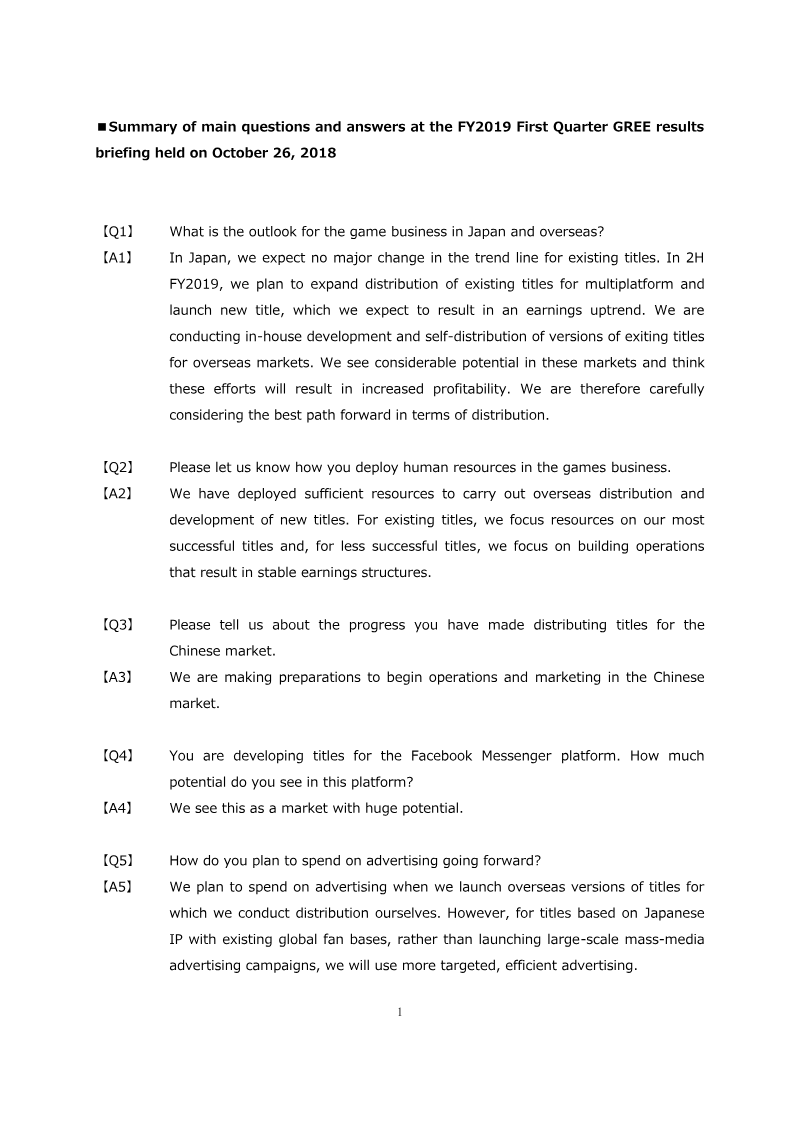
Summary of main questions and answers at the FY2019 First Quarter GREE results briefing held on October 26, 2018
GREE is prioritizing international expansion by self-distributing existing titles in high-profitability markets, with China identified as a key target for upcoming operations and marketing.
The company plans to drive an earnings uptrend in the second half of FY2019 through new title releases and expanded multiplatform distribution in Japan.
GREE is diversifying its distribution channels by targeting social media gaming, specifically highlighting Facebook Messenger as a high-potential platform for new releases.
Market Analysis
Market Forecast
Game Publishing
+5
GREE
Report
1 pages
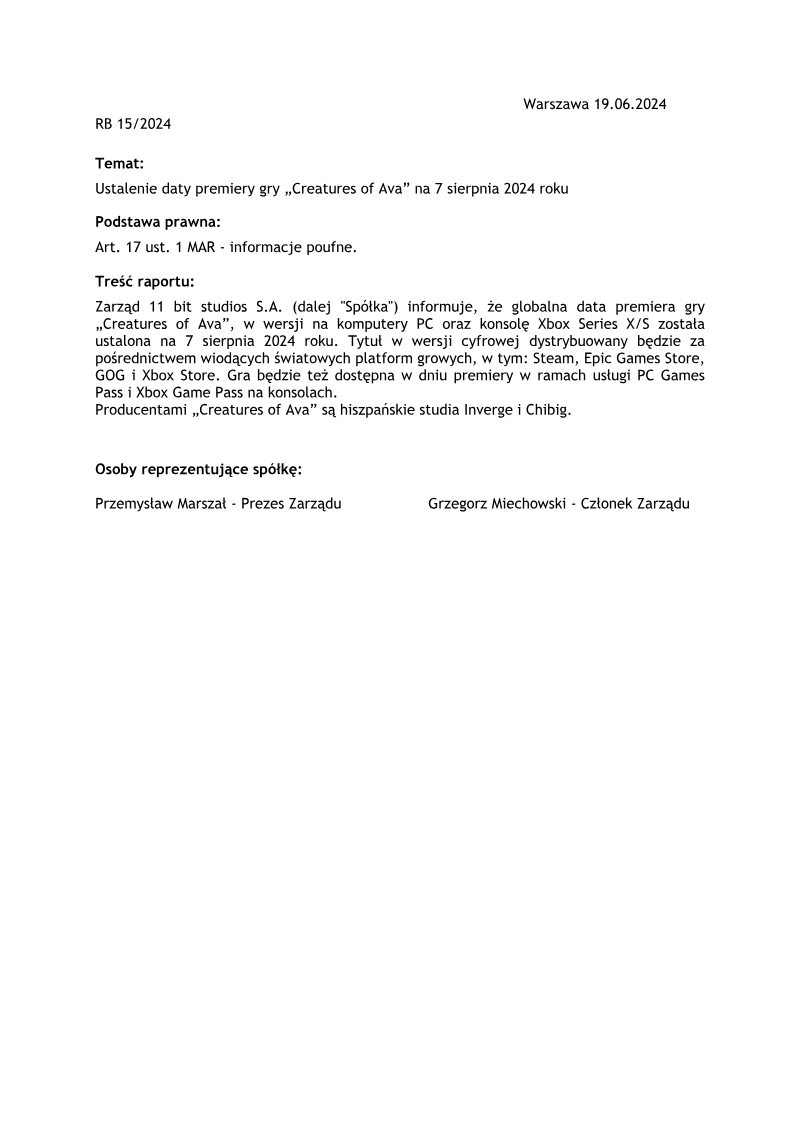
Ustalenie daty premiery gry „Creatures of Ava”
Creatures of Ava will launch globally on 7 August 2024 for PC and Xbox Series X/S platforms.
The game will be available at launch on PC Game Pass and Xbox Game Pass, alongside digital storefronts including Steam, Epic Games Store, GOG, and the Xbox Store.
11 bit studios S.A. is coordinating the release of the title.
Game Publishing
PC
Console
+3
11 bit studios
Report
1 pages
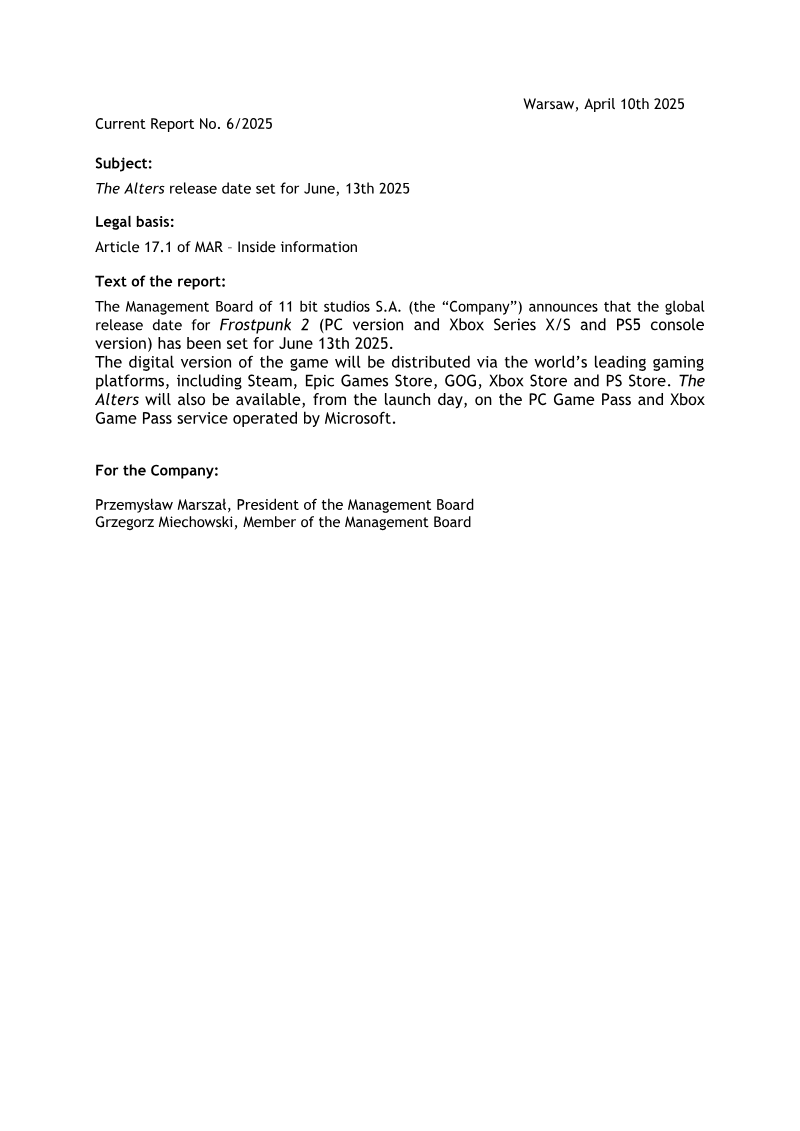
Current Report No. 6/2025: The Alters Release Date
11 bit studios has scheduled the global release of Frostpunk 2 for June 13, 2025.
The game will launch simultaneously on PC, Xbox Series X/S, and PlayStation 5.
Frostpunk 2 will be available on day one through PC Game Pass and Xbox Game Pass subscription services.
Game Publishing
PC
Console
+2
11 bit studios
Report
34 pages
Cross-Platform Gaming: Bridging Mobile and PC/Console 2025
Mobile platforms function as the primary discovery engine for the gaming industry, generating over 52 billion annual downloads and $82 billion in in-app purchase revenue.
Publishers maximize franchise growth by using mobile to feed into high-fidelity PC and console ecosystems, which anchor brand loyalty and drive high-value engagement.
Cross-platform progression and unified ecosystems are most effective for RPG and Shooter titles, significantly increasing player lifetime value and retention.
Market Analysis
Cross-Platform
Global
+1
Sensor Tower
Dec 2025
Report
46 pages
Global State of Game Publishing & Marketing 2025 Industry Report
The global game publishing market is projected to grow from $117.4 billion in 2025 to $150.7 billion by 2030, driven by cross-platform development and the democratization of publishing tools.
Digital sales now account for 95% of total revenue, signaling a near-total transition away from traditional retail channels.
Subscription-based revenue models are forecasted to grow at a 12.2% CAGR, reaching $21.6 billion by 2030, while the premium one-time purchase market experiences only marginal growth.
Market Analysis
Marketing
Global
+1
Epic Games
Jan 2025
Report
13 pages
China Game Industry Report 2025
Chinese self-developed mobile games generated US$20.455 billion in overseas revenue in 2025, marking a 10.23% year-on-year increase and the sixth consecutive year exceeding RMB 100 billion.
The United States remains the primary overseas market for Chinese games, accounting for 32.31% of total export revenue, followed by Japan at 16.35% and South Korea at 9.15%.
Strategy games (SLG) dominate the overseas market, capturing 49.97% of earnings, significantly outpacing shooters at 9.69% and RPGs at 9.39%.
Market Analysis
Market Forecast
China
+4
Meridian Play
Jan 2025
Report
6 pages
From Games to the Big Screen: The Impact of IP Across Platforms
The Fallout television series triggered a 410% surge in daily PC sales for Fallout 4 and sustained a 225% increase in daily active users for legacy titles for up to 20 weeks post-premiere.
The Minecraft film grossed over $900 million while driving a 44% spike in mobile in-app revenue and a 36% increase in console sales.
Transmedia adaptations create a symbiotic growth loop that simultaneously boosts gaming metrics and streaming platform performance, such as the 23% increase in Amazon Prime Video downloads following the Fallout series launch.
Market Analysis
Player Behavior
Marketing
+2
Sensor Tower
Jan 2025
Report
34 pages
Cross-Platform Gaming: Bridging Mobile and PC/Console
Mobile remains the primary driver of scale with 52 billion projected downloads and $82 billion in in-app purchase revenue for 2025, while PC and console segments generate over $12 billion from 1 billion units sold.
Unified cross-platform ecosystems, exemplified by titles like Genshin Impact and Delta Force, significantly improve player retention by enabling seamless progress synchronization across devices.
Publishers should adopt one of four strategic models—companion apps, 'lite' discovery versions, adapted standalone experiences, or full cross-play—to bridge the gap between mobile reach and PC/console engagement.
Market Analysis
Cross-Platform
Global
+1
Sensor Tower
Jan 2025
Report
39 pages
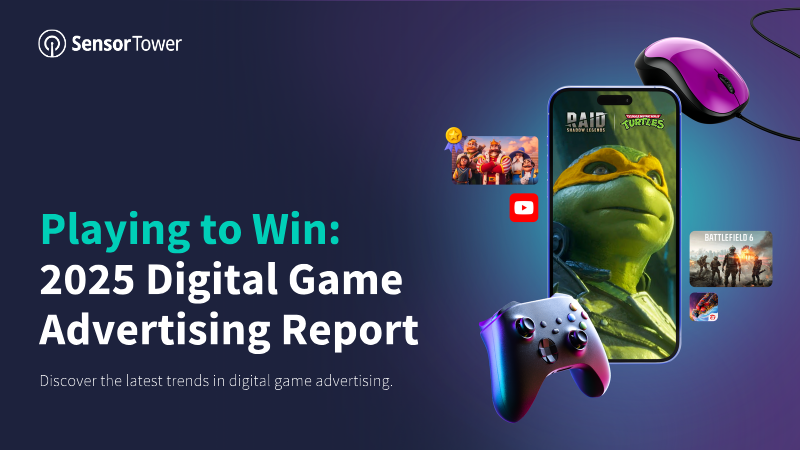
Playing to Win: 2025 Digital Game Advertising Report
Global digital gaming advertising expenditure reached $8.7 billion in 2025, with major publishers like Microsoft and Dream Games utilizing aggressive spending to maintain market share.
The industry has shifted its primary success metric from sheer download scale to engagement quality, despite a year-over-year decline in total mobile and PC downloads.
Roblox continues to bypass traditional external advertising, generating 187 billion visits through organic traffic and internal discovery mechanisms.
Advertising
Market Analysis
Global
+1
Sensor Tower
Jan 2025
Report
11 pages
Crypto on Live Streaming Mini‑Report
The number of unique crypto-focused streaming channels doubled in the six months leading to late 2024, with YouTube channels surging from 31 in July 2024 to over 200 by June 2025.
India has become a primary hub for crypto content, hosting four of the top ten global creators who stream primarily on YouTube.
Bitcoin remains the most discussed asset with over 500,000 chat mentions in the first half of 2025, while Solana has emerged as the dominant secondary interest with 171,000 mentions.
Streaming
Market Analysis
Cross-Platform
+3
Stream Hatchet
Nov 2024
Report
53 pages
The State of Play: Summer 2024 Edition
Indie studios are capturing a larger share of the market, generating 29% of total Steam revenue in 2023 compared to 25% in 2018.
Game development is becoming increasingly democratized as Unity usage grows by 8% year-over-year, Unreal grows by 10%, and Godot experiences a 69% surge.
The edutainment sector is poised for significant expansion, with a projected compound annual growth rate of 65–75% through 2034.
Market Analysis
Game Development
Global
+1
Xsolla
Mar 2024
Report
54 pages
Save Point 2024: Recapping the Year’s Biggest Trends on Live Streaming
Simulcasting has become the industry-standard distribution model, with top creators achieving concurrent-viewer gains between 148% and 491% by broadcasting across multiple platforms simultaneously.
Co-streaming is now the primary driver of esports engagement, accounting for 44.4% of total viewership and 1.2 billion hours watched.
Kick experienced significant growth in 2024, surging 176% to reach 1.7 billion hours of viewership, bolstered by major events like the 1.4 million-viewer 'Stream Fighters 3'.
Streaming
Market Analysis
Global
+1
Stream Hatchet
Jan 2024
Report
33 pages
Perforce 2024 State of Game Technology Report
Real-time 3D engines have expanded beyond gaming, with over 50% of organizations in media, automotive, education, and healthcare now integrating these technologies into their workflows.
Unreal Engine leads the market with 63% usage, followed by Unity at 47%, while Perforce Helix Core remains the primary version-control solution for 51% of firms.
Generative AI adoption is widespread, with over 65% of respondents utilizing AI tools, led by ChatGPT at 47%, with indie studios showing higher adoption rates than AAA counterparts.
Market Analysis
Global
Cross-Platform
Perforce Software
Jan 2024
Report
42 pages
How Different Generations Engage with Video Games Today
Gaming has become the primary entertainment medium for younger generations, with 94% of Gen Alpha identifying as game enthusiasts.
Approximately 60% of younger players invest in games, driven by a preference for social immersion and genres like Adventure and Battle Royale.
70% of younger players are 'player-viewers' who consume gaming content for social connection, whereas older generations use such content primarily for information like reviews and tutorials.
Player Demographics
Market Analysis
Global
+1
Newzoo
Jan 2023
Report
26 pages
Multiplayer Report 2022
Multiplayer gaming engagement grew by 3.3% year-over-year, with 77% of the global gaming population now participating in online play.
Unity internal data shows a 150% surge in PC multiplayer development and a 40% increase in mobile multiplayer projects since early 2021.
Genre remains the primary driver for game selection at 49%, followed by social connectivity factors including existing friend groups (34%) and in-game chat capabilities (31%).
Market Analysis
Player Behavior
Global
+1
Unity
Jan 2022
Report
33 pages
State of the Game Industry 2020
The industry is experiencing a significant shift in revenue expectations, as most developers reject the standard 30% platform fee in favor of a 10-15% revenue split.
Workforce demographics remain stagnant, with 75% of professionals identifying as male and nearly 50% of studios lacking formal diversity or accessibility initiatives.
Labor concerns persist as workweeks exceeding 40 hours remain common, and while a majority of developers support unionization, there is widespread skepticism regarding its near-term feasibility.
Market Analysis
Employment
VR
+4
Game Developers Conference
Jan 2020