Riot
Company
Documents about Riot

Start Rolling for Initiative: Sobering Market Signals Trigger Video Game Industry Reality Check
The video game industry is currently undergoing a significant "reality check" as pandemic-era hypergrowth transitions into a period of market contraction.
- The video game industry is experiencing a global market contraction, with Newzoo revising its 2022 forecast from growth to a 4.3 percent decline and U.S. consumer spending falling 5 percent in 22Q3.
- The Chinese gaming market has recorded its first revenue drop in two decades, signaling a significant cooling in a previously high-growth region.
- Aggressive consolidation strategies are under pressure; The Embracer Group recently cut earnings forecasts and saw a 20 percent share price decline following a period of rapid, multi-billion dollar acquisitions.

Trust Nobody
The release of the Impostors game mode within Fortnite serves as a case study for the growing power imbalance in the video game industry.
- Epic Games released a new Fortnite mode called Impostors that is a direct clone of the game Among Us, which was developed by the small studio Innersloth without any prior collaboration or communication.
- The release of Impostors highlights a power imbalance in the industry where large corporations like Epic Games utilize their scale to replicate the successful mechanics of smaller, independent developers.
- People Can Fly reported that the game Outriders has yet to generate profit for the developer, despite publisher Square Enix reporting 3.5 million launch players and the title's inclusion on Game Pass.
DFEH Alleges Riot Stalled Workplace Culture Investigation and Discouraged Employees from Reporting Harassment
The provided text covers two distinct developments involving Riot Games, focusing on legal and corporate challenges within the gaming industry.
- In 2022, Riot Games proposed a $250–500 million acquisition of Intrepid Studios, the developer of the MMORPG Ashes of Creation, but the deal was blocked by an investor.
- The California Department of Fair Employment and Housing (DFEH) filed a 2021 court petition alleging that Riot Games obstructed a workplace culture investigation by stalling the production of documents and discouraging employee cooperation.
- The DFEH alleged that Riot’s severance and settlement agreements contained language that discouraged employees from speaking candidly with government agencies about harassment, a claim Riot denied.

TWIG 144: Riot makes $100M on mobile. Micenuts?
Riot Games has generated over $100 million in global mobile player spending across its portfolio, a figure that, while significant in isolation, represents a modest contribution relative to the publisher’s annual PC revenue of $1.5 billion to $2 billion.
- Riot Games has generated over $100 million in total mobile player spending, led by League of Legends: Wild Rift ($65 million), Teamfight Tactics ($28 million), and Legends of Runeterra ($16 million).
- Despite the $100 million mobile milestone, these earnings remain a modest fraction of Riot’s annual PC revenue, which typically ranges between $1.5 billion and $2 billion.
- Mobile adoption remains limited, with Wild Rift reaching 50 million installs, while Teamfight Tactics and Legends of Runeterra have only achieved 6 million and 3 million installs, respectively.
Riot Games’ Mobile Revenue Crosses $100 Million
Riot Games has successfully expanded its footprint into the mobile gaming sector, with cumulative global revenue across its mobile portfolio surpassing $100 million.
- Riot Games has surpassed $100 million in total mobile revenue across its portfolio of titles including Teamfight Tactics, Legends of Runeterra, and League of Legends: Wild Rift.
- League of Legends: Wild Rift is the primary revenue driver, generating nearly $65 million in revenue and 46.3 million downloads since its October 2020 release.
- Teamfight Tactics has accumulated approximately $28 million in revenue with over 15 million lifetime downloads, while Legends of Runeterra has generated $16.2 million.
Riot Games Surpasses $100 Million in Revenue on Mobile
The mobile gaming industry has experienced significant shifts in monetization strategies and revenue performance, as evidenced by data from Sensor Tower.
- Riot Games surpassed $100 million in mobile revenue across three titles, with League of Legends: Wild Rift accounting for 60% of that total ($64.7 million) as of July 2021.
- In 2025, mobile game advertising revenue across 19 major markets exceeded $12 billion, with 2.4 trillion total ad impressions served.
- The share of mobile games utilizing ad monetization increased from 45.1% in July 2021 to 55.6% by May 2026, amid stagnation in in-app purchase (IAP) revenue.

Data Informed Decisions with the Champions of League of Legends
Riot Games employs a sophisticated, data-informed strategy to manage the character roster of League of Legends, balancing quantitative engagement metrics with qualitative sentiment research.
- Riot Games utilizes a 'breadth versus depth' framework to measure champion engagement, where breadth tracks the number of unique players and depth tracks the frequency of play per user.
- Champion updates, such as the rework of Akali, create significant spikes in play rate driven by both existing players and new users attracted by updated visuals and gameplay kits.
- Mass champion surveys are used to collect sentiment data on non-gameplay attributes like personality, voice, and visuals, allowing developers to understand player affinity beyond raw telemetry.
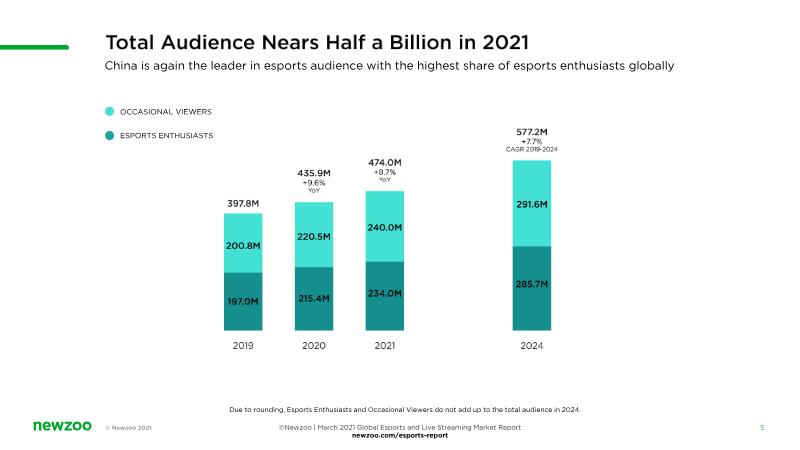
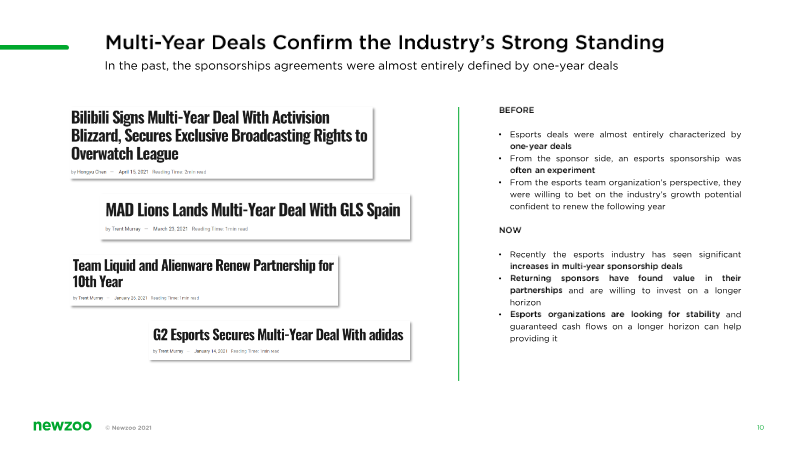

Esports Rising: State of the Global Esports Market
The global esports market is experiencing a period of robust expansion, characterized by double-digit growth in both viewership and revenue.
- The global esports market is projected to reach $1.08 billion in revenue by the end of 2021, marking a 14.5% year-over-year increase driven primarily by sponsorships and media rights.
- Total hours watched on major streaming platforms like Twitch and YouTube surged by 76% in 2020, with the global audience expected to exceed 577 million viewers by 2024.
- China remains the dominant market leader, holding the largest share of global esports revenue and the highest concentration of enthusiasts.

TWIG 128 | Epic Will Lose $300M on Game Store, Epic Raises $1B at $30B, Apple/Google Kill F2P?
The gaming industry is currently navigating a period of significant financial and structural transition, characterized by aggressive platform expansion, shifting monetization models, and evolving regulatory landscapes.
- Epic Games secured $1 billion in new funding at a $30 billion valuation to support its metaverse development, despite the Epic Games Store projecting $600 million in losses by the end of 2021.
- The Epic Games Store struggles with long-term profitability due to a lack of social features and platform stickiness compared to competitors like Steam.
- Mobile gaming faces significant headwinds from Apple’s App Tracking Transparency and the limitations of subscription services like Apple Arcade, which currently fail to incentivize long-term content development.

League of Legends Player Count, Revenue, & Stats
League of Legends maintains a dominant position in the global multiplayer online battle arena market, leveraging a massive, cyclical player base to drive consistent financial performance.
- League of Legends maintains a PC player base of approximately 2.88 million monthly active users and 304,000 daily active users as of early 2025.
- The PC title generates over $271 million in total revenue, yielding an average revenue per daily active user (ARPDAU) of $0.47.
- New player retention remains a critical challenge for the PC version, with only 4% of users remaining active after the first month.

4 Big Discovery Takeaways From 'not-E3'
This analysis examines the shifting landscape of game discovery following the 2022 "not-E3" season, a period characterized by a decentralized array of digital showcases in the absence of a traditional E3 event.
- The 2022 'not-E3' season saw 568 game trailers released, signaling a permanent shift toward a decentralized, direct-to-consumer discovery model over traditional physical trade shows.
- Steam emerged as a primary beneficiary of the decentralized landscape by aligning its Next Fest with third-party announcements to capture high user interest.
- Developers must treat non-platform showcases as 'pay-to-play' investments, with costs ranging from hundreds to six figures, and should evaluate ROI based on specific Steam wishlist growth.

Game Makers Change Tune About Ads
The video game industry is undergoing a significant shift in its business model, moving away from a historical aversion to advertising toward a strategy that embraces it as a primary revenue stream.
- The gaming industry is pivoting toward advertising as a primary revenue stream to offset rising development costs and monetize non-paying users in free-to-play titles.
- King demonstrated the financial viability of this shift by reporting over 50% year-over-year growth in advertising earnings during 2020.
- Zynga generated $117 million in ad revenue during the fourth quarter of 2020, highlighting the scale of potential income beyond traditional microtransactions.