Esports Charts
Research186 documents
Documents
Article
Most-Watched Esports Events of August 2026
The global esports landscape in August 2026 was defined by a clear bifurcation between the massive reach of mobile gaming and the enduring prestige of traditional PC titles. Mobile Legends: Bang Bang solidified its position as the month’s most-watched title, anchored by the Mid Season Cup, which achieved a peak viewership of 1.9 million. This mobile dominance was further bolstered by the PUBG Mobile World Cup, which drew 1.79 million peak viewers. Despite the rapid growth of mobile platforms, PC-based competition maintained significant cultural relevance, particularly among English-speaking audiences. The International 2026 served as a pivotal moment for the genre, recording its highest peak viewership in five years at 1.8 million.
Competitive excellence throughout the month centered on Team Spirit, an organization that demonstrated unparalleled consistency by securing victories in three major tournament grand finals. This period also featured high-profile events including the 2026 World Championship and the Esports World Cup, which collectively shaped the industry’s performance metrics. While major championships reached record-breaking heights, such as the RLCS 2026 World Championship, the broader market experienced localized volatility. Notably, the LPL 2026 Split 3 saw a 23.14% decline in viewership, suggesting shifting engagement patterns within specific regional leagues.
Overall, the data from August 2026 illustrates an industry in transition, where mobile titles are increasingly capturing the largest global audiences while established PC franchises continue to command high-value, dedicated viewership. The success of top-tier organizations and the mixed performance of regional leagues highlight a complex ecosystem where peak event engagement remains robust, even as specific segments face challenges in maintaining historical audience levels.
- The MLBB Mid Season Cup 2026, held as part of the Esports World Cup, was the most-watched event of August 2026, peaking at over 1.9 million concurrent viewers.
- The International 2026 Dota 2 grand final reached a peak of nearly 1.8 million concurrent viewers, marking the highest viewership for a Dota 2 tournament in the last five years.
- Team Spirit achieved a historic performance in August 2026 by winning three major tournament finals, including the MLBB Mid Season Cup, The International 2026, and the Esports World Cup Counter-Strike event.
- The PUBG Mobile World Cup 2026 recorded a peak of 1.79 million viewers during its final round, representing the second-highest viewership result in the game's history.
- The LCK 2026 Season playoffs match between T1 and FEARX attracted over 1.2 million peak viewers as teams competed for qualification spots at the 2026 World Championship.
+1
Esports Charts
Article
LFL 2026 Summer Results
The LFL 2026 Summer season represents a critical inflection point for the French League of Legends ecosystem, characterized by a sustained contraction in audience engagement. This downturn aligns with a broader cooling of interest across the global esports landscape, signaling potential challenges for regional tournament sustainability. The league’s performance metrics underscore a deepening crisis, as viewership figures have now suffered through seven consecutive seasons of decline, reflecting a systemic struggle to maintain momentum in an increasingly fragmented digital entertainment market.
Quantitative data from the 2026 Summer split reveals a significant erosion of the viewer base, with total hours watched falling by 10 percent and peak viewership decreasing by 9.7 percent compared to the preceding spring split. This downward trajectory is largely attributed to the departure of high-profile organizations such as Karmine Corp and Gentle Mates, whose fanbases previously served as the primary engines for league growth. Although the Galions emerged as the eventual champions, the competitive outcome failed to offset the loss of these marquee brands, leaving the league heavily reliant on community casting to sustain its remaining audience.
The current state of the LFL highlights an industry-wide shift toward data-driven analysis as a means of navigating these volatility trends. Platforms like Esports Charts have become essential infrastructure for tracking these shifts, providing the granular insights necessary to evaluate team performance and audience demographics in the EMEA region. As the league moves forward, the reliance on third-party analytical tools and community-led broadcast initiatives suggests that traditional viewership models are no longer sufficient to guarantee the long-term commercial viability of regional esports tournaments.
- LFL 2026 Summer viewership reached its lowest point in years, marking seven consecutive seasons of decline for the French League of Legends competition.
- Compared to the spring split, the tournament experienced a 4.9% drop in average viewers and a 9.7% decrease in peak viewers, totaling 1.19 million hours watched.
- The tournament's most-watched match was a Week 3 group-stage game between Joblife and ZYB, which reached a peak of 47,000 viewers, largely driven by community-casting support.
- The absence of popular organizations like Karmine Corp and Gentle Mates is identified as a primary driver for the sustained downward trend in audience engagement.
- Finalists Galions and TLN Pirates failed to generate significant viewership, with neither team ranking in the top five for average viewers or appearing in the most-popular matches by peak viewership.
+1
Esports Charts
Article
Esports World Cup 2026 Viewership Recap: Key Statistics, Platforms, and Audience Trends
+1
Esports Charts
Article
How Regional Creators and Co-streams Shaped Esports World Cup 2026 Viewership
+1
Esports Charts
Article
2018 Esports in Charts
The 2018 Esports in Charts summary serves as a foundational overview of the global competitive gaming landscape for the 2018 calendar year. Published in early 2019, the content acts as an introductory announcement for a comprehensive data-driven report developed in collaboration with esports.com. The primary objective is to provide stakeholders with a visual and analytical snapshot of industry performance, including key metrics, tournament rankings, and notable industry developments.
The scope of the analysis is global, though it explicitly excludes data from Chinese streaming platforms, which represents a significant limitation in the total market coverage. The methodology relies on the aggregation of large-scale esports data sets collected over a three-year period, synthesized into infographics and detailed performance reports. These findings highlight industry trends, identify top-performing teams and players, and offer insights into the growth of various esports titles during that period.
By consolidating viewership data and tournament statistics, the analysis provides a professional resource for understanding the competitive ecosystem as it existed at the close of 2018. The summary emphasizes the importance of data-backed decision-making for industry participants, positioning the full report as a tool for tracking the evolution of esports viewership and organizational success.
- The 2018 global esports landscape analysis is based on aggregated data sets collected over a three-year period ending in 2018.
- The report provides a comprehensive snapshot of industry performance, including tournament rankings, viewership metrics, and organizational success markers.
- Market coverage is limited by the explicit exclusion of data from Chinese streaming platforms, which impacts the total global scope of the findings.
- The analysis was developed through a strategic collaboration with esports.com to provide a data-driven resource for industry stakeholders.
- The findings are intended to facilitate data-backed decision-making by tracking the evolution of competitive gaming titles and team performance.
+1
Esports Charts
Article
MLBB and League of Legends Drove Esports Viewership in July 2026
Mobile Legends: Bang Bang and League of Legends served as the primary catalysts for global esports viewership throughout July 2026. This period was defined by intense competitive activity, anchored by high-profile tournaments including the Esports World Cup, the MLBB Mid Season Cup, and various regional league splits. The data confirms that Multiplayer Online Battle Arena titles maintained a dominant position in the industry, with the MLBB Mid Season Cup securing the highest peak viewership globally. While mobile gaming titles led overall charts due to their massive reach within Asian markets, League of Legends retained a unique competitive advantage as the only franchise to secure two events within the global top five.
The landscape of esports broadcasting experienced notable shifts in platform engagement and regional distribution during this timeframe. English-language viewership demonstrated increased diversity across streaming platforms, with the MSI 2026 event leading the category. Furthermore, the distribution of viewership became more balanced across various organizers and regions compared to the previous month, signaling a more fragmented yet robust ecosystem. TikTok Live emerged as a critical infrastructure component, playing an increasingly influential role in the delivery of esports content to global audiences.
Beyond the core MOBA dominance, the industry reached significant milestones across other genres. The Esports World Cup 2026 achieved record-breaking average viewership for Call of Duty, while the Honor of Kings World Cup set new performance benchmarks for its respective title. These findings collectively illustrate a maturing global market where mobile-first titles and established PC franchises coexist to drive record engagement, supported by an evolving technological landscape that prioritizes accessibility and platform diversification.
- The MLBB Mid Season Cup 2026 achieved the highest peak viewership of any esports event in July 2026.
- Mobile gaming titles dominated the global viewership charts, securing three of the top five spots, including the MLBB Mid Season Cup, the Free Fire Esports World Cup 2026, and the Arena of Valor Premier League 2026.
- League of Legends was the only title to place two events in the global top five for July, with its Mid-Season Invitational ranking second and its Esports World Cup tournament ranking third.
- Viewership in July was driven primarily by audiences in Southeast Asia and other Asian markets, particularly for mobile-focused competitions.
- Unlike June 2026, when ESL’s Counter-Strike broadcasts dominated top channel rankings, July saw viewership distribution spread more evenly across a variety of organizers, regions, and game titles.
+1
Esports Charts
Article
Esports Business in H1 2026: Four Structural Shifts Reshaping the Industry
The global esports landscape in the first half of 2026 is defined by a fundamental transition toward structural consolidation and institutional maturity. Driven by the aggressive expansion of Saudi-backed entities, the industry is witnessing a centralization of power across game publishing, tournament operations, and critical infrastructure. This shift is fundamentally altering the competitive ecosystem, forcing established tournament organizers to engage in high-stakes competition for calendar dominance, particularly within the Counter-Strike circuit. Simultaneously, game publishers are moving away from rigid league structures in favor of hybrid models that attempt to reconcile the need for financial stability among partner organizations with the necessity of maintaining open, meritocratic pathways for emerging talent.
Beyond corporate consolidation, the industry is experiencing a significant evolution in competitive formats through the formalization of national-team play. Events such as the Esports Nations Cup have demonstrated substantial commercial viability, prompting publishers to integrate these international, country-based competitions into their long-term strategic roadmaps. While the governance of these initiatives remains fragmented across a complex network of public and private stakeholders, the success of national-team formats is establishing a new institutional layer that operates alongside traditional club-based leagues.
These developments reflect a broader maturation of the sector, as stakeholders prioritize sustainable growth and diversified revenue streams. By balancing the influence of sovereign investment with the integration of nationalistic appeal, the industry is attempting to stabilize its commercial foundations. These structural shifts collectively signal a move toward a more rigid, formalized, and globally interconnected esports economy, setting the stage for a period of sustained institutionalization throughout the remainder of the decade.
- Savvy Games Group has moved to acquire the developer of Mobile Legends: Bang Bang in a deal reportedly valued at over $6 billion, signaling a major consolidation of mobile esports ecosystems.
- Saudi-backed entities are expanding their influence across the global esports value chain, evidenced by Qiddiya Investment Company’s full acquisition of the EVO tournament series in February 2026.
- The 2026 Esports World Cup relocation to Paris involved an estimated €250 million in Saudi spending, demonstrating the event's ability to operate as a global product independent of its original host city.
- Counter-Strike tournament operators face rising costs and increased calendar congestion, compounded by Valve’s stricter commercial regulations regarding skin-gambling and skin-trading sponsorships.
- Riot Games is shifting its Valorant Champions Tour (VCT) model for 2027 to allow wildcard teams direct paths to top-tier tournaments through open qualifiers, while maintaining financial protections for permanent partner organizations.
+1
Esports Charts
Article
What EWC 2026 Club Portfolios Reveal About Esports Sponsorship
The sponsorship landscape for the 2026 Esports World Cup is characterized by extreme fragmentation, as the vast majority of the 640 identified brands maintain partnerships with only a single organization. This decentralized market structure suggests that esports commercialization is currently driven by highly targeted, club-specific strategies rather than broad, global brand initiatives. While gaming hardware and peripherals continue to serve as the industry’s foundational pillar, accounting for over 27 percent of all partnerships, the ecosystem is rapidly diversifying into 19 distinct sectors, including financial services, food, and beverage.
Regional dynamics play a critical role in shaping these commercial portfolios. Europe currently leads in total sponsorship volume, yet East Asian clubs demonstrate the highest average number of partners per team, indicating a more aggressive and localized approach to monetization. North American organizations are increasingly successful at attracting diverse lifestyle brands, whereas clubs in the MENA region show a distinct preference for large-scale domestic institutions. These variations highlight that a club’s regional influence and specific audience demographics are the primary determinants of its sponsorship success.
Ultimately, the data indicates that the esports sponsorship market is moving toward a more nuanced model where success depends on the precise alignment between a brand’s campaign objectives and a team’s unique market position. As the industry matures, the reliance on endemic hardware partners is being supplemented by a broader array of non-endemic lifestyle and corporate entities. Organizations that effectively leverage their regional identity and audience data are best positioned to navigate this fragmented environment and secure sustainable, long-term commercial growth.
- The Esports World Cup 2026 featured 212 participating clubs and over 890 disclosed partnerships involving more than 640 unique brands.
- EWC Club Partners, which receive direct support from the Esports World Cup Foundation, maintain an average of 7.72 sponsors compared to 3.43 for non-partnered clubs.
- The five largest sponsorship categories—Food & Beverage, Betting & Gambling, Esports & Gaming Services, Consumer Electronics & Mobile, and Media/Streaming—account for 59.3% of all recorded partnerships.
- Food & Beverage is the most active sponsorship category, with Red Bull and Monster Energy serving as the primary leaders in a highly fragmented market.
- The Consumer Electronics & Mobile category shows high brand concentration, with Infinix and realme accounting for 42.3% of all partnerships within that sector.
Esports Charts
Article
Warzone at Esports World Cup 2026 Suffers 24% Dip in Peak Viewership
The 2026 Warzone Resurgence Series Championship at the Esports World Cup experienced a significant contraction in audience engagement, marked by a 24.3% decline in peak viewership. While the event reached a peak of 268,450 concurrent viewers, this figure represents a notable drop from the 333,093 peak recorded during the 2025 iteration. Despite this downward trend in peak reach, the tournament maintained stable average viewership levels, suggesting that while the event struggled to attract massive spikes in interest, it retained a core base of dedicated spectators throughout the competition.
Several factors contributed to this shift in performance, most notably the underperformance of high-profile organizations such as Team Falcons, whose early exits likely dampened broader audience enthusiasm. Furthermore, the strategic decision to exclude TikTok as a broadcasting platform removed a critical distribution channel, limiting the tournament's reach compared to previous years. These variables highlight the sensitivity of modern esports viewership to both the competitive success of marquee teams and the accessibility of diverse streaming platforms.
Despite the decline in peak metrics, the tournament remained a significant fixture in the global competitive landscape, supported by a substantial $1 million prize pool. The event concluded with G2 Esports securing the championship title, reinforcing the competitive integrity of the series even as it navigates shifting audience dynamics. This performance data underscores the ongoing challenges faced by major battle royale titles in sustaining year-over-year growth within the highly competitive international esports market.
- The Warzone tournament at the 2026 Esports World Cup recorded 268,450 peak viewers, representing a 24.3% decline compared to the 333,093 peak viewers achieved during the 2025 edition.
- While peak viewership dropped significantly, average viewership for the Warzone competition remained consistent between the 2025 and 2026 events.
- G2 Esports secured the championship title for the Warzone Resurgence Series 2026 after 11 rounds of competition in the grand final.
- The decline in peak viewership is attributed to the underperformance of popular teams such as Team Falcons, Twisted Minds, and Gentle Mates, none of which finished in the top three.
- The absence of top-tier regional favorites, particularly the poor performance of Team Falcons, resulted in a notable decrease in engagement from Arabic-speaking audiences.
+2
Esports Charts
Article
Top Esports Games and Tournaments by Live Viewership in H1 2026
The global esports landscape in the first half of 2026 is defined by the continued ascendancy of mobile gaming and a shifting linguistic demographic. Mobile titles currently command the highest levels of engagement, with the Mobile Legends: Bang Bang ecosystem securing three of the top five tournament spots globally. The M7 World Championship stands as the period's premier event, reaching a peak viewership of 5.68 million. This dominance underscores a broader trend where mobile-first titles increasingly dictate the industry’s reach and growth metrics.
Traditional PC-based esports remain highly competitive but face varied performance trajectories. Counter-Strike has successfully surged into the second position, bolstered by a record-breaking performance at the IEM Cologne Major that drew 2.75 million peak viewers, effectively surpassing League of Legends. Conversely, established titles like Dota 2 are experiencing a contraction in interest, evidenced by a 24% year-over-year decline in tournament popularity. Meanwhile, the Esports World Cup has proven to be a vital catalyst for engagement, exemplified by Apex Legends achieving a 74% growth in peak viewership during its opening week.
Geographic and cultural shifts are fundamentally altering the composition of the global audience. English is steadily losing its historical dominance as the primary language of esports consumption, reflecting a more decentralized and diverse international fan base. As mobile platforms continue to capture the largest share of the market, the industry is moving toward a model that prioritizes accessibility and regional engagement over traditional PC-centric viewership patterns. These findings suggest that future growth will likely be driven by mobile-first strategies and the ability of tournament organizers to cater to non-English speaking markets.
- Mobile Legends: Bang Bang (MLBB) dominated H1 2026 viewership, led by the M7 World Championship which reached a peak of 5,680,511 concurrent viewers.
- The top five most-viewed tournaments in H1 2026 were the M7 World Championship (5.68M peak), MPL Indonesia Season 17 (2.95M peak), IEM Cologne Major 2026 (2.75M peak), LCK 2026 Road to MSI (2.27M peak), and MPL Philippines Season 17 (1.70M peak).
- League of Legends slipped to third place in overall game rankings for the second quarter, despite the LCK 2026 Road to MSI qualifier achieving a peak of 2.27 million viewers.
- MPL Philippines Season 17 recorded its second-highest peak viewership in history at 1.69 million, driven by the Grand Final between Team Liquid PH and Team Falcons PH.
- Apex Legends demonstrated significant momentum during the opening week of the Esports World Cup 2026, achieving a 74% growth in peak viewership.
+1
Esports Charts
Article
Where Community Casting Mattered Most in Esports During H1 2026
Community casting has evolved into a foundational pillar of the global esports ecosystem, accounting for 46.7% of total watch time during the first half of 2026. This shift marks a transition where creator-led broadcasts now rival official channels in reach and engagement, forcing industry stakeholders to fundamentally rethink their media strategies. As viewership becomes increasingly fragmented across various platforms and individual influencers, the ability to track and monetize these decentralized audiences has become a critical priority for tournament organizers and sponsors alike.
The influence of co-streaming varies significantly based on both the specific game title and regional market preferences. While mobile-first esports such as Mobile Legends: Bang Bang and Arena of Valor maintain a traditional reliance on official broadcast channels, titles like Call of Duty and Valorant are now predominantly driven by creator-led content. Furthermore, a balanced distribution between official and community streams is most evident in established titles including Counter-Strike, League of Legends, Dota 2, and Rocket League. Regional trends further complicate this landscape, with audiences in Russia, Spain, Turkey, and Germany demonstrating a distinct preference for the personalized commentary provided by co-casters over standardized official productions.
Despite the widespread adoption of this model, the industry is experiencing a notable concentration of influence, as a small cohort of top-tier co-streamers captures the vast majority of community-driven viewership. This consolidation suggests that while the medium is democratized in theory, the actual power dynamics remain highly centralized. As the industry moves forward, the challenge for organizations will be to integrate these influential creators into broader commercial frameworks without sacrificing the authentic, community-focused appeal that has made co-casting a dominant force in modern esports consumption.
- Community casting accounted for 46.7% of total watch time across major competitive esports titles during the first half of 2026.
- Mobile esports titles, including Mobile Legends: Bang Bang, Arena of Valor, and Battlegrounds Mobile India, maintained a strong reliance on official streams as the primary audience gathering point.
- Regional language preferences dictate co-casting adoption, with Russian, Spanish, Turkish, and German audiences favoring creator-led streams over official tournament feeds.
- English-language broadcasts and major Asian market languages—such as Indonesian, Vietnamese, Tagalog, and Hindi—remain dominated by official channels, which serve as the primary reach vehicle for tournament organizers and sponsors.
- Top-tier co-casting is a cross-platform phenomenon, with leading creators utilizing Twitch, YouTube, SOOP, and Naver’s Chzzk to distribute content.
+1
Esports Charts
Article
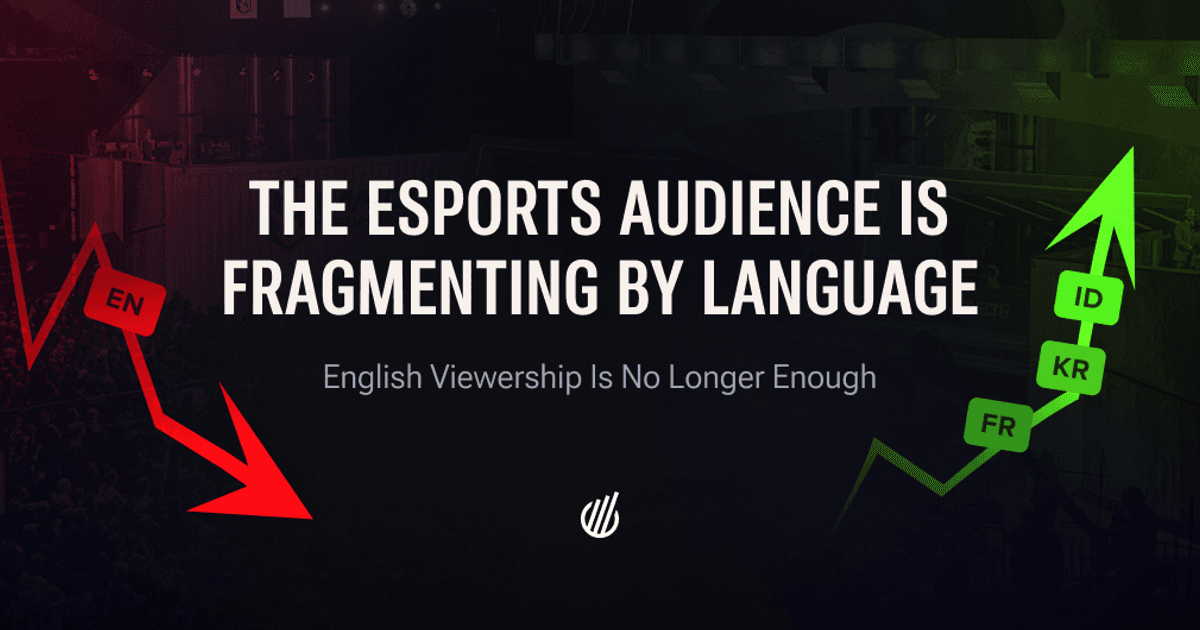
English Is Losing Its Dominance in Esports Viewership: But Not Its Relevance
English is undergoing a structural decline in its dominance within the global esports landscape, signaling a fundamental shift toward a more fragmented and localized viewership model. While the language remains a cornerstone for international sponsorship and high-level commercial engagement, its relative market share is shrinking as regional-language broadcasts experience significantly faster growth. This transition reflects the maturation of non-Western markets and the increasing preference of global audiences for content delivered in their native tongues.
By the first half of 2026, Asian-language streams officially surpassed English to become the largest viewership segment in the industry. This milestone underscores a broader trend where the rapid expansion of non-English ecosystems is outpacing the growth of traditional Western leagues. Although English-language broadcasts continue to see absolute gains in total hours watched for major events, their influence is being diluted by the sheer scale and velocity of emerging regional markets.
The industry is moving away from a monolithic, English-centric broadcasting strategy toward a decentralized approach where localization is a primary business imperative. As the global esports audience continues to diversify, stakeholders must prioritize regional engagement to maintain relevance. English retains its status as a vital tool for international reach and premium brand partnerships, but it no longer serves as the sole anchor for global viewership. Success in the current market now depends on the ability to navigate and invest in these increasingly powerful, localized linguistic ecosystems.
- As of the first half of 2026, Asian-language streams have overtaken English to become the largest language group by total viewership share in the global esports market.
- English-language viewership is not collapsing in absolute terms, but its market share is shrinking because regional language broadcasts are expanding at a significantly faster rate.
- English viewership is becoming increasingly concentrated, with a small number of massive broadcasts capturing the majority of the audience while the remainder of the market fragments into regional feeds.
- In mature Western ecosystems, major tournaments like the FNCS and IEM Cologne have seen a decline in English viewership share despite experiencing growth in total hours watched.
- Mobile esports, which historically prioritized audiences in Southeast Asia, South Asia, Latin America, and the Middle East, remains dominated by regional languages rather than English.
+1
Esports Charts