2015
Company
Documents about 2015
Collecting, Preserving, and Interpreting the History of Electronic Games: An Interview with Jon-Paul C. Dyson
Jon-Paul Dyson, director of The Strong museum's International Center for the History of Electronic Games (ICHEG), argues that video games deserve the same serious collection, preservation, and scholarly treatment as any other cultural artifact, and that they are best understood as part of the longer history of play.
- The International Center for the History of Electronic Games at The Strong in Rochester, New York, has grown from fewer than 100 items in 2006 to a collection exceeding 60,000 games and related artifacts, and draws more than 550,000 visitors annually.
- Director Jon-Paul C. Dyson argues that electronic games are uniquely hard to preserve because they depend on obsolete hardware, fragile storage media, and social play contexts that are easily lost.
- The museum's five-part preservation strategy covers original hardware and software, published materials and archival records from industry figures, gameplay recorded on original equipment, and source code preservation with file migration, with digitization occurring only after items are stabilized and cataloged.
If You Are Feeling Bold, Ask for $3: Value Crafting and Indie Game Developers
Consalvo and Paul introduce "value-crafting," a concept extending Browne's "indie labor" and Paul's "theorycrafting," to describe how independent developers use experimentation, data, and metrics to determine what their games are worth, how to price them, and how to market them, often while bearing heavy personal financial risk.
- Indie games have no industry-standard price point, with prices ranging from free to roughly $30 and developers debating between $5, $10, or free-to-play, often based on anecdote rather than consistent evidence.
- Indie success has shifted from simply making a good game toward "value-crafting," which relies on analytics, pricing research, community engagement, and sustained marketing.
- By 2014 and 2015 Steam dominated indie sales, often accounting for the large majority of units sold, with Valve taking 30 percent of revenue.

2017 Economic Impact Report
Video Games in the 21st Century: The 2017 Report, published by the Entertainment Software Association, presents itself as the most current measurement of the US entertainment software industry's contribution to the American economy.
- In 2016, the U.S. video game industry generated over $24.5 billion in total software sales.
- The U.S. video game industry contributed more than $11.7 billion in value to the national GDP in 2015.
- The industry directly employed more than 65,000 people across the United States in 2016.

Mobile Games Whitebook: Q1 2017
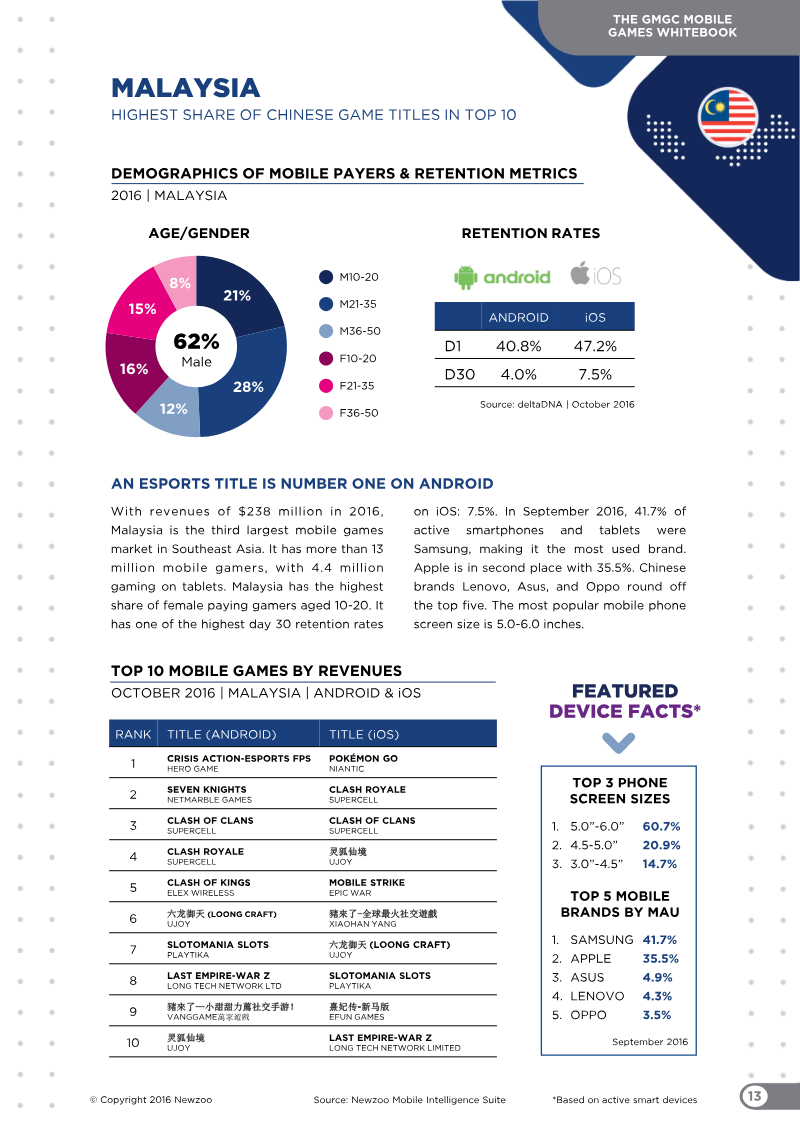
This report, a collaboration between the Global Game Confederation (GMGC) and Newzoo, provides an in-depth analysis of the global mobile games market with a specific focus on Southeast Asia (SEA) in Q1 2017.
- Southeast Asia's mobile gaming revenue is projected to grow at a 45.3% compound annual growth rate between 2015 and 2019.
- The 'Big Six' markets—Indonesia, Malaysia, the Philippines, Singapore, Thailand, and Vietnam—generate 97% of the region's total mobile gaming revenue.
- The region is the world's fastest-growing esports market, with the number of enthusiasts expected to rise from 9.5 million in 2016 to 20 million by 2019.


Global Esports Market Report: 2017
The "Global Esports Market Report: 2017" provides a comprehensive overview of the esports industry's status and future trajectory, forecasting trends, revenues, and audience growth toward 2020.
- The global esports economy reached $696 million in 2017, marking a 41.3% year-on-year growth with a projected revenue of $1.488 billion by 2020.
- Sponsorship is currently the largest revenue stream at $266.3 million, while media rights are the fastest-growing segment and are projected to reach $340 million by 2020.
- The global esports audience totaled 385.5 million viewers in 2017, split almost evenly between 191 million dedicated enthusiasts and 194 million occasional viewers.

State of the Polish Video Game Industry 2017
The Polish games industry in 2016-17 is portrayed as a growing, internationally significant sector. Poland ranks 23rd globally by games revenue in a market Newzoo valued at USD 101.1 bn.
- The Polish video game industry is growing, with 13 companies listed on the Warsaw Stock Exchange (WSE) having a combined worth of nearly PLN 9.5 billion and generating PLN 270 million in earnings last year. These WSE-listed developers contributed over PLN 67 million in taxes to the Polish treasury in 2016.
- Poland is a significant test market for game soft launches, particularly for mobile games, due to its comparable market significance to the US, UK, or Germany, and lower user acquisition costs compared to Western or Asian markets. While the percentage of paying players and amounts spent are lower than in Western Europe or North America, the gap is narrowing.
- The PlayStation brand, especially the PS4, dominates the console market in Poland, significantly outselling Xbox One. This trend is partly attributed to the high system requirements of cross-platform titles like The Witcher 3: Wild Hunt, which encouraged many PC players to switch to consoles for a smaller hardware investment.

Information on Planned Game Premieres and Current Sales Potential: Report No. 22/2017
PlayWay S.A. outlines its strategic release schedule and market positioning for the second quarter of 2017, focusing on a diverse portfolio of simulation and adventure titles.
- PlayWay S.A. is prioritizing PC releases through July 31, 2017, with a portfolio headlined by Car Mechanic Simulator 2018, which will feature licensed content from Mazda and Dodge.
- Steam Wishlist data indicates strong market demand for the company's catalog, led by Hard West (173,000 additions), 911 Operator (128,000), and Car Mechanic Simulator 2015 (110,000).
- The unreleased title Agony shows significant pre-launch momentum with 97,000 wishlist additions, signaling high consumer interest ahead of its debut.
Current Report No. 33/2017: Planned Game Releases and Sales Potential
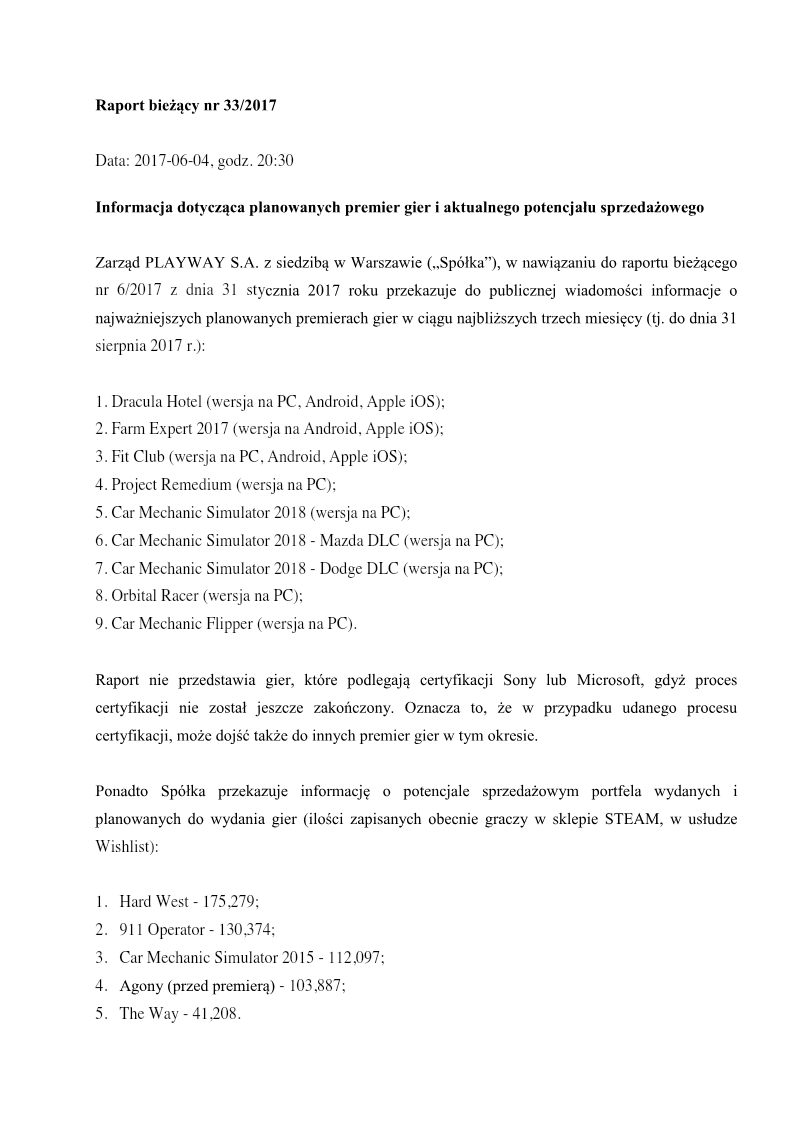
PlayWay S.A. outlines its strategic release schedule and market positioning for the mid-2017 period, focusing on the three-month window ending August 31, 2017.
- PlayWay S.A. is launching nine titles and expansions by August 31, 2017, headlined by Car Mechanic Simulator 2018 and its associated Mazda and Dodge DLC.
- Steam Wishlist data serves as the primary metric for forecasting sales, with Hard West leading the portfolio at over 175,000 additions.
- Unreleased title Agony shows strong market momentum with 103,887 wishlist entries, while UBOOT has reached 20,000 additions, outpacing the pre-launch interest of 911 Operator.
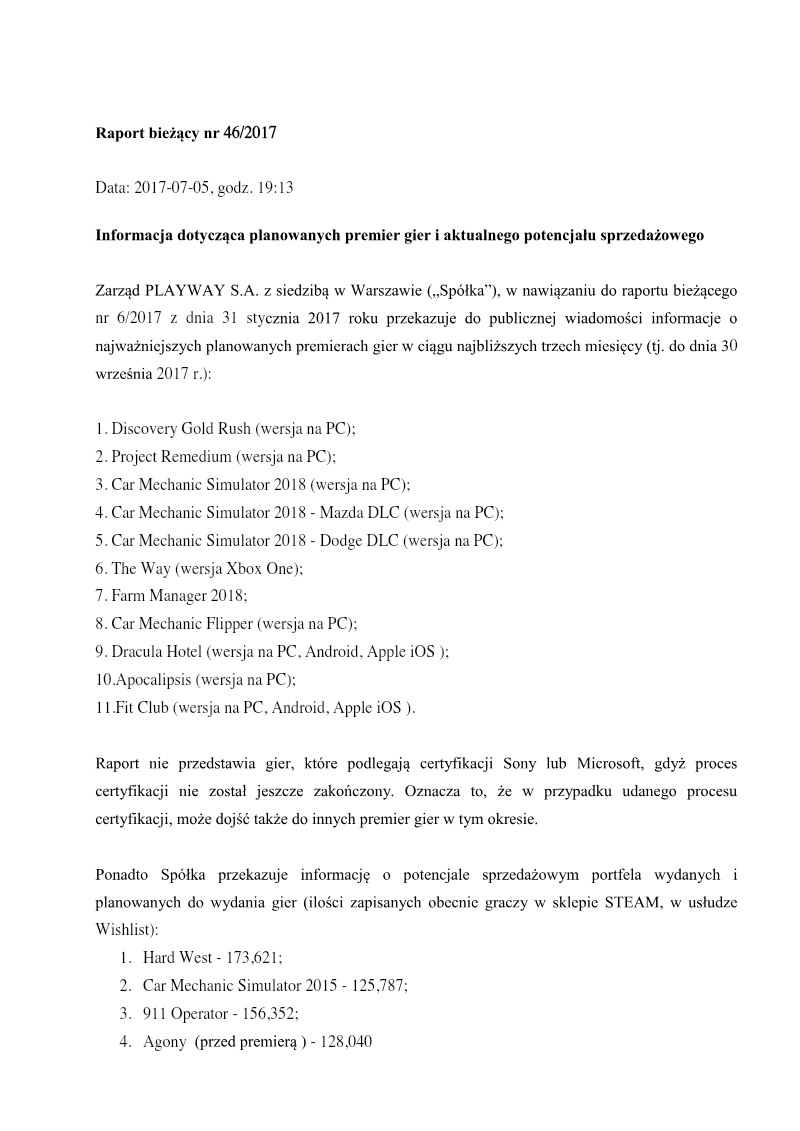
Raport Bieżący Nr 46/2017: Informacja Dotycząca Planowanych Premier Gier
PlayWay S.A. outlines its strategic release schedule and sales potential for the third quarter of 2017, focusing on the period ending September 30.
- PlayWay S.A. is launching eleven titles and expansions in Q3 2017, headlined by Car Mechanic Simulator 2018, Discovery Gold Rush, and Project Remedium.
- The upcoming title UBOOT shows strong commercial potential with 26,680 Steam wishlist additions, a figure that outpaces the pre-launch metrics of the successful 911 Operator.
- Established titles continue to drive long-term interest, led by Hard West with 173,000 wishlist additions, 911 Operator with 156,000, and Car Mechanic Simulator 2015 with 125,000.
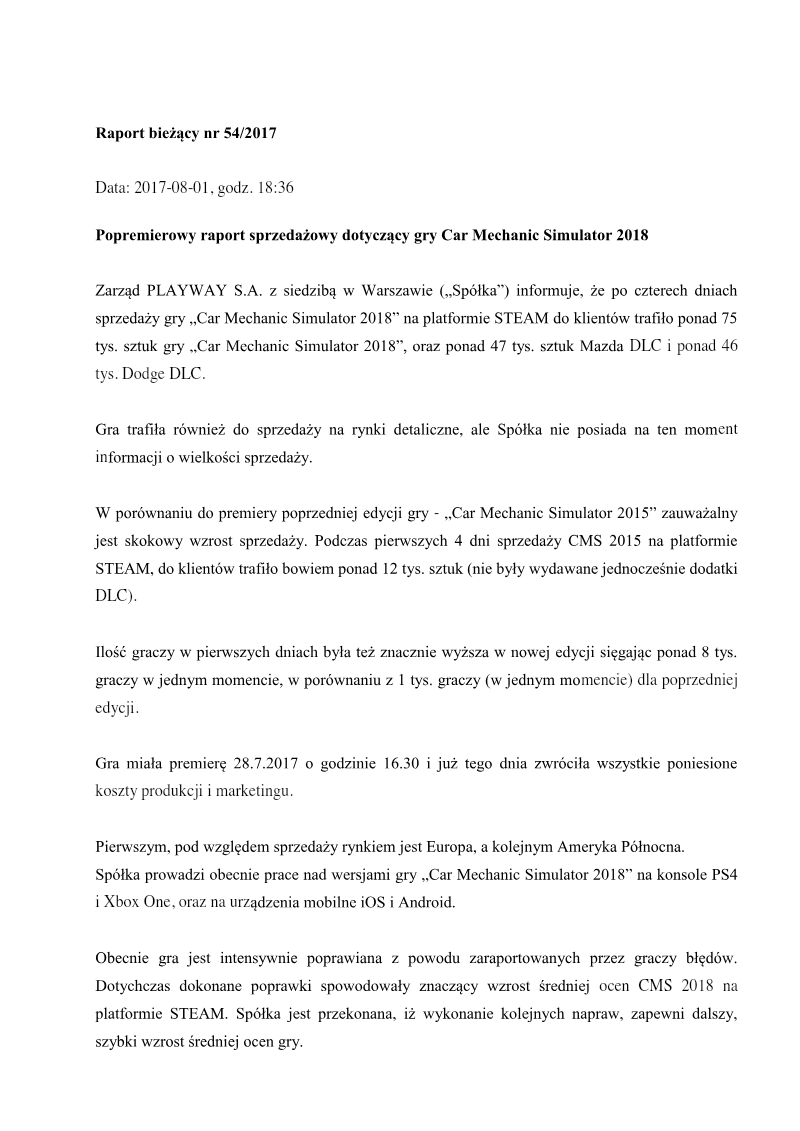
Popremierowy Raport Sprzedażowy: Car Mechanic Simulator 2018
Playway S.A., the Warsaw-based publisher, disclosed post-launch sales results for Car Mechanic Simulator 2018 in a regulatory filing dated 1 August 2017, four days after the game's 28 July 2017 release on Steam.
- Car Mechanic Simulator 2018 recouped all production and marketing costs within the first 24 hours of its July 28, 2017, release.
- The game sold over 75,000 units in its first four days, representing a more than six-fold increase over the 12,000 units sold by its predecessor in the same timeframe.
- Peak concurrent player counts reached over 8,000 users, an eightfold increase compared to the 1,000-player peak of Car Mechanic Simulator 2015.
GameStop Quarterly Report: Q3 2016
GameStop’s financial performance for the third quarter of 2016 reflects a period of strategic transition as the company navigates a maturing console cycle.
- GameStop's Technology Brands segment, which includes Spring Mobile (AT&T/Cricket) and Simply Mac, saw significant growth with gross profit rising to $380.0 million for the 39 weeks ended October 29, 2016, up from $195.8 million in the prior year period.
- Total gross profit for the 39 weeks ended October 29, 2016, reached $2,001.4 million (36.0% margin), compared to $1,875.1 million (32.1% margin) for the same period in 2015.
- Interest expense increased by $21.7 million for the 39-week period due to the March 2016 issuance of $475.0 million in 6.75% senior notes due in 2021.
Conflict and Change: Testing a Life-Cycle-Derived Model of Larp Group Dynamics
This study tests a life-cycle-derived model of small group dynamics applied to live action role-play (larp) communities, examining three challenges that larp groups face: embeddedness within dense networks of other larp groups, intragroup tension arising from zero-sum competitive play, and principled conflicts over the values…
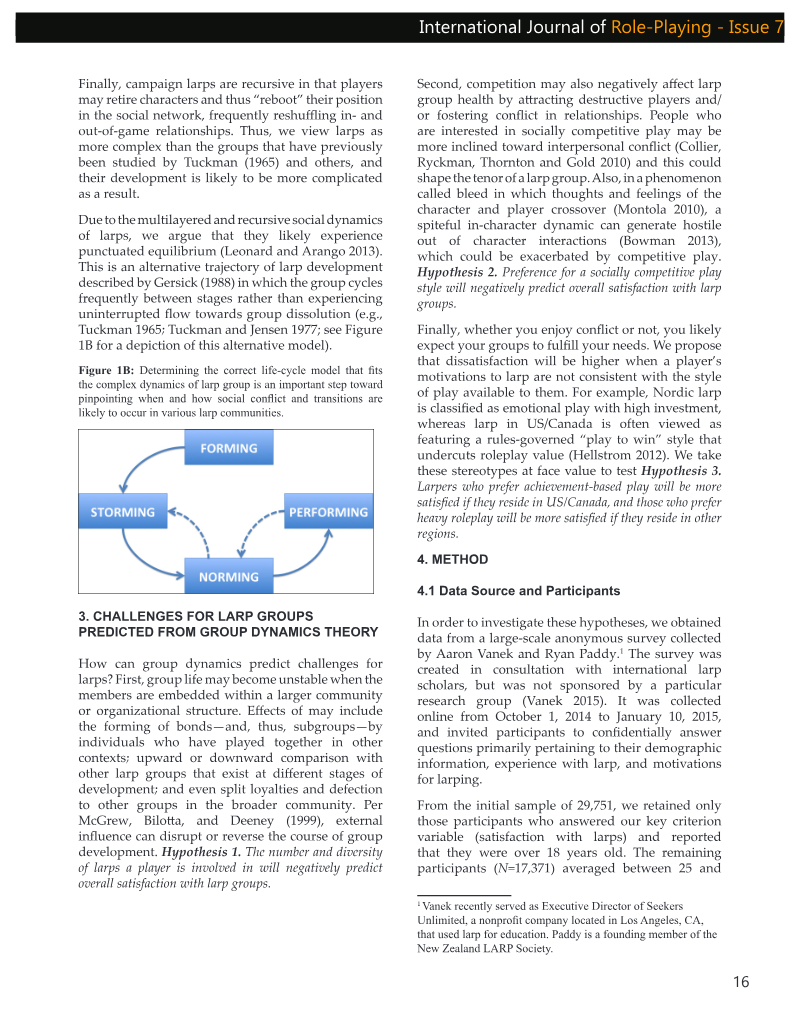
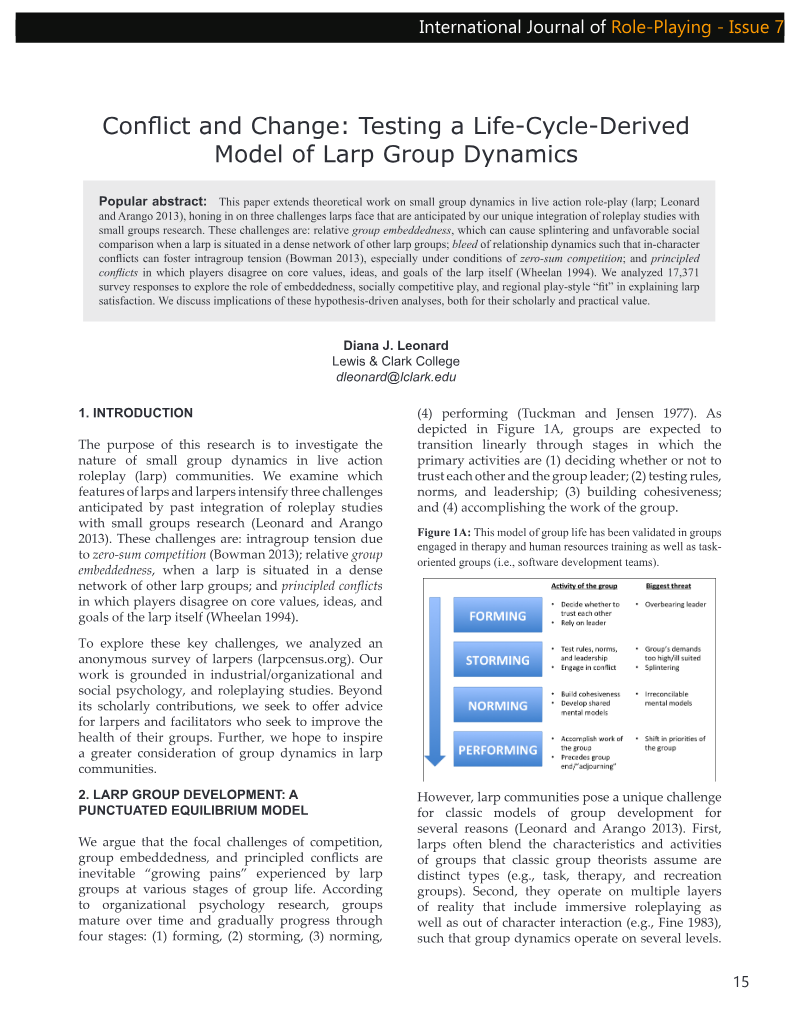
- The study proposes that larp groups follow a punctuated equilibrium trajectory rather than the linear stages of classic group development theory, because they blend task, therapy, and recreational characteristics and operate across in-character and out-of-character layers.
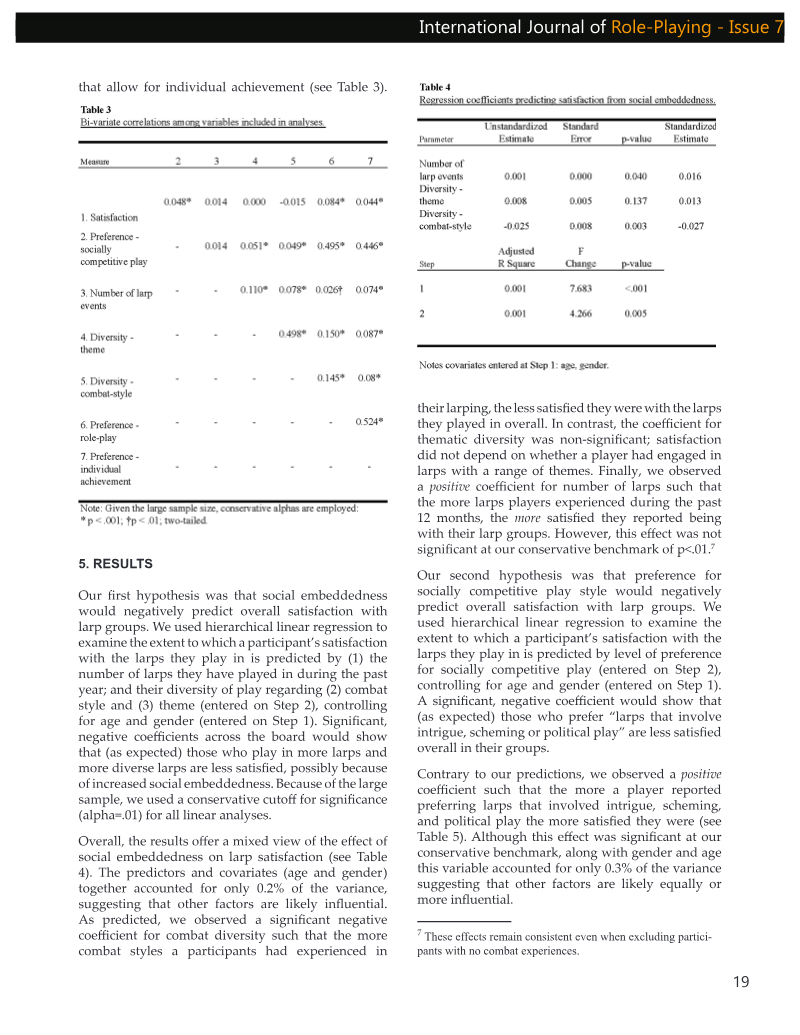
- Analysis of an anonymous online survey of 17,371 adult larpers (October 2014 to January 2015) used hierarchical regression and two-way ANCOVA, finding only mixed support for the hypotheses.
- The strongest finding was regional: achievement-oriented players reported greater satisfaction when living in the United States or Canada, while the expected regional advantage for role-play-oriented players did not appear.