Key insights
4 slides
Growth projection
Southeast Asia's mobile gaming revenue is projected to grow significantly.
The region is experiencing rapid expansion, positioning it as a global leader in growth. This growth is driven by increasing smartphone penetration, rising disposable incomes, and improved internet connectivity.
Rapid Growth. Southeast Asia's mobile gaming revenue is projected to grow at a 45.3% compound annual growth rate between 2015 and 2019.
Page 7 of the report45.3%
Projected compound annual growth rate for mobile gaming revenue (2015-2019).
Key markets
The 'Big Six' markets drive most of the region's mobile gaming revenue.
Growth in Southeast Asia's mobile gaming market is heavily concentrated in six key countries.
Revenue Concentration. The 'Big Six' markets—Indonesia, Malaysia, the Philippines, Singapore, Thailand, and Vietnam—generate 97% of the region's total mobile gaming revenue.
Page 7 of the report97%
Share of regional mobile gaming revenue from the 'Big Six' markets.
Esports growth
Southeast Asia is the world's fastest-growing esports market.
The region is experiencing a burgeoning interest in competitive gaming. The number of esports enthusiasts is expected to nearly double in a few years.
Esports Expansion. The region is the world's fastest-growing esports market, with the number of enthusiasts expected to rise from 9.5 million in 2016 to 20 million by 2019.
Page 9 of the report20 million
Projected number of esports enthusiasts in Southeast Asia by 2019.
- in 2016
- 9.5 million
Retention rates
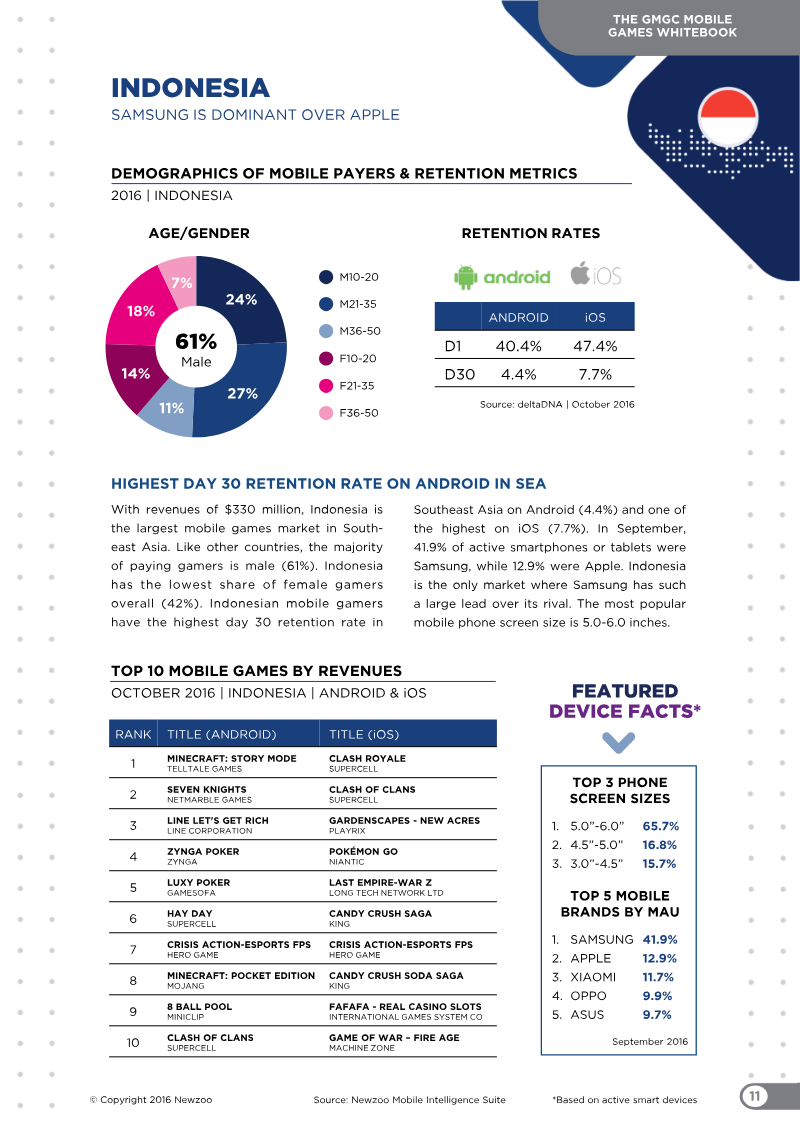
iOS users show higher day-30 retention rates than Android users.
Player retention varies by operating system across the region.
1 / 4
Ask AI about this report