Newzoo
Research100 documents
Documents

Article
The H5 Gaming Audience in 2026
The H5 gaming landscape in 2026 reflects a robust, cross-platform ecosystem where browser-based gaming serves as a significant engagement layer for a broad demographic. Based on a survey of approximately 7,500 individuals aged 13–55 across the US, Canada, Brazil, the UK, Germany, South Korea, Japan, and India, the findings indicate that 46% of internet users in these regions engaged with H5 games within the month prior to the study. The audience is evenly split by gender, though regional preferences vary, with younger users—particularly those aged 13–20—showing the highest engagement levels.
The research highlights that H5 gaming is rarely a standalone activity; 96% of browser gamers also participate in traditional mobile, console, or PC gaming. While H5 games generally command less weekly time than dedicated mobile apps, they are valued for their accessibility, lack of required downloads, and ease of discovery. Players primarily access these games through dedicated platforms (70%), social media (60%), and general websites (45%). Smartphones remain the dominant device for 83% of players, though younger demographics are more likely to utilize multiple devices compared to older cohorts.
Monetization strategies in the H5 sector rely heavily on advertising, which 94% of players have encountered. While 43% of users express dislike for ads, a majority prefer a free, ad-supported model over paid alternatives. Players are most receptive to rewarded ads, such as those offering a second life, and are generally willing to pay to remove ads or purchase in-game currency. The data suggests that browser games effectively increase the total time users spend on host websites, with a notable portion of the audience expressing a willingness to subscribe to platforms that offer a premium, ad-free experience.
- H5 gaming reaches 46% of internet users aged 13–55 across surveyed regions, with the highest penetration in South Korea (54%), India (53%), and Brazil (52%).
- Browser games significantly underperform mobile apps in engagement, with users aged 13–20 spending 3.7 hours weekly on H5 games compared to 4.9 hours on mobile apps, and the 41–55 segment showing a wider gap of 3.2 versus 6.6 hours.
- While Google and Newzoo suggest industry growth, external data from Sensor Tower indicates that browser game site traffic grew only slightly in H1 2026 to 9.45 billion, with all growth concentrated in Asia while European traffic declined.
- Smartphone dominance is clear, with 83% of players using mobile devices for H5 games, though younger players (13–30) are more likely to use multiple devices compared to 60% of the 41–55 age group who stick to one.
- Discovery is primarily driven by search engines, which 45% of players use to find specific game types, while only 23% of users navigate directly to known gaming portals.
+2
GoogleSept 2026
Article
The Gaming Market in 2026
The global gaming market is projected to reach $213.9 billion in 2026, representing a 6.1% year-over-year increase. This growth is supported by positive performance across all major platforms and geographic regions. Mobile gaming has re-emerged as the primary engine of industry expansion, with revenues expected to hit $121.1 billion, a 6.8% increase. This mobile growth is driven by deeper monetization of existing player bases, the international expansion of Chinese publishers, and the adoption of direct-to-consumer channels, even as total download volumes continue to decline.
The console and PC segments are also contributing to the overall market rise. Console revenue is forecast at $46.9 billion, a 5.1% increase largely contingent on the anticipated release of major titles, while the PC market is expected to grow by 5.3% to $45.9 billion, with microtransactions playing an increasingly significant role in the revenue mix. Geographically, the Asia-Pacific region remains the dominant market, accounting for 47% of global revenue, while the Middle East, Africa, and Latin America represent the fastest-growing regions, albeit from a smaller base.
The global player base is expected to expand to 3.7 billion individuals in 2026, a 4.4% increase. Mobile platforms command the largest share of this audience at 84%, followed by PC at 26% and console at 18%. Because the influx of new users is becoming limited, future industry growth is increasingly dependent on maximizing revenue from the existing player base. While North America remains the most lucrative region on a per-player basis, the disparity in average revenue per user compared to emerging markets highlights the ongoing challenge of balancing audience scale with monetization depth.
- The global gaming market is projected to reach $213.9 billion in 2026, representing a 6.1% year-over-year growth.
- Mobile gaming is the primary growth driver, forecasted to earn $121.1 billion (+6.8% YoY) due to deeper monetization, D2C channels, and Chinese publisher expansion, despite a decline in total downloads.
- The console segment is expected to reach $46.9 billion (+5.1% YoY), though this growth is heavily contingent on the November 2026 release of Grand Theft Auto VI.
- The PC market is forecast to grow to $45.9 billion (+5.3% YoY), with China identified as the primary driver for this segment and an increasing reliance on microtransactions.
- The global player base is expected to reach 3.7 billion in 2026, with 84% of these users (3.1 billion) playing on mobile devices.
+1
NewzooAug 2026

Article
Global Gaming Market Report: 2025
The report demonstrates that the global games market expanded to $201.6 billion in 2025, a 9.1 % year‑over‑year increase that surpassed Newzoo’s initial forecast. Growth was driven by a 12 % rise in the PC segment, reaching $43.6 billion—the highest growth rate recorded by Newzoo—alongside a 10.7 % jump in mobile revenue to $113.3 billion, despite declining download volumes and rising user‑acquisition costs. The console market grew modestly to $44.7 billion (+2.8 %), buoyed by the launch of Nintendo Switch 2 and stronger spending on new releases and subscription services, which grew 10.2 % YoY.
Revenue composition shifted: PC game sales rose 25 %, while console sales increased 8.1 %. Microtransaction revenue on PC grew 9.1 % (notably from Counter‑Strike 2 and Roblox), whereas console microtransactions fell 4.6 % due to underperformance of Fortnite and Call of Duty. Subscription services across PlayStation Plus and Xbox Game Pass contributed a 10.2 % increase.
Regionally, every market grew; Asia‑Pacific led with a 9.9 % rise to $95 billion, while the Middle East and Africa grew 15 % to $7.7 billion, becoming the fastest‑growing region. North America’s growth slowed to 5.7 % ($54 billion). Europe expanded 10.7 % to $36.3 billion, driven by strong PC and mobile performance.
Newzoo projects a 5.1 % CAGR through 2028, reaching $234.4 billion by year‑end 2028. Forecasts account for rising hardware costs, the anticipated impact of GTA VI on console revenue (+5.1 % to $46.9 billion in 2026), and a continued, albeit slower, mobile growth trajectory driven by Chinese publishers. The report bases its estimates on Newzoo’s proprietary data collection, including sales and subscription metrics across physical, digital, and D2C channels.
- The global gaming market surpassed $200 billion in 2025, reaching $201.6 billion with a 9.1% year-over-year growth, exceeding initial expectations due to strong PC market performance, D2C revenue growth, mini-games, and successful releases.
- The mobile market reached $113.3 billion in 2025 (+10.7% YoY), despite declining download volumes, with developers focusing on monetizing existing audiences due to rising user acquisition costs.
- The PC market experienced its highest recorded growth rate in Newzoo's history, increasing by 12% to $43.6 billion in 2025, driven by a 25% increase in game sales and a 9.1% rise in microtransaction revenue.
- Console market growth was slower at $44.7 billion (+2.8% YoY), with new game releases and subscription services (up 10.2% YoY) offsetting a 4.6% decline in microtransaction revenue, partly due to underperformance from titles like Fortnite and Call of Duty.
- The Asia-Pacific region remained the largest market at $95 billion, growing 9.9% YoY, while MEA was the fastest-growing region at 15% YoY, reaching $7.7 billion.
NewzooJun 2026
Article
Top Roblox Games in 2025
The Roblox platform experienced significant growth throughout 2025, substantially outperforming the broader global games market. Driven by Gamefam RoMonitor Stats, the data indicates that annual revenue reached $4.9 billion, a 36% year-over-year increase, while total bookings rose 55% to $6.8 billion. User engagement metrics also saw marked expansion, with total time spent in games climbing 69% to 123.8 billion hours and daily active users averaging 126.5 million, representing a 53% increase over the previous year.
The platform demonstrated a high capacity for rapid scaling, as evidenced by the emergence of new hits such as Grow a Garden, Steal a Brainrot, and 99 Nights in the Forest, which achieved record-breaking visit counts shortly after their respective launches. However, these titles often faced sharp declines in popularity following their initial peaks. In contrast, established experiences like Brookhaven RP and Blox Fruits maintained consistent presence in the top 10 rankings throughout the entire year, highlighting a dichotomy between viral, short-lived hits and enduring platform staples.
A notable trend throughout 2025 was the increasing concentration of audience attention. The share of total visits held by the single most popular game grew from 22% in the first quarter to 43% by the fourth quarter. By the end of the year, the top three games accounted for over 70% of all visits among the top 10 titles. This shift suggests a maturing ecosystem where a small number of dominant experiences capture a disproportionate share of user engagement, even as the platform continues to facilitate the rapid rise of new, high-traffic content.
- Roblox experienced significant 2025 growth, with annual revenue reaching $4.9 billion (up 36%) and total bookings rising 55% to $6.8 billion.
- User engagement metrics surged, with daily active users increasing 53% to 126.5 million and total time spent in games climbing 69% to 123.8 billion hours.
- Audience attention became increasingly concentrated, as the top three games accounted for over 70% of all visits among the top 10 titles by year-end.
- The share of total platform visits held by the single most popular game grew from 22% in Q1 to 43% by Q4, indicating a maturing ecosystem dominated by a few experiences.
- While new titles like 'Grow a Garden', 'Steal a Brainrot', and '99 Nights in the Forest' achieved rapid, record-breaking launches, they frequently suffered from sharp declines in popularity.
+2
NewzooApr 2026

Article
Newzoo's Inflection Point Report: Three Things Worth Arguing About
The 2026 PC and Console market analysis identifies a critical inflection point characterized by a "winner-take-more" dynamic within a stagnant engagement environment. While total revenue has increased, aggregate playtime across major platforms remained flat or declined, suggesting that growth is increasingly concentrated among the top 20 franchises. The analysis covers global PC and console markets, excluding Nintendo and certain Asian regions, and relies on proprietary industry data to evaluate shifting consumer behaviors and monetization models.
A primary finding is the dominance of Roblox, which has emerged as the leading franchise on PC and console. Data indicates that Roblox and similar sandbox titles are not acting as a gateway to traditional AAA gaming; rather, they capture and retain younger audiences who exhibit little interest in migrating to premium narrative-driven experiences. Consequently, the long-held industry assumption that younger players will eventually graduate to mid-core or AAA titles is unsupported by current engagement trends.
The analysis also highlights a divergence in monetization strategies. While free-to-play (F2P) revenue per hour has grown on PC, it has declined on consoles, where premium live-service titles are increasingly capturing player spending. Furthermore, the rise of the $30–$50 price band represents a strategic shift for developers lacking established franchise leverage. Rather than a purely organic renaissance, this pricing tier is a tactical response to market saturation, where developers lower entry costs to drive conversion while relying on live-service mechanics to monetize the remaining player base. Ultimately, the data suggests that the market is becoming increasingly bifurcated, favoring established giants while creating a high-risk environment for new, unproven intellectual property.
- The PC and console market is experiencing a 'winner-take-more' dynamic where total revenue growth is increasingly concentrated within the top 20 franchises while aggregate playtime remains stagnant or in decline.
- Roblox has emerged as the leading franchise on PC and console, effectively capturing younger audiences who show no inclination to migrate toward traditional premium, narrative-driven AAA titles.
- The industry's long-held assumption that younger players will eventually transition from sandbox titles to mid-core or AAA gaming is unsupported by current engagement data.
- A strategic shift is occurring in the $30–$50 price band, where developers are lowering entry costs to combat market saturation while relying on live-service mechanics for long-term monetization.
- Monetization performance is diverging by platform, with revenue per hour for free-to-play titles increasing on PC but declining on consoles as premium live-service games capture more player spending.
+1
Deconstructor of FunApr 2026
Article
Newzoo: PC and Console Market in 2026
The global PC and console gaming market experienced a resurgence in 2025, generating $88.3 billion in total revenue. This growth trajectory suggests a structural shift in platform dominance, with PC revenue projected to surpass console earnings by 2028. While the industry is currently navigating a slight contraction in total playtime—which fell by 1% during the 2025 calendar year—the underlying engagement patterns are evolving. Players are increasingly gravitating toward expansive sandbox environments, signaling a departure from the previously dominant Battle Royale and annualized sports game models.
Market dynamics reveal a distinct preference for buy-to-play titles and non-annualized franchises, reflecting a broader trend toward diversified gaming experiences. Although playtime is becoming less concentrated across major titles, revenue remains heavily anchored by premium software priced above $50. This reliance on high-cost titles is particularly pronounced within the console ecosystem, whereas the PC market demonstrates a more equitable distribution of revenue across various price tiers. These findings highlight a maturing industry where consumer spending habits are decoupling from traditional release cycles.
The current landscape reflects a transition period for the global gaming sector, characterized by shifting engagement metrics and evolving monetization strategies. As sandbox titles capture a larger share of player attention, developers and publishers are forced to reconsider the viability of established genre conventions. The sustained growth in revenue despite stagnant playtime suggests that the industry is successfully extracting higher value from its core audience, setting the stage for a competitive landscape where PC platforms increasingly challenge the historical revenue leadership of consoles.
- The global PC and console market generated $88.3 billion in 2025, with projections indicating that PC revenue will overtake console earnings by 2028.
- Total playtime across the industry contracted by 1% in 2025, yet revenue continues to grow, indicating an increased ability to monetize the core audience.
- Consumer preference is shifting away from Battle Royale and annualized sports titles toward expansive sandbox environments.
- Revenue remains heavily concentrated in premium software priced above $50, particularly within the console ecosystem.
- The PC market exhibits a more equitable distribution of revenue across price tiers compared to the console market's reliance on high-cost titles.
+2
NewzooApr 2026

Report80 pages
PC & Console Gaming Report 2026
1. Market trajectory What direction is the PC and console market heading in 2026? 8 What direction is the PC and console market heading in 2026? 2. Attention & value allocation Where do players spend time and money on PC and console? 17 3. Market concentration What happens if you are not a top-20 game? 45 4.
- PC player base is projected to exceed one billion by 2028, with a CAGR of 2.9% from 2025-2028, while console player growth moderates with a 2.2% CAGR in the same period.
- Almost two-thirds of console revenues (PlayStation and Xbox) go to the top 20 games, whereas on PC, over half of revenue comes from games ranked 21+.
- PC is the only platform effectively monetizing Free-to-Play (F2P) games, with revenue holding stable despite falling playtime in the west; on console, F2P revenue is dropping faster than engagement.
- Games ranked 21+ are capturing a growing share of playtime across platforms, with PC showing the strongest shift since 2022, indicating market disaggregation and growth from outside the top 20 titles.
- Premium game revenue is growing on PC and PlayStation, but Xbox's more modest growth cannot offset declines in F2P and Call of Duty.
+3
NewzooApr 2026

Article
Top Games of 2025 on PC & Console
The 2025 performance analysis of the PC and console gaming markets highlights distinct consumption patterns and platform-specific trends. The primary objective is to evaluate revenue generation and player engagement across major gaming ecosystems, identifying which platforms remain receptive to new intellectual properties versus those dominated by established franchises and live-service titles.
On PC, the market demonstrated a notable openness to new intellectual properties, with titles such as R.E.P.O. and Clair Obscur: Expedition 33 securing positions among the top-selling games. Battlefield 6 led the revenue rankings, followed by ARC Raiders and Schedule I. Conversely, the console market—specifically PlayStation and Xbox—remains heavily concentrated around blockbuster releases and sports franchises, with the latter accounting for half of the top ten revenue-generating titles. The Nintendo Switch maintains a unique position, relying heavily on first-party content while simultaneously providing a viable space for indie and AA titles that align with the platform's specific audience preferences.
Regarding player engagement, measured by monthly active users, the landscape remains characterized by long-standing stability. The top of the charts continues to be dominated by established live-service giants, including Counter-Strike 2, Roblox, and Fortnite, which have maintained their market positions for several years. These findings suggest that while the PC market offers greater flexibility for new entrants to achieve commercial success, the broader console and live-service sectors remain highly resistant to disruption, favoring entrenched brands and recurring revenue models. The analysis underscores a bifurcated industry where platform identity significantly dictates the potential for new game discovery and long-term player retention.
- The PC market is significantly more receptive to new intellectual properties than consoles, with titles like R.E.P.O. and Clair Obscur: Expedition 33 achieving top-selling status.
- Console revenue on PlayStation and Xbox is heavily concentrated, with sports franchises accounting for 50% of the top ten revenue-generating titles.
- Battlefield 6, ARC Raiders, and Schedule I emerged as the leading revenue generators on the PC platform in 2025.
- Player engagement remains dominated by established live-service giants, specifically Counter-Strike 2, Roblox, and Fortnite, which continue to hold long-term market positions.
- The Nintendo Switch maintains a distinct ecosystem that relies on first-party content while supporting niche indie and AA titles tailored to its specific audience.
+1
NewzooFeb 2026
Report94 pages
The PC & Console Gaming Report 2025
The global PC and console gaming market is projected to reach $92.7 billion by 2027, driven by a significant recovery in the console sector. While PC growth remains modest at a 2.6% CAGR, the console segment is expected to expand by 7.0%, fueled by the anticipated launch of the Nintendo Switch 2 and blockbuster releases such as Grand Theft Auto VI. Despite a revenue dip in 2024 due to a lighter premium release schedule, total playtime grew by 6%, signaling robust engagement even as market dynamics shift toward a "near zero-sum" competition for player attention.
Player behavior is increasingly characterized by "calcification," where engagement is concentrated into a shrinking pool of established "forever games." Titles aged six years or older now command over 60% of playtime on PC and nearly half on consoles. This consolidation is most visible on PC, where just five legacy titles account for 30% of annual hours. While PlayStation has emerged as a growth leader with a 21% increase in playtime since 2021, the broader trend across all platforms shows players becoming more "unreachable," with a rising share of the audience engaging with only one to three games per year.
To combat stagnation, publishers are increasingly leveraging "recursive nostalgia" by reintroducing classic maps and mechanics. While this strategy yielded massive engagement spikes for Fortnite, its effectiveness varies, often serving as a short-term boost rather than a long-term retention tool unless structured as a permanent gameplay mode. Furthermore, the discoverability crisis has intensified as annual releases on Steam approached 19,000 in 2024. With the impact of traditional seasonal sales declining fourfold since 2019, success now requires a shift toward targeted global events, external traffic generation, and product differentiation to break through a market dominated by AAA franchises and entrenched free-to-play titles.
- The global PC and console market is projected to reach $92.7 billion by 2027, with the console segment expected to grow at a 7.0% CAGR driven by the Nintendo Switch 2 launch and Grand Theft Auto VI.
- Player engagement is increasingly 'calcified,' as titles aged six years or older now account for over 60% of PC playtime and nearly 50% of console playtime.
- Market competition for player attention has become a near zero-sum game, with a rising percentage of the audience now limiting their engagement to only one to three games per year.
- On PC, market consolidation is extreme, with just five legacy titles responsible for 30% of total annual hours played.
- Despite a 2024 revenue dip caused by a light release schedule, total player engagement grew by 6%, indicating that playtime remains robust even as monetization becomes more difficult.
+2
NewzooFeb 2026
Report67 pages
2025 Global Games Market Report
The global games market is entering a period of moderate maturation, with total revenue projected to reach $188.8 billion in 2025, a 3.4% increase over the previous year. The industry now serves 3.6 billion players, reflecting a 4.4% year-over-year expansion. While mobile gaming maintains its dominance, accounting for $103.0 billion or 55% of total revenue, console gaming is poised for the strongest growth at 5.5%, reaching $45.9 billion. PC gaming remains a stable pillar with $39.9 billion in revenue. Despite the growth in player counts, average spend per payer is experiencing a slight decline, signaling a strategic pivot toward maximizing engagement and retention within saturated markets rather than relying solely on aggressive monetization.
Strategic success in this environment increasingly depends on long-tail engagement and the effective management of post-launch content. Data indicates that releasing single-player titles during the second quarter yields 34% higher engagement compared to the saturated holiday season. Furthermore, simultaneous multi-platform launches significantly outperform staggered releases, and titles exiting Early Access after a six-month window demonstrate superior acquisition results. Developers are also increasingly leveraging remakes and remasters to mitigate rising development costs, while user-generated content platforms like Roblox continue to expand as foundational ecosystems for daily active users.
Geographically, the market continues to diversify, with Latin America emerging as a notable growth region projected to reach $8.3 billion, driven primarily by mobile adoption. The industry’s analytical framework, which focuses on consumer spending on software and services, highlights that player attrition typically stabilizes after 12 weeks. Consequently, long-term commercial viability is now inextricably linked to aligning content updates and discounting strategies with this post-launch retention curve, ensuring that community support remains as critical as initial sales performance.
- The global games market is projected to reach $188.8 billion in 2025, a 3.4% year-over-year increase, driven by a player base that has expanded to 3.6 billion people.
- Mobile gaming remains the industry leader with $103.0 billion in revenue (55% of the total), while console gaming is expected to see the highest growth rate at 5.5%, reaching $45.9 billion.
- Average spend per player is declining, forcing a strategic shift toward long-tail engagement and retention rather than aggressive monetization in saturated markets.
- Releasing single-player titles in the second quarter yields 34% higher engagement than holiday-season launches, and simultaneous multi-platform releases consistently outperform staggered strategies.
- Developers are increasingly utilizing remakes and remasters to offset rising production costs, while platforms like Roblox are becoming essential ecosystems for maintaining daily active users.
+4
NewzooSept 2025
Report5 pages
Newzoo’s Games Market Reports & Forecasts Q1 2025 Update
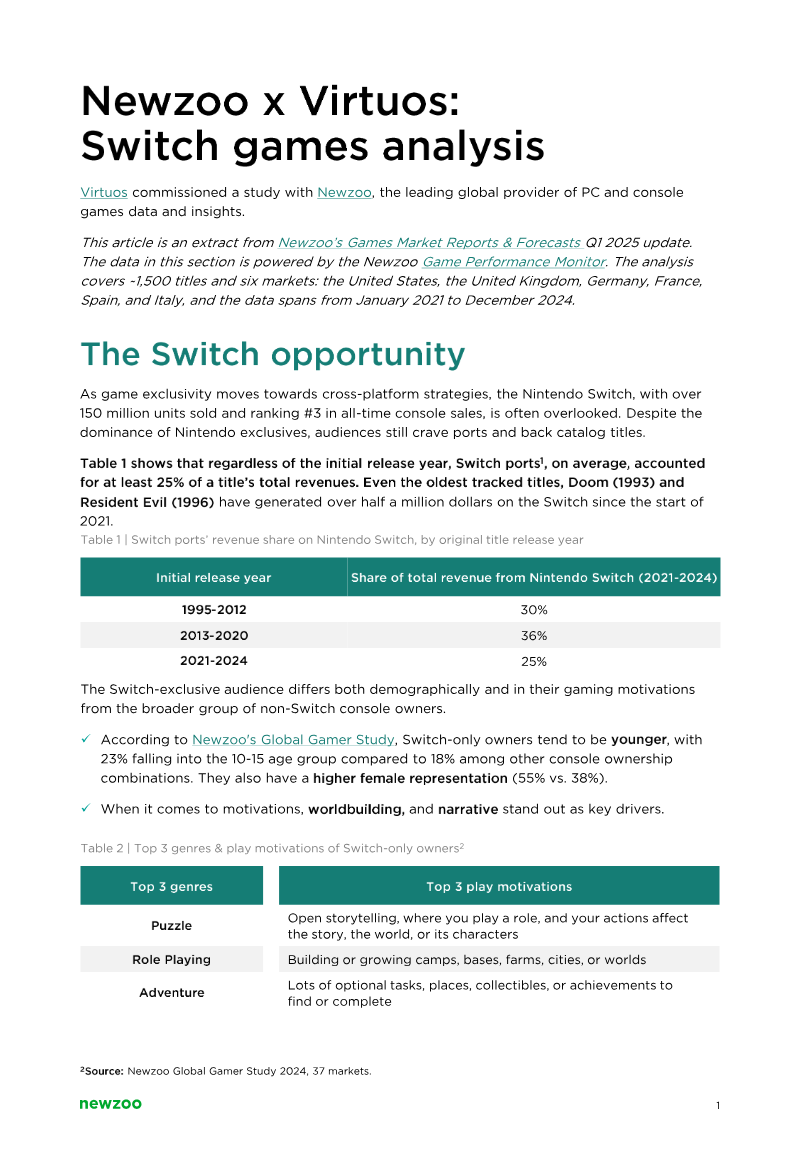
This analysis examines the Nintendo Switch market landscape from January 2021 to December 2024, focusing on the performance of third-party ports across the United States, United Kingdom, Germany, France, Spain, and Italy. Utilizing data from approximately 1,500 titles, the study highlights that while Nintendo-published exclusives dominate the platform, third-party ports represent a significant and growing revenue stream. By 2024, ports accounted for over a third of the console's revenue, a trend accelerating as the industry anticipates the transition to the next generation of hardware.
The findings reveal a distinct demographic and motivational profile for Switch-only owners. This audience is younger than the broader console market—with 23% aged 10-15—and features a higher concentration of female players at 55%. Their primary gaming motivations include immersive storytelling, world-building, and completionism. Consequently, genres such as Role-Playing, Simulation, and Platformers consistently outperform others. Role-Playing titles are particularly successful, with over one-third of ported RPGs generating more than $1 million in revenue.
The data distinguishes between simultaneous and staggered releases, noting that staggered ports often achieve higher average revenue per title due to major hits like Hogwarts Legacy, while simultaneous releases capture a higher percentage of total cross-platform revenue share. Fighting games also emerge as high performers when tied to strong intellectual properties. Ultimately, the analysis concludes that while the Switch offers substantial long-tail revenue opportunities, success depends on navigating technical hardware limitations and aligning game design with the specific preferences of the handheld audience.
- Third-party ports have grown to account for over one-third of total Nintendo Switch revenue as of 2024.
- The Switch audience is distinct from the broader console market, with 23% of users aged 10–15 and 55% identifying as female.
- Role-Playing, Simulation, and Platformer genres consistently outperform others, with over one-third of ported RPGs generating more than $1 million in revenue.
- Staggered releases often achieve higher average revenue per title, exemplified by high-performing ports like Hogwarts Legacy, while simultaneous releases capture a larger share of total cross-platform revenue.
- Fighting games demonstrate strong commercial performance on the platform when paired with established intellectual properties.
+1
NewzooMar 2025

Report37 pages
Insights into the Japanese Gaming Market: 2025
The Japanese gaming market stands as a uniquely high-value ecosystem, generating 9.1% of global industry revenue despite accounting for only 2.2% of the worldwide player base. This disparity underscores a high average revenue per user driven by a mature demographic that prioritizes quality, depth, and domestic intellectual property. While Nintendo and established local publishers maintain a firm grip on the console sector, the landscape is undergoing a structural shift as PC gaming emerges as a critical growth engine, representing a substantial $2.5 to $3.0 billion opportunity for international entrants.
Success within this region necessitates a nuanced understanding of local consumer behavior, which diverges significantly from Western trends. Japanese players demonstrate a profound preference for narrative-driven, single-player role-playing games and fantasy-themed experiences, often eschewing the open-world, sports, and multiplayer-centric titles that dominate other major markets. This cultural specificity acts as a barrier to entry for many global publishers, who must tailor their content to align with these distinct aesthetic and gameplay expectations to achieve meaningful penetration.
Beyond cultural alignment, international companies must navigate complex macroeconomic conditions, most notably the volatility of the Japanese Yen. While the market remains a lucrative target, the combination of currency headwinds and the entrenched dominance of domestic franchises requires a strategic, long-term approach. By focusing on high-fidelity, story-rich experiences that resonate with the local appetite for solo play, external publishers can effectively capture a share of this high-margin market, provided they remain adaptable to the evolving preferences of the Japanese gaming audience.
- The Japanese gaming market generates 9.1% of global industry revenue despite representing only 2.2% of the worldwide player base, indicating an exceptionally high average revenue per user.
- PC gaming is a critical growth engine in Japan, representing a $2.5 to $3.0 billion opportunity for international publishers.
- Success in Japan requires prioritizing narrative-driven, single-player role-playing games and fantasy themes, which contrast with the multiplayer and sports-centric preferences of Western markets.
- Domestic publishers and Nintendo maintain a firm grip on the console sector, creating a high barrier to entry for international companies.
- International entrants must navigate macroeconomic challenges, specifically the volatility of the Japanese Yen, when planning market entry.
+2
NewzooJan 2025