Skip to main content
Game Industry
Library
Library
Search
Ask AI
News
Connect your AI
Browse
The Catch Up
Topics
Collections
Writers
Help
Subscribe
Game Industry
Library
Library
Search
Ask AI
Saved
Library
15 reports matching your filters
All Types
Reports
Articles
Presentations
Whitepapers
Financial
Legal
Other
Search
Southeast Asia
Esports
Mobile
Market Analysis
Streaming
MOBA
Advertising
Monetization
Indonesia
Player Behavior
Marketing
Player Demographics
User Acquisition
Investment
Battle Royale
Turkey
Creative Ads
Game Development
Clear
Filters
1
Southeast Asia
Recently added
Newest first
Oldest first
Title A–Z
Title Z–A
Report
18 pages
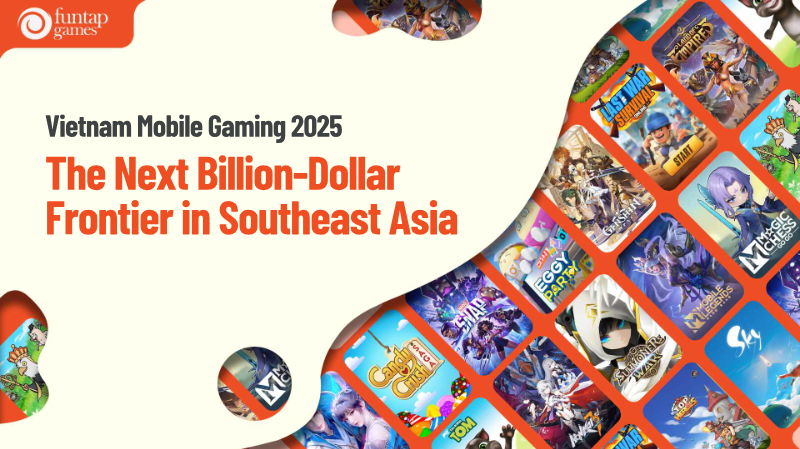
Vietnam Mobile Gaming 2025: The Next Billion-Dollar Frontier in Southeast Asia
Vietnam's mobile gaming market is projected to reach a billion-dollar valuation by 2025, supported by a 9.8% compound annual growth rate.
A 2025 regulatory crackdown resulted in the removal of 1,081 unlicensed titles, leading to a 13.7% decline in total downloads but fostering a more stable environment for compliant mid-core games.
Vietnam demonstrates strong monetization potential, with revenue per download exceeding that of the Philippines by at least 28%.
Market Analysis
Market Forecast
Player Demographics
+4
InvestGame
Feb 2026
Report
25 pages
Let’s Play! 2024: The Esports Market in Southeast Asia
Southeast Asia is the world's largest esports market by reach at 75%, though regular viewership remains limited to 32% of the total audience.
Mobile gaming drives 55% of all esports consumption in the region, fueling a shift toward digital-first platforms like YouTube Gaming, Facebook Gaming, and local streaming services.
The audience is predominantly young, with 81% of viewers belonging to the Millennial or Gen Z generations, and features a 43% female viewership share.
Esports
Market Analysis
Southeast Asia
+2
Deloitte
Feb 2026
Report
7 pages
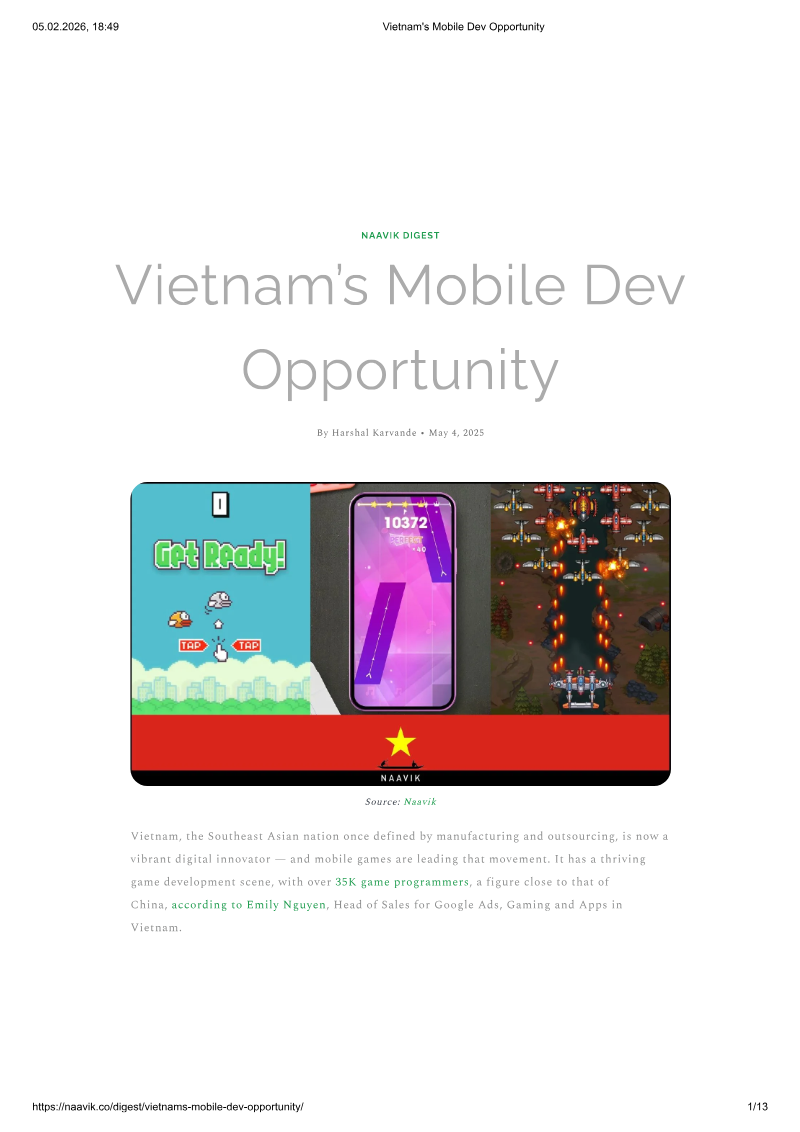
Vietnam's Mobile Dev Opportunity
Vietnam has emerged as a major global mobile development hub with over 35,000 game programmers and more than 300 active local publishers.
In 2024, five Vietnamese studios ranked among the world’s top 25 publishers, generating 2.4 billion downloads and $133 million in revenue.
Since 2020, the sector has experienced significant growth, marked by a 67% increase in downloads and an 82% rise in earnings.
Market Analysis
Game Development
Game Publishing
+2
Naavik
Feb 2026
Report
88 pages
Gaming and Esports in Vietnam: A New Arena for Brands
Vietnam has the world's highest adult gamer rate at 85%, with a demographic where 70% of the population is under 25 and one-third of citizens are engaged in esports.
Mobile gaming dominates the market, supported by high smartphone penetration and 4G coverage, with gamers typically spending 1–3 hours per session.
Influencer marketing is highly effective, as 51% of gamers trust key opinion leader (KOL) recommendations and 42% report purchasing products endorsed by them.
Market Analysis
Esports
Marketing
+3
Decision Lab
Feb 2026
Report
19 pages
Southeast Asia Gaming Consumer Economy
The Southeast Asian gaming population is projected to reach 367.8 million by 2025, with Indonesia, Malaysia, the Philippines, Singapore, Thailand, and Vietnam accounting for 85% of the total regional gamer base.
Mobile gaming is the dominant market force, generating 70% of in-game revenue and achieving a 13.7% CAGR in consumer spending between 2018 and 2021, reaching a total of US$5.57 billion.
Monetization is heavily reliant on free-to-play models with in-app purchases, which account for 86% of total revenue, though hybrid and subscription models are increasingly utilized.
Market Analysis
Player Demographics
Player Behavior
+2
Telekom Malaysia
Feb 2026
Report
82 pages
Vietnam Gaming Outlook 2026: Building Sustainable Growth
Vietnam’s mobile gaming sector is shifting from an ad-driven model to hybrid-casual titles prioritizing in-app purchases (IAP) and subscriptions, following a 65% surge in local IAP growth in 2025.
While Vietnam led global Google Play downloads with 6.1 billion installs in 2024, the market generated only $430 million, highlighting the profitability ceiling of pure advertising models.
Localized pricing strategies, including purchasing power parity tiers and one-tap tokenized payments, can increase conversion rates by over 20% and reduce checkout abandonment by up to 30%.
Market Analysis
Market Forecast
Monetization
+3
InvestGame
Feb 2026
Report
114 pages
Vietnam Innovation and Private Capital Report: 2025
Vietnam’s digital economy has reached a valuation of $36 billion, supported by a 6% annual real GDP growth rate.
Private capital investment in 2024 totaled $2.3 billion across 141 deals, with a notable rebound in early-stage venture capital during the second half of the year.
Resolution No. 57-NQ/TW mandates that by 2030–2045, digital and high-tech exports must account for 30–50% of GDP, with 2% of GDP allocated to R&D.
Market Analysis
Investment
Funding
+1
Boston Consulting Group
Feb 2026
Report
12 pages
Connecting Digital Investments and Real Estate: Malaysia’s Competitive Advantage
Malaysia has attracted RM 342.6 billion in approved digital investments, with 95 percent of these projects concentrated in the Klang Valley, Johor, and Penang.
The Klang Valley serves as the primary digital hub, accounting for approximately 75 percent of the nation's total digital foreign direct investment.
Digital-sector employment across these investment clusters generates a total value of RM 13.9 billion.
Investment
Market Analysis
Southeast Asia
Malaysia Digital Economy Corporation (MDEC)
Feb 2026
Report
37 pages
Southeast Asia: Mobile Game Market Insights 2025
Southeast Asia is the world’s second-largest mobile gaming market by volume, recording 1.93 billion installs in early 2025, while ranking seventh globally in revenue at $625 million.
Indonesia is the region's primary volume driver with 870 million installs, whereas Thailand leads in monetization, generating $162 million in consumer spending.
Publishers based in Singapore and Vietnam have become a dominant global force, contributing over 5.8 billion installs to the international market through hypercasual and competitive titles.
Market Analysis
Mobile
Southeast Asia
+3
Sensor Tower
Jun 2025
Report
13 pages
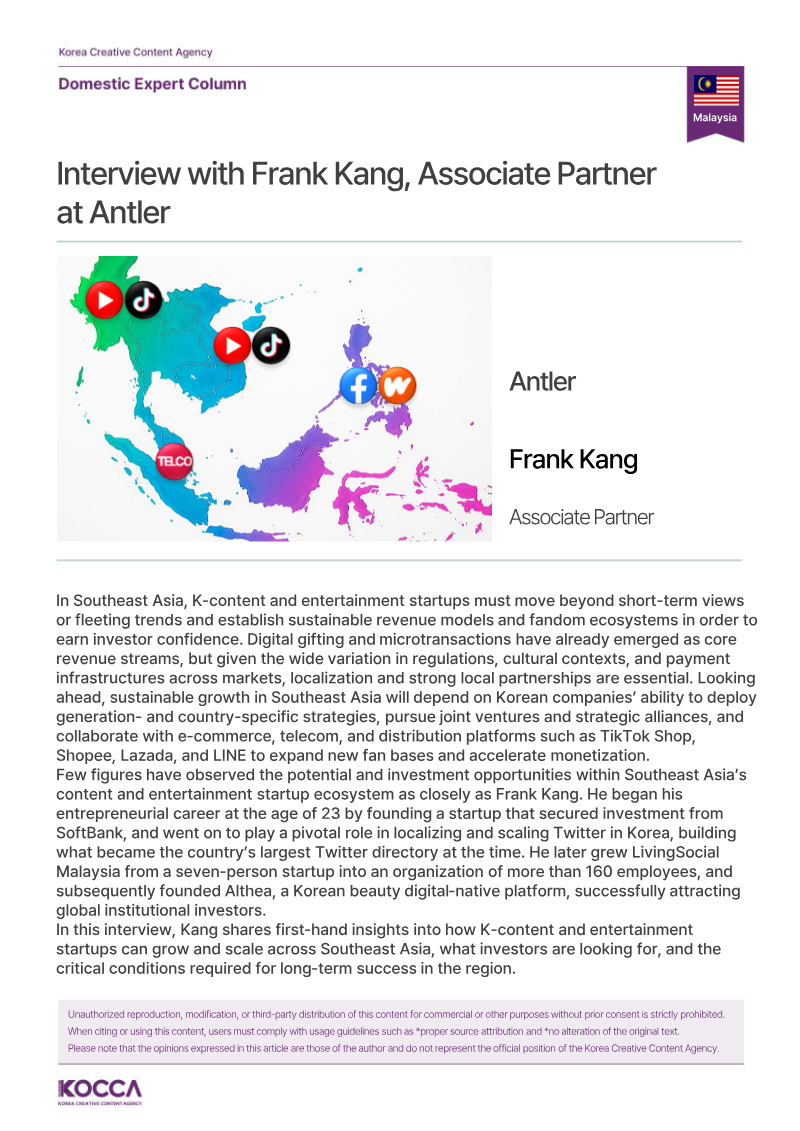
Interview with Frank Kang, Associate Partner at Antler: Malaysia
Korean entertainment and content startups must treat Southeast Asia as a primary growth engine rather than a peripheral market to achieve sustainable expansion.
Success requires deep localisation through local 'co-pilots' to navigate fragmented linguistic, regulatory, and payment landscapes in key hubs like Jakarta, Manila, and Bangkok.
Revenue models should shift toward mobile-wallet-driven micro-transactions, live-commerce, and hybrid free-plus-premium structures to align with local consumption habits.
Monetization
Mergers & Acquisitions
Investment
+1
KOCCA – Korea Creative Content Agency
Jan 2025
Report
37 pages
SensorTower Report: Southeast Asia Mobile Game Market Insights 2025
Southeast Asia generated 1.93 billion new mobile game installs and $625 million in in-app purchase revenue during Q1 2025.
Casual genres like Arcade and Simulation drive the highest download volumes, while Strategy, Shooters, and social-driven RPGs account for the majority of monetization.
Mobile Legends: Bang Bang and Garena Free Fire remain the region's top revenue-generating titles, though newer IPs like Ragnarok M: Classic and Magic Chess: Go Go are rapidly gaining market share.
Market Analysis
Mobile
Southeast Asia
Sensor Tower
Jan 2025
Report
15 pages
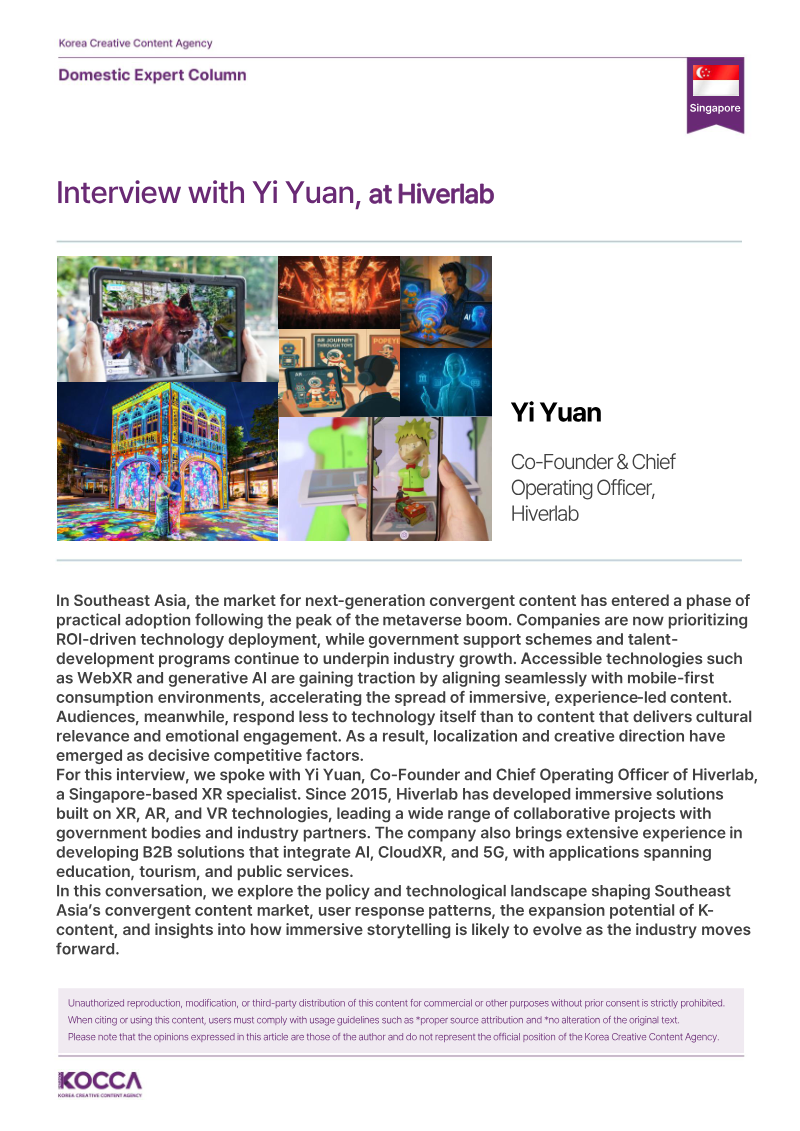
Interview with Yi Yuan, at Hiverlab: Southeast Asia
Southeast Asia’s convergent-content market has shifted from speculative metaverse projects to a pragmatic, ROI-driven focus on augmented reality for marketing and tourism.
Success in the region is measured by quantitative metrics including dwell time, interaction density, and social-virality indicators rather than technological novelty.
Large-scale AR deployments are currently anchored by government funding and mobile-first infrastructure, utilizing WebXR and 5G networks to ensure scalability.
Market Analysis
AI
AR
+1
KOCCA – Korea Creative Content Agency
Jan 2025
Report
24 pages
Insights into Marketing Trends in Southeast Asian Mobile Games in 2024
Video-centric marketing is the dominant strategy in Southeast Asia, accounting for nearly 70% of all ad creatives across all mobile game genres.
Indonesia is the region's largest market by advertiser volume with 12.3K monthly advertisers, while Thailand leads in content intensity with over 100 creatives per advertiser.
The Southeast Asian mobile gaming market saw a 9.5% year-over-year increase in active advertisers, averaging over 20,000 per month between January and August 2024.
Market Analysis
Advertising
Southeast Asia
+1
SocialPeta
Oct 2024
Report
25 pages
South East Asian Mobile Game Market Insights 2024
Southeast Asia's mobile game market saw 4.2 billion installs in H1 2024, a 3.4% increase, while in-app purchase (IAP) revenue reached $1.16 billion, a 3.4% year-over-year rise but a 3% decline from the previous half-year.
Indonesia is the region's largest market by volume, accounting for 41% of total downloads with 10% growth, while Thailand leads in profitability, contributing $400 million in IAP revenue.
Google Play remains the dominant platform in the region, capturing 91% of total download volume and 57% of total IAP revenue.
Market Analysis
Mobile
Southeast Asia
+1
Sensor Tower
Jan 2024
Report
25 pages
A Rising Market: Southeast Asia
Southeast Asia's esports audience is experiencing rapid expansion, with year-over-year growth reaching as high as 18.2% between 2019 and 2024.
The market is defined by a mobile-first culture where 82% of the online population plays mobile games and 39% identify mobile as their primary gaming platform.
Three mobile titles—Mobile Legends: Bang Bang, Garena Free Fire, and PUBG Mobile—accounted for approximately 50% of all global esports hours watched for those specific games on Twitch and YouTube Live in the first half of 2021.
Market Analysis
Esports
Southeast Asia
+1
Newzoo
Jul 2021