Market Analysis reports and market data
Documents


Rewarded UA Handbook: 2026
The "Rewarded UA Handbook: 2026" examines the state of rewarded user acquisition (UA) in the mobile gaming industry, providing best practices and future outlooks.
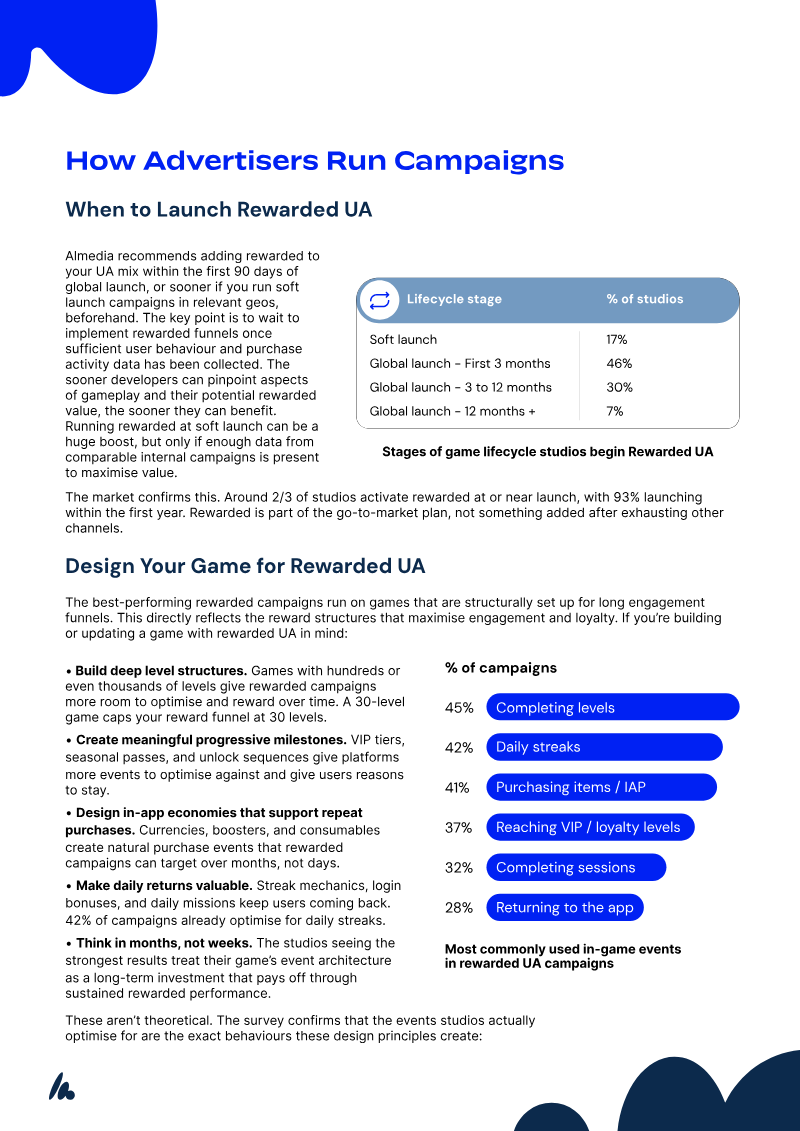
- Rewarded UA is now a core marketing channel, with 61% of surveyed studios planning to increase their budget in 2026 and 65% of studios allocating between 11% and 50% of their total UA spend to the channel.
- Extending reward structures beyond traditional short-term windows is critical for retention; for example, Candivore increased their Match Masters reward structure from 50 to 90 days, resulting in a 50% increase in D60 retention and a 70% uplift in D90 ROAS.
- Campaigns that layer multiple event types outperform single-event campaigns, with IAP/hybrid games utilizing an average of 3.25 distinct event types per campaign to drive long-term engagement.

How Things Got So Bad At Xbox
Xbox is currently navigating a period of profound organizational instability characterized by significant layoffs, studio closures, and the cancellation of major projects.
- Xbox is undergoing a major organizational overhaul under new CEO Asha Sharma, involving significant layoffs and potential studio closures as the company pivots to prioritize higher profit margins.
- The $68.7 billion acquisition of Activision Blizzard, which took 18 months to close, significantly increased Xbox's operational costs by adding thousands of employees during a period of industry-wide market cooling.
- Xbox's financial strategy has been complicated by the conflicting goals of its hardware, software, and services divisions, leading to internal debates over whether Game Pass cannibalizes full-game sales.
Market Model Reports: Asia & MENA
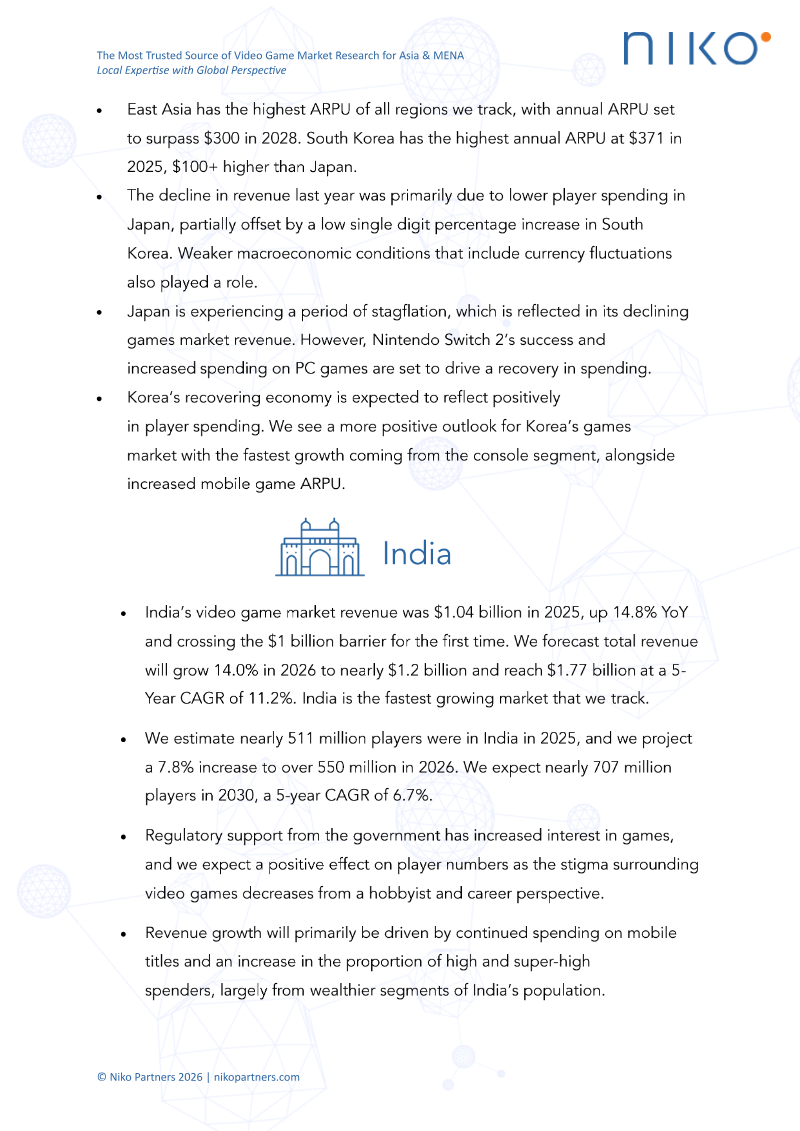
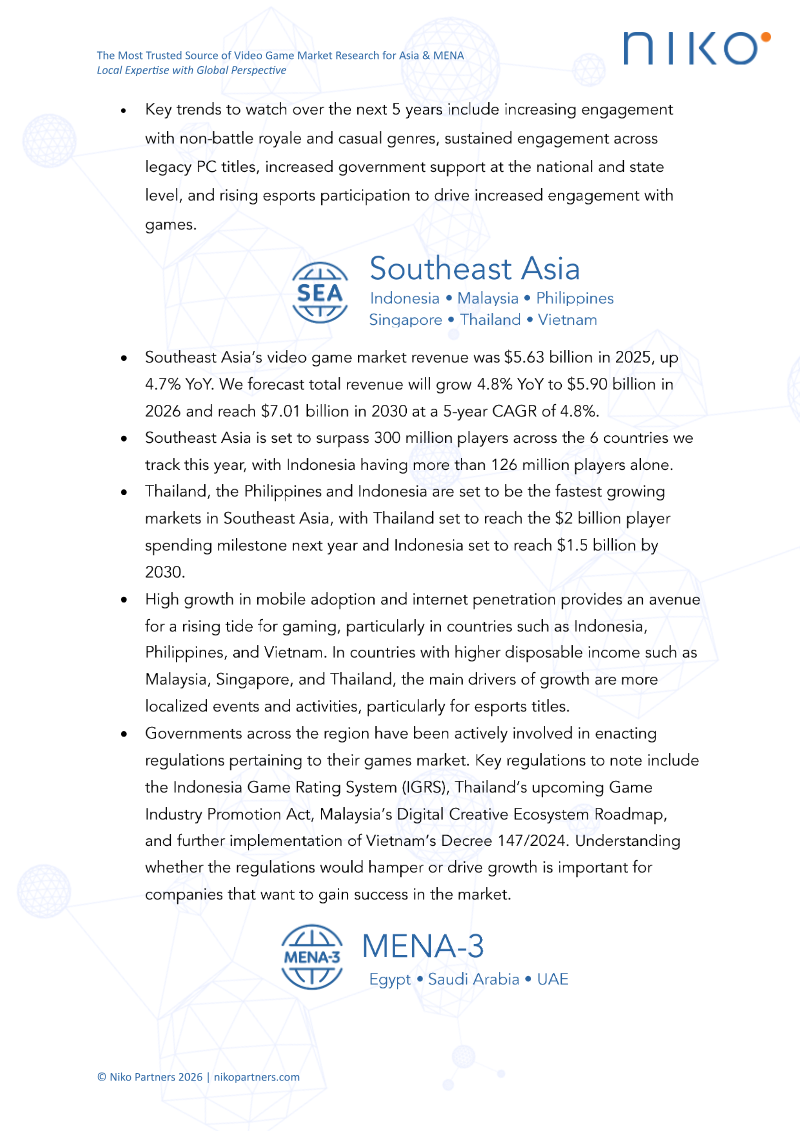
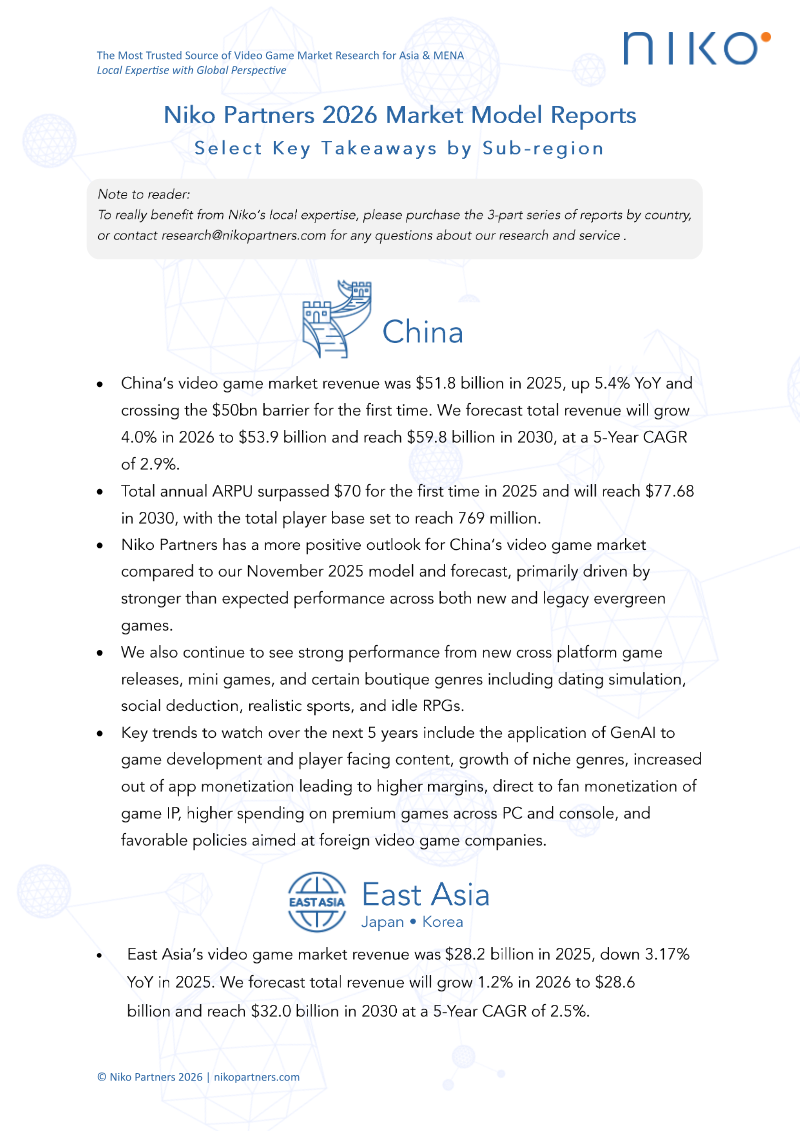
This document provides key takeaways from Niko Partners' 2026 Market Model Reports, focusing on video game market revenue and player base forecasts across Asia and the MENA region, with data extending to 2030.
- China’s video game market reached $51.8 billion in 2025 and is projected to grow at a 2.9% CAGR to reach $59.8 billion by 2030.
- India is the fastest-growing market tracked, with 2025 revenue of $1.04 billion and a projected 11.2% CAGR through 2030, supported by a player base expected to reach 707 million.
- East Asia remains the region with the highest ARPU, though 2025 revenue declined 3.17% to $28.2 billion due to Japanese market stagnation and macroeconomic conditions.

Epic Won the Fee War. So Why Is Everyone Losing? (Liam Wiltshire, Tebex)
The gaming industry is currently navigating a period of severe margin compression, driven by an infinite supply of content—increasingly accelerated by artificial intelligence—and a finite pool of player attention.
- The player relationship is the most critical asset in gaming, as evidenced by the shadow economy of UGC servers like FiveM and Hypixel, where community owners retain direct control and monetization power without publisher intervention.
- Creator codes significantly boost monetization, increasing average spend by 227% in titles like Rust by leveraging the trust and affinity players feel toward content creators.
- Alternative payment methods like Buy Now, Pay Later (BNPL) and cryptocurrency drive significantly higher spending, with transaction values 50–70% higher than traditional credit or debit card payments.

Nothing has changed: June Steam Next Fest 2026
The June 2026 Steam Next Fest analysis emphasizes that the event’s structure and the Steam algorithm remain largely static, with minimal changes observed between the February and June iterations.
- Steam Next Fest performance is largely predetermined by pre-festival wishlist counts, with the vast majority of games following predictable statistical trends rather than experiencing viral spikes.
- The number of games participating in Steam Next Fest has grown significantly, rising from 2,650 in October 2025 to 3,458 in February 2026, and reaching 4,358 in June 2026.
- There are no effective 'gimmicks' or last-minute marketing tactics to improve performance during the event; developers should only push updates if the game is technically broken or crashing.

Can PlayStation’s Housemarque repeat the FromSoftware story?
Housemarque is currently navigating a strategic evolution as a first-party PlayStation studio, aiming to elevate its historically niche, arcade-inspired design philosophy into the realm of major, top-tier gaming franchises.
- Housemarque is transitioning from a niche arcade developer to a major first-party PlayStation studio by scaling its high-intensity, flow-state gameplay for a broader, mainstream audience.
- The studio currently employs approximately 120 people and is leveraging Sony’s internal resources, user testing, and collaborative infrastructure to support this growth.
- Housemarque aims to replicate the success trajectories of established studios like Naughty Dog and Insomniac Games by treating new intellectual properties as long-term foundations for player engagement.

Valuable Childhoods: Nostalgia, Intersectionalities, and Vintage Game Fairs
This paper examines nostalgia surrounding retro gaming, the resale market for childhood games, and the intersectional dimensions of play through a duoethnography of two researchers' shared player biographies.
- The paper argues that nostalgia for retro games is strongly sensorial, shaped by the tactile handling of cartridges, the location of play, and the company kept during it, and that these affective memories diverge sharply from the monetary value the same objects carry in the secondary resale market.
- Based on a duoethnography of two UCL researchers' childhoods in Brazil and England, the authors found their tactile recollections of Sega Mega Drive play were markedly similar despite differing national and social contexts.
- The authors interpret this similarity as evidence that class and shared material experience may matter as much as ethnicity, nationality, or gender in shaping gaming memory, and therefore advocate interconnected rather than nationally bounded approaches to game history.
Instrumental Pleasures: Game Informer and the Masculinist Review Discourse of Fantasy Game Magic
This paper examines how reviews in the American mass-market magazine Game Informer framed the pleasures of magic systems in fantasy games between 1991 and 2011.
- The paper analyzes reviews in Game Informer, an American mass-market game magazine, from 1991 to 2011 to examine how fantasy game magic systems were praised and framed.
- Reviewers repeatedly valued magic systems for five themes: destruction, spectacle, choice, creativity, and mastery, which the author interprets through Taylor's concept of instrumental play (efficiency, goal orientation, system understanding).
- The author argues that the magazine's repeated valorization of instrumental engagement amounted to a gendered script of enjoyment, since instrumental rationality has historically been coded as masculine.
Beyond the Studio: Long-Term Career Trajectories of Swedish Game Graduates
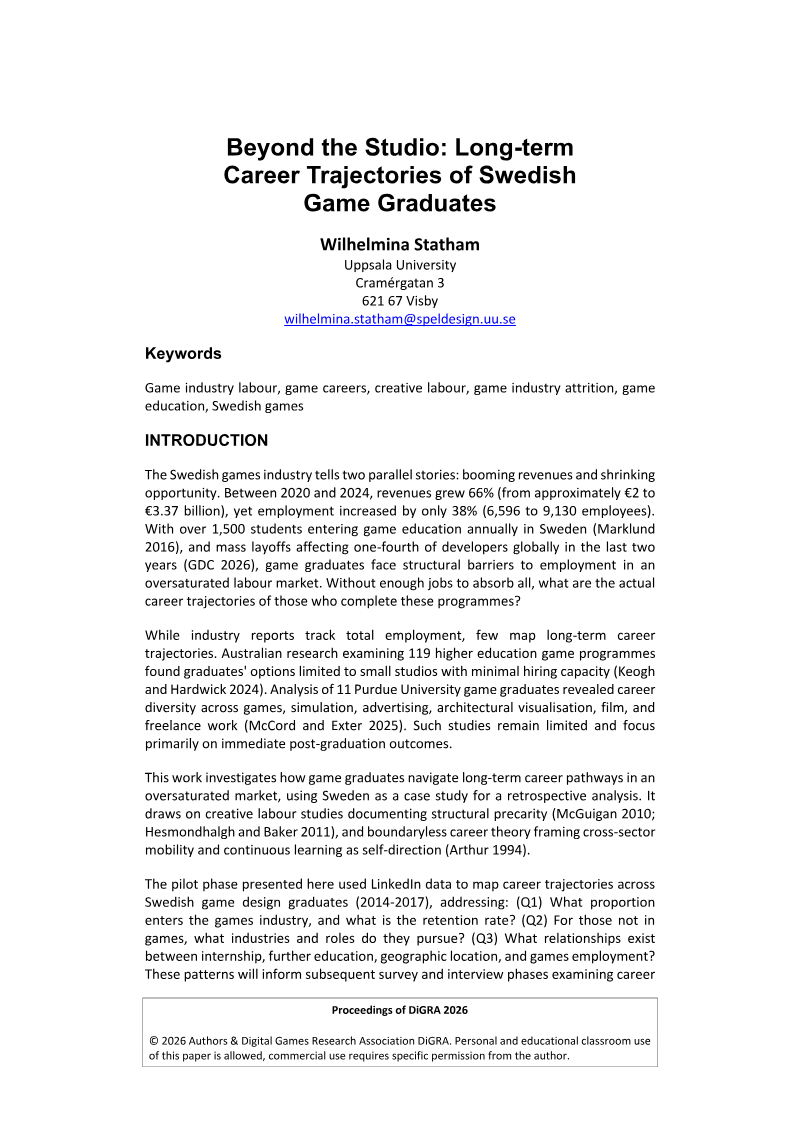
This pilot study investigates the long-term career trajectories of Swedish game design graduates, specifically focusing on those from Uppsala University, Campus Gotland, between 2014 and 2017.
- Only 43% of Uppsala Campus Gotland game design graduates (2014–2017) were still working in games at the time of analysis, despite 63% having worked professionally in the field at some point, a 31% attrition rate and 68% retention among those who entered.
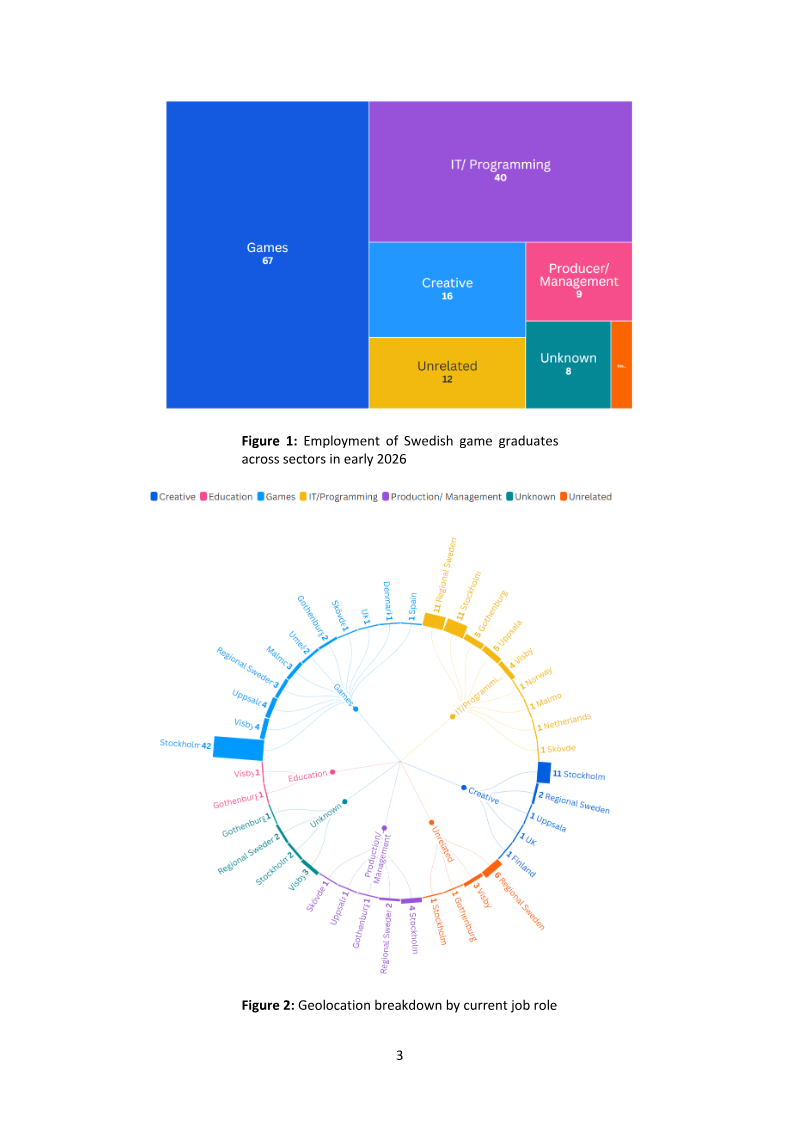
- Current employment is spread across game development (43%), IT and programming (26%), other creative industries (10%), management (6%), education (1%), and unrelated or unknown sectors (13%), suggesting the degree's skills transfer well beyond games.
- Swedish games sector revenues grew 66% between 2020 and 2024 while employment grew only 38%, a gap the author frames as a market unable to absorb all graduates.

Gacha Game Collaborations and the Circulation of Affective Value
This paper examines cross-media collaborations in China's mobile gacha game sector, arguing that they function as affective infrastructure through which emotional attachments circulate across commercial, cultural, and institutional domains and are converted into different forms of value.
- Collaborations in China's mobile gacha games are framed as affective infrastructure that moves and redirects existing emotional attachments across commercial, cultural, and institutional domains, rather than as mere marketing or fan service.
- The study identifies three collaboration modes: brand and retail co-promotions that channel affect toward consumption, culture- and state-oriented partnerships that redirect affect toward cultural legitimacy, and inter-game crossovers that extend the lifespan of fan attachments.
- A 2024 romance game partnership with a fast-food chain is cited as an example of turning purchasing into a pleasurable and socially performative act.
Final Boss: Video Games as a Technology of Geopolitical Cultural Power
Video game production and culture, the paper argues, constitute a geopolitical field in which the United States, Japan, and Western Europe hold dominant positions while Global South territories such as Latin America, Africa, and the Middle East are marginalized.
- The paper argues video games are not neutral entertainment but instruments of cultural and geopolitical power, with effects reaching into sovereignty, identity, and knowledge.
- Production and cultural influence in video games are concentrated in the United States, Japan, and Western Europe, while Latin America, Africa, and the Middle East are marginalized and largely confined to consumer roles.
- The author frames the Global South's dependency as "technocoloniality," linked to the Coloniality of Power and Milton Santos's account of metropolitan control over time and information flows, with pressure on producers to reproduce Northern narratives in exchange for symbolic recognition and market access.
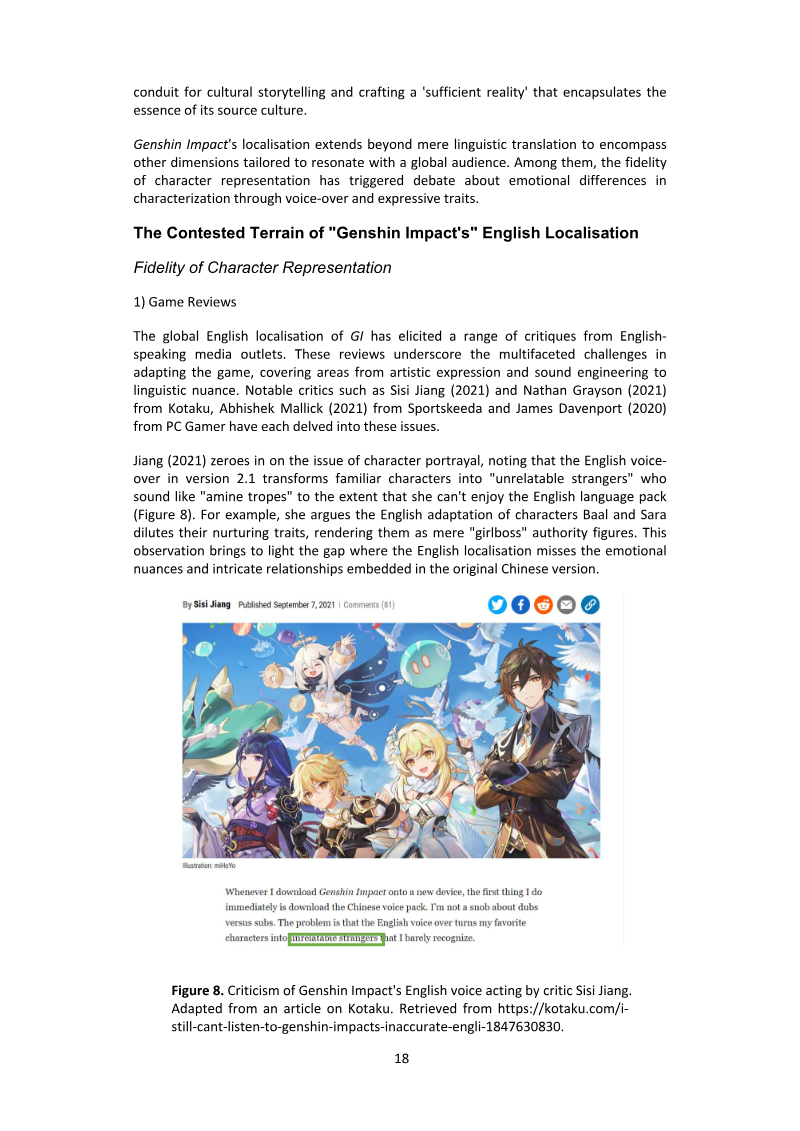
Genshin Impact: Cultural Hybridisation, Localisation and Contra-Flow of Cultural Production in China's Open-World Role-Playing Game
Genshin Impact: Cultural Hybridisation, Localisation and Contra-Flow of Cultural Production in China's Open-World Role-Playing Game examines how miHoYo's open-world title operates as a case of Chinese cultural production reshaping the global games industry.
- The study frames Genshin Impact as a 'contra-flow' of cultural production in which Chinese publisher miHoYo challenges the long-standing dominance of US and Japanese companies in the global games industry.
- Genshin Impact generated roughly $3 billion in mobile revenue within a single month, with around 70 percent of that income coming from outside China.
- The game blends Chinese motifs, Japanese anime aesthetics, American open-world mechanics, and global mythologies into a multidirectional hybrid aesthetic.