1 free read left. Create a free account for unlimited reading + AI research.
Create free accountReport DiGRA
1 free read left. Create a free account for unlimited reading + AI research.
Create free accountReportDiGRA
The study notes that Swedish games sector revenues grew 66% between 2020 and 2024 while employment grew only 38%.
This pilot study investigates the long-term career trajectories of Swedish game design graduates, specifically focusing on those from Uppsala University, Campus Gotland, between 2014 and 2017. The research aims to understand how graduates navigate an oversaturated labor market, examining the proportion entering and remaining in the games industry, the alternative industries and roles pursued, and the influence of internships, further education, and geographic location on employment outcomes. This retrospective analysis utilizes publicly available LinkedIn data for 154 graduates, providing approximately 10-year career trajectories.
Key findings indicate that while 63% of graduates initially worked professionally in games, only 43% remained in the industry at the time of analysis, representing a 31% attrition rate. This suggests the market struggles to provide sustained opportunities for all graduates, though the industry retains 68% of those who initially enter. Graduates demonstrate significant skill transferability, with 26% moving into IT/Programming, 10% into other creative industries, and 6% into producer/management roles. Only 13% work in unrelated or unknown sectors, challenging simplistic narratives of success or failure.
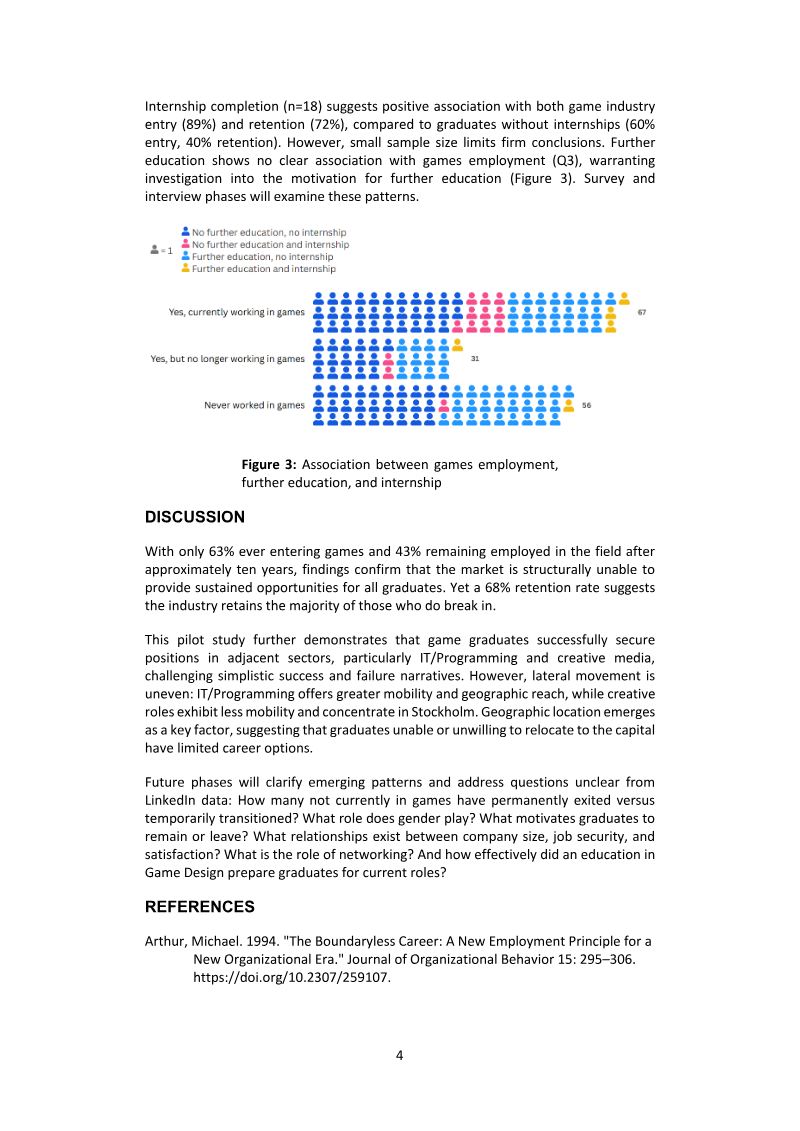
Geographic location emerges as a critical factor, with a concentration of game and creative roles in Stockholm, while IT/Programming positions show broader distribution. This suggests that graduates unable or unwilling to relocate to the capital face limited opportunities within the games sector. Internships appear positively associated with both game industry entry (89%) and retention (72%), compared to graduates without internships (60% entry, 40% retention), though the small sample size for internships limits definitive conclusions. Further education shows no clear association with games employment. The study's scope is limited to a single Swedish university program, and future phases will incorporate surveys and interviews to address limitations of LinkedIn data, such as gender, motivations for career choices, and the impact of company size and job satisfaction.

DiGRA · 2026

DiGRA · 2026



DiGRA · 2026



DiGRA · 2026



DiGRA · 2026



DiGRA · 2026



DiGRA · 2026



DiGRA · 2026

DiGRA · 2026



DiGRA · 2026



DiGRA · 2026

DiGRA · 2026
Dataspelsbranschen · 2025