Market Analysis
Documents
Półroczne sprawozdanie Zarządu z działalności Grupy Kapitałowej PCF Group S.A.
WarSzawa | 30 WRZESNIA 2025 ROKU PEOPLE PÓŁROCZNE SPRAWOZDANIE ZARZĄDU Z DZIAŁALNOŚCI GRUPY KAPITAŁOWEJ PCF GROUP S.A. ORAZ SPÓŁKI PCF GROUP S.A. KAPITALOWEJ PCFGROUP S.A. ORAZSPÓEKI PCF GROUP S.A. ZA OKRES 01.01.2025- 30.06.2025 ZA 0KRES 01.01.2025 - 30.06.2025 za okres 01.01.2025–30.06.202 5r.(dane w tys. zł, chyba że zaznaczono inaczej) Niniejsze półroczne sprawozdanie z działalności Grupy Kapitałowej PCF Group S.A. i spółki PCF Group S.A. za okres 01.01.2025 – 30.06.2025 r.
- PCF Group S.A. experienced a significant reduction in its development teams, laying off over 60 people from the Gemini project due to the expiration of an agreement with Square Enix Limited, and over 50 people from the Bifrost project due to a lack of funding for its self-publishing model, both occurring around June 1, 2025.
- The company's cash and cash equivalents decreased by 87% from 83,426 thousand PLN on June 30, 2024, to 11,190 thousand PLN on June 30, 2025, with net cash flows for the period being negative 46,370 thousand PLN.
- PCF Group's equity decreased by 12% (29.5 million PLN) as of June 30, 2025, compared to December 31, 2024, primarily due to losses incurred during the reporting period.
- PCF Group decided to gradually withdraw from VR game publishing activities, though it agreed with Incuvo S.A. on March 6, 2025, to complete the Bison project, with a planned release in Q4 2025, and Incuvo S.A. contributing to some production costs in exchange for a share of future revenues.
- The company has high revenue concentration risk, relying on agreements with publishers like Square Enix Limited (for Outriders and Project Gemini), Microsoft Corporation (Project Maverick), Krafton Inc. (Project Echo and Project Zulu), and Sony Interactive Entertainment LLC (Project Delta).
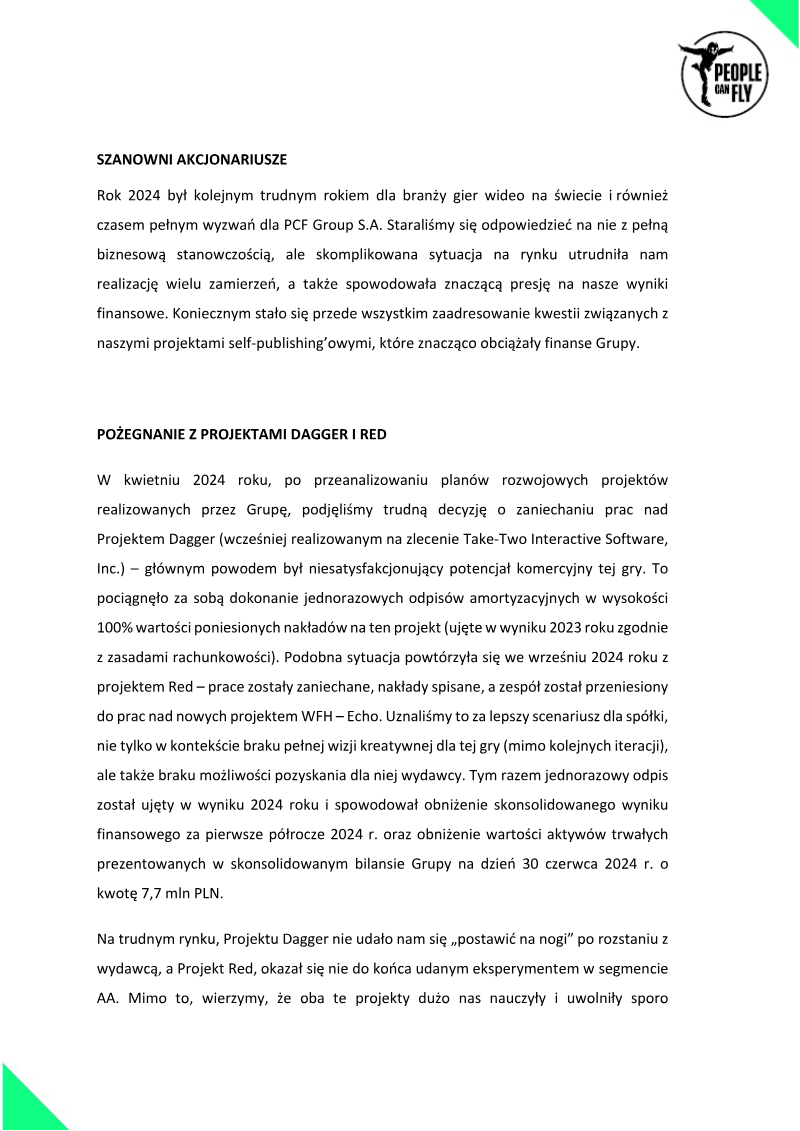
Letter to Shareholders: 2024
The letter explains that 2024 was a challenging year for the video‑game industry and for PCF Group S.A., prompting decisive actions to protect financial stability. In April, the company discontinued the Dagger project after a partner withdrawal and recorded a 100 % write‑off of its costs, followed by the cancellation of Red in September. These decisions reduced consolidated earnings for the first half of 2024 and lowered fixed‑asset values by PLN 7.7 million. The board also halted work on Victoria and Bifrost in December, laying off over 120 employees; a PLN 154.964 million impairment was booked for Bifrost, while Victoria’s costs were retained due to an upcoming early‑access release.
To counter market headwinds, the board launched a strategic options review in August aimed at securing external investment or restructuring. The effort failed, leaving the group to reassess short‑ and long‑term plans. Concurrently, the company tightened its self‑publishing pipeline, focusing on work‑for‑hire (WFH) contracts. In early 2024, a short‑term agreement with Square Enix for Gemini led to a workforce reduction of 30 staff, yet the project’s revenue only covered direct costs. New WFH deals were secured with Krafton (Echo), Sony Interactive Entertainment (Delta), and Microsoft (Project Maverick), bolstering revenue streams.
The VR segment was largely exited, with Incuvo’s Bison slated as the final title. Game On, another subsidiary, saw limited improvement in 2024‑25. Overall, the letter acknowledges losses and staff cuts but stresses a commitment to rebuilding through strategic partnerships, focused development on AAA action titles, and continued investment in high‑quality games for a global audience.
- PCF Group S.A. underwent a massive restructuring in 2024, cancelling four major projects (Dagger, Red, Victoria, and Bifrost) and recording a PLN 154.964 million impairment for Bifrost alone.
- The company significantly reduced its workforce, laying off over 120 employees in December following the cancellation of Victoria and Bifrost, in addition to 30 staff cuts earlier in the year related to the Gemini project.
- Financial stability was severely impacted by project cancellations, including a 100% write-off of Dagger costs and a PLN 7.7 million reduction in fixed-asset values during the first half of 2024.
- The company has pivoted its business model toward work-for-hire (WFH) contracts, securing new partnerships with Krafton (Echo), Sony Interactive Entertainment (Delta), and Microsoft (Project Maverick) to stabilize revenue.
- A strategic review initiated in August to seek external investment or restructuring failed, forcing the company to abandon its VR segment and narrow its focus to AAA action titles.
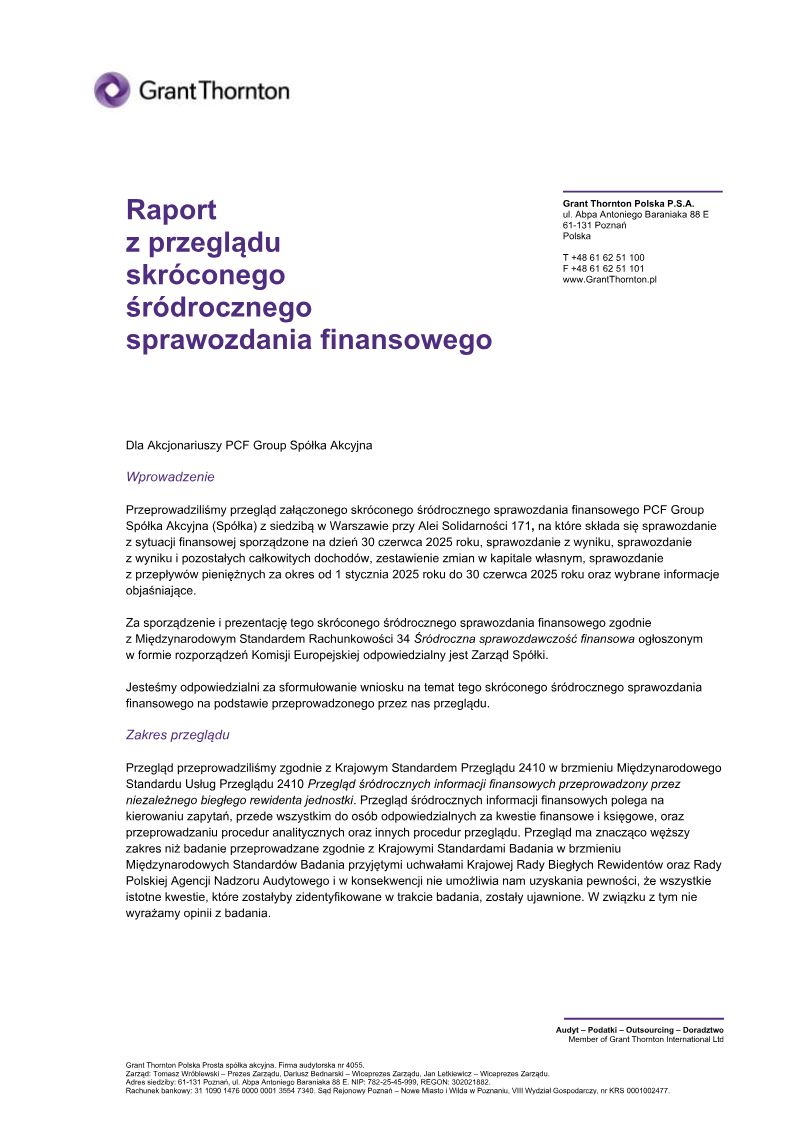
Report on the Review of the Condensed Interim Financial Statement: 2025
The report presents the findings of a review conducted by Grant Thornton Polska on the condensed interim financial statements of PCF Group Spółka Akcyjna for the period from 1 January to 30 June 2025. The review was performed in accordance with the Polish Standard for Review Engagements 2410, equivalent to International Standard on Review Engagements, and focused on the company’s compliance with IAS 34 Interim Financial Reporting as adopted by EU regulations. The scope included examination of the balance sheet, income statement, statement of comprehensive income, changes in equity, cash‑flow statement and selected explanatory notes.
Key conclusions indicate that no material misstatement was identified and the interim statements are presented in all significant respects in accordance with IAS 34. The review involved analytical procedures and inquiries of finance and accounting personnel, but did not provide assurance equivalent to an audit. The report highlights specific disclosures in explanatory notes: a valuation test for the cash‑generating unit related to development costs of a new game, noting uncertainty in projected cash flows due to potential deviations in early‑access sales; and an assessment of deferred tax assets amounting to PLN 52,659 thousand, reflecting uncertainty in five‑year tax profit forecasts and the feasibility of the company’s strategy.
The geographic coverage is limited to PCF Group’s operations in Poland, and the time frame covers the first half of 2025. The review methodology relied on management’s internal controls and financial records, with no sampling or audit evidence beyond the scope of a review engagement.
- Grant Thornton Polska concluded that PCF Group’s interim financial statements for the first half of 2025 comply with IAS 34 standards, with no material misstatements identified.
- The review highlighted uncertainty regarding the valuation of a cash-generating unit tied to new game development costs, specifically citing potential volatility in early-access sales projections.
- PCF Group carries deferred tax assets totaling PLN 52,659 thousand, which are subject to risks associated with five-year profit forecasts and the execution of the company’s strategic plan.
- The review was conducted under the Polish Standard for Review Engagements 2410 and involved analytical procedures and management inquiries, though it does not provide the same level of assurance as a full audit.
- The scope of the financial review was limited to the period between 1 January and 30 June 2025 and focused exclusively on PCF Group’s operations within Poland.
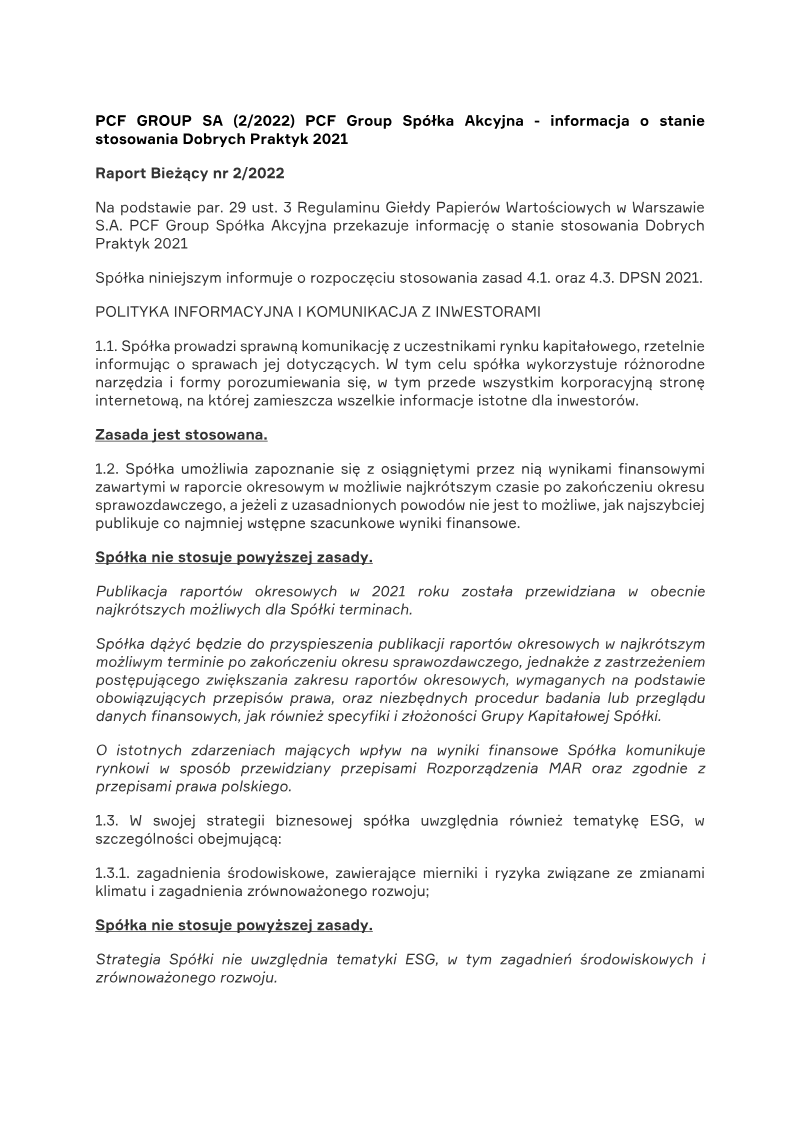
Information on the State of Application of Best Practices 2021
PCF GROUP SA ( 2/2022) PCF Group Spółka Akcyjna - informacja o stanie stosowania Dobrych Praktyk 2021 Na podstawie par. 29 ust. 3 Regulaminu Giełdy Papierów Wartościowych w Warszawie S.A. PCF Group Spółka Akcyjna przekazuje informację o stanie stosowania Dobrych Spółka niniejszym informuje o rozpoczęciu stosowania zasad 4.1. oraz 4.3. DPSN 2021. POLITYKA INFORMACYJNA I KOMUNIKACJA Z INWESTORAMI 1.1.
- PCF Group SA has begun applying principles 4.1 and 4.3 of the DPSN 2021 best practices.
- The company does not apply the principle of publishing financial results as quickly as possible after the reporting period, citing increasing scope of reports, audit procedures, and the complexity of its Capital Group as reasons.
- PCF Group SA does not apply a diversity policy for its management and supervisory boards, nor does it aim for a minimum 30% representation of minorities in these bodies, prioritizing qualifications and experience over other criteria.
- The company does not apply the principle of presenting a gender pay gap indicator, stating that due to the industry's employment structure, a cross-sectional indicator would be misleading, though it maintains equal pay for identical positions.
- PCF Group SA does not have an internal audit function or an internal auditor, and the management board does not prepare reports on the effectiveness of internal control, risk management, and compliance systems for the supervisory board.
Szacunkowe wyniki finansowe za I półrocze 2022 r.
The report announces preliminary consolidated financial results for PCF Group S.A. and its capital group for the first half of 2022, following earlier interim reports. The key figures presented are revenue from sales at PLN 90.6 million, EBITDA of PLN 29.0 million, and net profit of PLN 25.5 million. These numbers are provisional and will be reviewed by an external auditor before finalization. The definitive half‑year financial statements, covering the six months ending 30 June 2022, are scheduled for publication on 29 September 2022. The scope of the data is limited to consolidated results for the entire PCF Group, with no breakdown by geographic region or individual business segments disclosed. The methodology is not detailed beyond the indication that an audit will verify the estimates; no survey or sample size information is provided. The report serves to inform shareholders and market participants of the group’s early performance, highlighting a strong profitability profile with EBITDA and net profit margins exceeding 30 % of sales. The forthcoming official report will provide audited confirmation of these figures and any adjustments made during the review process.
- PCF Group S.A. reported preliminary consolidated revenue of PLN 90.6 million for the first half of 2022.
- The company achieved a net profit of PLN 25.5 million and an EBITDA of PLN 29.0 million for the six-month period ending 30 June 2022.
- Profitability metrics remain strong, with both EBITDA and net profit margins exceeding 30% of total sales.
- These financial results are provisional and currently subject to an external audit.
- The final, audited half-year financial statements for the PCF Group are scheduled for publication on 29 September 2022.

Annual Report 2010: Bandai Namco Holdings Inc.
The BANDAI NAMCO Group develops entertainment-related products and services in a wide range of fields, including toys, game software, arcade game machines, visual content, music content, and amuse- ment facilities. We aim to become a “Globally Recognized Entertainment Group” by establishing a strong operational foundation in Japan while aggressively developing operations in overseas markets to secure “Dreams, Fun and Inspiration” are the Engine of Happiness.
- Bandai Namco Holdings Inc. introduced a "Restart Plan" in April 2010 to improve profitability, strengthen financial standing, and transform into a speedy organization, alongside its Mid-term Business Plan (commenced April 2009) for global growth.
- The company reorganized its Strategic Business Units (SBUs) from April 1, 2010, establishing a new Content SBU to maximize content value through a horizontal structure focused on content creation and diverse distribution, replacing a previous vertical organization.
- Bandai Namco is launching a "PAC-MAN 30th Anniversary Project" in 2010, including new game titles across platforms, character goods, and a new 3D PAC-MAN animation set for release from 2012, with Avi Arad as executive producer.
- Net sales for the Visual and Music Content Business decreased by 15.6% year-on-year to ¥29,236 million in 2010, resulting in an operating loss of ¥872 million, down from an operating income of ¥39 million in the previous year.
- The Amusement Facility Business experienced a 15.4% year-on-year decrease in net sales to ¥65,363 million and a 27.5% decrease in operating income to ¥285 million in 2010, despite strategic facility closures and efficiency efforts.

Annual Report 2012
The BANDAI NAMCO Group develops entertainment-related products and services in a wide range of fields, including toys, arcade game machines, home video game software, visual software, network content, and amusement facilities. In April 2012, we started a Mid-term Plan that includes the vision of “Empower, Gain Momentum, Accelerate Evolution.” Aiming to be No. 1 with strong conviction, we are committed to being the “Leading Innovator in Global Entertainment” and recording strong growth.
- BANDAI NAMCO Group launched a new Mid-term Plan in April 2012, aiming to be the "Leading Innovator in Global Entertainment" with a vision of "Empower, Gain Momentum, Accelerate Evolution" for sustained growth.
- The Group's net sales increased by 12.4% to ¥177,994 million in the fiscal year ended March 31, 2012, with segment income rising 16.7% to ¥16,113 million.
- The Content SBU showed the strongest growth, with net sales increasing by ¥45,587 million and segment income by ¥13,911 million in 2012 compared to 2011.
- The Toys and Hobby SBU saw strong domestic performance from the Kamen Rider and Super Sentai series, and overseas success with POWER RANGERS SAMURAI toys in North America and character products in Asia.
- Key character sales for the Group in 2012 included Mobile Suit Gundam series (¥44.7 billion), Kamen Rider series (¥31.9 billion), and ONE PIECE (¥28.8 billion).
Annual Report 2015
FUN AND OUR MISSION “Dreams, Fun and Inspiration” are the Engine of Happiness. Through our entertainment products and services, BANDAI NAMCO will continue to provide “Dreams, Fun and Inspiration” to people around the world, based on our boundless creativity and enthusiasm. As an entertainment leader across the ages, exploring new areas and heights in entertainment.
- Bandai Namco's vision is to be the "Leading Innovator in Global Entertainment" by exploring new areas and heights in entertainment, aiming to expand its business in Asia and achieve growth for the next 10-20 years.
- The company achieved solid results in both operational and quantitative areas under its previous Mid-term Plan, driven by the IP axis strategy, and plans to continue this strategy.
- Bandai Namco is entering a period where digital networks will be integrated into real life, leading to the creation of the Network Entertainment SBU to develop content and businesses for both digital and real networks.
- The Visual and Music Production SBU focuses on entertaining people globally through IP production, with successful examples like "Love Live! School Idol project" and "Mobile Suit Gundam UC (Unicorn) episode 7: Over the Rainbow" contributing to performance.
- The company aims for ¥60.0 billion in sales in Asia (including exports) by FY2018.3, expanding popular IPs like "Yo-kai Watch DX" into established brands in the region.
Integrated Report 2017
“Dreams, Fun and Inspiration” are the Engine of Happiness. Through our entertainment products and services, BANDAI NAMCO will continue to provide to people around the world, based on our boundless creativity and enthusiasm. The BANDAI NAMCO Group develops entertainment-related products and services in a wide range of fields, including toys, network content, home video games, arcade games, amusement facilities, and visual and music content.
- BANDAI NAMCO's core strategy is the "IP Axis Strategy," which aims to maximize intellectual property value by delivering products and services at optimal times and in optimal business fields. This strategy is considered the primary driver of the Group's growth.
- The company is in the final year of its Mid-term Plan (launched April 2015), with a vision of "NEXT STAGE—Empower, Gain Momentum, Accelerate Evolution," and plans to launch a new Mid-term Plan in April 2018.
- DRAGON BALL is a key IP, generating ¥61.1 billion in net sales for the Group in FY2017.3, representing 9.9% of consolidated net sales. Initiatives for DRAGON BALL are accelerating globally, particularly in Europe and the Americas.
- BANDAI NAMCO is actively investing in VR entertainment, having opened VR ZONE SHINJUKU in July 2017 to commercialize VR experiences and plans to open multiple VR facilities in Japan and overseas.
- The Group's net cash from operating activities increased to ¥60,861 million in FY2017.3 (from ¥48,489 million in the previous fiscal year), driven by profit before income taxes and depreciation/amortization.
Fact Book 2019
1 BANDAI NAMCO Group Outline 3 Related Market Data Group Organization Toys and Hobby 01 Overview of Group Organization 20 Toy Market Results of Operations Figure Market 02 Consolidated Business Performance Capsule Toy Market Management Indicators Card Product Market 03 Sales by Category 22 Candy Toy Market Children’s Lifestyle (Sundries) Market Products ...
- The DRAGON BALL series was BANDAI NAMCO Group's top-performing IP in FY2019.3, generating ¥129.0 billion in groupwide sales, a significant increase from ¥97.9 billion in FY2018.3.
- The Mobile Suit Gundam series also showed strong growth, with groupwide sales increasing from ¥68.3 billion in FY2018.3 to ¥79.3 billion in FY2019.3.
- The Toys and Hobby Unit's sales of KAMEN RIDER series in Japan increased from ¥24.8 billion in FY2018.3 to ¥27.3 billion in FY2019.3, while the Super Sentai series saw a decrease from ¥9.1 billion to ¥6.0 billion in the same period.
- Cumulative worldwide shipments of the Tamagotchi (March 2004 to March 2019) reached 42.33 million units, following the first-generation Tamagotchi's 40.00 million units shipped between November 1996 and March 1999.
- The Real Entertainment Unit's amusement machine sales increased from ¥28.2 billion in FY2018.3 to ¥35.6 billion in FY2019.3, while amusement facilities sales slightly increased from ¥64.2 billion to ¥66.8 billion.
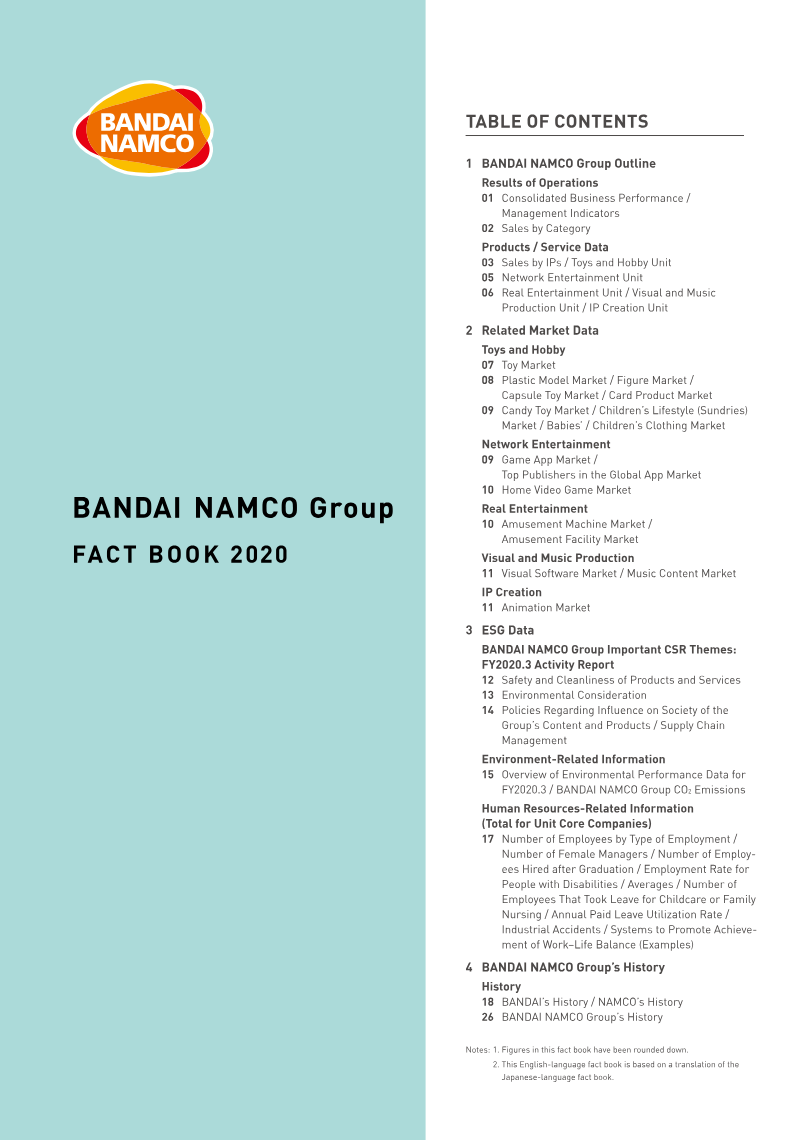
Bandai Namco Group Fact Book 2020
01 Consolidated Business Performance / 03 Sales by IPs / Toys and Hobby Unit 05 Network Entertainment Unit 06 Real Entertainment Unit / Visual and Music Production Unit / IP Creation Unit 08 Plastic Model Market / Figure Market / Capsule Toy Market / Card Product Market 09 Candy Toy Market / Children’s Lifestyle (Sundries) Market / Babies’ / Children’s Clothing Market Top Publishers in the Global App Market BANDAI NAMCO Group 10 Home Video Game Market 10 Amusement Machine Market /...
- Bandai Namco Group's Toys and Hobby Unit has achieved significant cumulative shipment volumes for key product lines as of March 2020: Gundam plastic models (696.73 million units), Ultraman soft figures (98.77 million units), Super Sentai series robots (30.45 million units), and Digital Monsters (14.15 million units).
- The Network Entertainment Unit's sales for network content decreased from ¥211.1 billion in FY2019.3 to ¥200.9 billion in FY2020.3, while home video game sales also slightly declined from ¥102.1 billion to ¥99.0 billion in the same period.
- As of March 2020, Bandai Namco Rights Marketing Inc. reported a cumulative total of 492,924,783 fee-based viewings for on-demand animation delivery since October 2002, with 4,508 productions (71,739 episodes) available.
- Bandai Namco Group was formed in September 2005 through the management integration of BANDAI and NAMCO, establishing NAMCO BANDAI Holdings Inc.
- The Japanese figure market reached ¥30.5 billion in FY2019, while the digital card market, where Bandai holds a significant share (60.8% in FY2019), was ¥24.7 billion in FY2019.
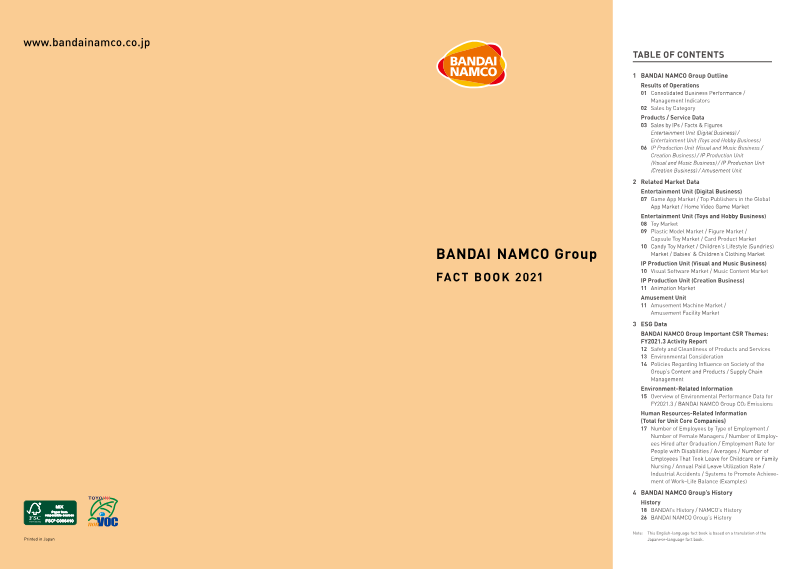
Bandai Namco Group Fact Book 2021
1 BANDAI NAMCO Group Outline 01 Consolidated Business Performance / 03 Sales by IPs / Facts & Figures Entertainment Unit (Digital Business) / Entertainment Unit (Toys and Hobby Business) 06 IP Production Unit (Visual and Music Business / Creation Business) / IP Production Unit (Visual and Music Business) / IP Production Unit (Creation Business) / Amusement Unit Entertainment Unit (Digital Business) 07 Game App Market / Top Publishers in the Global App Market / Home Video Game Market ...
- Bandai Namco Group's top-performing IP by sales (worldwide) in FY2021.3 was DRAGON BALL series at ¥127.4 billion, followed by Mobile Suit Gundam series at ¥95.0 billion and ONE PIECE at ¥38.0 billion.
- Network content sales (digital business) grew from ¥200.9 billion in FY2020.3 to ¥207.7 billion in FY2021.3, while home video game sales increased from ¥99.0 billion to ¥118.1 billion in the same period.
- Amusement unit sales declined significantly from FY2020.3 to FY2021.3, with amusement machines dropping from ¥27.1 billion to ¥16.7 billion and amusement facilities from ¥64.7 billion to ¥47.1 billion.
- Bandai Namco Group was ranked 6th globally among app market publishers in 2020, behind Nintendo, Playrix Ireland, Koei Tecmo, Activision Blizzard, and Zynga.
- The company has a strong history of product longevity, with cumulative shipments including 2.65 billion candy toys (since 1995), 101.87 million Ultraman soft figures (since 1983), and 30.89 million Super Sentai series robots (since 1979).