1 free read left. Create a free account for unlimited reading + AI research.
Create free accountWhitepaper DiGRA
1 free read left. Create a free account for unlimited reading + AI research.
Create free accountWhitepaperDiGRA
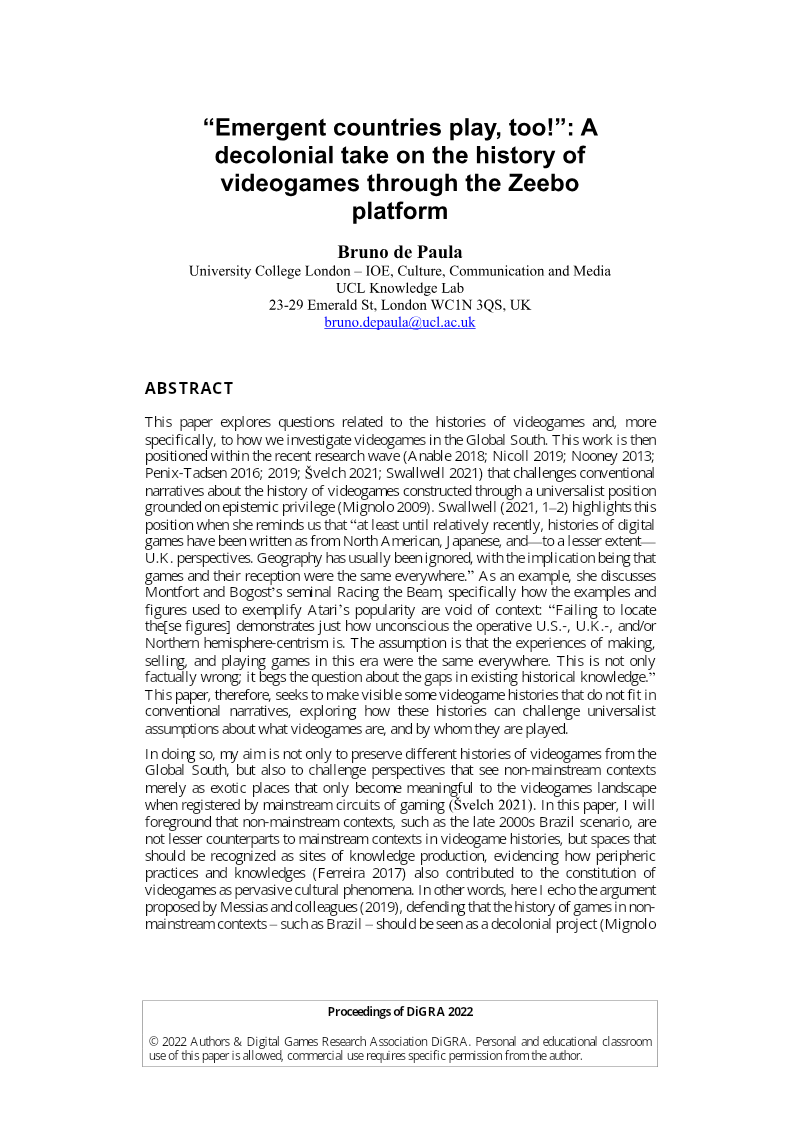
The paper contends that video games are not neutral entertainment technologies. Its effects reach into sovereignty, identity, and knowledge.
Video game production and culture, the paper argues, constitute a geopolitical field in which the United States, Japan, and Western Europe hold dominant positions while Global South territories such as Latin America, Africa, and the Middle East are marginalized. Drawing on decolonial theory, agenda-setting theory, and Bourdieu's concept of symbolic power, the author contends that this Northern hegemony produces a kind of "cacophony" that silences local productions, reproduces foreign imaginaries, and confines Global South actors largely to the role of consumers. The central thesis is that video games are not neutral entertainment technologies but instruments of cultural power whose effects extend into questions of sovereignty, identity, and knowledge.
The analysis situates these dynamics within a broader philosophy of technology, critiquing Heidegger's notion of "enframing" for treating technology as neutral and universal while ignoring social construction and local context. The paper traces the sector's history from MIT's Spacewar! (1962), supported by Cold War military-industrial resources, through the 1983 U.S. crash and Japan's ascendance, to show how countercultural Silicon Valley ideology merged with corporate capitalism. Global South producers, the author argues, face pressure to reproduce Northern narratives in exchange for symbolic recognition and market access, a dynamic framed as "technocoloniality" and linked to the Coloniality of Power and to Milton Santos's account of metropolitan control over time and information flows. Nintendo's treatment of the Brazilian market serves as a principal case study.
The evidence base is primarily theoretical and case-based rather than quantitative, drawing on examples such as Brazilian resistance to localization and the prevalence of Northern-themed Latin American games. Scope is global in its framing but centered on the Global South relative to the Northern metropoles, spanning the sector's development from the 1960s onward. The paper concludes that video games constitute a contested field in which Latin American producers face dependency, and it calls for resistance and local sovereignty to guard subalternized populations against epistemicide.
Each row is a game or company this document names, each column a document, oldest first. A mark means that document names it. Select a row to see those documents.

DiGRA · 2026

DiGRA · 2026



DiGRA · 2026



DiGRA · 2026



DiGRA · 2026



DiGRA · 2026



DiGRA · 2026



DiGRA · 2026

DiGRA · 2026



DiGRA · 2026



DiGRA · 2026

DiGRA · 2026
GamesIndustry.biz · 2026