Global reports and market data
Documents
Consecutive Endings and the Aesthetic Potential of Cognitive Dissonance
This extended abstract examines "consecutive endings" in digital games, a phenomenon where an apparent game conclusion is revealed to be an interruption, allowing for continued play.
- Consecutive endings are a distinct phenotype of game closure in which a game signals that it has concluded yet permits play to continue, building on Riccardo Fassone's (2017) taxonomy of game endings.
- Unlike voluntary replay, consecutive endings create cognitive dissonance: a player facing an apparently final ending must decide whether to continue, weighing the costs of action against inaction and reinterpreting the game's nature in the process.
- The paper draws on Festinger's theory and psychological research on inaction and regret to explain why players experience this dilemma when an ending seems final but play remains possible.
Cause, Effect, and Player-Centric Time
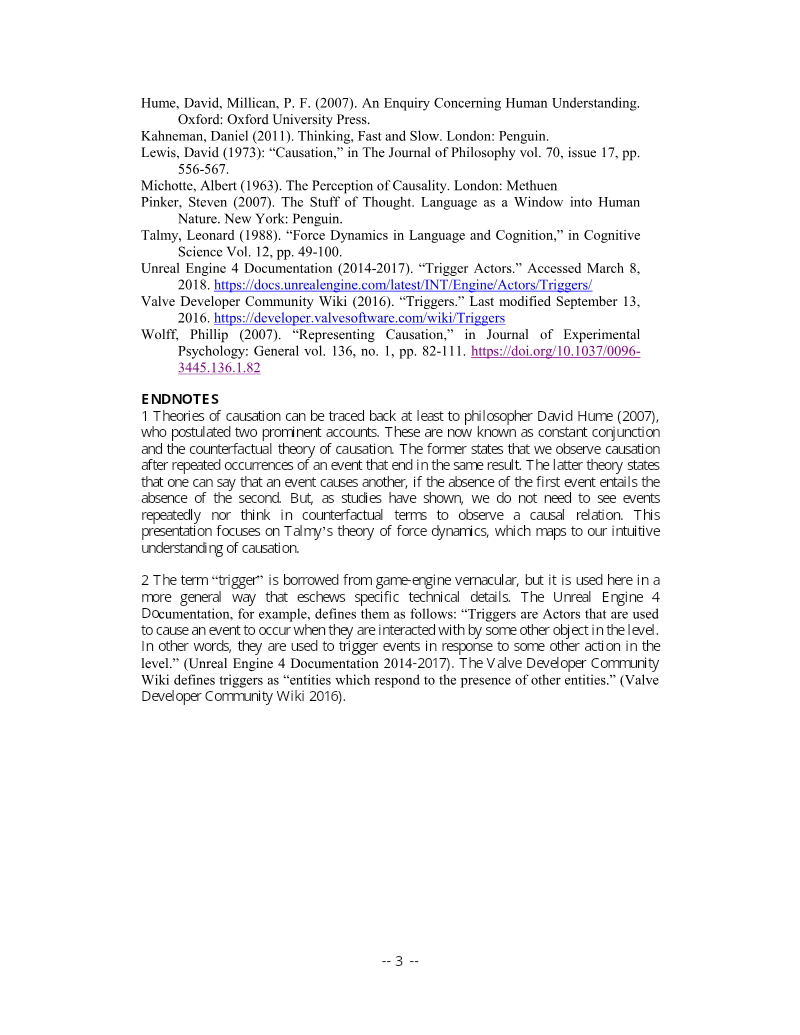
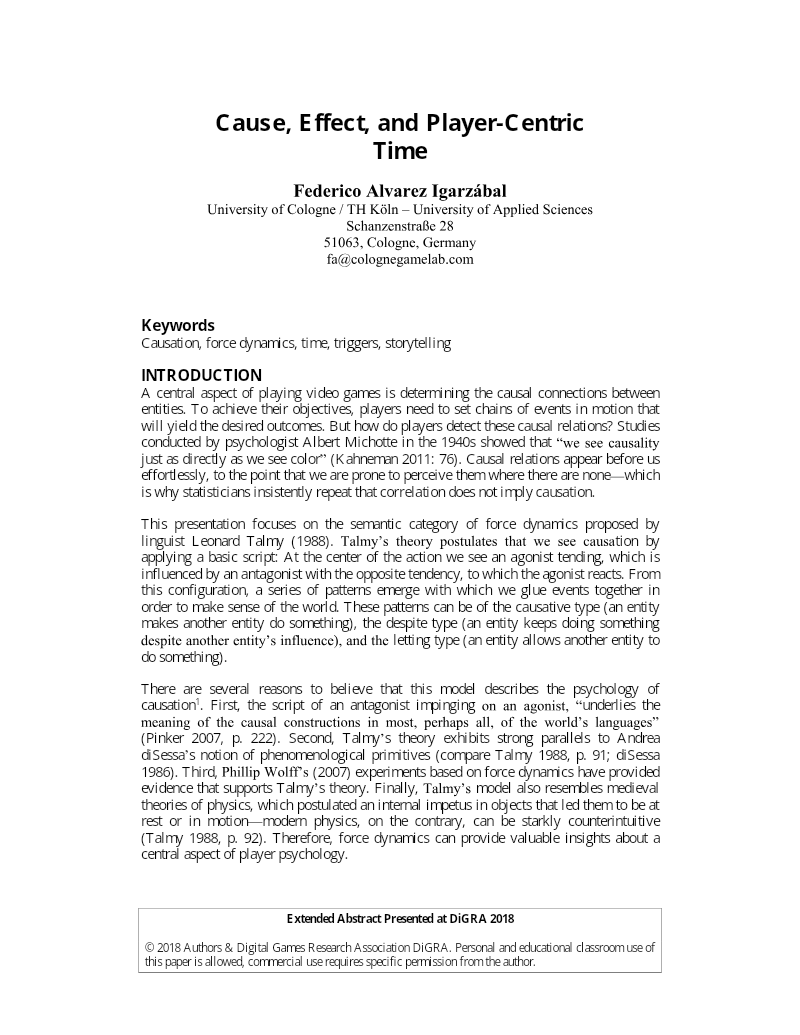
The document explores how players perceive causality in video games through the lens of Leonard Talmy's theory of force dynamics.
- Players make sense of games by searching for causal relations, and the paper proposes Leonard Talmy's force dynamics theory (agonist and antagonist roles yielding causative, despite, and letting patterns) as a framework for how these causal intuitions form.
- The paper argues that the theory's cross-linguistic prevalence, resemblance to diSessa's phenomenological primitives, experimental evidence from Phillip Wolff, and similarity to pre-modern impetus physics together support its plausibility as a model of causal cognition.
- 'Triggers,' entities that initiate events only when the player interacts with them, make in-game time player-centric, so events that seem independent are actually caused by the player's presence, which players can detect and which makes time feel artificial.

Understanding Player Elimination in Boardgames as a Form of Permadeath
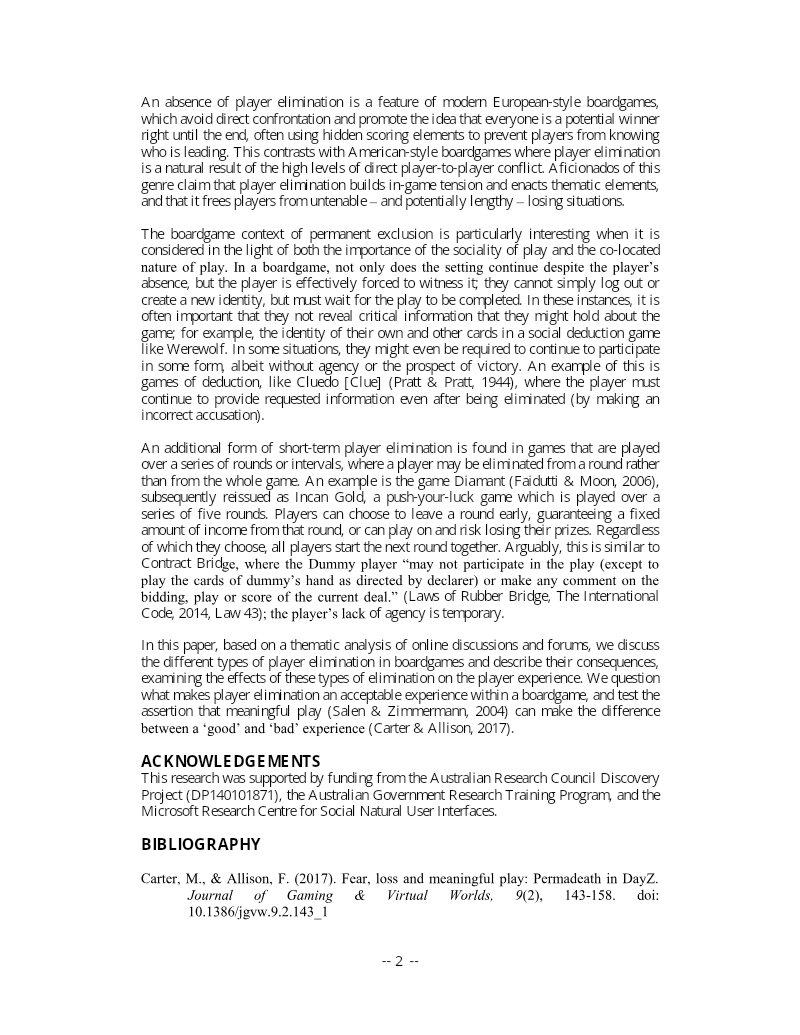
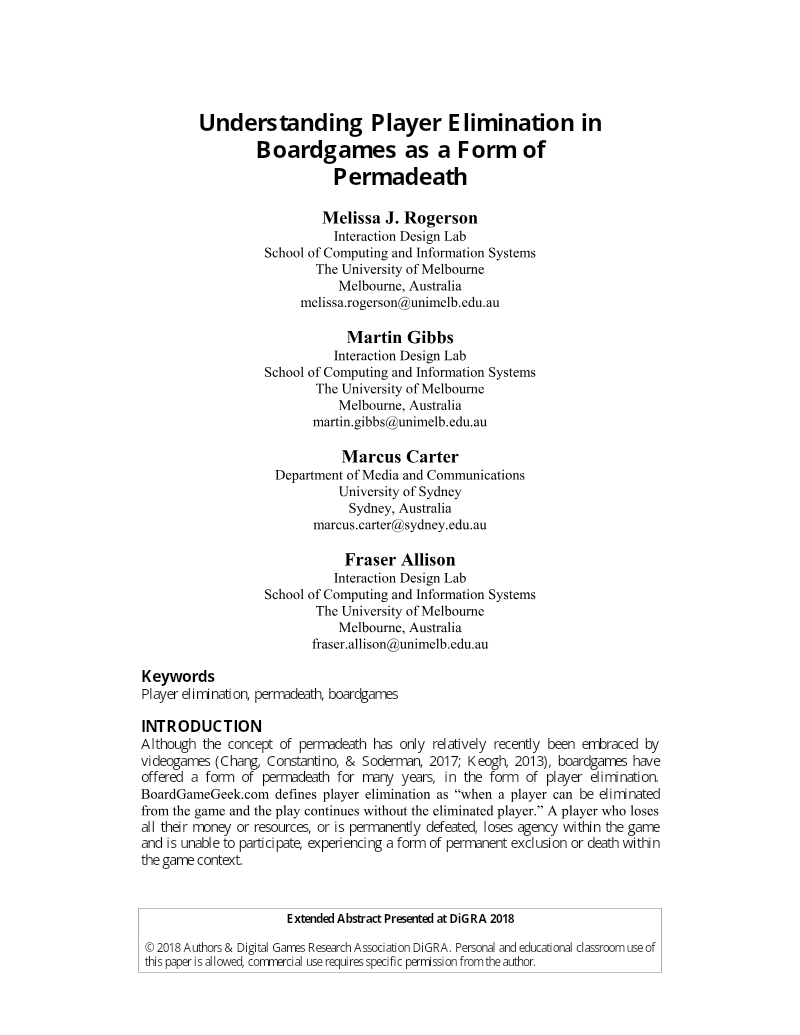
The document explores player elimination in boardgames as a form of permadeath, analyzing its types, consequences, and impact on player experience.
- Boardgames offered permanent and temporary player elimination well before videogames adopted permadeath, and the paper treats elimination as a loss of agency where the player must watch the game continue, unlike digital play where a player can log out or create a new identity.
- Permanent elimination appears in social deduction games and Cluedo, where eliminated players must still contribute information, while short-term elimination appears in round-based games such as Diamant (Incan Gold) and in Contract Bridge's dummy player, whose lack of agency is only temporary.
- Elimination is naturally prevalent in American-style games built around direct conflict and largely absent from modern European-style games, which emphasize indirect competition and hidden scoring.

Game Engines: Design, Labour, and Legality
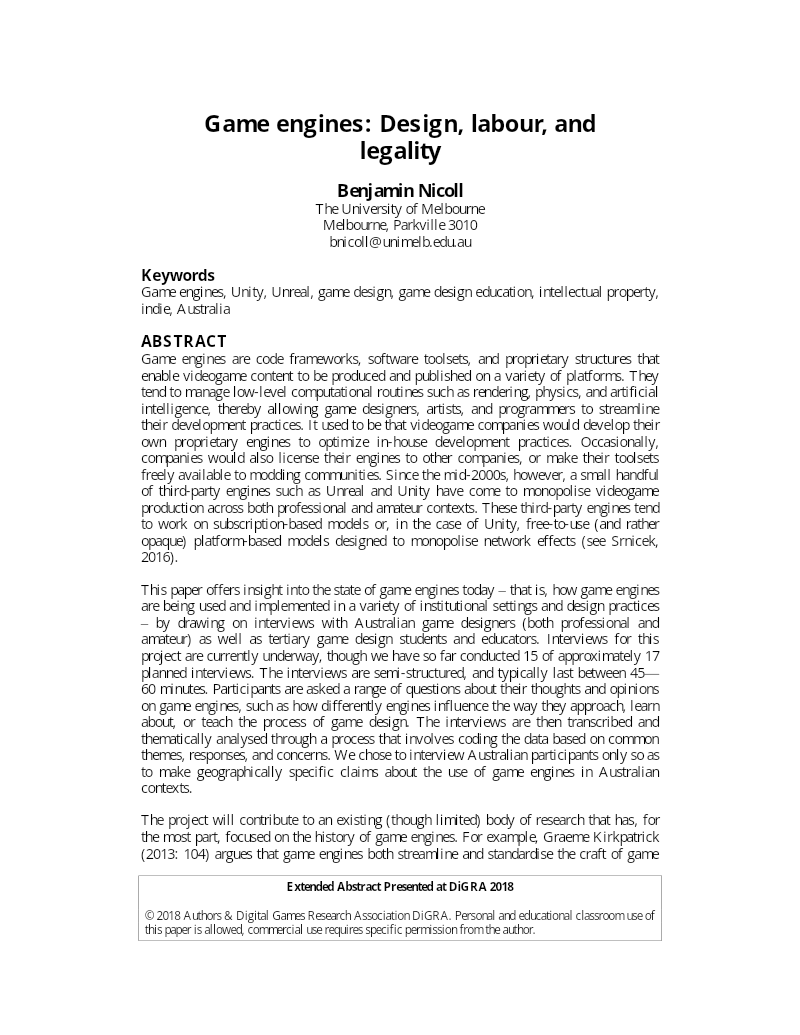
This paper investigates the contemporary landscape of game engine utilization, focusing on how these proprietary structures and toolsets are reshaping game design, labor practices, and legal frameworks within the Australian context.
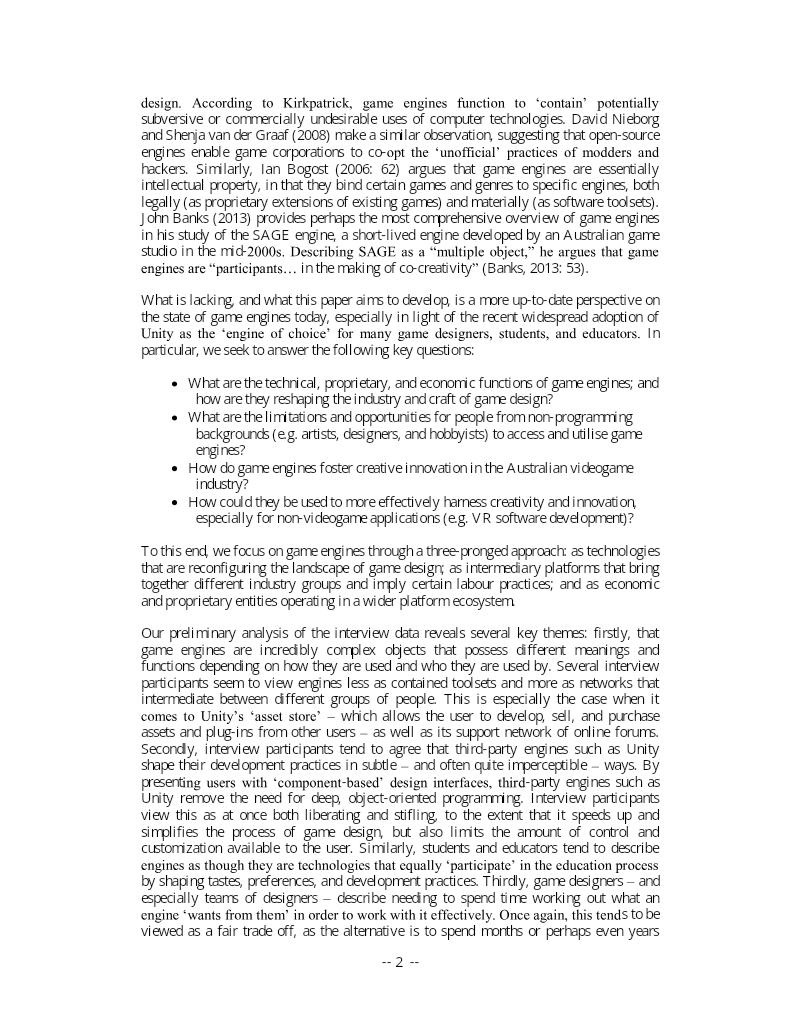
- The shift from proprietary in-house engines to a few third-party platforms such as Unity and Unreal is reshaping game design as a technical, labour, and economic practice in Australia.
- The study is a preliminary, work-in-progress extended abstract from DiGRA 2018, based on semi-structured interviews of 45 to 60 minutes with Australian designers, amateurs, students, and educators, with 15 of a planned 17 interviews completed at the time of writing.
- Participants described engines less as contained toolsets than as networks mediating between people, particularly via Unity's asset store and online support forums.

Larp Typology
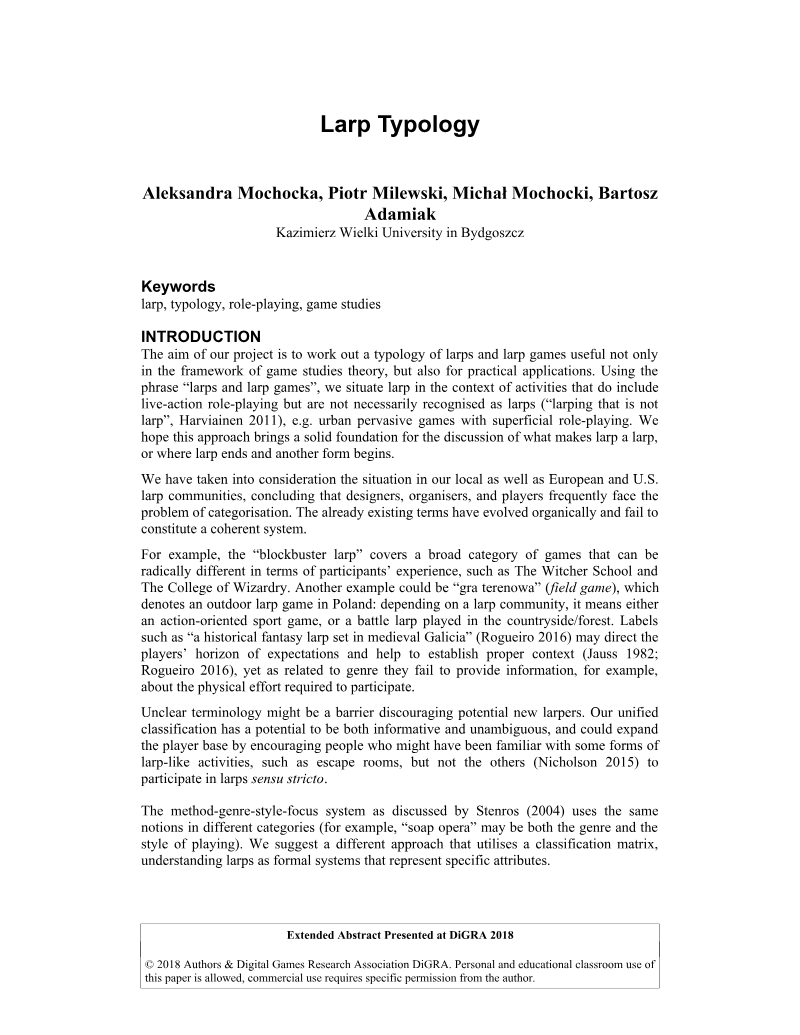
This document proposes a new typology for Live-Action Role-Playing (Larp) and larp-like games, aiming to provide a coherent classification system for both academic game studies and practical application by designers, organizers, and players.
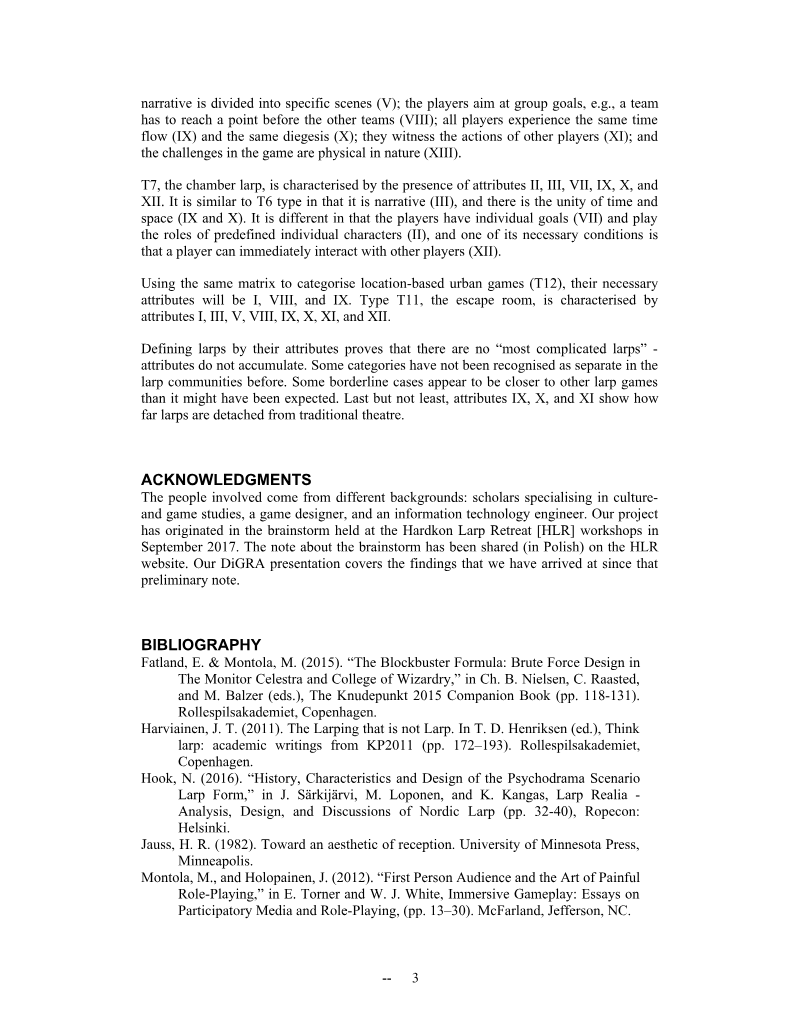
- The report proposes a unified typology of larps built on thirteen classification attributes, to replace informal and inconsistent community labels such as "blockbuster larp" and "gra terenowa" that can describe very different experiences.
- The typology defines fourteen types of larps and larp games by the necessary presence of a minimum set of attributes, and it is explicitly open to future expansion.
- Genre labels alone fail to convey practical information such as the physical effort a larp requires, which the attribute-based approach is designed to make visible.

Bonding with Horses and Other Animals in Breath of the Wild
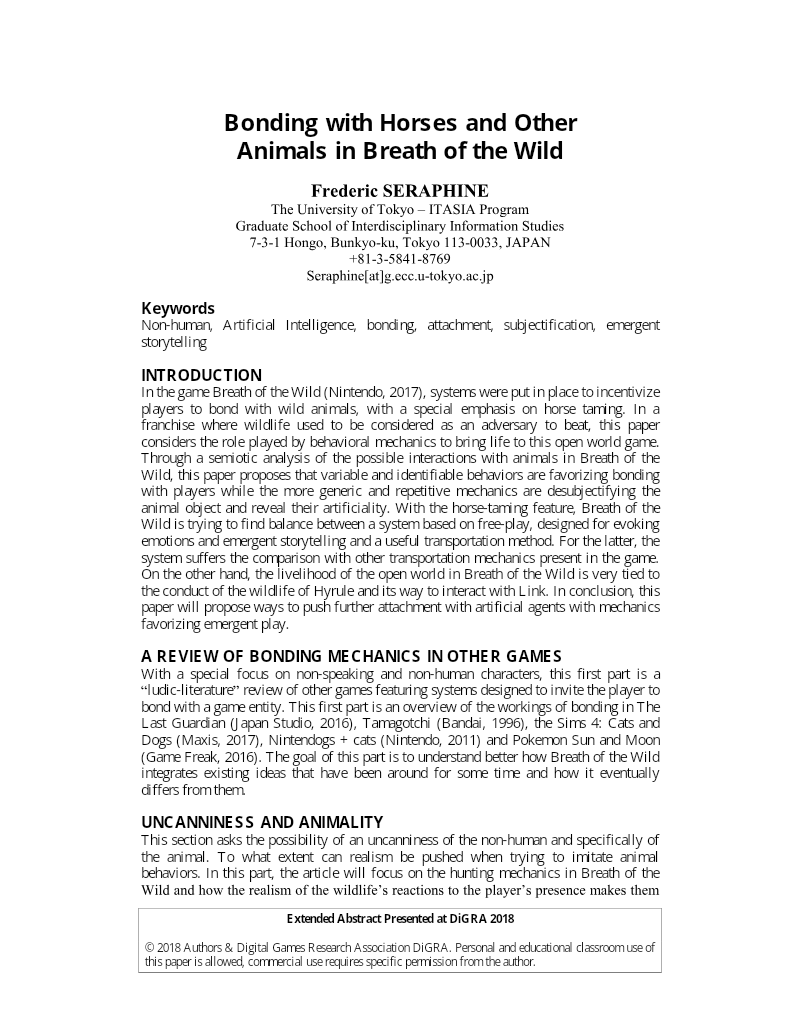
The document analyzes the mechanics designed to foster player bonding with non-human animals, particularly horses, in The Legend of Zelda: Breath of the Wild.
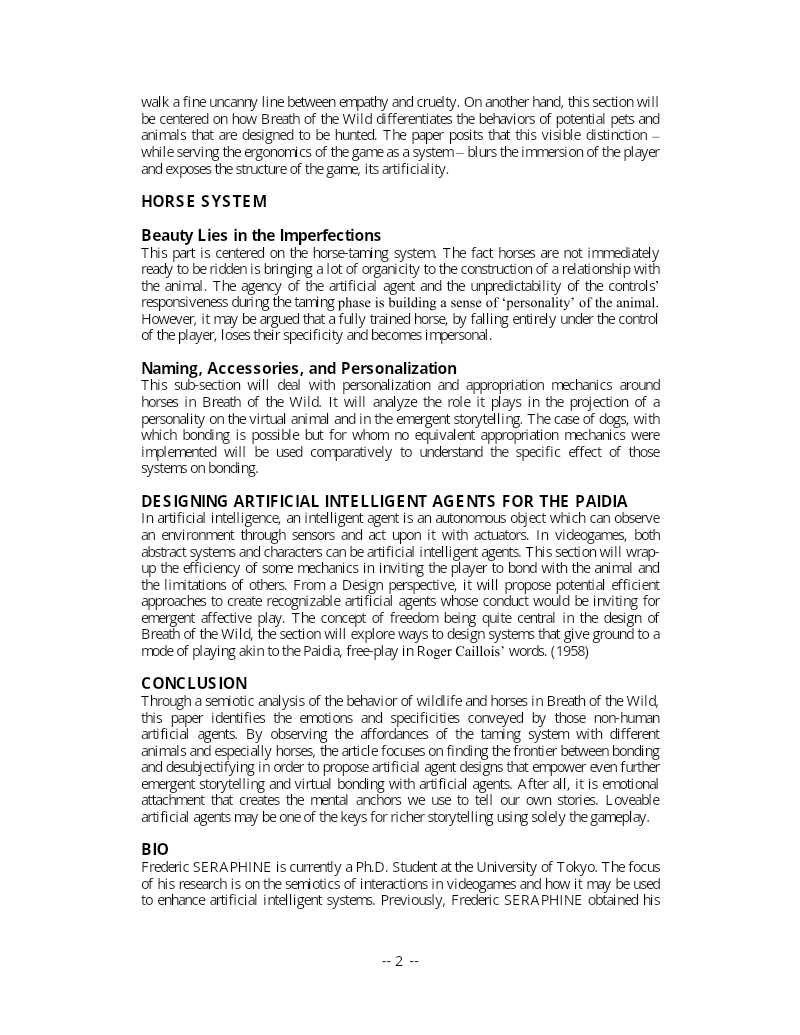
- Imperfect, variable animal behavior, such as a horse's delayed readiness for riding and unpredictable control responsiveness, gives animals a sense of personality, while fully trained, predictable behavior risks making them feel impersonal.
- Generic and repetitive animal mechanics strip creatures of subjectivity and expose the game's artificiality, undermining player attachment to non-human agents.
- Naming and accessory customization function as appropriation mechanics that let players project personality onto animals and support emergent, player-authored narrative.
From ‘Training Grounds’ to Sociotechnical Actors: Do MMORPGs Presage the Futures of Work?
This conceptual paper, presented as an extended abstract at DiGRA 2018, challenges the prevailing view that massively multiplayer online role-playing games (MMORPGs) serve as "training grounds" for leadership skills that transfer to organizational settings.
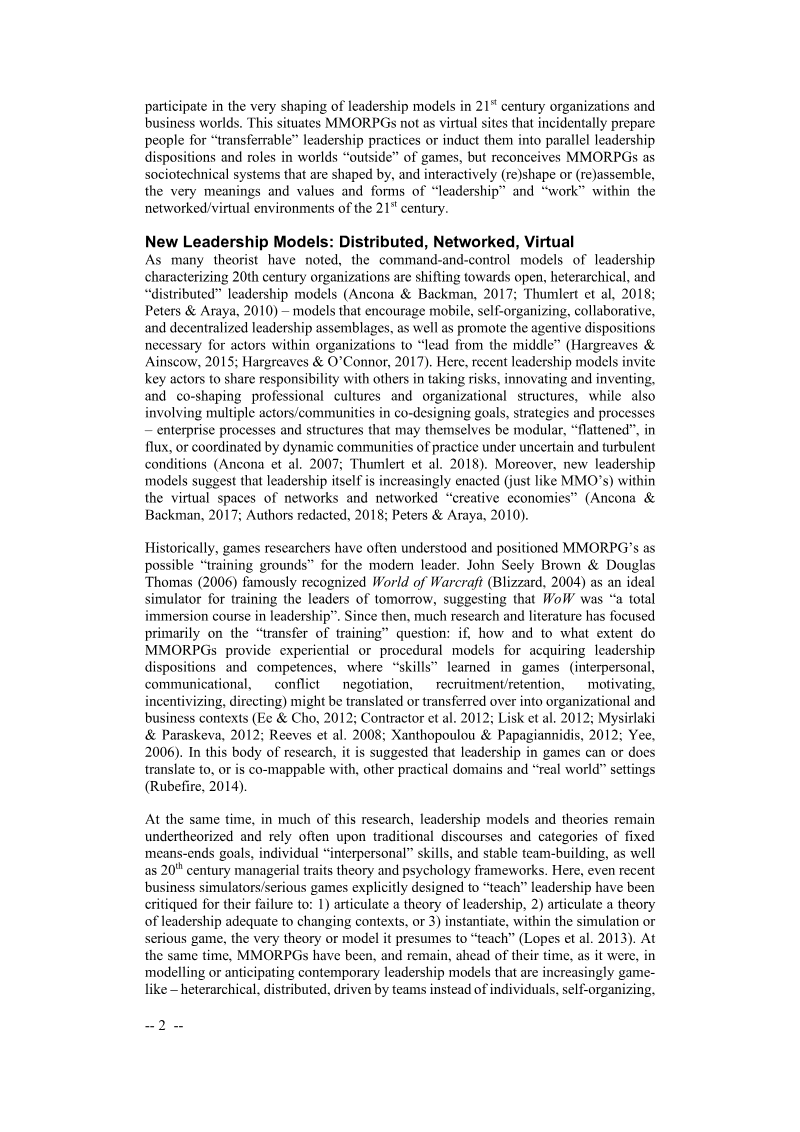
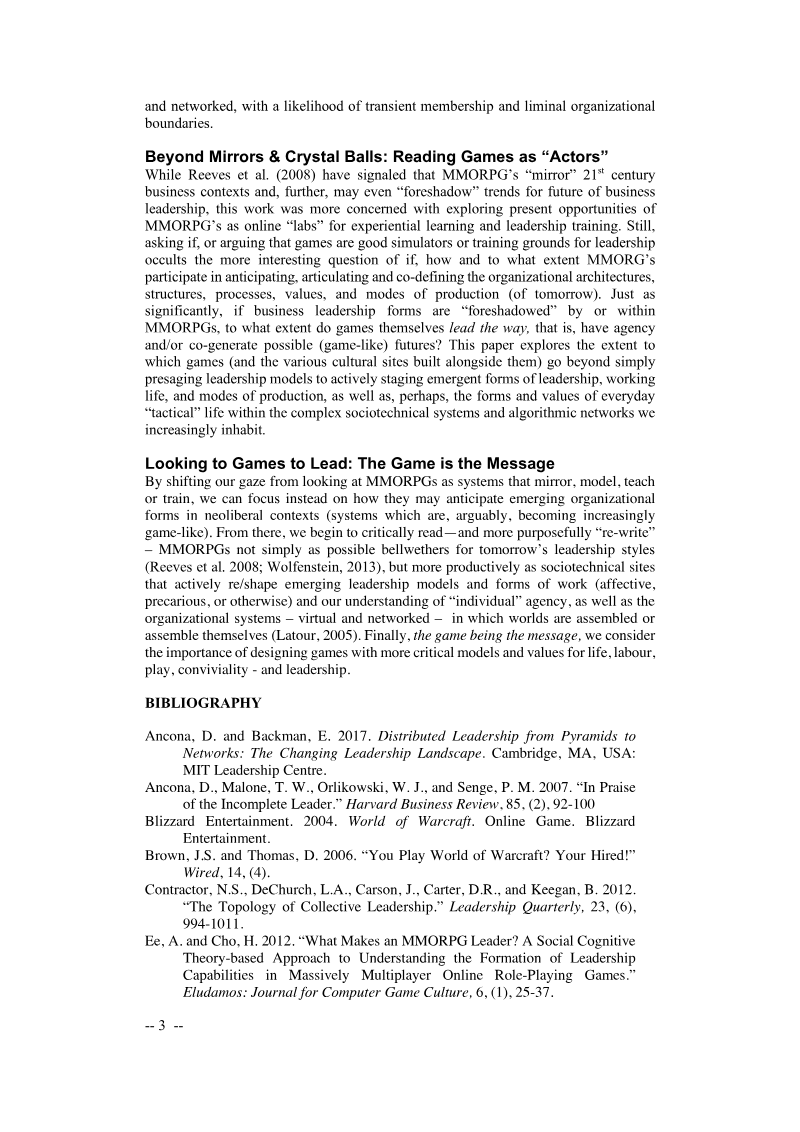
- The paper reverses the common view of MMORPGs as 'training grounds' for workplace leadership, arguing instead that games like World of Warcraft are sociotechnical systems that actively shape 21st-century leadership models and forms of work.
- The authors frame their inquiry around whether MMORPGs prestage emerging cultural and organizational forms, and whether games exert agency over new modes of knowledge creation and affective labour in globalized economies.
- The paper situates its argument within a shift from command-and-control leadership toward distributed, networked, and heterarchical models emphasizing self-organizing teams, shared responsibility, and leadership exercised 'from the middle.'

Defining Genre in Video Game Historiography: Structural, Discursive, and Sociocultural Definitions
The document, "Defining Genre in Video Game Historiography: Structural, Discursive, and Sociocultural Definitions," proposes a new framework for understanding video game genres, particularly for historical analysis.
- The paper identifies three types of video game genre definitions: structural (genre as inherent organization of games and play), discursive (genre as a way of using and relating texts), and sociocultural, which it argues best serves historical research.
- Structural definitions struggle to explain the divergent meanings players and critics assign to the same titles, while discursive definitions detach genre from the games themselves and so have limited practical use.
- The proposed sociocultural definition treats genre as a set of games classified together by one or more social groups, drawing on Wendy Griswold's cultural sociology.
"Travel Bugs": Toys Traveling Socially Through Geocaching
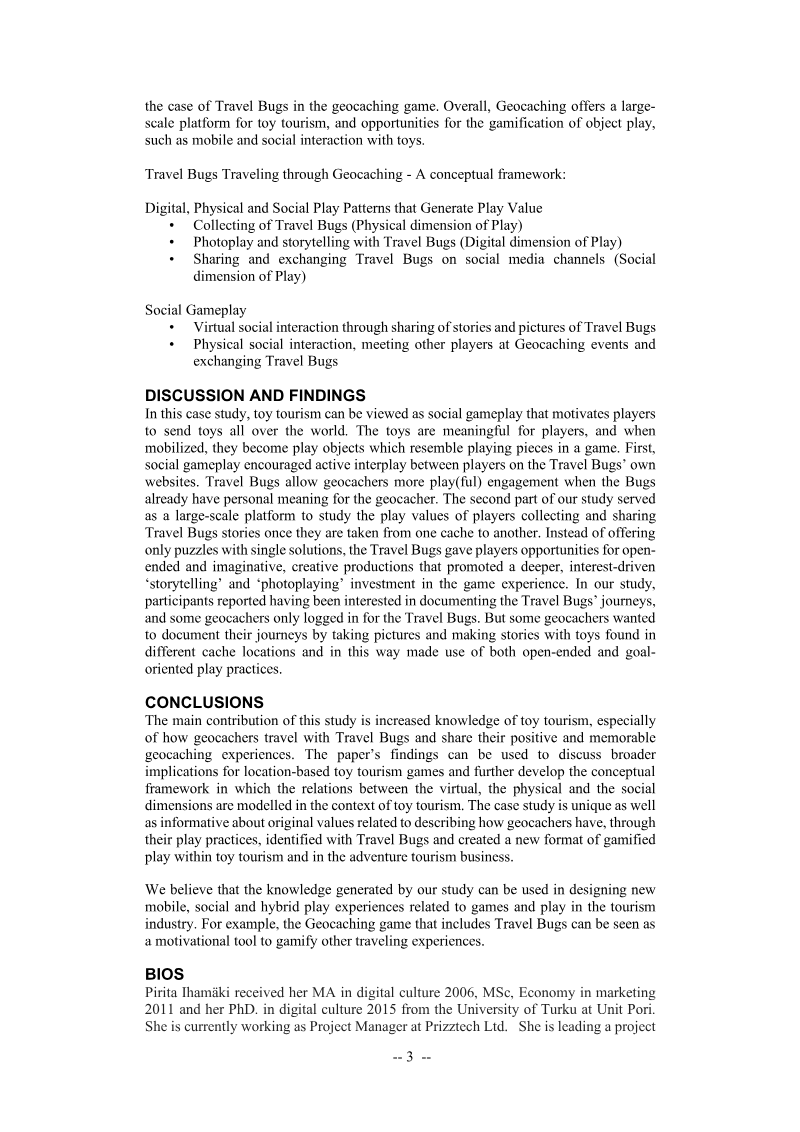
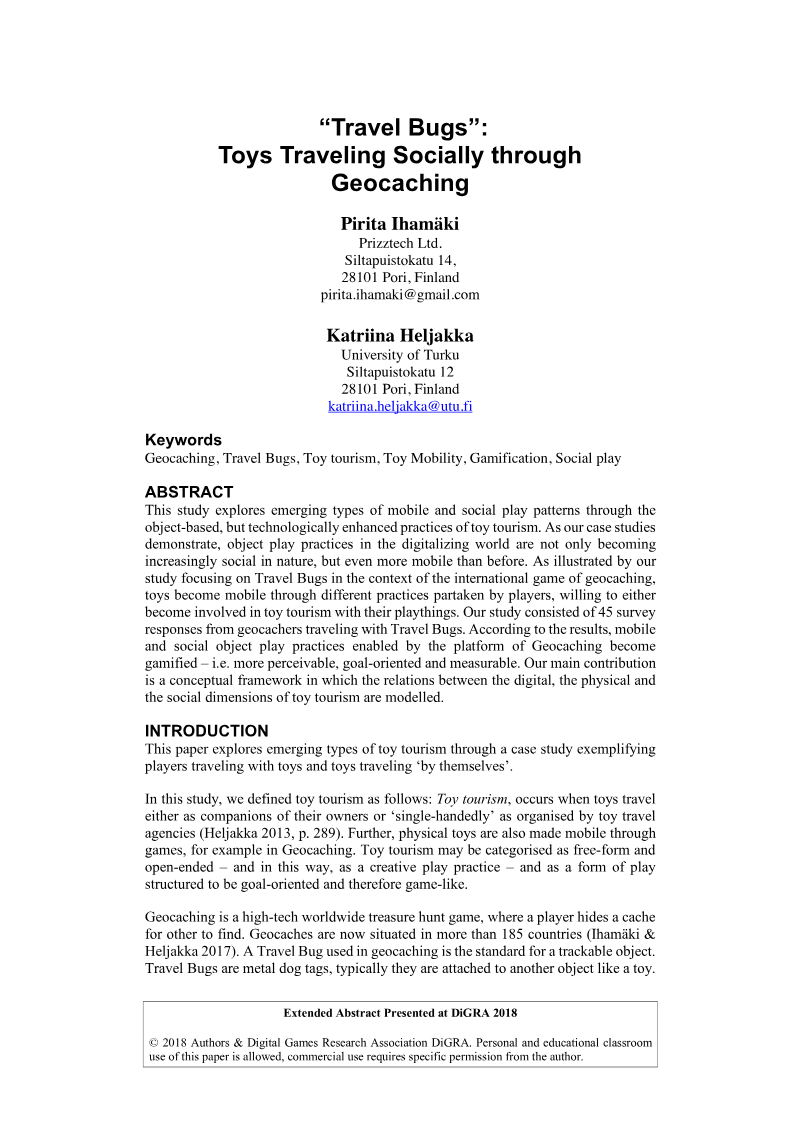
This study investigates emerging patterns of mobile and social play through the lens of "toy tourism," specifically focusing on Travel Bugs within the global game of geocaching.
- Geocaching's Travel Bugs are trackable metal tags attached to toys that move independently between geocaches around the world, with each journey documented on dedicated online pages, making toy tourism a form of mobile, social object play.
- The authors propose a conceptual framework linking the digital, physical, and social dimensions of toy tourism, showing how these practices become more gamified, goal-oriented, and measurable.
- The findings come from a qualitative case study based on an August 2016 internet survey of 45 geocachers recruited via Facebook groups, supplemented by stories from the Groundspeak Forum, so the conclusions are explicitly provisional given the small sample.
Playing for Real
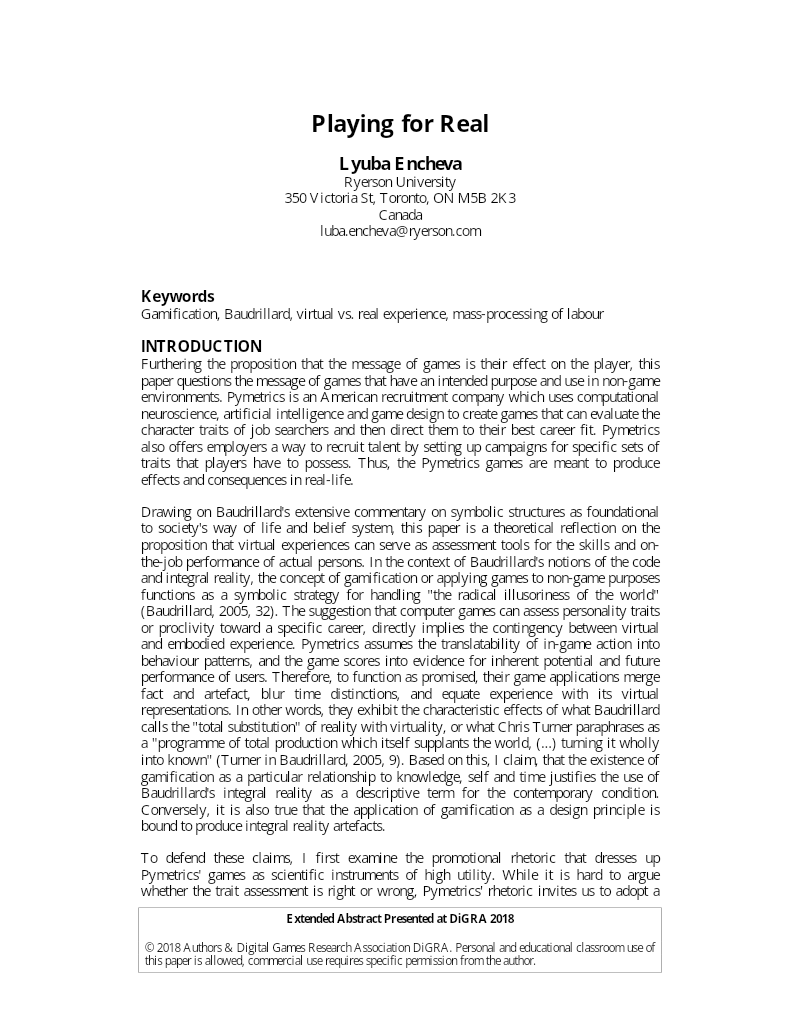
The document, "Playing for Real," explores the implications of gamification, specifically focusing on its application in non-game environments for real-world assessment.
- The paper is a conceptual, interpretive essay by Lyuba Encheva examining a single commercial case, Pymetrics, a recruitment company that combines computational neuroscience, artificial intelligence, and game design to assess job seekers' traits and match them to careers.
- Its central claim is that gamified assessments blur the boundary between virtual and embodied experience, reflecting Jean Baudrillard's concept of "integral reality," in which virtuality substitutes for and reorders the real.
- The author argues gamification functions as a symbolic strategy for managing the perceived illusoriness of the world, and that Pymetrics' games are designed to produce real-life consequences rather than remain confined to play.
If You Guild It, They Will Come: Organizational Leadership in Games
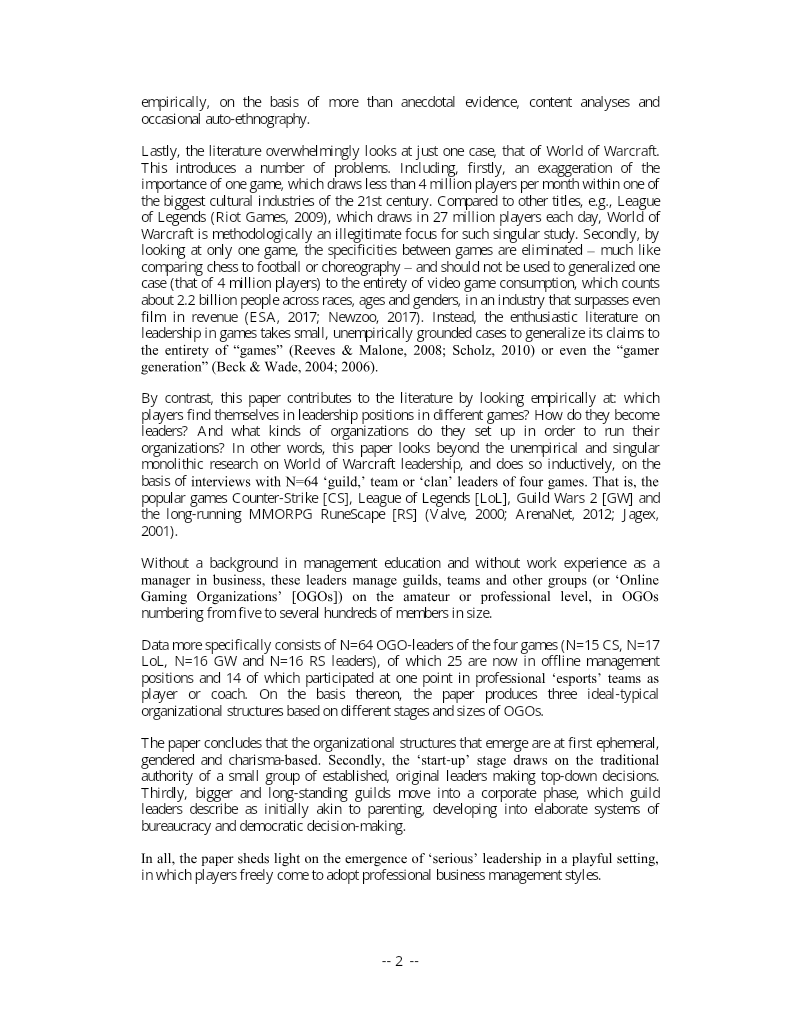
This study examines how leadership emerges and organizational structures form within online gaming groups, challenging the prior literature's reliance on anecdotal evidence and single-game case studies, particularly World of Warcraft.
- The study moves beyond prior anecdotal and single-game (largely World of Warcraft) evidence by interviewing 64 leaders of online gaming organizations across four titles: Counter-Strike (15), League of Legends (17), Guild Wars 2 (16), and RuneScape (16).
- Leaders in the sample had no formal management education or prior business work experience, yet 25 currently hold offline management positions and 14 have participated in professional esports teams as players or coaches.
- Using an inductive approach, the authors derive three ideal-typical organizational structures tied to group stage and size, ranging from groups of five to several hundred members.
Indie-viduals: Videogames' Hegemonic (Re-)Production Culture
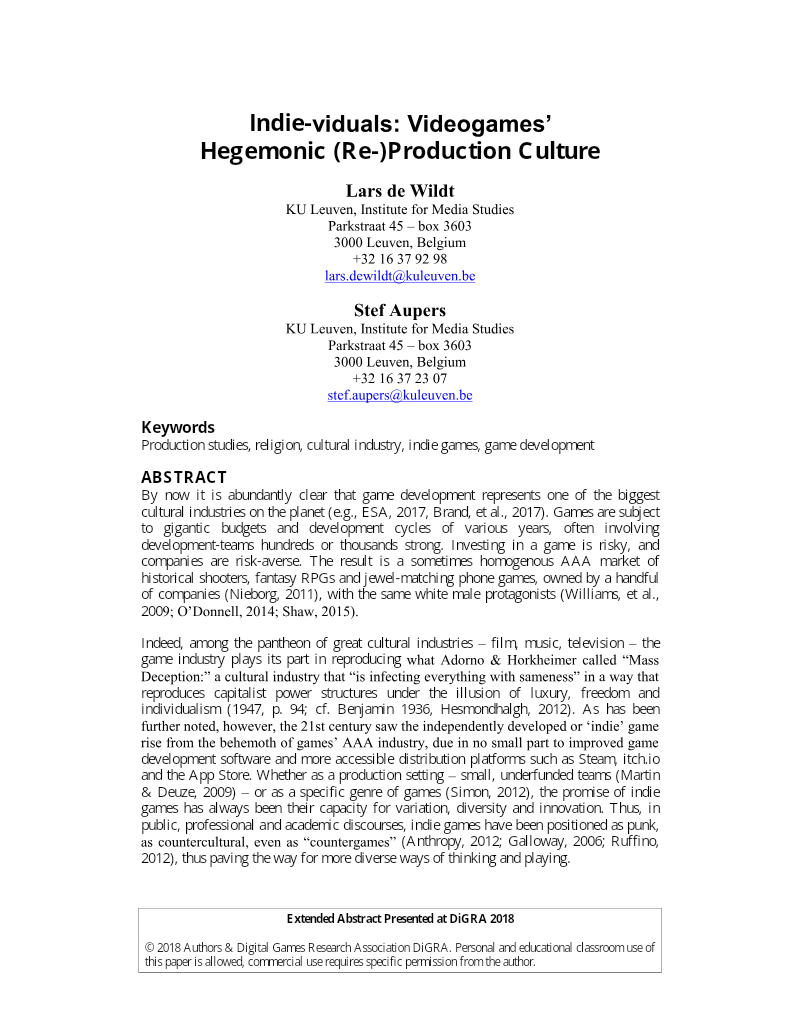
This DiGRA 2018 extended abstract, authored by Lars de Wildt and Stef Aupers of KU Leuven, examines whether independent game development escapes the commercial conformity of the AAA industry or instead reproduces its dominant conventions, with a particular focus on how religion is represented in games.
- Independent game development often reproduces rather than escapes the conventions of the commercial AAA industry, according to a qualitative study of 27 international developers by Lars de Wildt and Stef Aupers of KU Leuven.
- Non-religious developers tend to rely on stereotyped religious imagery, such as priests who heal simply because they are priests, as narrative shortcuts, while religious developers struggle to find room for their own convictions in their work.
- The authors argue that game design has become a universal language of tropes rooted in North American and Japanese development culture, which frames religion as commodity, conspiracy, or fantasy.
Writers
Games and companies
Games