1 free read left. Create a free account for unlimited reading + AI research.
Create free accountWhitepaper DiGRA
1 free read left. Create a free account for unlimited reading + AI research.
Create free accountWhitepaperDiGRA
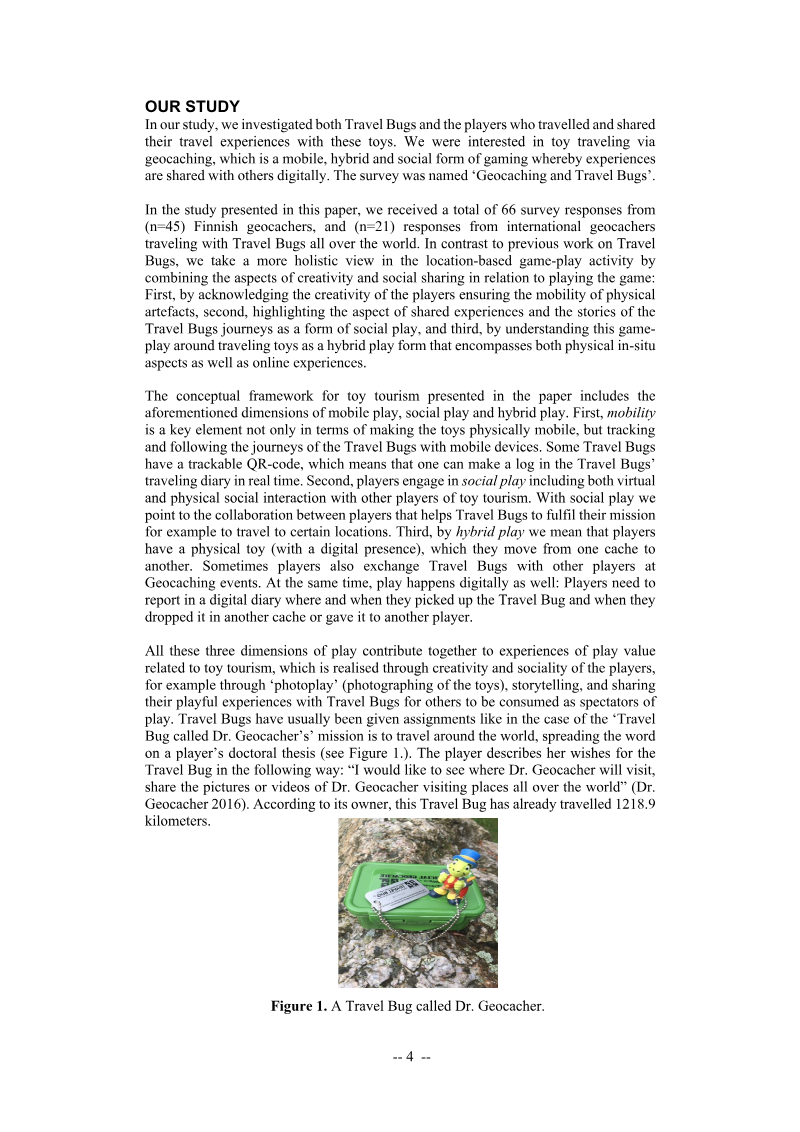
Travel Bugs are trackable metal tags attached to toys that move independently between geocaches around the world. Each journey is documented on dedicated online pages.
This study examines toy tourism within the international geocaching game, focusing on Travel Bugs: trackable metal tags attached to toys that move between geocaches around the world. The authors argue that geocaching offers a contemporary platform for mobile and social object play, in which toys travel both with their owners and independently, with their journeys documented on dedicated online pages. The central contribution is a conceptual framework that models the relations between digital, physical, and social dimensions of toy tourism, showing how these practices become more gamified, goal-oriented, and measurable.
The research is qualitative and relies on a case study design. Data came from an internet survey of 45 geocachers conducted in August 2016, distributed through geocaching Facebook groups, supplemented by secondary material drawn from stories posted on the Groundspeak Forum. Content analysis was used to interpret the responses, and the authors acknowledge that the limited sample size means their conclusions are provisional.
Key findings indicate that the Travel Bugs' play value stems from their personal meaning to players, which encourages open-ended storytelling and photoplay alongside goal-oriented geocaching activity. Participants reported strong interest in documenting the journeys of Travel Bugs, and some players engaged with the game primarily for these objects. Social gameplay emerged both virtually, through sharing stories and images online, and physically, through meetups and exchanges at geocaching events. The authors conclude that players have co-created a new gamified play format that could inform the design of location-based tourism services and adventure tourism businesses.
DiGRA · 2022
DiGRA · 2022
DiGRA · 2022
DiGRA · 2022
DiGRA · 2022
DiGRA · 2022

DiGRA · 2022
DiGRA · 2022
DiGRA · 2022
DiGRA · 2022



DiGRA · 2022
DiGRA · 2022
Extra Credits · 2023