Global reports and market data
Documents
Blank Arcade: Exhibition of Games and Toys as Art
The Blank Arcade is a recurring exhibition of games, play art, and interactive media, organized by Lindsay Grace of American University in association with the Digital Games Research Association's annual conference.
- The Blank Arcade is a recurring games-and-play art exhibition organized by Lindsay Grace of American University in association with the Digital Games Research Association's annual conference, aiming to bring game art practice and history into the game studies community.
- Prior editions were held in Salt Lake City (2014), Lüneburg, Germany (2015), and Dundee, Scotland (2016), and the abstract proposes a 2018 edition.
- The model is designed to be sustainable for host conferences: organizers handle curation, outreach, advertising, and web hosting, while local hosts provide space, equipment, and logistics, with sponsorships sometimes covering shipping and catering.
A Comparative Study of Attachment: Fighting Games and Taekwondo in Life
This study investigates the points of connection and disconnection between digital fighting game players and analog Taekwondo practitioners, examining their attachment to these activities.
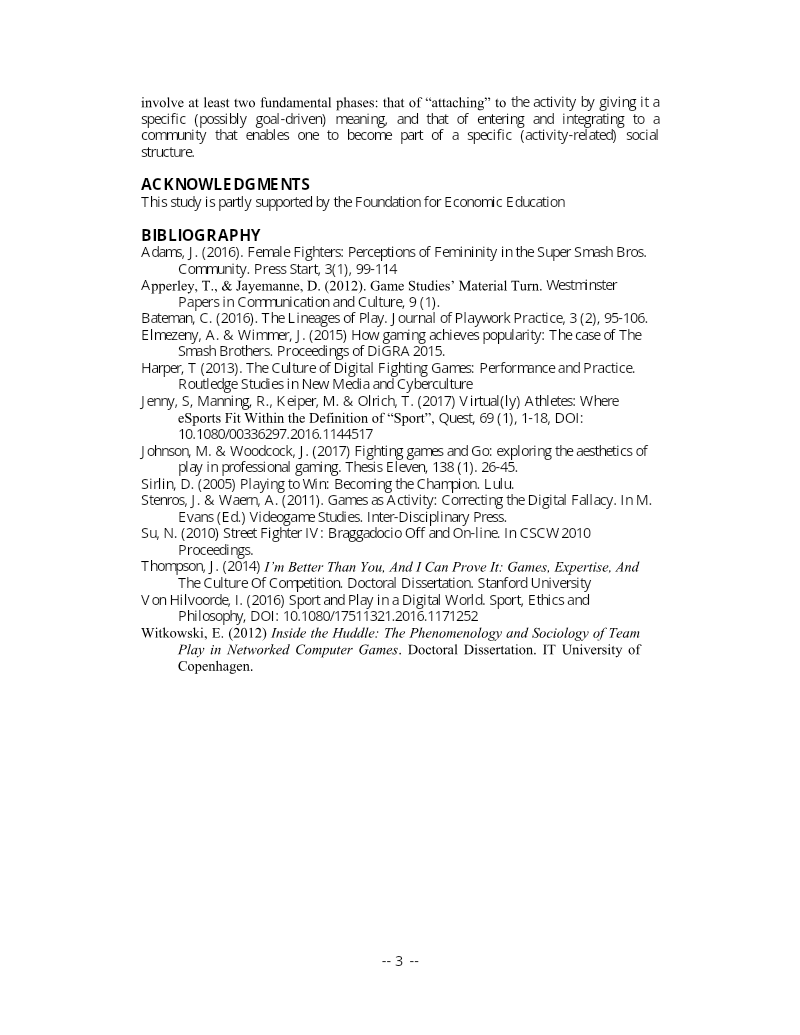
- The study is a qualitative, exploratory DiGRA 2018 comparison of how players form lasting attachments to digital fighting games versus analog taekwondo, drawing on 14 forum narratives and 15 interviews with fighting game players, plus 9 forum narratives, 8 interviews, and 14 WTF essays for taekwondo, all with multiple years of practice.
- Both groups followed parallel developmental paths: they typically started with a friend for enjoyment, then deepened commitment as skill grew, joined communities, and often moved into competition.
- Participants in both activities expressed a strong ethos of long-term commitment, framing continued participation in physical terms such as playing or practicing for as long as their wrists or bodies allowed.
Monetization is the Message: A Historical Examination of Video Game Microtransactions
This paper historically examines how video game microtransaction monetization methods fundamentally change game design and potentially players' experience with the medium, particularly focusing on the rise of "loot boxes."
- The paper's central thesis, framed through McLuhan's 'the medium is the message,' is that monetization is itself a formative force: microtransactions change what games deliver, so content can become a delivery mechanism for purchases rather than an end in itself.
- The lineage of microtransaction practices is traced to the early 2000s, when publishers such as EA and Square Enix embraced 'games as a service' with continual multiplayer content and downloadable additions sold via microtransactions.
- The paper credits the free-to-play Chinese MMO ZT Online with pioneering randomized 'virtual treasure boxes,' which later spread to mobile free-to-play titles, major franchises like Call of Duty and Destiny, and eventually primarily single-player games.

Star Ocean: Till the End of Time: A Nietzschian Approach to Games
Andrea Bergamini's extended abstract, presented at DiGRA 2018, argues that Star Ocean: Till the End of Time (tri-Ace, 2004) engages in a self-reflection on video game media through a Nietzschian lens.
- Andrea Bergamini's DiGRA 2018 abstract reads Star Ocean: Till the End of Time (tri-Ace, 2004) through a Nietzschian lens, centering on the game's revelation that its characters' world is a simulated MMORPG run by a programmer-God.
- The paper links the game to two themes: the overturning of Plato's Myth of the Cave in science fiction, and the atheistic, emancipatory stance tied to Nietzsche's declaration that God is dead.
- Bergamini situates the game within a wider tendency of Japanese RPGs to stage deicide and quote Nietzsche directly, citing Final Fantasy VI, Xenogears, Xenosaga, and Metal Gear Solid V.

Interpretive Challenges in Games
The document introduces and defines the concept of "interpretive challenges" in games, distinguishing them from traditional physical and mental challenges.
- Jonne Arjoranta's paper defines the 'interpretive challenge': a mental challenge in which a player must draw on knowledge outside the game (understanding people, cultural frameworks, background concepts) to progress or win, distinct from the logical or strategic challenges usually discussed in game studies.
- Most games involve some interpretation, but only a small number make successful interpretation a condition of play, which is why the category is useful for identifying a specific class of games.
- The paper's central case study is Her Story (2015), in which players search fragmentary video interview clips about a murder and revise hypotheses to connect vague statements to narrative events.
Audiencing on Twitch
The document "Audiencing on Twitch" examines the active role of viewers on the Twitch live-streaming platform, arguing that their interactive engagement, termed "audience power," generates significant economic value.
- Viewers on Twitch are framed as active, economically valuable participants ('audiencing') rather than passive recipients, and their labor is commoditized by the platform.
- Concurrent and cumulative viewer counts are used to rank streams, reinforce the dominance of popular channels, and support advertising revenue.
- The chat window is the most prominent form of participation; in high-traffic streams messages move too fast to read, so chat speed acts as a proxy for crowd noise and signals excitement.

Beyond Paratexts, Towards Paratextuality: A Case for Granular Analysis of Video Game Paratextuality
This paper argues that the concept of paratextuality, as applied in game studies, has drifted from Gérard Genette's original 1982 formulation and should be reconceived rather than simply reapplied.
- The paper argues that 'paratextuality' in game studies has drifted from Gérard Genette's 1982 formulation, where it was only one relation within a broader system of transtextual relations, and has become a catch-all label for any secondary artifact of video games.
- It contrasts a reduced framework, which limits paratext to spatially bound verbal material, with an expanded framework associated with Mia Consalvo and Jonathan Gray that includes trailers, livestreams, walkthroughs, and tie-in novels regardless of authorship, and argues the expanded version reproduces the main-text/epiphenomenon hierarchy it claims to critique.
- The author proposes treating paratextuality as a granular quality linking any text, or part of a text, to its socio-historical context, so phenomena are analyzed by degree of paratextual features rather than classified categorically as paratexts.
Past Stories and Future Worlds: History and Popular Imagination in Fallout 4
This analysis examines how the video game Fallout 4 utilizes history and counterfactual narratives to create an engaging player experience and challenge assumptions about historical knowledge production.
- The paper argues that Fallout 4's interactive structure lets developer and player co-author historical narrative, allowing the game to challenge assumptions about what history is, who tells it, and for what ends.
- Fallout 4's Massachusetts setting, including Concord, Lexington, and Boston, anchors its story in an American narrative of optimism and renewal, which the postapocalyptic landscape of devastation sharply contrasts.
- By blending real historical elements with a fictional outcome in which the Cold War turns hot, the game is argued to unsettle the narrative neatness of popular histories that portray the Cold War as a settled victory for capitalism and American consumerism.

Projectuality in Digital Gameworlds
This paper explores the existential structure of player engagement with digital gameworlds through the philosophical concept of "projectuality," drawing primarily from the works of Martin Heidegger and Jean-Paul Sartre.
- The paper argues that a player's existential 'project' (an orientation toward an overarching goal) is what makes game entities appear as resources, obstacles, friends, or foes, constituting the gameworld as a meaningful world of possibility.
- Drawing on Heidegger and Sartre, the authors frame digital gameplay through the existential notion of the project, linking the playing individual's being within a non-actual gameworld to their broader life orientation.
- The authors propose a 'double perspectival structure' in which ludic subjectivity is nested within the individual's subjectivity in the actual world, which allows gameworld experience to acquire significance for the player.

Instantaneously Punctuated Picture-Music: Pilgrim in the Microworld and an Alternative Evaluation of Videogame Expression
The document, an extended abstract presented at DiGRA 2018, proposes an alternative framework for evaluating videogame expression, drawing primarily from David Sudnow's 1983 book, Pilgrim in the Microworld.
- The paper argues David Sudnow's 1983 book Pilgrim in the Microworld, about playing a simplified Atari 2600 port of Missile Command, offers a better framework for evaluating videogame expression than the dominant game studies models that emerged about fifteen years later.
- Sudnow located the core pleasure of videogames not in winning, narrative immersion, or sophisticated rules, but in becoming incorporated into an audiovisual spectacle where the player's bodily movements are reflected back as rhythmic lights and sounds.
- The author identifies a persistent tension in early game studies between mechanical, technical, and narrative essentialisms, and notes that videogames have repeatedly resisted the predictive models scholars built around them.
Implementing Intelligence: The Platform Culture of Intellivision
The document analyzes the "platform culture" of the Intellivision home game console, focusing on how the concept of "intelligence" was implemented and expressed throughout its design, marketing, and development.
- The paper argues that 'intelligence' was an aesthetic, pragmatic, and social principle underlying the Intellivision console (Mattel Electronics, late 1970s–early 1980s), not just a marketing slogan, despite the system lacking complex onboard AI.
- Intellivision's marketing used comparative framing and visual realism, with slogans urging consumers to 'compare' and positioning the system as the choice of sophisticated gamers, in contrast to rivals such as the Atari VCS.
- Mattel's modular, extensible design, including speech, keyboard, synthesizer, network, and cartridge-adapter peripherals, promoted an imaginary of augmented human intelligence.

Watching People Play: The Role of Spectatorship in Player Careers
This document examines the role of spectatorship in the player careers of adults, challenging the traditional view of games solely as an interactive medium.
- Game watching is treated as a substantial, socially meaningful part of gaming culture, challenging the assumption that games are only an interactive medium to be played rather than watched.
- The study is a preliminary qualitative project: ten semi-structured and biographical interviews with regular spectators aged 20 to 40 had been conducted, with twenty more planned, so findings remain subject to revision.
- The author frames a 'player career' as the succession of games and modes of play embedded in an individual's social, professional, and affective biography, using a symbolic interactionist understanding of career.
Writers
Games and companies
Games