Game Studies reports and market data
Documents

Architecting Scalability for Massively Multiplayer Online Gaming Experiences
Scalability in Massively Multiplayer Online Games (MMOGs) is framed here as the capacity to absorb growing player demand without degrading the player experience, a requirement that varies by genre, from fast-paced First Person Shooters to turn-based strategy.
- Scalability in MMOGs is defined as absorbing growing player demand without degrading the player experience, and the required standard varies by genre, from fast-paced FPS to turn-based strategy.
- The report argues that scalability challenges in simulation, communication, content distribution, and structural architecture are interdependent and cannot be solved in isolation, so a generic MMOG infrastructure needs an integrated design.
- Client/Server models remain dominant in deployed MMOGs, while Peer-to-Peer simulation is constrained by load balancing, state coherence, peer unpredictability, and cheating risks.

Games for Learning: Are Schools Ready for What's To Come?
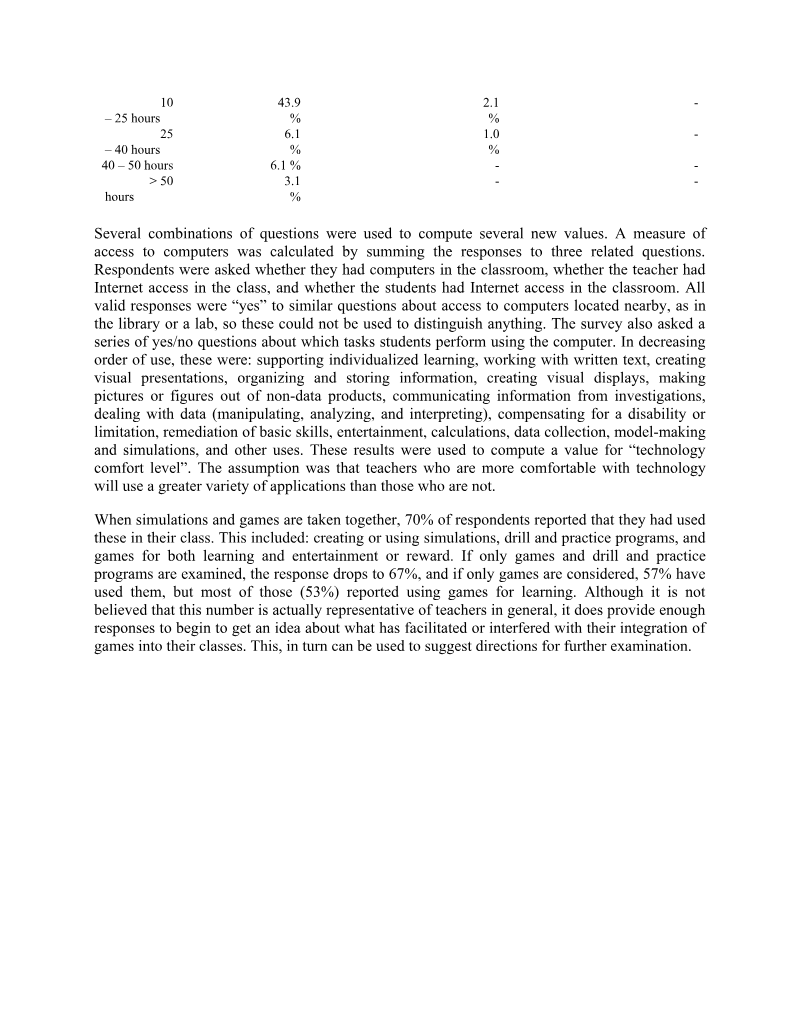
This 2005 pilot study, presented at the DiGRA conference and conducted by researchers at the University of Calgary, examines whether K-12 teachers are ready to integrate digital games into classroom instruction.
- Seventy percent of surveyed K-12 teachers reported using simulations or games in class, and 57 percent used games specifically, mostly for learning.
- The main barriers to classroom game use were inadequate hardware and software, insufficient time, and lack of knowledge about integrating games into curricula, rather than resistance to games themselves.
- Willingness to try game-related applications was generally high, with educational downloads and simulations rated most favorably and commercial off-the-shelf games receiving more mixed responses.
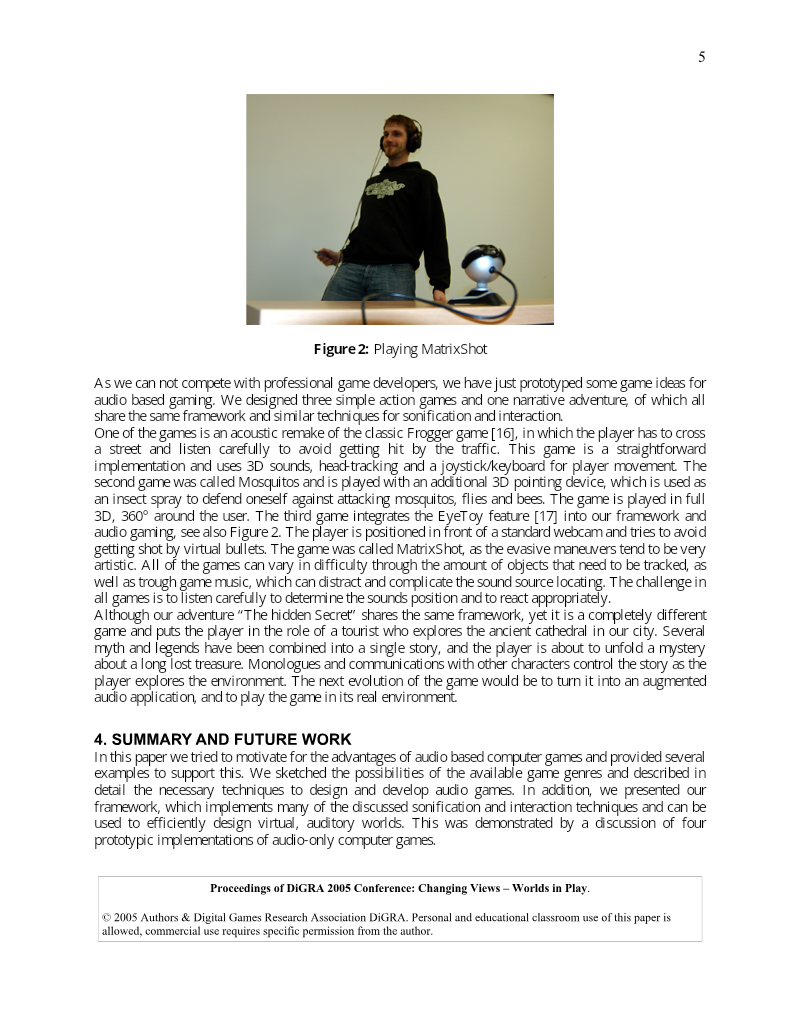
Playing Audio-Only Games: A Compendium of Interacting with Virtual, Auditory Worlds
This paper presents an overview of audio-only computer games, games played and perceived entirely through sound and acoustics.
- Audio-only games were originally developed by and for visually impaired players, but the authors argue they offer advantages for gameplay experimentation, mobile gaming, and immersive storytelling that also appeal to hearing players.
- The central design challenge is balancing functional information for orientation and navigation against artistic aesthetics, avoiding both cluttered auditory displays and silent stretches that disorient players.
- Designers can tune difficulty through narration, monologues, the number of sound objects, and background music, which the paper presents as tools for managing this functionality-aesthetics balance.
The Play's the Thing: Practicing Play as Community Foundation and Design Technique
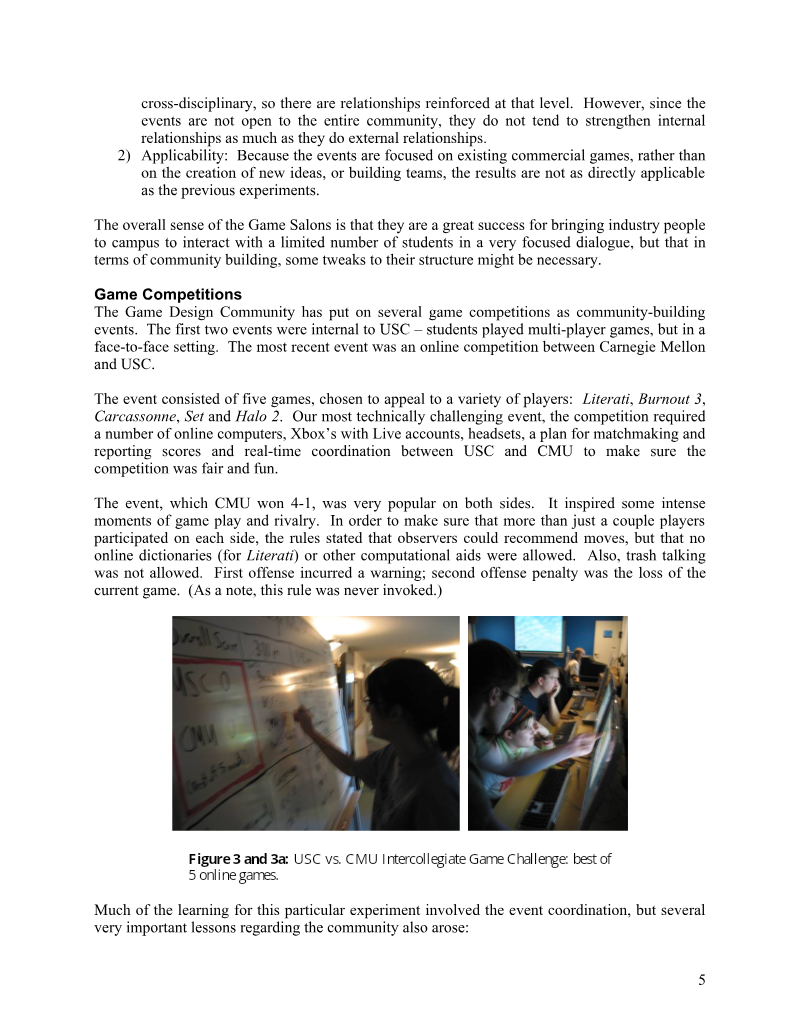
Tracy Fullerton's paper describes the USC Game Design Community, an extracurricular, cross-departmental initiative at the University of Southern California's School of Cinema-Television and Annenberg Center for Communication.
- Tracy Fullerton's paper argues that shared play experiences can give students and researchers from different disciplines a common vocabulary, social bonds, and collaboratively generated design concepts, complementing formal curricula that leave cross-disciplinary teamwork to chance.
- The USC Game Design Community is an extracurricular, cross-departmental initiative run through the School of Cinema-Television and the Annenberg Center for Communication at the University of Southern California.
- The Cooperative Game Play Experiment, drawing on the 1970s New Games Movement and led by Bernie DeKoven, was judged the community's most successful event, with its outdoor, technology-free format and the motto "play hard, play fair, nobody hurt" credited with sustaining discussion.
Fundamental Components of the Gameplay Experience: Analysing Immersion
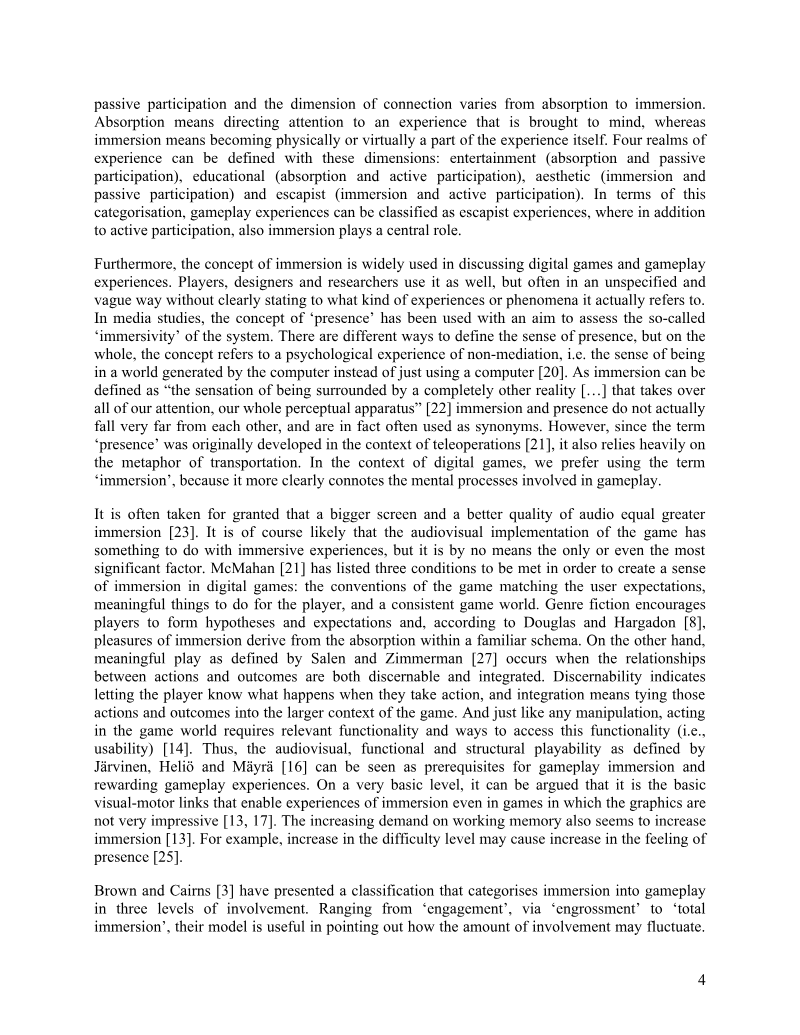
This study examines immersion as a central component of the gameplay experience, proposing the Sensory, Challenge-based, and Imaginative (SCI) model as a way to distinguish qualitatively different forms of immersion.
- The report proposes the Sensory, Challenge-based, and Imaginative (SCI) model to distinguish qualitatively different forms of game immersion, arguing that existing research lacked the qualitative distinctions needed to explain why different games absorb players in different ways.
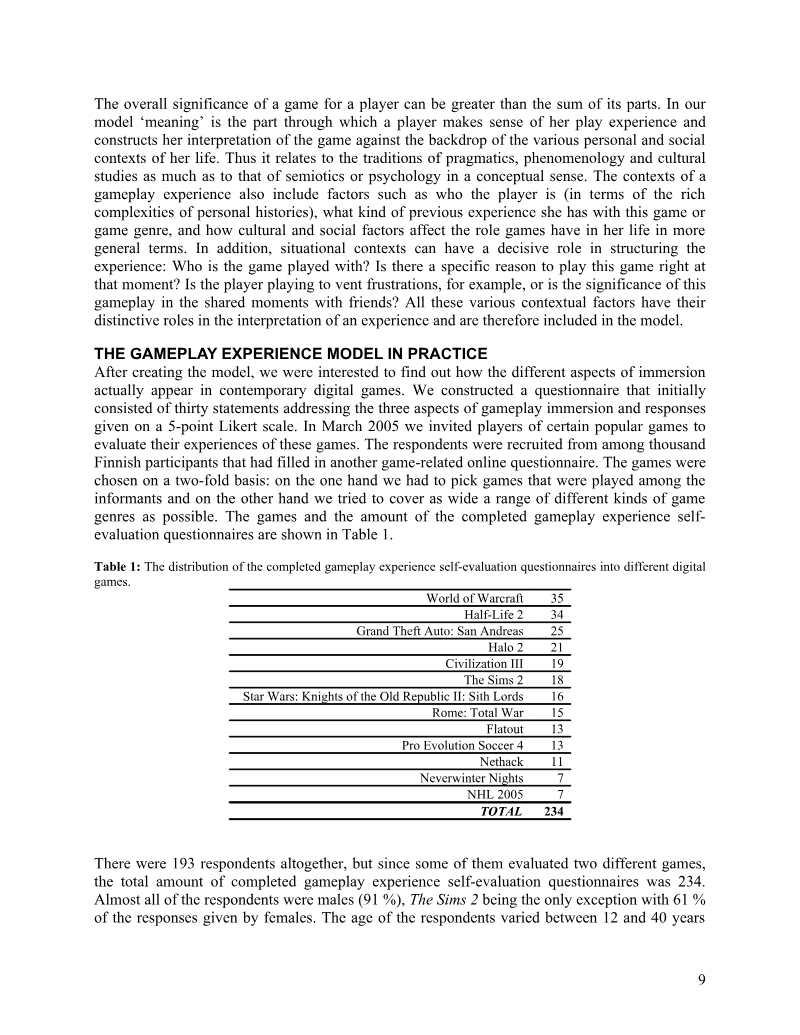
- A survey of 234 self-reported gameplay experiences across 13 popular titles found overall immersion levels were high across the sample, which was predominantly male and aged 12 to 40.
- Half-Life 2 recorded the highest combined immersion score in the study, while The Sims 2 recorded the lowest.

Baldur's Gate and History: Race and Alignment in Digital Role Playing Games
Christopher Warnes's paper argues that digital role-playing games, using Baldur's Gate I and II as its central case, cannot be fully understood through the formalist approaches that dominate game studies, particularly the ludology/narratology debate.
- Christopher Warnes argues that digital role-playing games such as Baldur's Gate I and II cannot be fully understood through the formalist ludology/narratology approaches that dominate game studies, which he attributes to disciplinary insecurity and anxiety about the games industry's commercial pull.
- Warnes advocates historicised, cultural materialist and postcolonial critique as alternatives, applying them to commercially produced computer games in a sustained way for the first time.
- The paper is a theoretical and interpretive essay, not an empirical study; it draws on literary, historical, and media-studies sources rather than survey data or original player research.


Canadian Content in Video Games
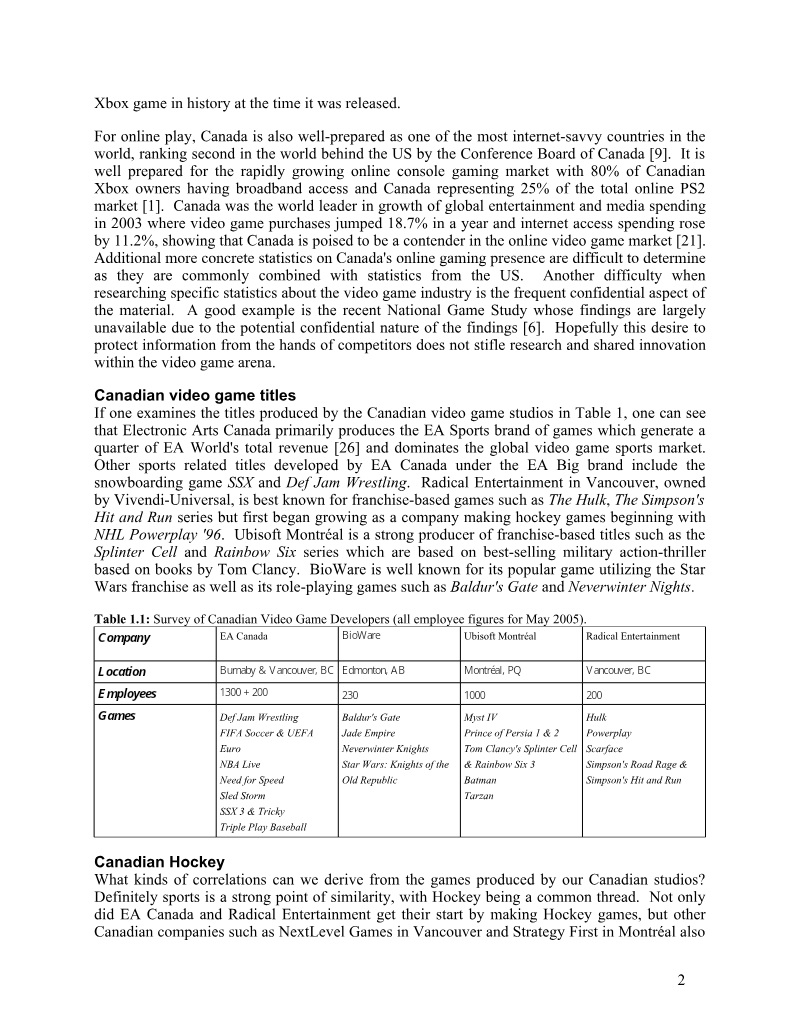
Leonard J. Paul's paper, "Canadian Content in Video Games," examines whether video games produced in Canada reflect a distinct national culture, despite Canada being one of the world's leading producers and consumers of the medium.
- The paper's central finding is that Canadian-made video games show little distinct cultural identity, with Canadian content surfacing mainly in isolated touches like hockey-themed details or Quebec French-language requirements.
- Studios often replace Canadian place names and spellings with American or generic equivalents to reach the largest market, indicating that publisher market calculations, not national cultural policy, drive how Canadian content appears.
- The author concludes that the sector's economic growth has not yet been matched by culturally distinctive output, though academic game programs and new funding may eventually change this.
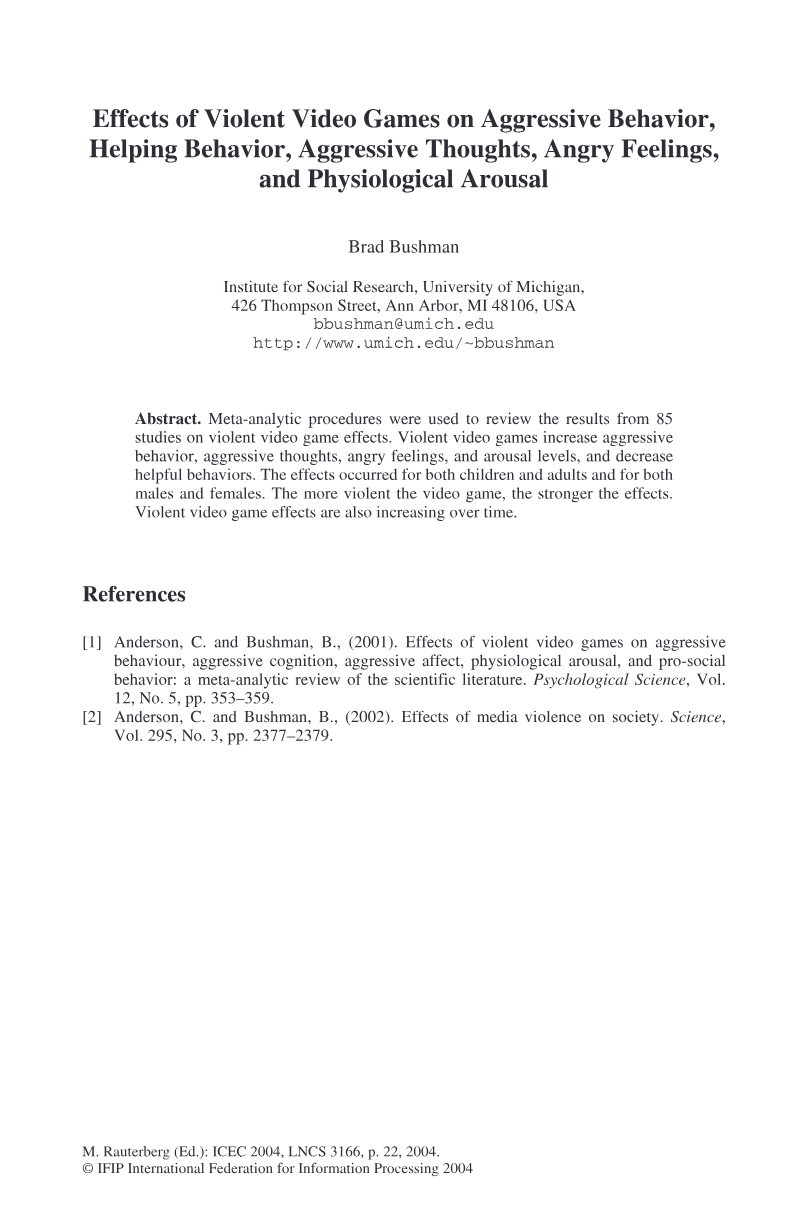
Effects of Violent Video Games on Aggressive Behavior, Helping Behavior, Aggressive Thoughts, Angry Feelings, and Physiological Arousal
Violent video games exert a measurable negative influence on human behavior and psychological states.
- Exposure to violent video games consistently correlates with increased aggressive behavior and a measurable reduction in prosocial, helping behaviors.
- The findings are based on a meta-analysis of 85 distinct studies, confirming that these psychological impacts affect both children and adults across all genders.
- A dose-response relationship exists where the intensity of depicted violence directly correlates with the strength of the observed aggressive thoughts, angry feelings, and physiological arousal.

Model Endgame Analysis
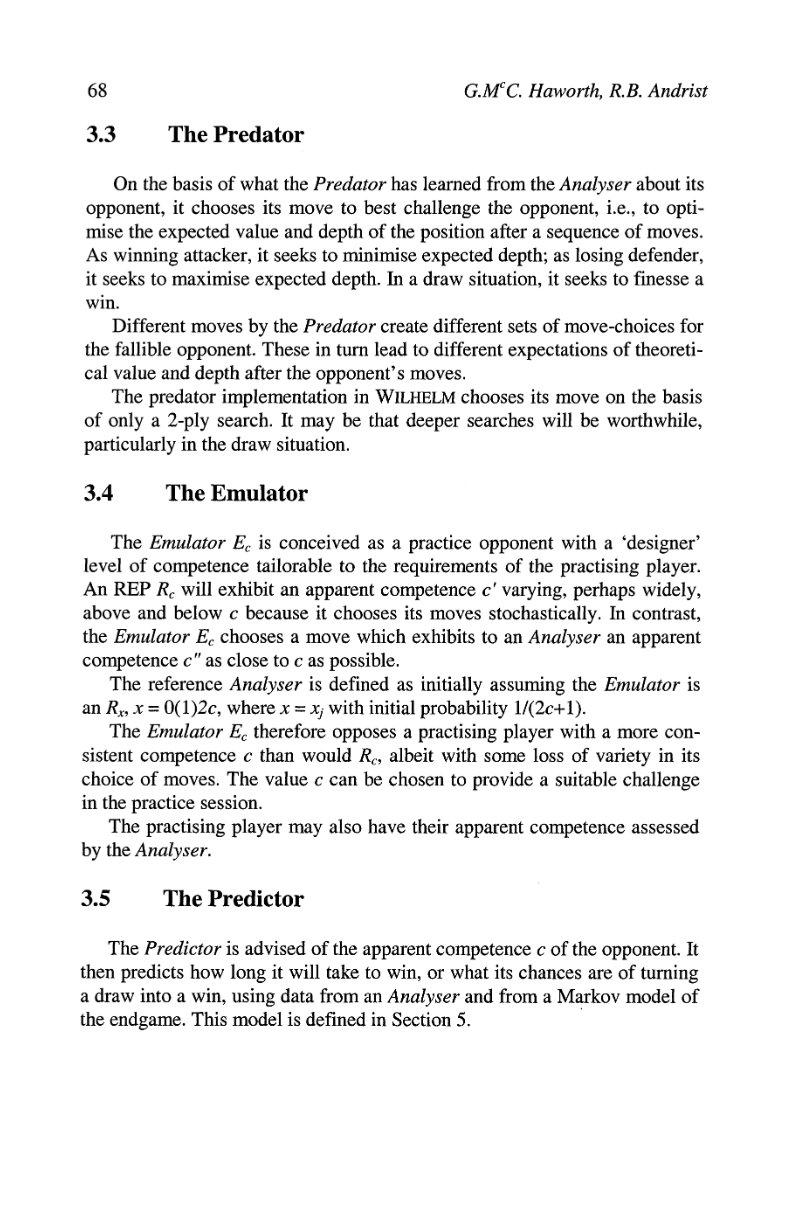
This analysis evaluates a reference model of fallible endgame play in chess, utilizing a spectrum of Reference Endgame Players (REPs) to simulate and analyze human and machine performance.
- The Reference Endgame Player (REP) model uses Bayesian inference and Markov chains to accurately quantify the competence of both human and machine players in chess endgames.
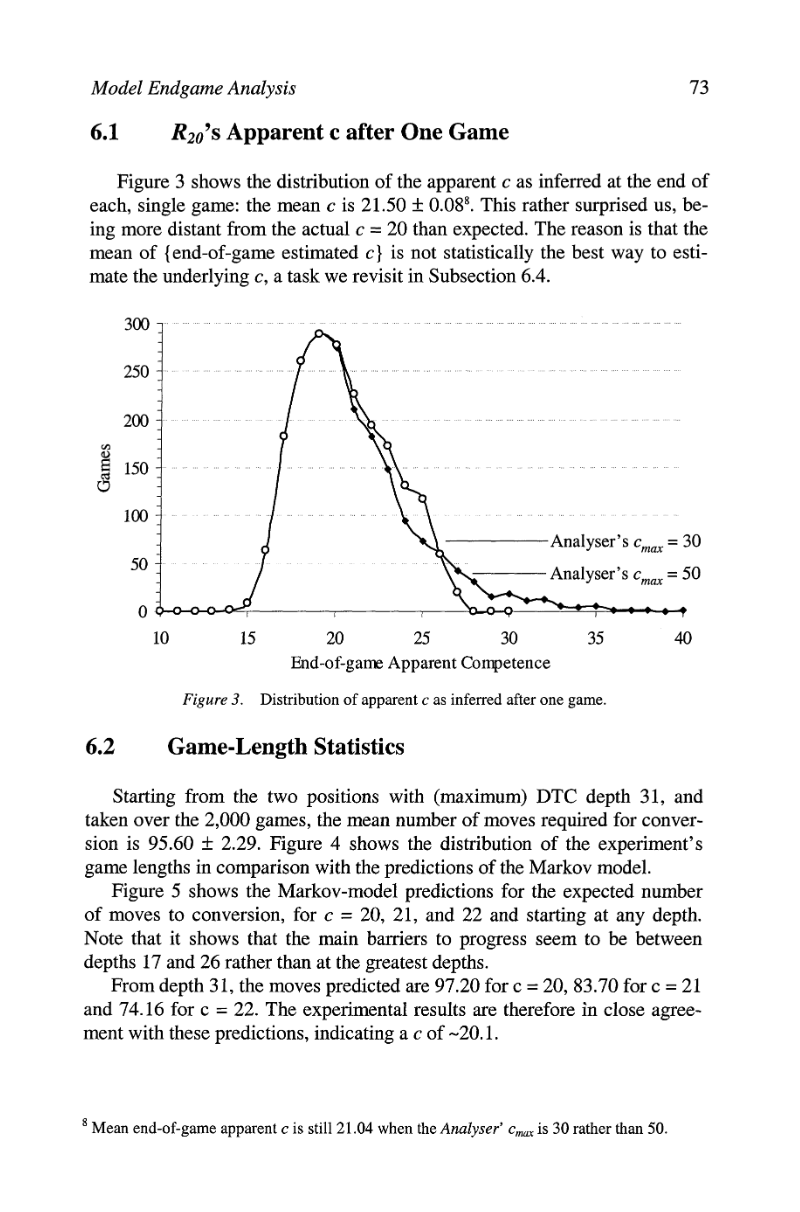
- Experimental simulations of 2,000 King-Queen versus King-Rook (KQKR) games demonstrate that the model’s predicted game lengths align closely with observed performance data.
- In the KQKR endgame, the primary barriers to progress for fallible players occur at depths between 17 and 26, rather than at the maximum theoretical depths.

New Games Related to Old and New Sequences
Combinatorial game theory provides a rigorous framework for analyzing two-pile subtraction games, where the governing move constraints are defined by a function of the current pile sizes.
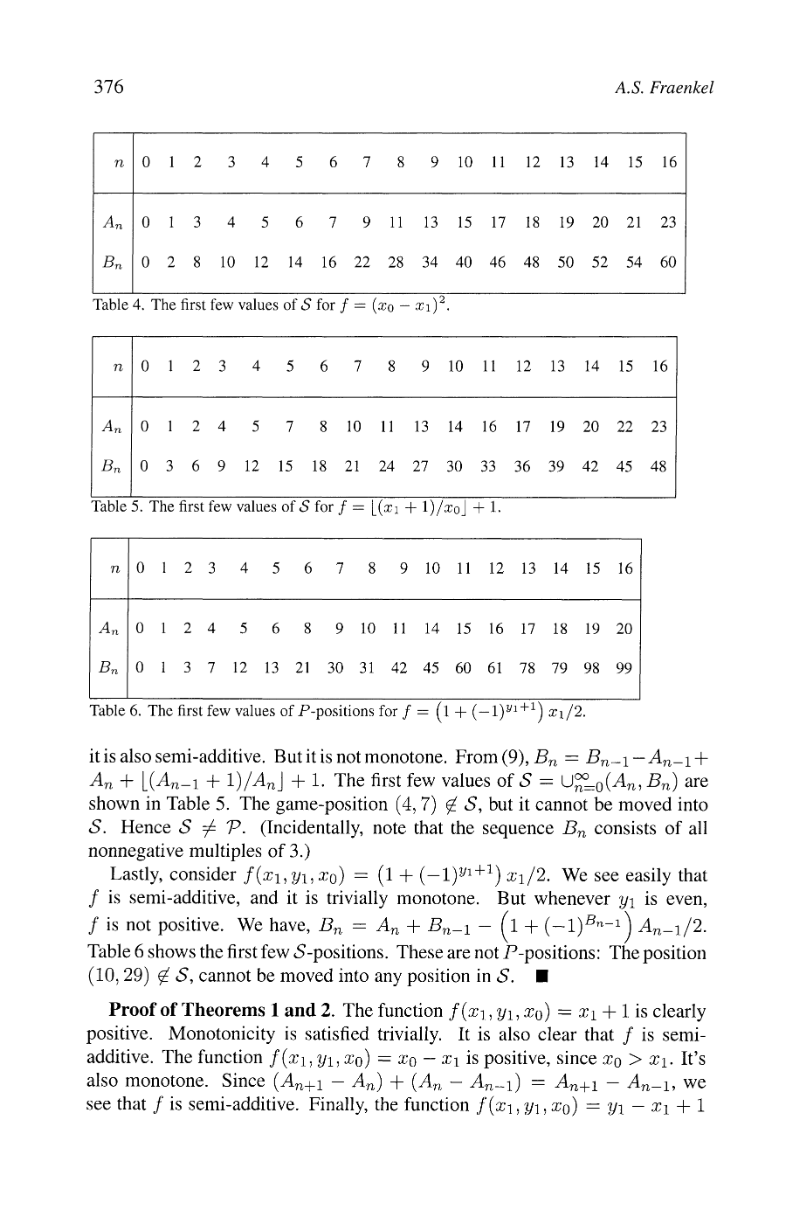
- Combinatorial game theory provides a rigorous framework for identifying second-player winning positions (P-positions) in two-pile subtraction games using complementary sequences.
- Constraint functions must satisfy the three criteria of positivity, monotonicity, and semi-additivity to ensure predictable game states and valid strategic modeling.
- The research establishes a unified model that classifies diverse integer sequences, such as the Hofstadter and Prouhet-Thue-Morse sequences, as determinants of optimal play.
Solving the Oshi-Zumo Game
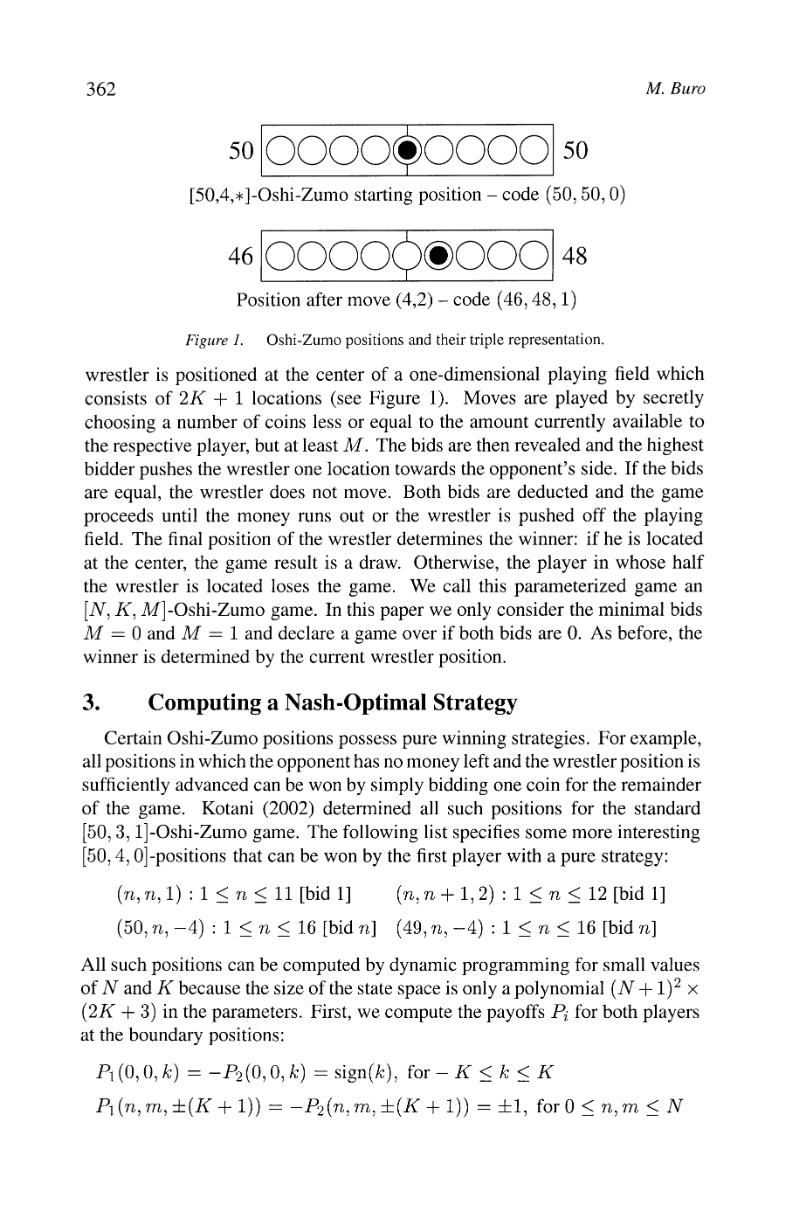
The Japanese game Oshi-Zumo, a two-player, zero-sum game of incomplete information, is analyzed to determine its Nash-optimal mixed strategies.
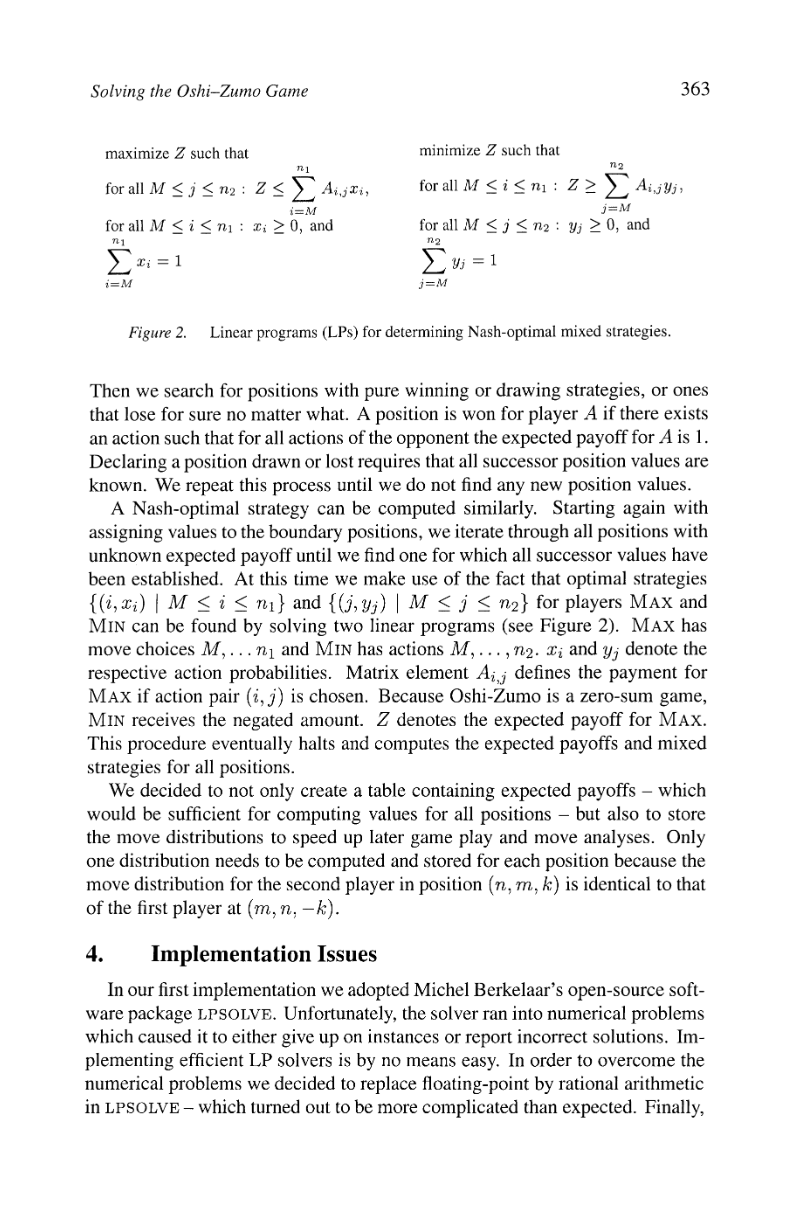
- Researchers have successfully computed Nash-optimal mixed strategies for the two-player, zero-sum game Oshi-Zumo using a combination of dynamic and linear programming.
- The implementation solves the standard 50-coin, 3-location game in approximately 12 seconds on a 1-GHz processor.
- To ensure numerical stability, the methodology employs a two-phase approach that defaults to rational arithmetic via the GNU arbitrary precision library when floating-point calculations fail.


Evaluation Function Tuning via Ordinal Correlation
Static evaluation functions in computer chess are most effectively optimized by prioritizing the relative ordering of positions rather than the absolute numerical values assigned to them.
- Optimizing chess engine evaluation functions via ordinal correlation—specifically using Kendall’s tau—is more computationally efficient and statistically aligned with minimax search than traditional numerical methods.
- Empirical testing on the CRAFTY engine demonstrates that maximizing the correlation between machine assessments and grandmaster-level human judgments can successfully restore high-level performance after weight randomization.
- The effectiveness of machine-human evaluation concordance increases as search depth grows, confirming that deeper search cycles benefit more from ordinal-based tuning.
Writers
Games and companies
Games