1 free read left. Create a free account for unlimited reading + AI research.
Create free accountReport DiGRA
1 free read left. Create a free account for unlimited reading + AI research.
Create free accountReportDiGRA
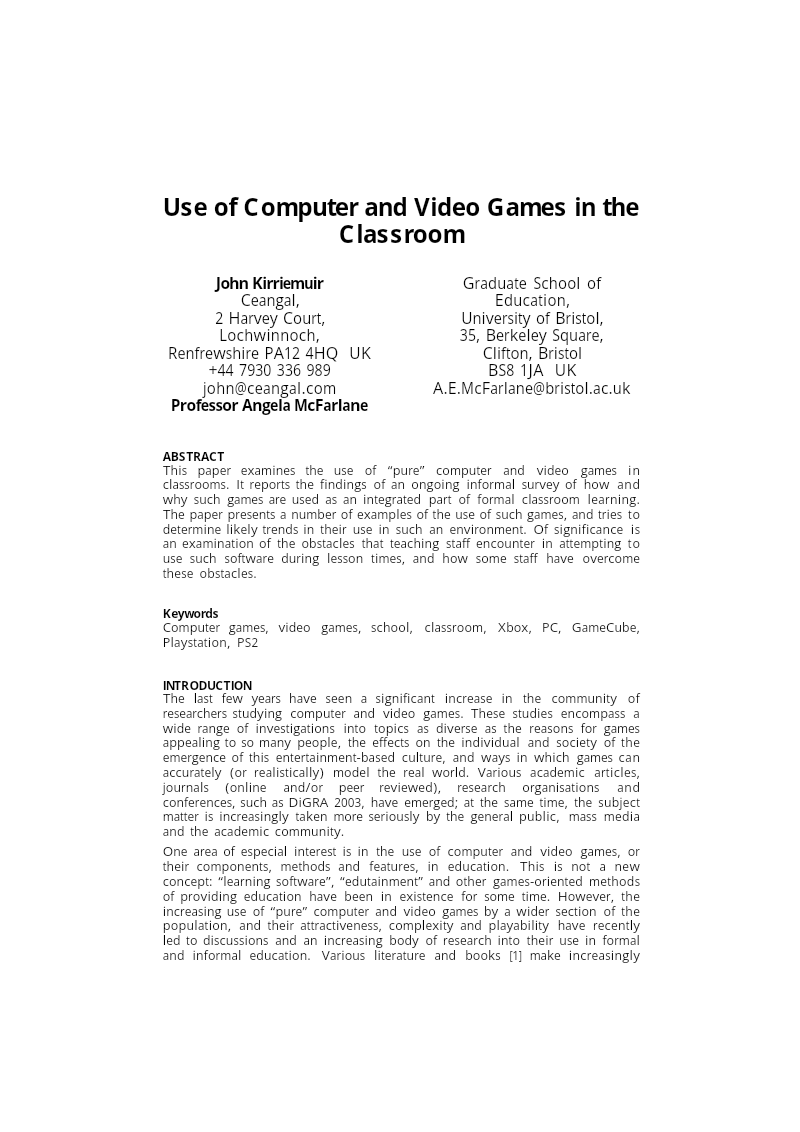
This 2005 pilot study, presented at the DiGRA conference and conducted by researchers at the University of Calgary, examines whether K-12 teachers are ready to integrate digital games into classroom instruction. Its central aim is to identify who currently uses games for learning, who might be willing to try them, and which factors facilitate or hinder adoption. The authors frame their work as an early contribution to a relatively new field, offering a template for future research rather than conclusive findings.
The survey was an online questionnaire distributed to K-12 teachers across four local school districts in Canada, with 109 respondents drawn from roughly 400 schools. The response rate was low, and the online-only format, administrator-controlled distribution, and timing near a reporting cycle likely produced a self-selected sample skewed toward technologically comfortable educators. Within those limits, respondents appeared broadly representative across grade levels and experience. Seventy percent reported using simulations or games in class, with 57 percent using games specifically, most of them for learning. Willingness to try game-related applications was generally high, with downloads from educational sources and simulations rated most favorably, while commercial off-the-shelf games received more mixed responses.
The principal barriers reported were inadequate hardware and software, insufficient time, and a lack of knowledge about how to integrate games into curricula, rather than resistance to games themselves. Teachers were most often helped by their own efforts, followed by professional development and colleagues. A statistically significant positive relationship was found between current game use and willingness to try games, though the direction of causality remains unclear. The authors conclude that providing lightweight, low-preparation games, accessible resources, and professional development could meaningfully advance classroom adoption.

DiGRA · 2026

DiGRA · 2026



DiGRA · 2026



DiGRA · 2026



DiGRA · 2026



DiGRA · 2026



DiGRA · 2026



DiGRA · 2026



DiGRA · 2026

DiGRA · 2026



DiGRA · 2026



DiGRA · 2026
Institute for Educational Technology · 2019