1 free read left. Create a free account for unlimited reading + AI research.
Create free accountWhitepaperComputers and Games
Distilling the key insights…
This analysis evaluates a reference model of fallible endgame play in chess, utilizing a spectrum of Reference Endgame Players (REPs) to simulate and analyze human and machine performance. The research aims to quantify the competence of players through stochastic move selection based on endgame table (EGT) values and depths. By implementing these agents within the WILHELM chess engine, the study establishes a framework for identifying opponent competence, predicting game outcomes, and developing strategic, opponent-sensitive play.
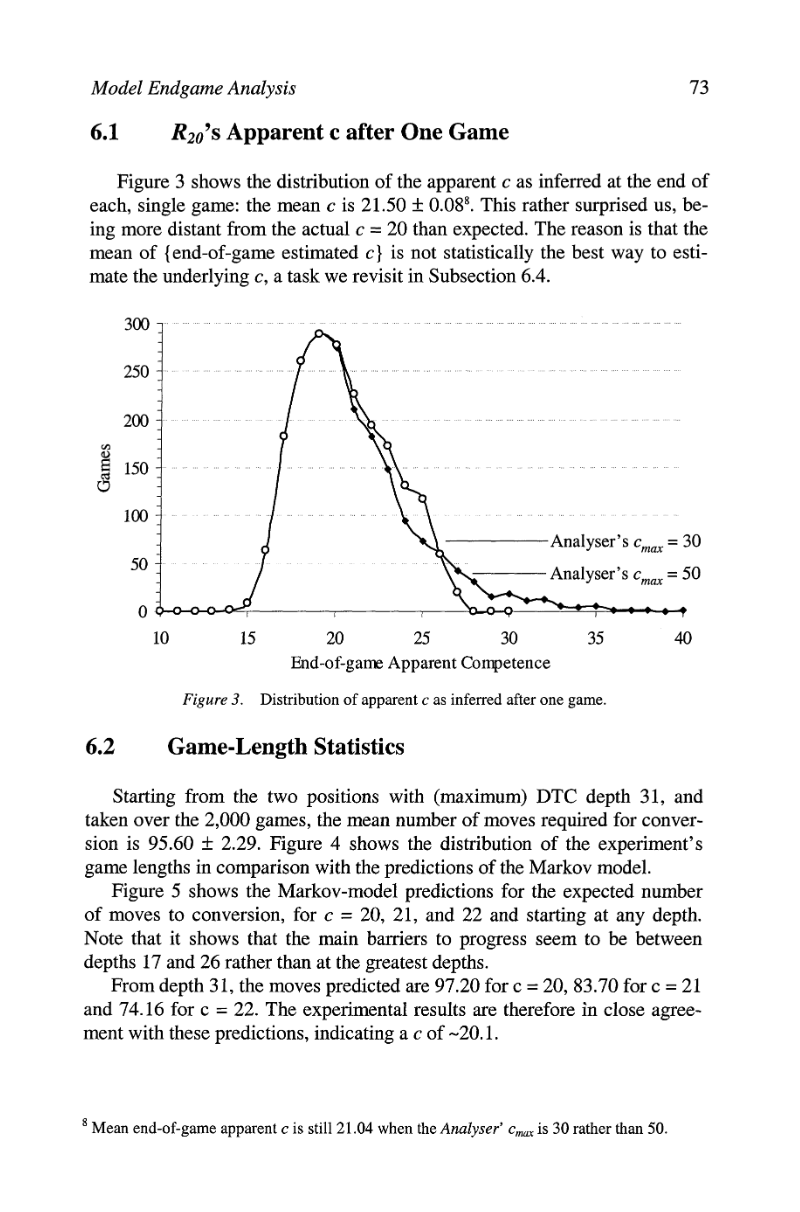
The methodology relies on Bayesian inference to estimate an opponent’s competence index, denoted as c, and employs Markov models to characterize endgame transitions. The study utilizes a dataset of 2,000 simulated games between a fallible attacker and an infallible defender in the King-Queen versus King-Rook (KQKR) endgame. Key findings demonstrate that the model is robust, with numerical approximations converging reliably as parameters are adjusted. Experimental results show a close alignment between observed game lengths and theoretical predictions derived from Markov matrices. Specifically, the analysis reveals that the primary barriers to progress in the KQKR endgame occur between depths 17 and 26, rather than at the maximum depths.
The research concludes that the REP model effectively captures the nuances of fallible play, providing a consistent metric for assessing both silicon and carbon players. By analyzing historical matches, the study highlights how time constraints and human error significantly impact endgame performance. The findings suggest that the model is highly scalable, with potential applications in other convergent games such as Chinese Chess or checkers. Future research directions include testing the model against diverse endgame scenarios, enhancing the predictive capabilities of the "Predator" agent, and utilizing the "Emulator" as a training tool for human players.
University of Luxembourg · 2025
Comments