Game Studies reports and market data
Documents
Videogames and Complexity Theory: Learning through Game Play
This analysis explores video games as complex, adaptive, and self-organizing systems that facilitate sophisticated learning.
- Video games function as complex, adaptive systems that facilitate superior learning by coupling information with action, unlike traditional educational models that isolate tasks from their context.
- Games foster emergent learning by keeping players within a 'regime of competence' through well-ordered, pleasantly frustrating challenges that promote system thinking over rote memorization.
- The inherent instability and infinite, emergent possibilities within a game environment serve as the primary drivers for high levels of player engagement and skill acquisition.
Frames and Simulated Documents: Indexicality in Documentary Videogames
Documentary videogames function as sophisticated instruments for historical inquiry by leveraging indexical relationships to forensic data and archival records.
- Documentary videogames function as tools for historical inquiry by shifting the player's role from a passive participant to an active forensic investigator of archival records.
- The effectiveness of these games relies on the indexical relationship between digital simulations and real-world forensic data rather than a pursuit of perfect historical fidelity.
- Procedural design in titles like JFK Reloaded allows players to analyze the causal links between digital signs and historical events through the reconstruction of physical processes.
Seeking the Embodied Mind in Video Game Theory: Embodiment in Cybernetics, Flow, and Rule Structures
This analysis examines the role of the human body within video game theory, specifically critiquing how cybernetics and flow theory conceptualize the player.
- Current game theory is overly reliant on formalist, rule-based frameworks that prioritize cognitive processes while neglecting the player's physical and material reality.
- Cybernetic models in game theory treat players as disembodied information processors, focusing exclusively on mechanical feedback loops rather than human experience.
- Flow theory creates a flawed, adversarial relationship between mind and body, requiring the player to condition their physical self to achieve immersion.
Playing in the Fields of Desire: Hegemonic Masculinity in Live Combat LARPs
Live-action role-playing (LARP) environments frequently function as liminal spaces that reinforce rather than subvert traditional gender norms.
- Live-action role-playing (LARP) environments often reinforce traditional gender norms by prioritizing physical combat and aggressive assertiveness as the primary metrics for success.
- Game mechanics act as gatekeepers that create a binary divide between 'power-gamers' who embody dominant masculine traits and 'role-players' who prioritize empathy or support-based development.
- The institutionalization of combat-heavy gameplay systematically marginalizes participants who do not conform to traditional masculine archetypes.

Close Reading Oblivion: Character Believability and Intelligent Personalization in Games
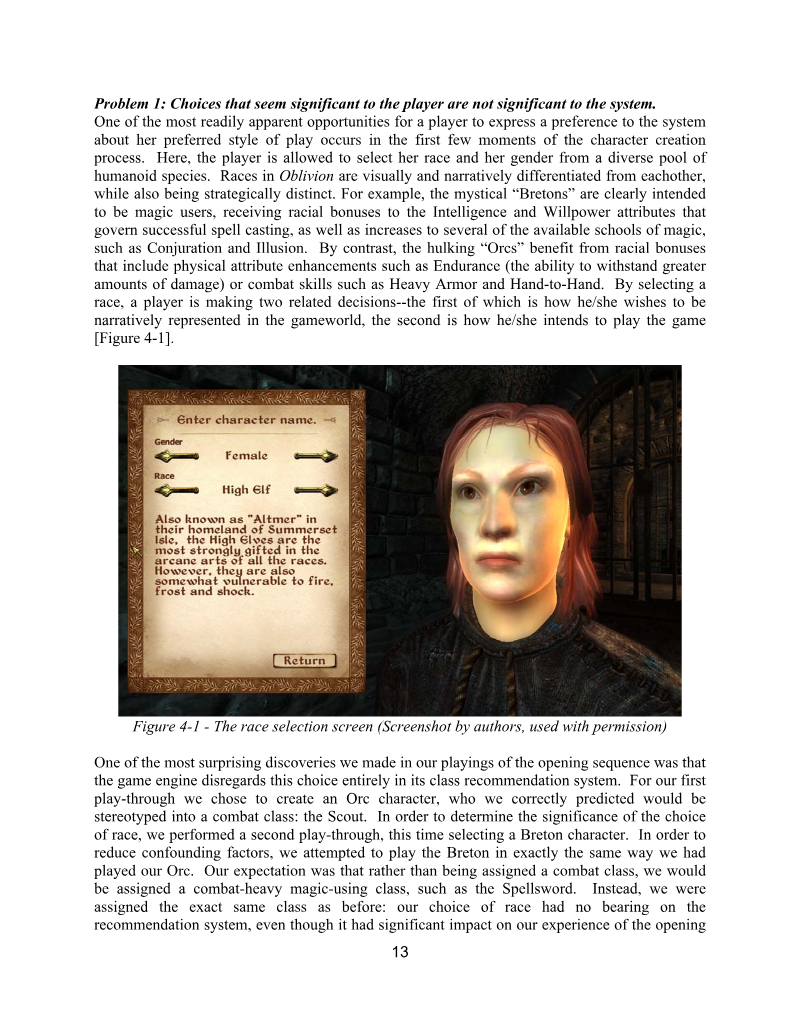
The Elder Scrolls: Oblivion serves as a primary case study for examining the tension between intelligent personalization and the psychological phenomenon of character believability in open-world role-playing games.
- Over-promising on the depth of interactive AI systems creates a dissonance between player expectations and technical execution, which ultimately undermines the perceived authenticity of the gameworld.
- The 'uncanny valley' effect in open-world RPGs is frequently triggered when sophisticated modeling attempts exceed the underlying technology's capacity to sustain consistent, human-like behavior.
- Adaptive systems that rely on rigid stereotyping and class-recommendation algorithms often fail to account for the nuance of individual player choices, leading to biased or inconsistent NPC interactions.
Fun Forever?: Toys, Games, and Play in Louisa May Alcott's Little Women
Louisa May Alcott's Little Women (1868/1869) is presented here as an unusually early and original American children's text in which play is valued for its own sake rather than merely as a vehicle for moral instruction.
- Louisa May Alcott's Little Women (1868/1869) treats play as valuable in its own right rather than merely as a vehicle for moral instruction, an unusually early stance in American children's literature, and it contrasts sharply with Martha Finley's Elsie Dinsmore (also 1868), where play is subordinated to Christian submission.
- The novel is read as a faithful record of nineteenth-century American play culture, with its improvised toys, domestic spaces such as the garret, and period games like croquet, Authors, and Rigmarole reflecting the era's leisure practices.
- Alcott's family commitment to play, especially her mother Abba's practice of hosting games, grounds the novel's emphasis on play, as shown in Alcott's childhood journals.

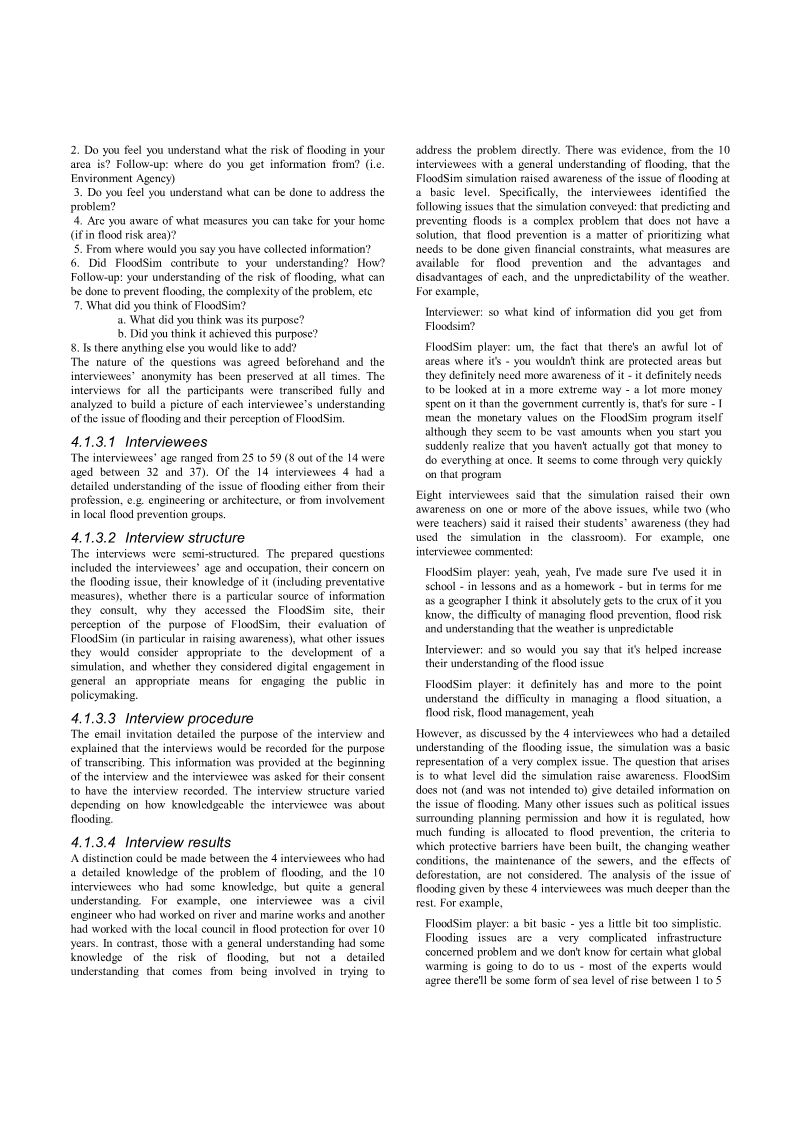

Societal Impact of a Serious Game on Raising Public Awareness: The Case of FloodSim
FloodSim serves as a primary case study for evaluating the efficacy of serious games in fostering public awareness regarding complex environmental policy.
- FloodSim successfully engaged over 25,000 users, demonstrating that digital simulations can serve as effective, accessible entry points for public environmental education.
- While the game effectively frames flooding as a complex societal challenge, there is a critical tension between high user engagement and the lack of pedagogical depth required for informed policy discourse.
- Subject matter experts identified that the simulation lacks the nuance necessary for high-level policy decision-making, limiting its utility beyond superficial awareness-raising.

Relating Cognitive Models of Computer Games to User Evaluations of Entertainment
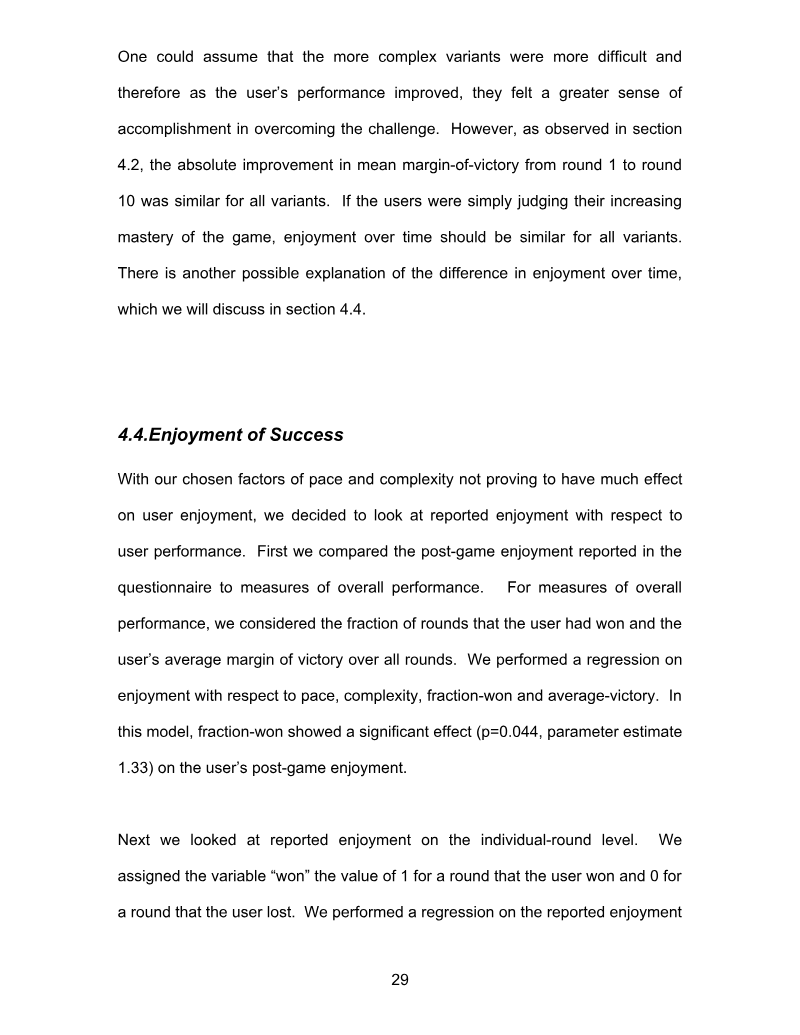
The relationship between cognitive complexity and user enjoyment in digital gaming reveals that entertainment value is not strictly tied to mastery or performance.
- Player enjoyment follows an inverted-U relationship with performance, peaking when users hover near the threshold of victory rather than achieving total mastery.
- Satisfaction paradoxically declines once a player surpasses the optimal success threshold, suggesting that effortless mastery reduces overall entertainment value.
- Cognitive friction—the struggle inherent in near-failure states—is a critical component of the user experience that designers should prioritize over ease of play.
In and Out of Control: Learning Games Differently
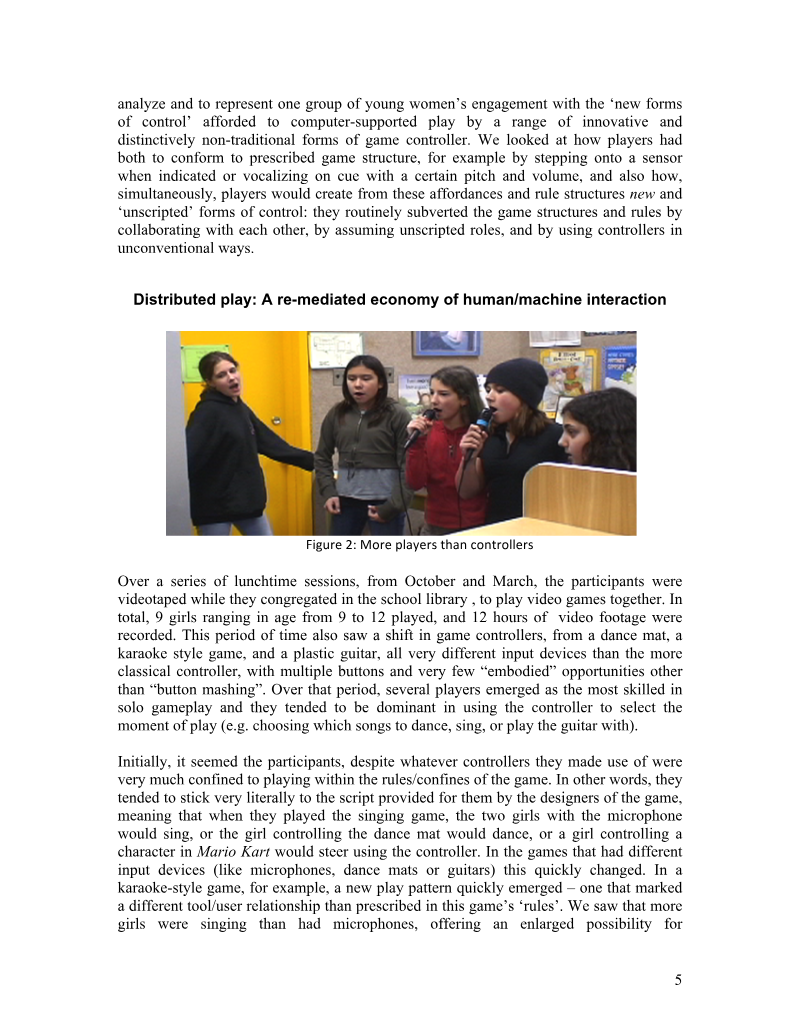
Digital gameplay functions as a complex, networked environment where agency is distributed across human players, social bystanders, and technological interfaces.
- Game mastery is an embodied, relational practice developed through sustained interaction with technology and social peers, rather than an innate or static skill set.
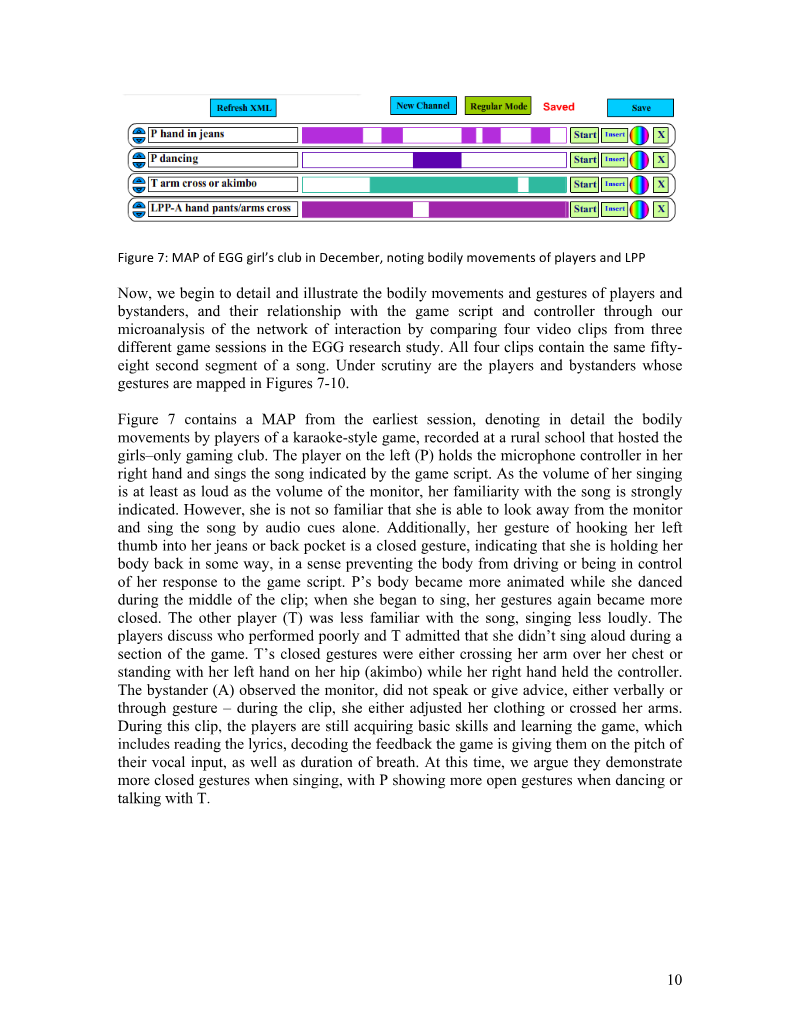
- The transition from novice to expert is marked by a shift in focus from the screen to social interaction, accompanied by a transition from guarded, closed physical postures to open, fluid movements.
- Technological competence is a social and technical construction built through practice and equitable access, debunking the myth of the 'digital native' as an inherent trait.
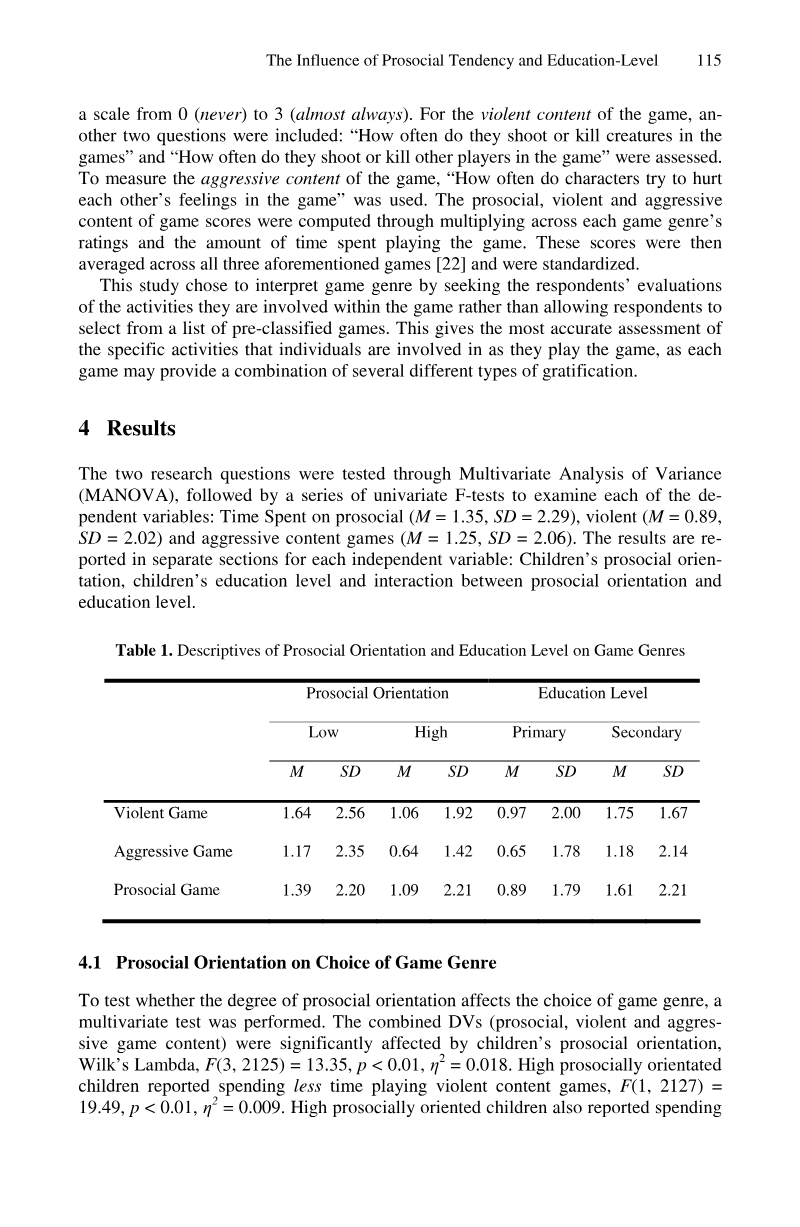
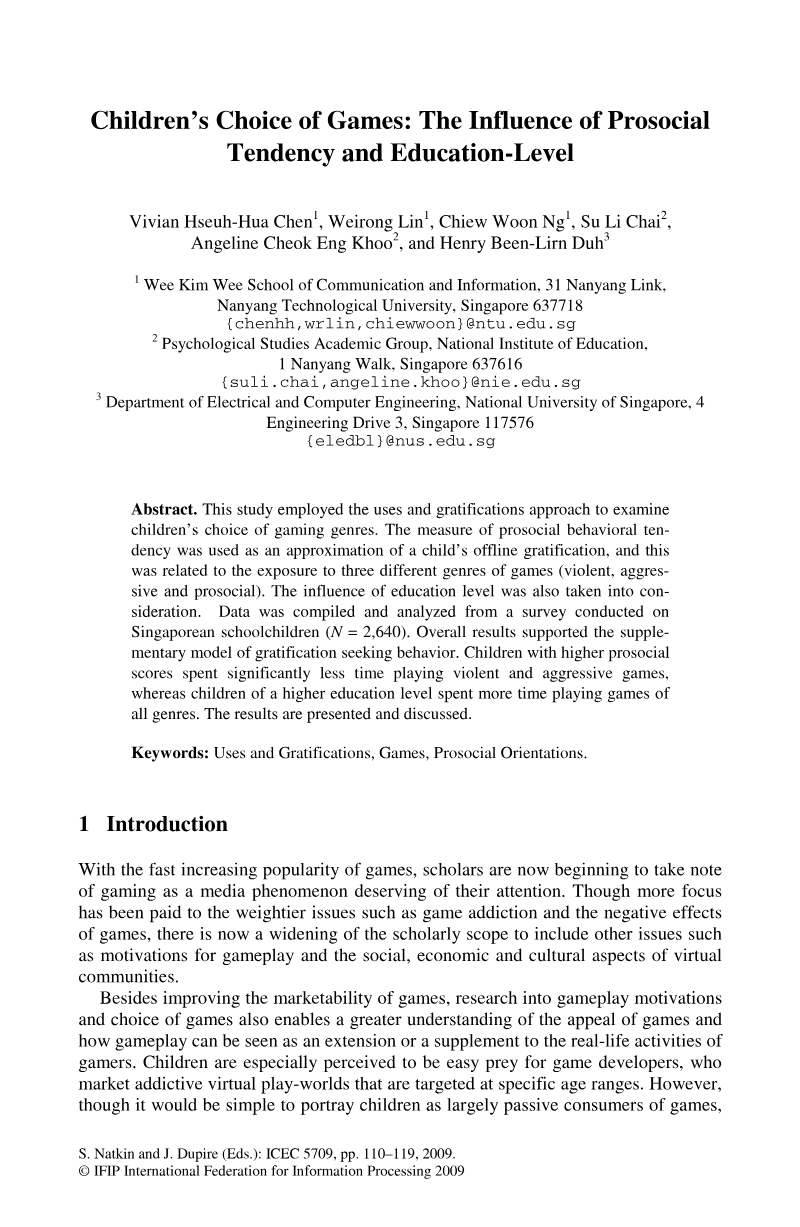
Children's Choice of Games: The Influence of Prosocial Tendency and Education-Level
Children's Choice of Games: The Influence of Prosocial Vivian Hseuh-Hua Chen1, Weirong Lin1, Chiew Woon Ng1, Su Li Chai2, Angeline Cheok Eng Khoo2, and Henry Been-Lirn Duh3 1 Wee Kim Wee School of Communication and Information, 31 Nanyang Link, Nanyang Technological University, Singapore 637718…
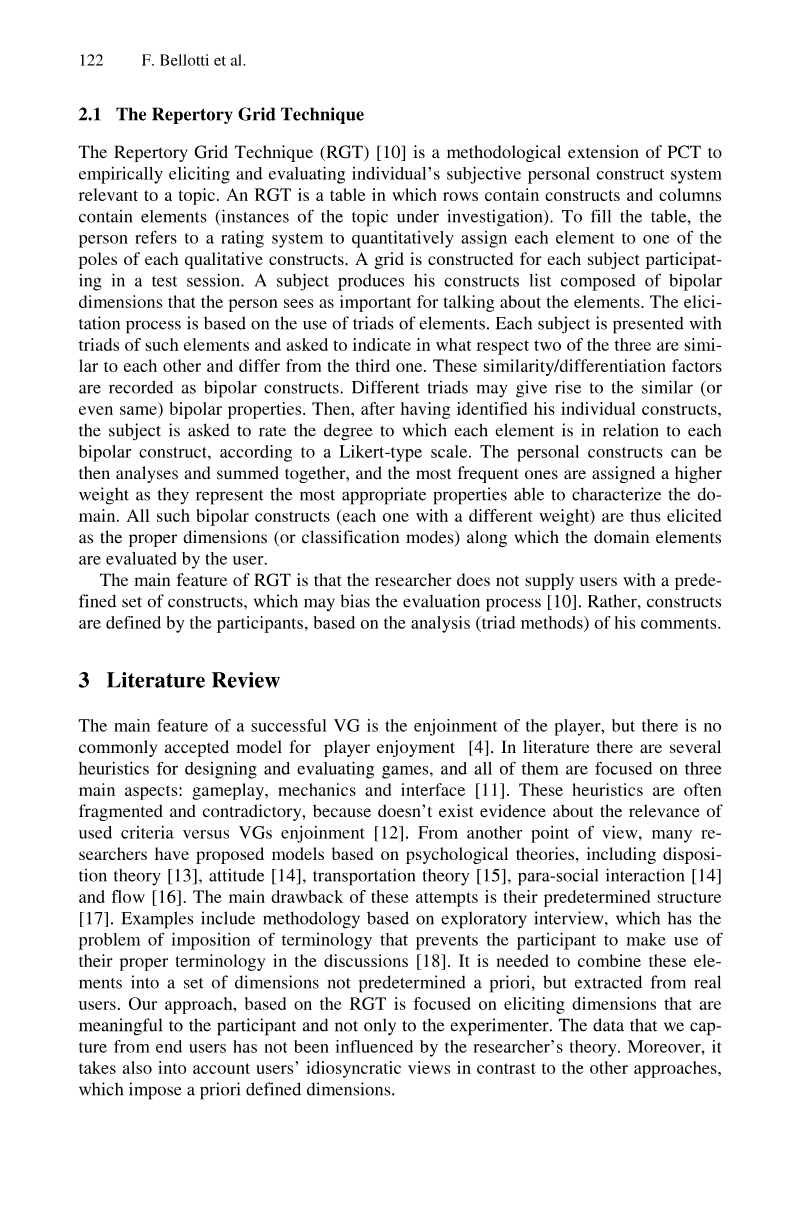
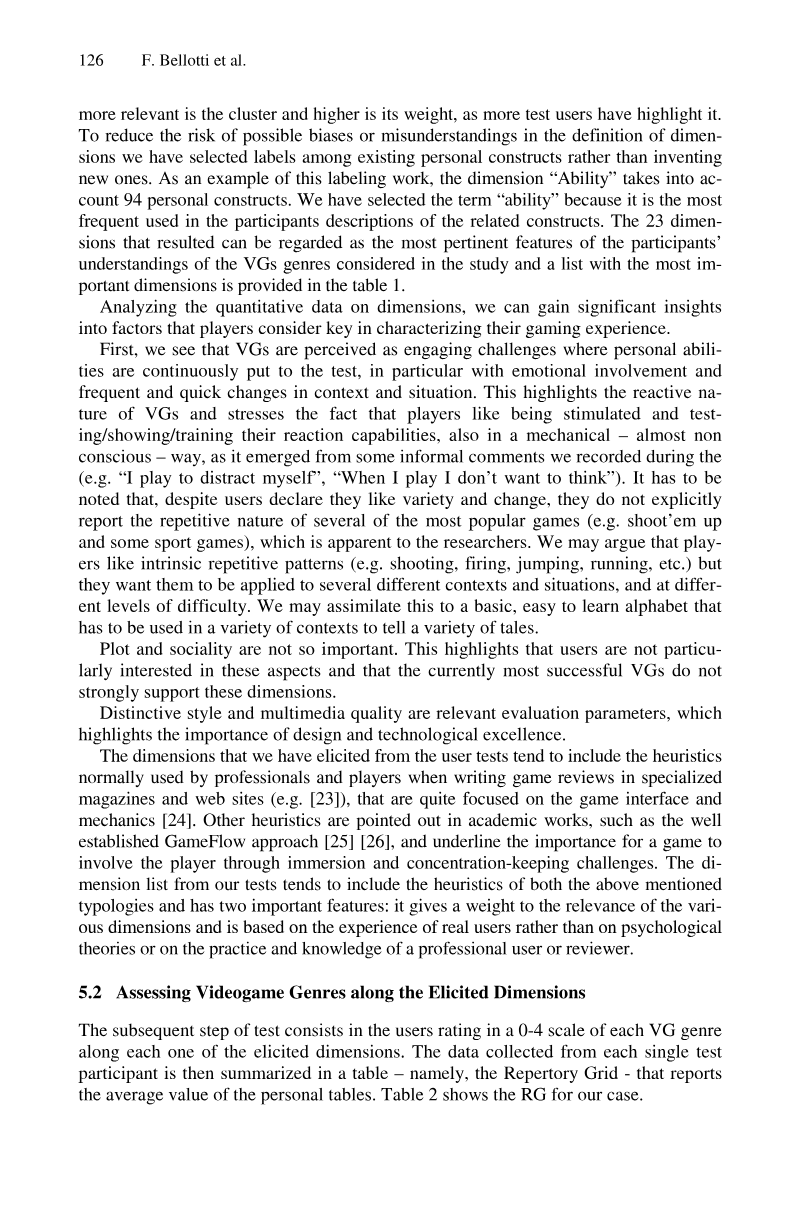
Player Experience Evaluation: An Approach Based on the Personal Construct Theory
Player Experience Evaluation: An Approach Based on Francesco Bellotti, Riccardo Berta, Alessandro De Gloria, and Ludovica Primavera DIBE - Department of Electronics and Biophysical Engineering University of Genoa, via Opera Pia 11 a, {franz,berta,adg,primavera}@elios.unige.it Abstract.
Plug: Secrets of the Museum: A Pervasive Game Taking Place in a Museum
"Plug: Secrets of the Museum": A Pervasive Game Taking Place in a Museum Michel Simatic1, Isabelle Astic2, Coline Aunis2, Annie Gentes1, Aude Guyot-Mbodji1, Camille Jutant1, and Emmanuel Zaza3 1 Institut TELECOM, 46 rue Barrault, 75634 Paris Cedex 13, France [email protected], [email protected]…
Writers
Games and companies
Games