1 free read left. Create a free account for unlimited reading + AI research.
Create free accountWhitepaper American Journal of Play
1 free read left. Create a free account for unlimited reading + AI research.
Create free accountWhitepaperAmerican Journal of Play
The novel is presented as an unusually early American children's text in which play is not merely a vehicle for moral instruction. It contrasts with Elsie Dinsmore, also from 1868.
Louisa May Alcott's Little Women (1868/1869) is presented here as an unusually early and original American children's text in which play is valued for its own sake rather than merely as a vehicle for moral instruction. Contrasting it with pre-1860 children's literature and with Martha Finley's Elsie Dinsmore (also 1868), where play is subordinated to Christian submission, the analysis treats the novel as a privileged window onto nineteenth-century American play culture. The author grounds this reading in Alcott's childhood journals and her family's commitment to play, particularly her mother Abba's practice of hosting games, and notes how the March sisters' improvised toys and games reflect that emphasis.
The novel's portrayal of amusement is shown to have been regarded as subversive at publication, evidenced by pressure to remove the theatricals. Everyday objects, domestic spaces such as the garret, and period games including croquet, Authors, and Rigmarole are read as faithful records of the era's leisure practices. Play also functions as a marker of romantic compatibility: Brooke, Bhaer, and Laurie and Amy are depicted as well-matched through shared or developing commitment to play.
The analysis further argues that the novel treats play as essential to a balanced life rather than frivolous indulgence. The "Experiments" chapter, in which a week of unchecked fun leaves the sisters dissatisfied and their household neglected, and the adult examples of Jo's writing obsession and Meg's neglect of her husband, illustrate the costs of imbalance. Feminist readings that dismiss the March sisters' play as conservative are challenged, with the claim that the novel links play to independence, relief from domestic drudgery, and personal satisfaction, largely through Marmee's unconventional parenting. The work closes by tracing Alcott's influence on later children's literature, which increasingly regarded play as the "stuff of childhood."
American Journal of Play · 2025
American Journal of Play · 2025
American Journal of Play · 2024
American Journal of Play · 2024
American Journal of Play · 2024
American Journal of Play · 2023
American Journal of Play · 2023
American Journal of Play · 2022
American Journal of Play · 2022
American Journal of Play · 2021
American Journal of Play · 2020
American Journal of Play · 2020
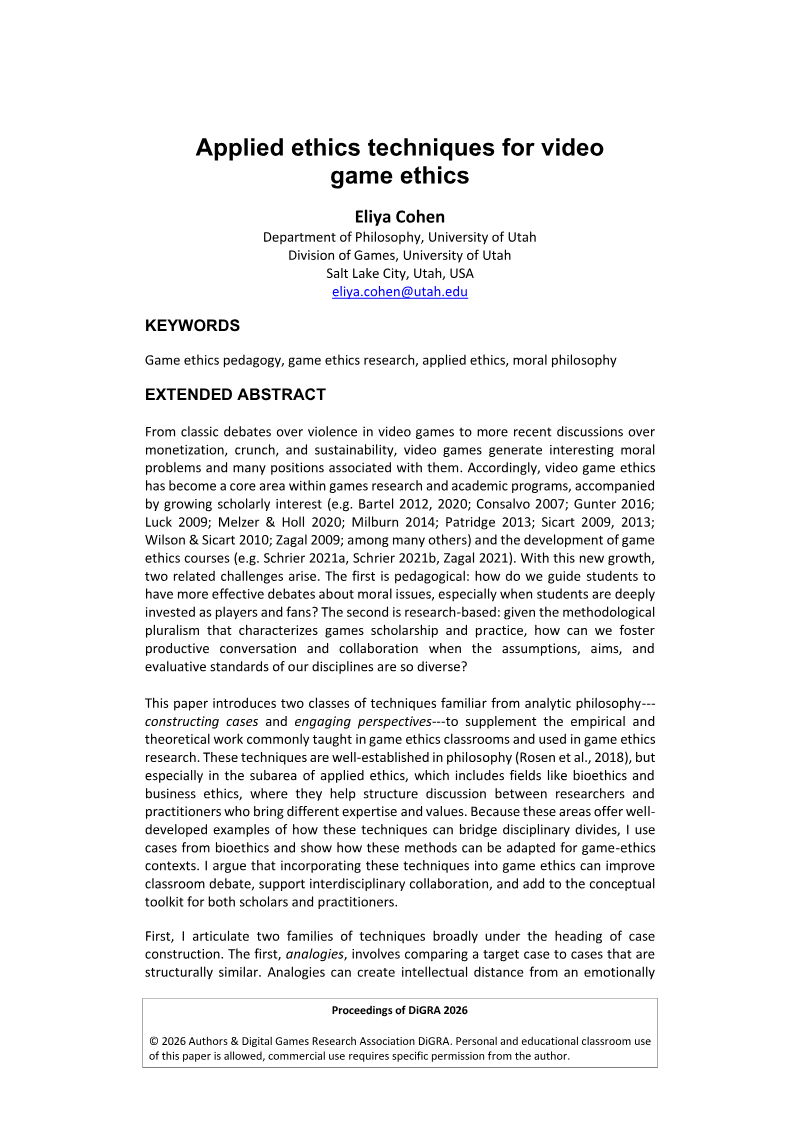
DiGRA · 2026