Report4 pages
Market Model Reports: Asia & MENA
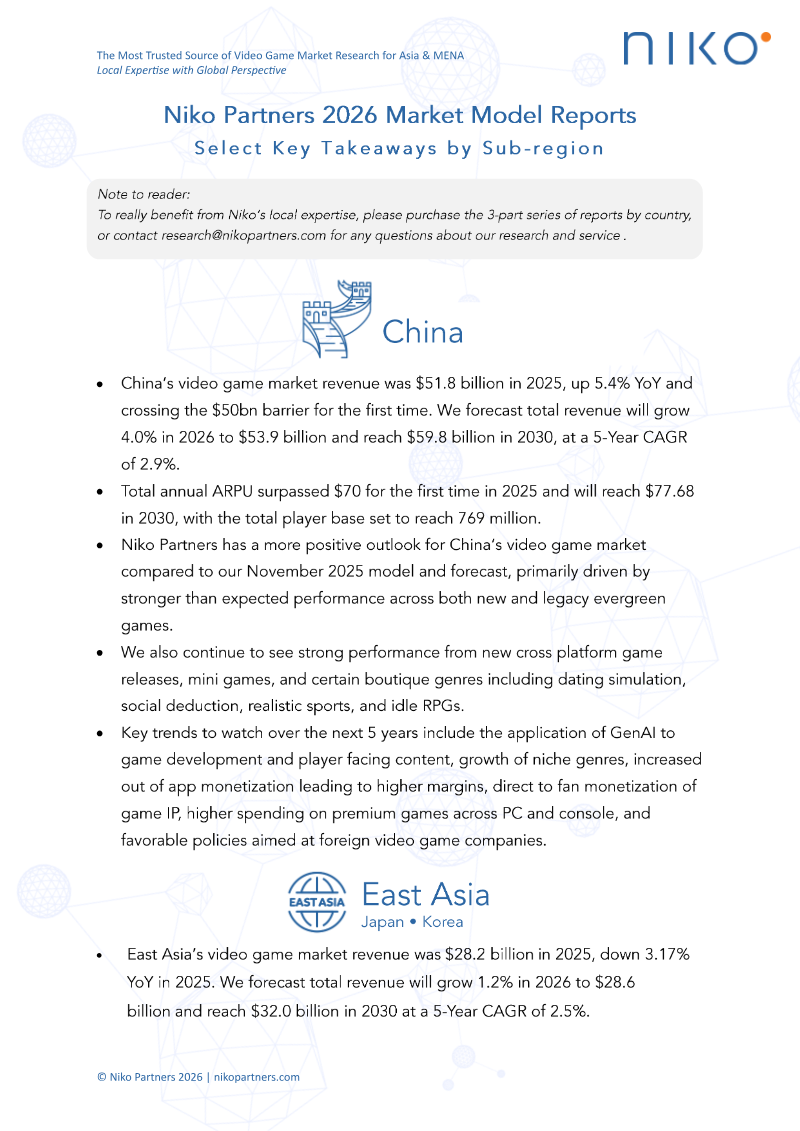
The 2026 Market Model Reports provide a comprehensive analysis of video game industry performance and growth projections across Asia and the Middle East and North Africa (MENA). Covering China, East Asia, India, Southeast Asia, and the MENA-3 region (Egypt, Saudi Arabia, and the UAE), the research evaluates revenue trends, player demographics, and macroeconomic influences through 2030. The analysis utilizes proprietary market modeling, player survey data, and regional expertise to assess the evolving landscape of mobile, PC, and console gaming.
Key findings highlight significant regional disparities in growth and maturity. China remains a dominant force, with 2025 revenue reaching $51.8 billion and a projected 2.9% CAGR through 2030. India emerges as the fastest-growing market, having surpassed $1 billion in revenue in 2025 with an expected 11.2% CAGR. Conversely, East Asia experienced a 3.17% revenue decline in 2025 due to macroeconomic pressures in Japan, though South Korea shows signs of recovery. Southeast Asia continues to expand, driven by mobile adoption and internet penetration, while the MENA-3 region benefits from strong government support and rising disposable income, despite potential geopolitical headwinds.
The research identifies several critical industry drivers, including the integration of generative AI, the rise of niche genres, and increased government regulation across Southeast Asia. Higher average revenue per user (ARPU) remains a focal point, particularly in East Asia, which maintains the highest regional spending levels. Overall, the findings suggest that while short-term volatility persists due to economic and geopolitical factors, the broader outlook for these markets remains positive, supported by increased localization, infrastructure development, and shifting consumer spending toward digital entertainment.
- China’s video game market reached $51.8 billion in 2025 and is projected to grow at a 2.9% CAGR to reach $59.8 billion by 2030.
- India is the fastest-growing market tracked, with 2025 revenue of $1.04 billion and a projected 11.2% CAGR through 2030, supported by a player base expected to reach 707 million.
- East Asia remains the region with the highest ARPU, though 2025 revenue declined 3.17% to $28.2 billion due to Japanese market stagnation and macroeconomic conditions.
- Southeast Asia’s market revenue hit $5.63 billion in 2025 and is forecast to grow at a 4.8% CAGR, with Thailand, the Philippines, and Indonesia identified as the fastest-growing sub-markets.
- The MENA-3 region (Egypt, Saudi Arabia, UAE) generated $2.15 billion in 2025 and is expected to see the strongest ARPU growth, reaching $38 by 2030 despite potential geopolitical instability.
+3
Niko PartnersJun 2026
Report36 pages
Asia Pacific Market Report 2025: Creating Opportunities for Video Games in Asia
Asia’s gaming landscape in 2025 is dominated by a triad of regional strengths that together shape the global market. Japan remains the cultural nucleus, with iconic franchises such as Pokémon, Final Fantasy and Monster Hunter generating $215 billion in worldwide influence and $178.8 million in IP revenue, while mobile titles like Fate/Grand Order expand overseas earnings. The country’s mature domestic market and brand prestige are offset by regulatory limits on gacha mechanics, sparse esports sponsorships, and a need to align with global live‑service standards. Success will depend on leveraging storytelling prowess and anime‑gaming synergies rather than chasing fleeting trends.
South Korea contributes a high‑speed, 5G‑driven esports ecosystem and hybrid free‑to‑play models that set industry benchmarks for competitive play and monetization. Southeast Asia, meanwhile, is the fastest‑growing mobile‑centric market, with a $14.8 billion industry powered by 680 million under‑30 residents and high mobile engagement. Monetization is shifting from ad‑heavy hypercasuals to midcore RPGs and MOBAs, supported by local payment systems such as GCash and GoPay. Esports in the region is projected to generate $350–380 million, underscoring its economic significance.
Developers face significant entry barriers across the APAC region, including localization challenges, fragmented regulations, and diverse payment ecosystems. End‑to‑end solutions that integrate local payments, provide compliance support, and enable flexible distribution are essential. Embedding community‑driven monetization—through affiliate revenue shares, in‑game branded content, and live‑stream partnerships—offers a sustainable path to growth. The overarching thesis is that deep cultural insight, sharp localization, and adaptability to mobile‑first dynamics are the keys to unlocking opportunities in Asia’s rapidly evolving gaming market.
- Southeast Asia is the region's fastest-growing mobile-centric market, currently valued at $14.8 billion and driven by a demographic of 680 million residents under the age of 30.
- Japan remains a global cultural powerhouse, with iconic franchises generating $215 billion in worldwide influence and $178.8 million in IP-specific revenue.
- Esports in Southeast Asia is a significant economic driver, with projected revenue between $350 million and $380 million.
- Market entry in the APAC region requires integrated solutions for fragmented regulations, diverse payment ecosystems like GCash and GoPay, and complex localization challenges.
- Monetization strategies in Southeast Asia are shifting away from hypercasual ad-heavy models toward midcore RPGs and MOBAs.
+2
GamesBeat
Report3 pages
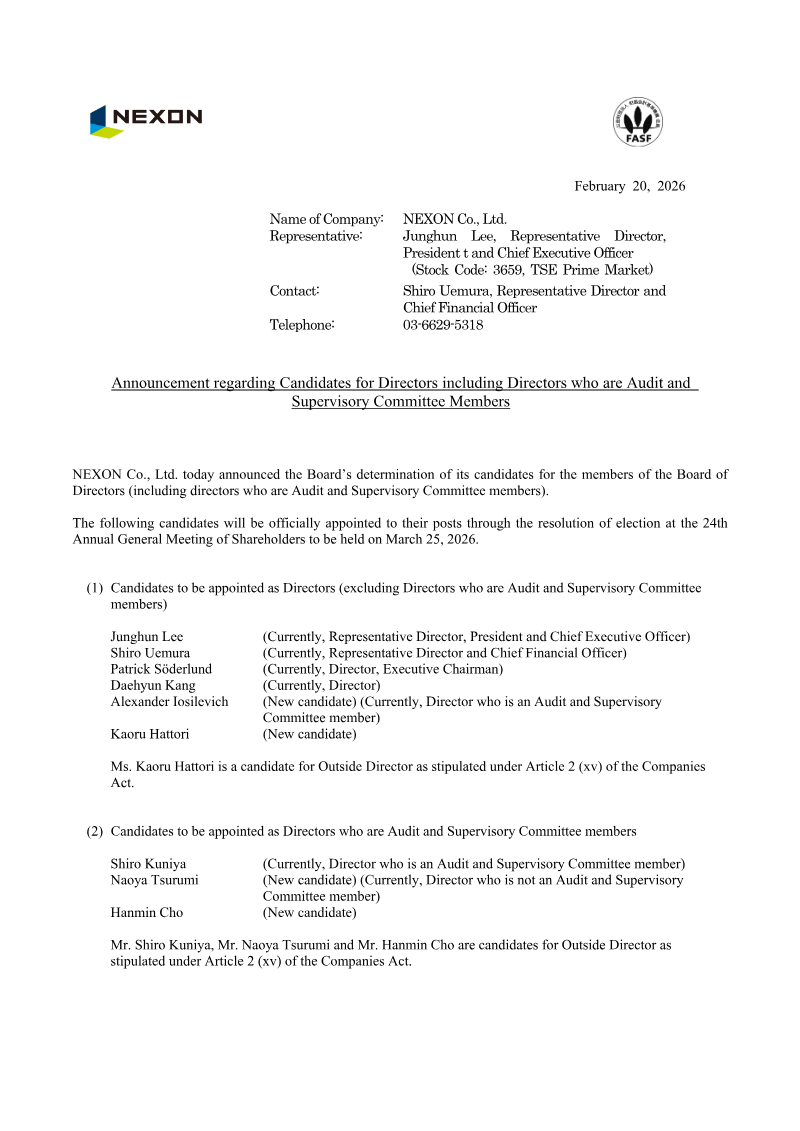
2026.02.20 Announcement regarding Candidates for Directors including Directors who are Audit and Supervisory Committee Members
NEXON Co., Ltd. announced the Board’s selection of candidates for its 24th Annual General Meeting on March 25, 2026. The slate includes six directors, among them two new outside directors and three individuals who will serve concurrently on the Audit and Supervisory Committee. Current executives Junghun Lee, Shiro Uemura, Patrick Söderlund and Daehyun Kang are retained. New appointments comprise Alexander Iosilevich, a seasoned investment‑banking executive with no shareholding in NEXON, and Kaoru Hattori, a Japanese lawyer and partner at Nagashima Ohno & Tsunematsu who also holds trustee and board roles in Toyo Seikan Group Holdings. The Audit and Supervisory Committee will be strengthened by Shiro Kuniya, Naoya Tsurumi—an experienced Sega executive with extensive leadership roles across SEGA subsidiaries—and Hanmin Cho, a private‑equity professional who has led investment divisions at NXC Corporation and holds directorships in NXMH B.V. and Bitstamp Limited.
The announcement details each candidate’s career trajectory, concurrent positions, and share ownership (all new candidates hold zero shares). The selection aligns with Korean Companies Act provisions for outside directors and reflects NEXON’s strategy to blend internal leadership continuity with external expertise in finance, gaming operations, and regulatory oversight. The candidates’ diverse backgrounds—spanning global investment banking, legal practice, gaming industry leadership, and private‑equity management—are intended to enhance governance, strategic direction, and risk oversight for the company’s operations in South Korea and its international markets.
- NEXON Co., Ltd. will present a slate of six director candidates for approval at its 24th Annual General Meeting on March 25, 2026.
- The board is retaining current executives Junghun Lee, Shiro Uemura, Patrick Söderlund, and Daehyun Kang to ensure leadership continuity.
- New outside director appointments include Alexander Iosilevich, an investment-banking executive, and Kaoru Hattori, a partner at the law firm Nagashima Ohno & Tsunematsu.
- The Audit and Supervisory Committee will be strengthened by the addition of Shiro Kuniya, former Sega executive Naoya Tsurumi, and private-equity professional Hanmin Cho.
- The new director candidates hold zero shares in NEXON, and their appointments are intended to bolster governance and regulatory oversight in South Korea and international markets.
+1
NEXON Co.
Report11 pages
Consolidated Financial Statements: Q1 Fiscal Year 2026 (Japan)
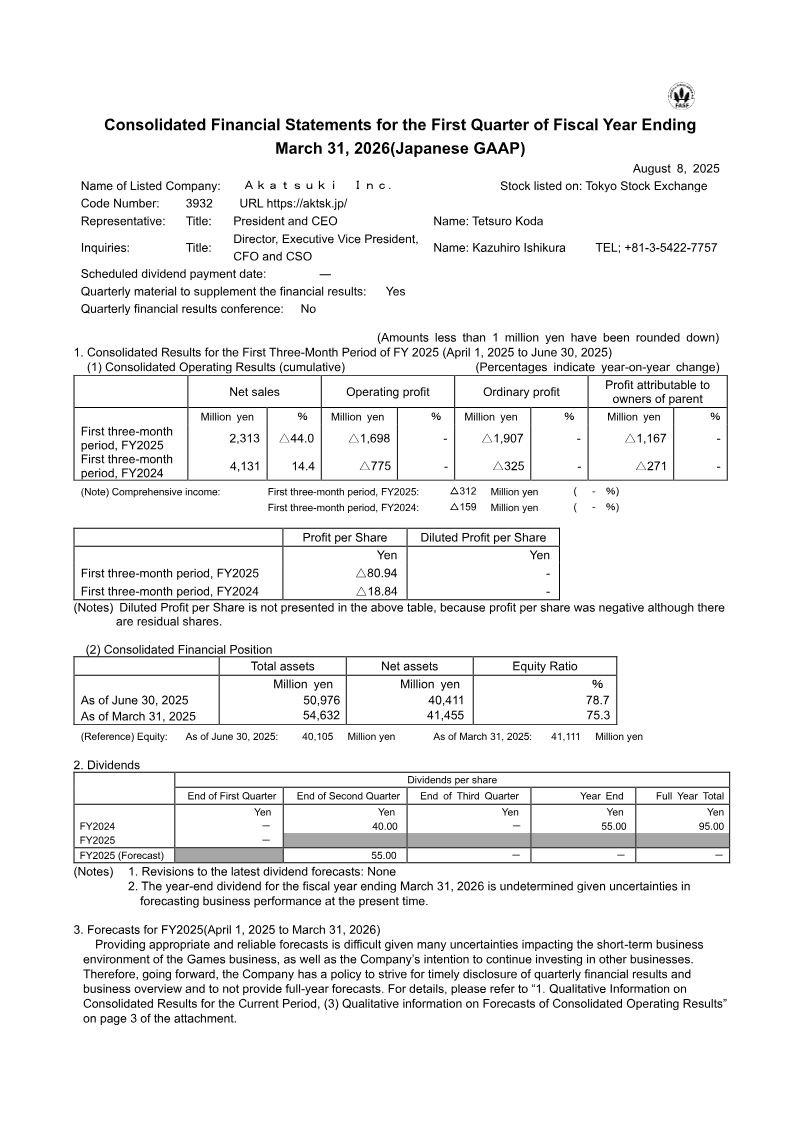
Akatsuki Inc. reports a first‑quarter fiscal 2025 performance that reflects a sharp contraction in its core gaming and comics businesses amid a challenging macro‑environment. Net sales fell 44 % YoY to ¥2,313 million, while operating loss widened to ¥1,698 million from a prior‑year loss of ¥775 million. The company’s consolidated equity ratio improved to 78.7 % from 75.3 %, but total assets declined by ¥3,656 million to ¥50,976 million. Net loss attributable to parent shareholders reached ¥1,167 million, a significant increase from the prior‑year loss of ¥271 million. Comprehensive income deteriorated to ¥312 million in losses versus ¥159 million previously.
Segment analysis shows the Games unit suffered a 52.3 % sales decline and an operating loss of ¥1,643 million; the Comics unit posted a modest profit of ¥20 million after an 18.3 % sales drop; the newly standalone IP Solutions unit grew sales by 167 % and generated a ¥122 million profit, largely driven by the inclusion of subsidiary CRAYON, Inc. The Others segment recorded a small profit after an 80.9 % sales increase.
Geographically, the report focuses on Japan with no disclosed overseas revenue breakdown. Methodologically, figures are based on Japanese GAAP quarterly consolidation; no full‑year forecasts are provided due to market uncertainty. The company maintains a policy of timely quarterly disclosure while withholding FY2026 forecasts, citing volatile gaming and investment conditions.
- Akatsuki Inc. experienced a sharp financial downturn in Q1 FY2025, with net sales falling 44% year-over-year to ¥2,313 million and operating losses widening to ¥1,698 million.
- The core Games unit was the primary driver of the deficit, suffering a 52.3% decline in sales and recording an operating loss of ¥1,643 million.
- Net loss attributable to parent shareholders increased significantly to ¥1,167 million, compared to a ¥271 million loss in the same period last year.
- The IP Solutions unit emerged as a growth driver, increasing sales by 167% and generating a ¥122 million profit, largely due to the inclusion of subsidiary CRAYON, Inc.
- The Comics unit remained marginally profitable at ¥20 million, despite an 18.3% decline in segment sales.
+1
Akatsuki

Report37 pages
Earnings Results: Q3 Fiscal Year Ending March 2026
1. 2026 年3 月期第 3四半期連結実績サマリ P3 2. 2026 年3 月期第 3四半期連結実績(セグメント別) P10 3. Appendix P19 Q12 20263ThDuloos①#H3-A? A 2025年3月期 2026年3月期 前年同期比 2025年3月期 2026年3月期 前年同期比 (単位:百万円) 4-12月実績 4-12月実績 (増減額) 10-12月実績 10-12月実績 (増減額) 売上高 206,587 202,991 ▲1.7% 70,267 69,058 ▲1.7% Q12 (▲3,595) (▲1,208) ③ ▲59.7% ...
- For the first three quarters of fiscal year ending March 2026 (April-December), overall sales decreased by 1.7%, operating profit by 59.7%, ordinary profit by 47.1%, and net profit by 70.0% compared to the previous year, largely due to declines in publishing/IP creation, anime/live-action, and games.
- The Publishing/IP Creation segment's operating profit decreased by 90.2% year-over-year, primarily due to a change in revenue recognition timing for electronic books (approx. -2 billion JPY), reduced marginal profit from smaller per-title sales despite increased new IP, and higher personnel and investment costs.
- The Anime/Live-Action segment experienced a 16.6% decrease in sales and a significant drop in operating profit year-over-year, mainly because the previous year benefited from major anime titles and extensive secondary usage of live-action films, which were not replicated this period.
- The Education/EdTech segment saw strong growth, with sales increasing by 13.4% and operating profit by 10.9% year-over-year, driven by increased student numbers at Vantan and N High School Group/ZEN University.
- Despite overall declines, the Game segment saw strong sales from "ELDEN RING NIGHTREIGN" and its DLC, though it still experienced a year-over-year decrease compared to the previous period's significant contributions from "ELDEN RING" DLC and the main game.
+1
Kadokawa Corporation
Report3 pages
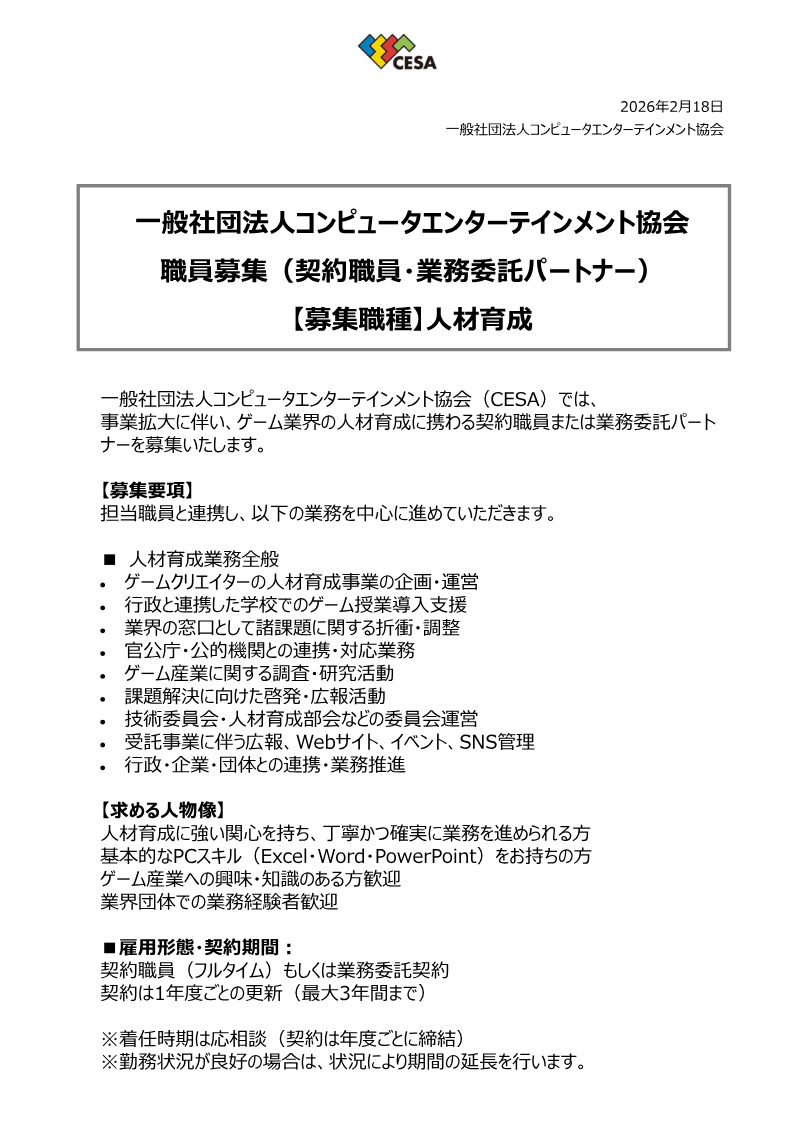
職員募集(契約職員・業務委託パートナー):人材育成
The Computer Entertainment Society (CESA) announces a recruitment drive for contract personnel and outsourced partners to support its expanding human‑resource development initiatives within Japan’s video‑game sector. The role centers on planning and operating creator training programs, facilitating the introduction of game‑based curricula in schools in collaboration with government bodies, and acting as a liaison for industry‑wide issues. Additional responsibilities include coordinating with public agencies, conducting research on the gaming industry, managing outreach and publicity, overseeing committee activities, and handling web, event, and social‑media communications tied to commissioned projects.
Candidates are expected to possess at least five years of professional experience, demonstrable negotiation and coordination skills, and a strong interest in gaming. Preferred backgrounds include prior interaction with governmental entities, experience driving contract‑based projects, and familiarity with educational or certification activities related to games. Basic PC proficiency in spreadsheet, word‑processing, and presentation software is required, while prior employment in game companies or teaching roles is advantageous.
Employment is offered either as a full‑time contract employee with a standard 9:00‑17:30 schedule in Shinjuku, Tokyo, or as an outsourced partnership negotiated according to individual expertise. Contract terms are annual, renewable up to three years, with an hourly wage starting at ¥1,800, subject to experience. Benefits encompass health, pension, unemployment, and workers’ compensation insurance, a complete two‑day weekend, and a smoke‑free office environment. Applications are to be submitted via the CESA inquiry form, followed by a two‑stage interview process conducted online and in person.
- The Computer Entertainment Society (CESA) is hiring contract personnel and outsourced partners to lead human-resource development and creator training programs within the Japanese video-game industry.
- Core responsibilities include facilitating game-based curricula in schools, managing government relations, conducting industry research, and overseeing communications for commissioned projects.
- Candidates must have at least five years of professional experience, with preference given to those with backgrounds in government liaison work, project management, or educational certification.
- Contract employees are based in Shinjuku, Tokyo, with a standard 9:00–17:30 schedule and an hourly wage starting at ¥1,800.
- Employment terms are annual and renewable for up to three years, with full benefits including health, pension, unemployment, and workers' compensation insurance.
+2
CESA – Computer Entertainment Supplier's AssociationFeb 2026
Report4 pages
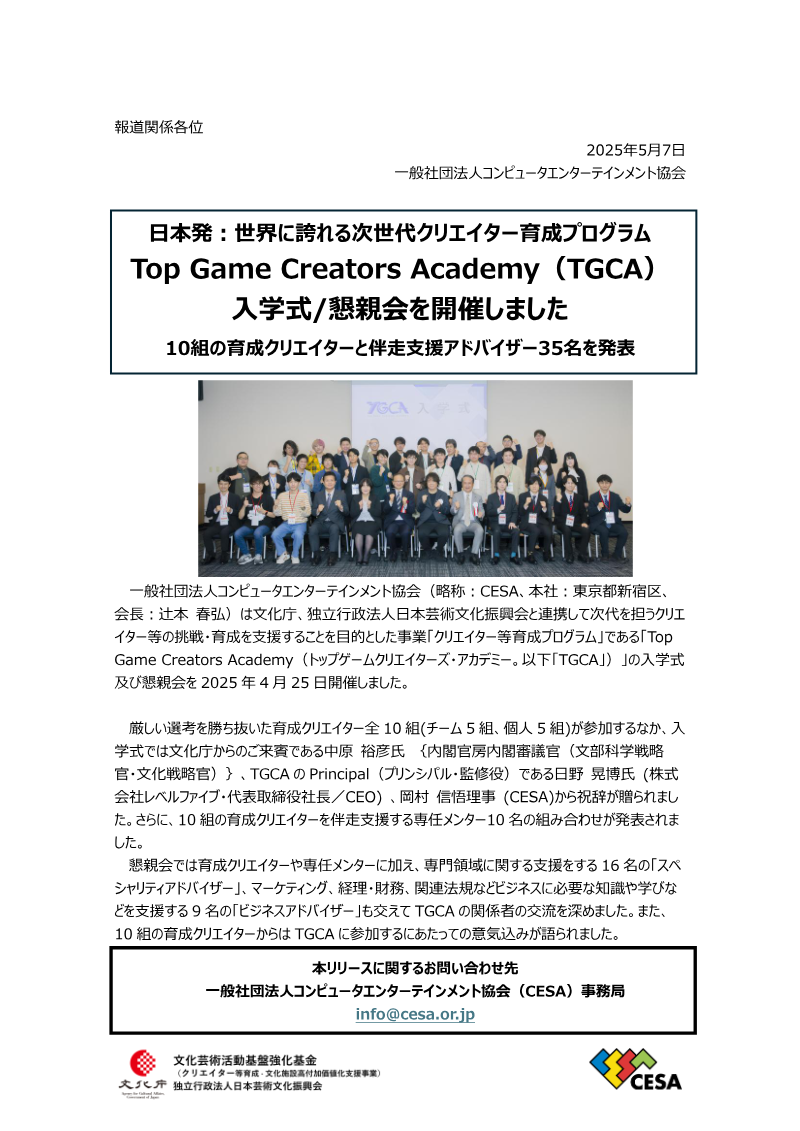
Top Game Creators Academy: 入学式/懇親会を開催しました
The Top Game Creators Academy (TGCA) was inaugurated on 25 April 2025 as a joint initiative of the Cultural Agency, the Japan Arts and Culture Promotion Agency, and the Computer Entertainment Association (CESA) to cultivate next‑generation game creators capable of delivering original IP that can compete globally. Ten selected teams—five groups and five individual creators—were formally admitted, accompanied by thirty‑five advisors who will provide ongoing mentorship, specialty guidance, and business support throughout a two‑year development cycle.
The program draws on the Cultural Arts Activity Strengthening Fund, allocating public resources to enable intensive, mentor‑driven training. Each creator cohort is paired with a dedicated mentor from leading studios such as Bandai Namco, Capcom, and Square Enix, while sixteen specialty advisors cover visual art, engineering, design, sound, and project management, and nine business advisors address marketing, finance, and legal matters. Progress meetings occur monthly, fostering collaborative feedback within multi‑person groups rather than one‑on‑one pairings.
Participants will showcase their work at major industry events, beginning with an online appearance at CEDEC in July 2025, a debut at Tokyo Game Show in September 2025, and subsequent exhibitions at the Taipei Game Show in January 2026, with potential expansion to international venues such as Gamescom in 2026. The cohort aims to graduate by March 2027, having refined both creative and commercial competencies to launch globally competitive titles.
- The Top Game Creators Academy (TGCA) launched on 25 April 2025 to develop globally competitive original IP through a two-year intensive mentorship program.
- The cohort consists of 10 teams—5 groups and 5 individuals—supported by a network of 35 advisors, including 16 specialty experts and 9 business consultants.
- Mentorship is provided by industry leaders from major studios, specifically Bandai Namco, Capcom, and Square Enix.
- The program is funded by the Cultural Arts Activity Strengthening Fund, a joint initiative involving the Cultural Agency, the Japan Arts and Culture Promotion Agency, and CESA.
- Participants will debut their projects at CEDEC in July 2025 and Tokyo Game Show in September 2025, followed by Taipei Game Show in January 2026.
+2
CESA – Computer Entertainment Supplier's AssociationMay 2025
Report3 pages
2025 Half-Year Market Model Update: Asia & MENA
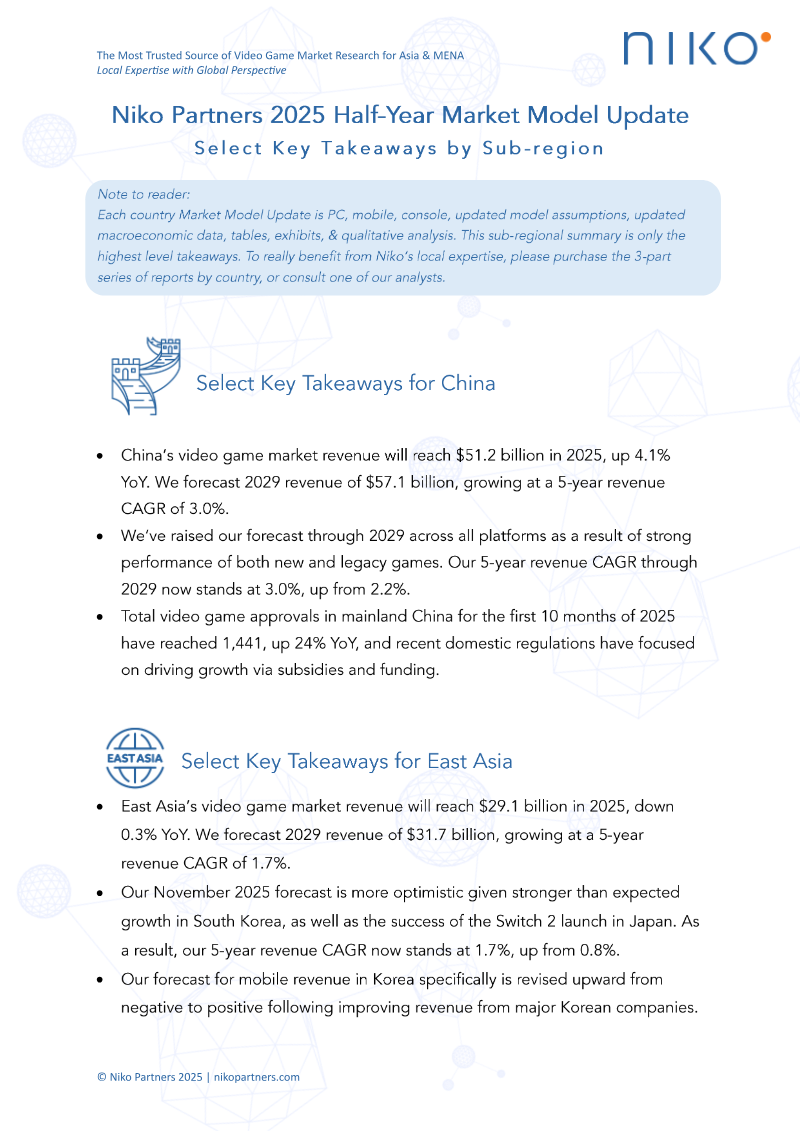
The 2025 Half-Year Market Model Update provides a comprehensive assessment of the video game industry across Asia and the Middle East and North Africa (MENA) region. By synthesizing macroeconomic data, platform-specific performance metrics, and regulatory developments, the analysis offers updated revenue forecasts through 2029 for key markets, including China, East Asia, India, Southeast Asia, and the MENA-3 region. The primary objective is to adjust long-term growth expectations based on recent industry performance, government policy shifts, and evolving consumer behavior.
Regional performance varies significantly, with India emerging as a high-growth market, projected to reach $1.1 billion in 2025 with a robust 12.9% five-year compound annual growth rate (CAGR). China remains the dominant market, with 2025 revenue expected to hit $51.2 billion, supported by a 24% year-over-year increase in game approvals. Conversely, East Asia and Southeast Asia show more moderate growth trajectories, with five-year CAGRs of 1.7% and 3.5%, respectively. The MENA-3 region is forecasted to reach $2.2 billion in 2025, though long-term projections have been tempered by economic headwinds in Egypt and slower mobile growth in Saudi Arabia and the UAE.
Methodologically, these insights are derived from proprietary market models that integrate platform-specific data for PC, mobile, and console segments. The analysis highlights the critical role of government intervention, such as the PROG act in India and regulatory subsidies in China, in shaping market expansion. By updating previous forecasts to reflect current fiscal realities and hardware cycles, such as the Switch 2 launch in Japan, the findings offer a refined outlook for stakeholders navigating the complex regulatory and economic landscapes of these diverse geographic segments.
- China remains the dominant regional market with projected 2025 revenue of $51.2 billion, bolstered by a 24% year-over-year increase in game approvals.
- India is positioned as a high-growth market expected to reach $1.1 billion in 2025 with a 12.9% five-year compound annual growth rate (CAGR).
- The MENA-3 region is forecasted to reach $2.2 billion in 2025, though long-term growth is tempered by economic headwinds in Egypt and slowing mobile performance in Saudi Arabia and the UAE.
- East Asia and Southeast Asia exhibit moderate growth trajectories, with five-year CAGRs of 1.7% and 3.5%, respectively.
- Market expansion across these regions is increasingly driven by government policy, including the PROG act in India and regulatory subsidies in China.
+5
Niko PartnersJan 2025
Report7 pages
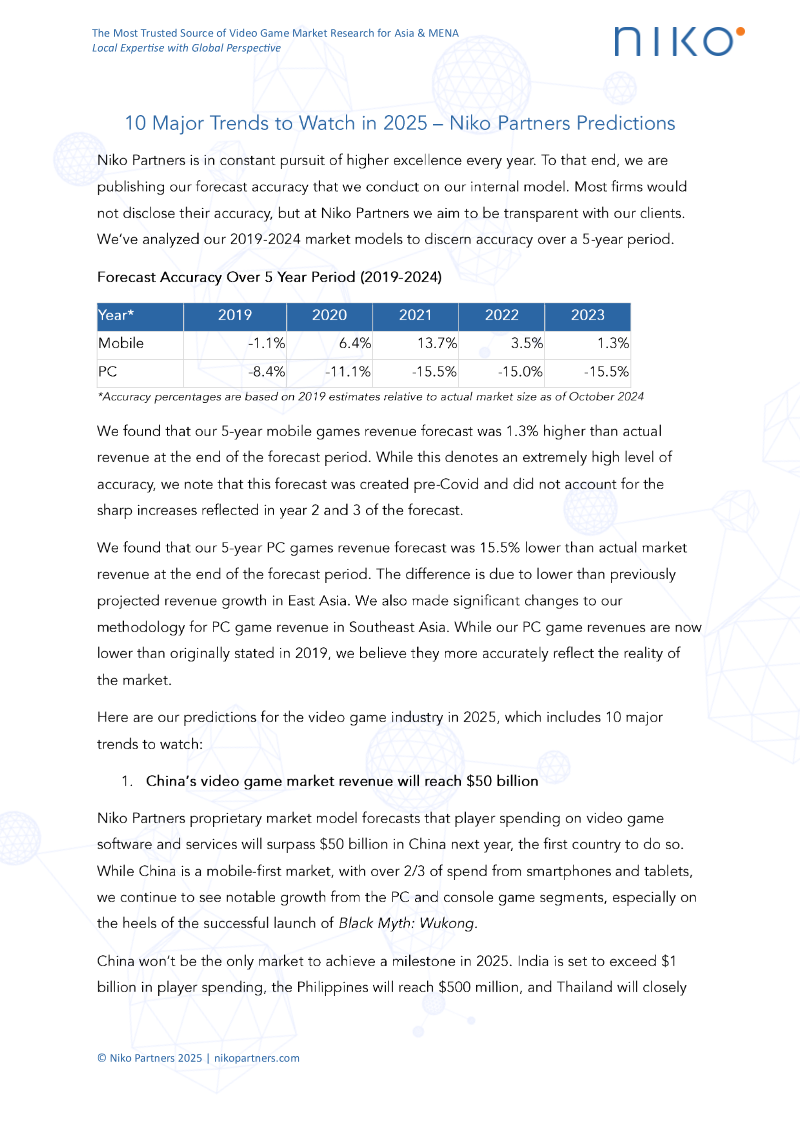
10 Major Trends to Watch in Asia & MENA
The video game industry across Asia and the Middle East and North Africa (MENA) is undergoing a period of significant transformation as of 2025, driven by shifting player demographics and evolving monetization strategies. These regions represent the primary engines of global gaming growth, characterized by a massive mobile-first audience and a rapidly expanding middle class with increasing discretionary income. Market dynamics are increasingly defined by the convergence of social media, competitive gaming, and cross-platform accessibility, which have collectively lowered the barrier to entry for new consumers while deepening engagement among existing enthusiasts.
Strategic focus in these territories has shifted toward hyper-localization and the integration of emerging technologies to enhance user retention. In the MENA region, government-backed initiatives and large-scale investments are accelerating the development of local infrastructure and talent, positioning countries like Saudi Arabia and the United Arab Emirates as central hubs for international esports and game development. Meanwhile, the Asian market continues to lead in the refinement of live-service models and the adoption of innovative payment ecosystems that bypass traditional storefront limitations.
The current landscape emphasizes the necessity of understanding regional regulatory environments and cultural nuances to achieve commercial success. As the industry moves forward, the integration of artificial intelligence in content creation and the rise of niche gaming communities are expected to further diversify the market. Companies that prioritize local expertise and adapt to the unique technological preferences of these diverse populations will be best positioned to capitalize on the sustained upward trajectory of the Asia and MENA gaming sectors.
- Asia and MENA are the primary engines of global gaming growth, driven by a mobile-first audience and a rising middle class with increased discretionary income.
- Government-backed investments in Saudi Arabia and the UAE are rapidly establishing these nations as central hubs for international esports and game development infrastructure.
- Market success in these regions now requires hyper-localization and the adoption of innovative payment ecosystems that bypass traditional storefront limitations.
- The convergence of social media, competitive gaming, and cross-platform accessibility is successfully lowering barriers to entry while deepening user engagement.
- Future market growth will be defined by the integration of artificial intelligence in content creation and the strategic targeting of niche gaming communities.
+2
Niko PartnersJan 2025
Report3 pages
Asian & MENA Markets: 2025 Half-Year Report
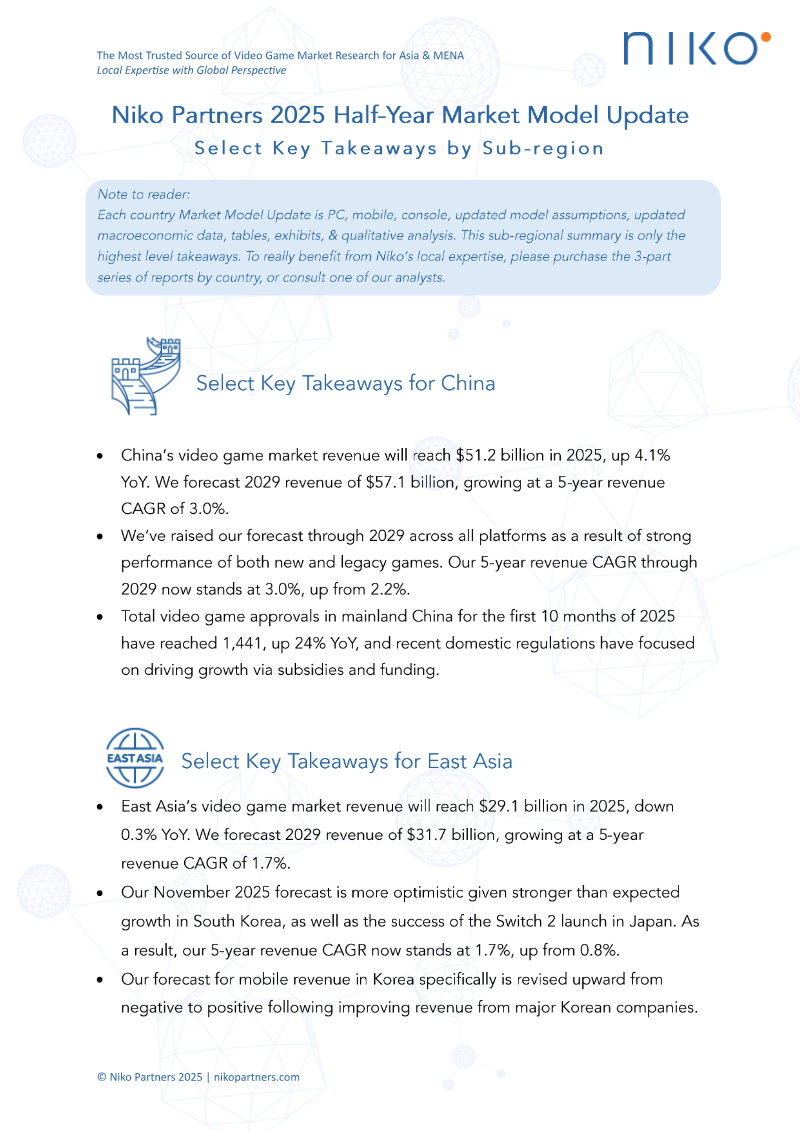
The video game markets across Asia and the Middle East are entering a period of recalibrated growth, with total revenues across key sub-regions projected to reach significant milestones by 2025. China remains the dominant force, with revenues expected to hit $51.2 billion in 2025, supported by a 4.1% year-over-year increase. This growth is fueled by a 24% rise in game approvals and proactive government subsidies. While China maintains a steady long-term outlook with a 3.0% five-year compound annual growth rate, India emerges as the fastest-growing market. India is projected to surpass the $1 billion threshold in 2025 with a 16.2% year-over-year increase, driven by the PROG Act of 2025, which pivoted the industry away from real-money gaming toward traditional video games and esports.
Regional performance varies significantly based on local macroeconomic conditions and hardware cycles. East Asia, comprising Japan and South Korea, shows a more optimistic outlook than previously anticipated, with a revised five-year growth rate of 1.7%. This shift is attributed to the successful launch of the Nintendo Switch 2 and a recovery in the South Korean mobile sector. Conversely, Southeast Asia and the MENA-3 region (Saudi Arabia, UAE, and Egypt) face more tempered expectations. Southeast Asia’s growth forecast was lowered to 3.5% due to headwinds in Thailand and Indonesia, despite strong performance in Vietnam. Similarly, the MENA-3 forecast was adjusted downward to a 6.4% growth rate as economic challenges in Egypt and slower mobile growth in Saudi Arabia offset increased government support for localization and age-rating reforms.
The data, derived from Niko Partners’ 2025 half-year market model updates, covers PC, mobile, and console platforms across 13 distinct markets. The methodology integrates proprietary market models, macroeconomic indicators, and qualitative regulatory analysis to provide a comprehensive five-year outlook through 2029. Overall, the findings suggest that while mature markets like China and East Asia are stabilizing, emerging markets like India and Vietnam are becoming critical drivers of global industry expansion.
- China remains the dominant regional market with projected 2025 revenues of $51.2 billion, supported by a 4.1% year-over-year increase and a 24% rise in government game approvals.
- India is the fastest-growing market, projected to exceed $1 billion in 2025 with 16.2% year-over-year growth following the PROG Act's shift toward traditional gaming and esports.
- The MENA-3 region (Saudi Arabia, UAE, and Egypt) has a revised growth forecast of 6.4%, as economic challenges in Egypt and slowing mobile growth in Saudi Arabia temper the impact of government-led localization efforts.
- East Asia’s five-year growth outlook has been revised to 1.7%, bolstered by the launch of the Nintendo Switch 2 and a recovery in the South Korean mobile sector.
- Southeast Asia’s growth forecast is 3.5%, with strong performance in Vietnam being offset by macroeconomic headwinds in Thailand and Indonesia.
+1
Niko PartnersJan 2025
Report9 pages
Longitudinal Survey Report on Gaming Disorder: Japan
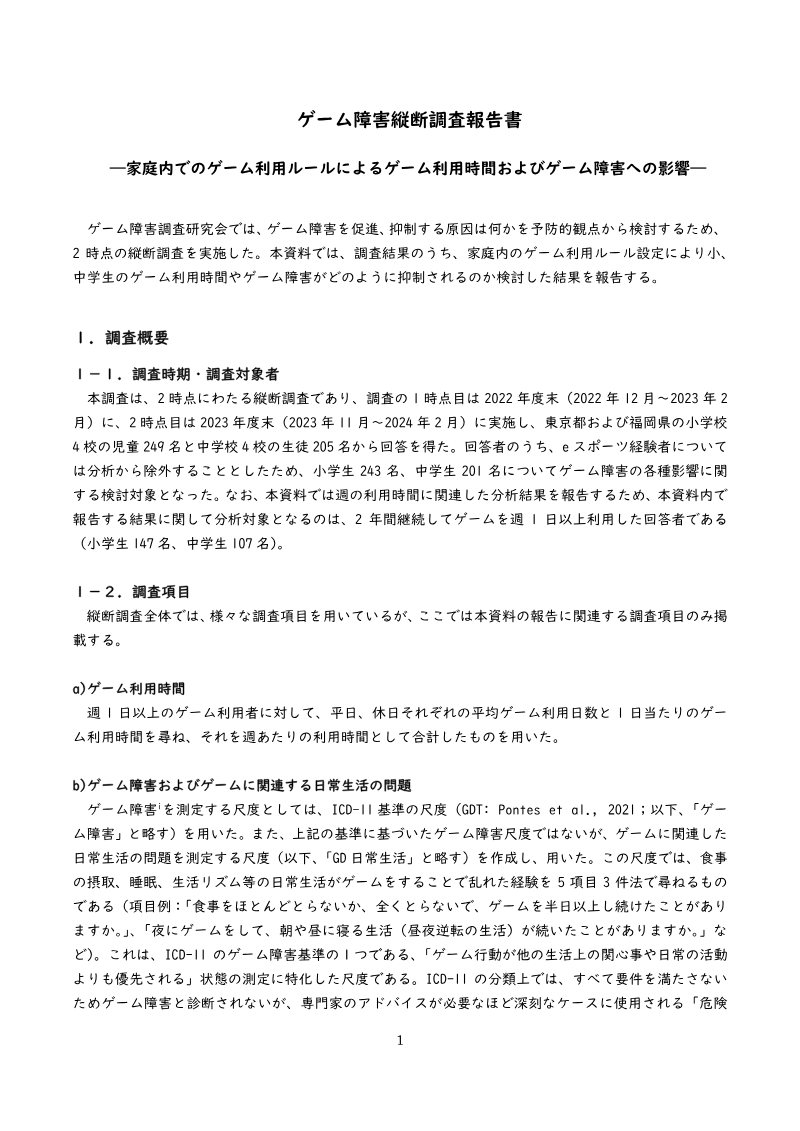
The study investigates how household rules governing video‑game use influence weekly play time and the emergence of gaming disorder among Japanese elementary and middle‑school students. By tracking participants over two survey waves—late 2022 to early 2023 and late 2023 to early 2024—the research tests whether specifying permissible gaming periods or prohibiting certain times can curb excessive play and related daily‑life problems.
A longitudinal sample was drawn from four elementary schools and four middle schools in Tokyo and Fukuoka, yielding 243 elementary and 201 middle‑school respondents after excluding esports players. Analyses focused on the 147 elementary and 107 middle‑school students who reported gaming at least once per week across both waves. Weekly gaming hours were calculated from weekday and weekend use, while gaming disorder was measured with the ICD‑11‑based Gaming Disorder Test and a custom scale assessing disruptions to sleep, meals, and routine. The presence of two rule types—“allowed‑time” (e.g., one hour per day) and “prohibited‑time” (e.g., no gaming after midnight)—was recorded at each wave and examined using cross‑lagged models and mixed‑design ANOVAs.
Results show that higher weekly gaming hours predict later increases in gaming‑disorder scores for both age groups (standardized coefficients .12 for elementary and .11 for middle‑school students), while disorder does not feed back into later play time. Gaming hours and daily‑life problems mutually reinforce each other, forming a negative feedback
- Increased weekly gaming hours serve as a significant predictor for higher gaming disorder scores, with standardized coefficients of .12 for elementary students and .11 for middle-school students.
- Gaming hours and daily-life problems, such as disruptions to sleep and meals, create a negative feedback loop where each factor mutually reinforces the other.
- Gaming disorder symptoms do not appear to influence or increase future weekly play time, suggesting that excessive play is the primary driver of disorder rather than a consequence of it.
- The study tracked 254 total students—147 elementary and 107 middle-schoolers—who played games at least once per week across two survey waves between late 2022 and early 2024.
- Research methodology utilized the ICD-11-based Gaming Disorder Test and a custom scale to measure the impact of household rules, specifically 'allowed-time' limits and 'prohibited-time' restrictions.
+1
CESA – Computer Entertainment Supplier's AssociationJan 2024
Report3 pages
NHK Enterprise's 'Kami-Ge Creator Evolution' Succeeds Japan Game Awards 'Amateur' and 'U18' Divisions
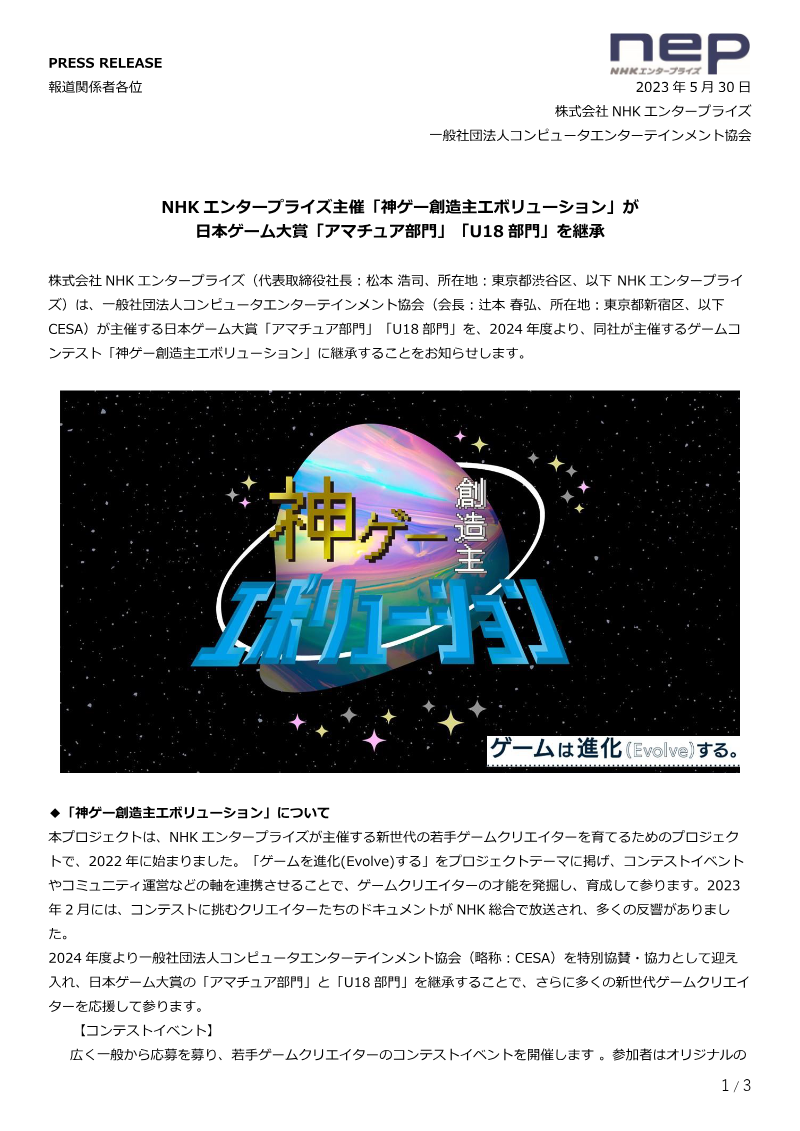
NHK Enterprise is launching the “Kami‑Ge Creator Evolution” contest as a dedicated platform for nurturing the next generation of Japanese game developers, and from 2024 it will incorporate the Japan Game Awards’ Amateur and U18 divisions. The initiative, begun in 2022 under the theme “Evolve the Game,” seeks to discover and develop talent through a series of contest events, community support, and media exposure, including a documentary broadcast on NHK General in February 2023 that generated strong public interest.
The competition invites creators from across Japan to submit original games, which are evaluated for innovative expansion of the medium’s boundaries by a diverse panel of established game designers, media artists, and other industry figures. In addition to expert judging, a public popularity vote is conducted, and the contest awards a Grand Prize, Excellence Awards, and Honorable Mentions in the Amateur category, while the U18 category focuses on participants aged 18 or younger, reflecting the Japan Game Awards’ long‑standing commitment to youth development since 2018. The 2024 schedule begins with an entry period from 1 February to the end of April, followed by nomination, second‑round video submissions in July, third‑round game submissions in October, finalist announcements at the end of October, and a final event slated for December.
A closed Discord community supports participants with exclusive benefits, knowledge sharing, and mentorship, reinforcing the project’s role as a learning environment. Special cooperation from the Computer Entertainment Supplier’s Association (CESA) provides additional industry credibility and resources. The contest is open to individuals, teams, corporations, and organizations regardless of age, gender, nationality, or the number of entries, emphasizing inclusivity and broad outreach.
By integrating the Amateur and U18 awards, the “Kami‑Ge Creator Evolution” aims to broaden the creative framework of Japanese games, foster innovative design, and strengthen the pipeline of skilled developers. The organizers are actively seeking sponsors to sustain the project’s growth and align with NHK Enterprise’s broader commitment to sustainable development and cultural enrichment.
- NHK Enterprise has integrated the Japan Game Awards’ Amateur and U18 divisions into its 'Kami-Ge Creator Evolution' contest, effective from 2024.
- The 2024 competition timeline spans from February 1 to a final event in December, featuring a multi-stage evaluation process including video submissions in July and game submissions in October.
- The contest is open to all applicants regardless of age, nationality, or organizational status, with specific categories for general amateur creators and those aged 18 or younger.
- Participants gain access to a closed Discord community providing mentorship, knowledge sharing, and exclusive resources to support developer growth.
- The initiative is supported by the Computer Entertainment Supplier’s Association (CESA) to provide industry credibility and resources for the project.
+2
CESA – Computer Entertainment Supplier's AssociationMay 2023

Report15 pages
Five Key Mobile Game Genres in Asia and MENA
The bulletin delivers a data‑driven assessment of the five most influential mobile game genres in Asia and MENA for 2022, combining a 9,000‑respondent survey from Niko Partners with AppMagic’s analytics of Apple and Google Play stores. The analysis covers China, India, Indonesia, Japan, Korea, Malaysia, Philippines, Saudi Arabia, Singapore, Thailand, UAE, Vietnam and Egypt, providing a comprehensive view of regional spending patterns, download volumes, and player demographics.
RPGs dominate the market, generating 50 % more revenue than the other four genres combined and achieving the highest monetization score (7.7) thanks to strong spend in East Asia. Strategy games rank second in revenue and third in downloads, yet exhibit the lowest engagement score (5.2) due to shorter play sessions and lower player longevity. MOBAs deliver the second‑highest revenue per download (5.4) and lead in average weekly playtime, but their esports engagement is modest. Puzzle titles enjoy the largest download base (highest engagement score of 6.0) but suffer from low monetization and esports relevance. Battle Royale games, while generating the lowest total revenue, excel in esports metrics (score 9.5) and maintain high engagement levels.
The methodology blends survey‑derived player profiles with AppMagic’s download, revenue, and esports viewership data across 21 metrics, weighted into four categories—monetization, engagement, esports appeal, and overall genre score. The resulting scores (1–10) rank RPG as the top genre overall, with Battle Royale leading in esports influence and Puzzle offering the broadest download reach. The bulletin concludes that developers targeting these markets should tailor monetization strategies to RPG’s high spend, leverage MOBAs’ loyal user base, and capitalize on Battle Royale’s esports traction.
- RPG titles are the dominant market force, generating 50% more revenue than the other four top genres combined and achieving the highest monetization score of 7.7.
- Puzzle games command the largest download volume and highest engagement score of 6.0, though they suffer from low monetization and minimal esports relevance.
- Battle Royale games lead the market in esports influence with a score of 9.5, despite generating the lowest total revenue among the five genres.
- MOBAs maintain the second-highest revenue per download at 5.4 and lead all genres in average weekly playtime.
- Strategy games rank second in total revenue but exhibit the lowest engagement score of 5.2, driven by shorter play sessions and lower player longevity.
+1
Niko PartnersJan 2023
Report23 pages
Peak Play: Trends in East Asian Videogame Streaming H1 2023
The East Asian videogame livestreaming market is a mature and culturally distinct ecosystem where competitive esports serve as the primary engine for audience engagement. During the first half of 2023, MOBA and Battle Royale titles accounted for over half of the region's most-watched content. While established franchises like League of Legends maintain a dominant presence, the market is increasingly shaped by the influence of Key Opinion Leaders and VTubers. These creators contribute up to 15% of total viewership for major titles and have demonstrated the power to revitalize older games such as Minecraft and Escape from Tarkov.
Regional preferences reveal a bifurcated landscape where specific titles command massive scale. In China, Honor of Kings remains the undisputed leader with 5.67 billion views, while VALORANT and Apex Legends dominate the Japanese and Korean markets, each surpassing 100 million hours watched. The barrier to entry for new releases is high, as only high-profile 2023 titles like Diablo IV, Honkai: Star Rail, and Street Fighter 6 managed to break into regional top-ten rankings. The rapid ascent of Honkai: Star Rail in China notably came at the expense of Genshin Impact, which saw a 31% decline in viewership as audiences shifted toward the newer release.
The integration of granular streaming analytics and market intelligence is essential for navigating this complex environment. By tracking metrics across platforms such as Twitch, YouTube, and AfreecaTV, stakeholders can monitor audience retention and demographic shifts. This data-driven approach highlights the volatility of the market, evidenced by the 68.5% decline in Splatoon 3 viewership following its launch period. Understanding these dynamics—ranging from the professional esports circuit to the rising prominence of virtual avatars—is critical for identifying growth opportunities and executing successful market entry strategies across Asia.
- Competitive esports, specifically MOBA and Battle Royale titles, drive over 50% of total viewership in the East Asian streaming market.
- Honor of Kings remains the dominant force in China with 5.67 billion views, while VALORANT and Apex Legends lead in Japan and Korea with over 100 million hours watched each.
- Key Opinion Leaders and VTubers are significant market drivers, contributing up to 15% of total viewership for major titles and successfully revitalizing older games.
- New title launches face high barriers to entry, with only Diablo IV, Honkai: Star Rail, and Street Fighter 6 breaking into regional top-ten rankings during H1 2023.
- Audience cannibalization is a measurable risk, as evidenced by Honkai: Star Rail’s growth contributing to a 31% decline in Genshin Impact viewership.
+1
Niko PartnersJan 2023
Report14 pages
Female Gamers in Asia: Version for Women in Games Asia Panel
Female gamers represent a primary engine of growth within the Asian interactive entertainment market, accounting for 35% of the region's 1.46 billion total gamers as of 2021. This demographic is expanding at a faster rate than the general gaming population, with a year-over-year growth of 7.6% compared to the total market increase of 5.0%. The scope of this analysis covers China and the Asia-10 markets, which include Chinese Taipei, India, Indonesia, Japan, Korea, Malaysia, Philippines, Singapore, Thailand, and Vietnam. Data was derived from a 2021 survey of over 6,500 randomized respondents who identified as active gamers across mobile, PC, and console platforms.
Mobile gaming is the dominant platform for this demographic, utilized by 95% of female gamers, while 60% engage with PC games and 17% use consoles. In terms of genre, female players in Asia show a strong preference for role-playing, racing, and strategy games. Discovery of new titles is primarily driven by social recommendations from friends, followed by the visual quality of graphics and core gameplay mechanics.
Monetization trends indicate that female gamers are highly engaged with in-game economies, with 84% of those willing to spend making in-game purchases. They are particularly inclined toward purchasing cosmetic items and participating in gacha mechanics. In 2021, female gamer spending reached $13.07 billion in China and $5.52 billion across the Asia-10 for mobile titles, while PC game spending reached $9.70 billion and $3.93 billion in those respective regions. These findings suggest that gender inclusivity and targeted development for diverse interests are essential for capturing the full economic potential of the Asian games industry.
- Female gamers in Asia represent 35% of the region's 1.46 billion total gamers, with a year-over-year growth rate of 7.6% that outpaces the 5.0% growth of the general gaming population.
- In 2021, female gamer spending on mobile titles reached $13.07 billion in China and $5.52 billion across the Asia-10, while PC spending reached $9.70 billion and $3.93 billion respectively.
- Mobile is the primary platform for this demographic, with 95% of female gamers playing on mobile devices, compared to 60% on PC and 17% on consoles.
- Female players in Asia demonstrate high engagement with in-game economies, as 84% of those willing to spend make in-game purchases, specifically favoring cosmetic items and gacha mechanics.
- New title discovery for this demographic is driven primarily by social recommendations from friends, followed by visual graphics quality and core gameplay mechanics.
+1
Niko PartnersOct 2022

Report26 pages
Mobile Game Genre Report: Puzzle Games
This analysis examines the mobile puzzle game market, contrasting dynamics between Western and Eastern regions with a focus on the United States, United Kingdom, Japan, and South Korea. In 2021, mobile emerged as the primary gaming platform globally, with puzzle games representing a significant 8% of total mobile game revenues, totaling $6.9 billion in 2020. The United States leads as the largest market for the genre ($2.0 billion), followed by Japan ($1.2 billion) and China ($0.9 billion).
While puzzle games are the most popular genre across all surveyed markets, regional player behaviors and monetization preferences vary significantly. In the West, players favor casual experiences and show a higher tolerance for in-app advertising (IAA). Conversely, Eastern markets, particularly Japan, demonstrate a higher propensity for in-app purchases (IAP) and deeper engagement with character collection, progression mechanics, and "gacha" systems. Demographically, puzzle gamers worldwide skew female and hold mid-to-high incomes, though players in the East tend to be younger and more highly educated than their Western counterparts.
The findings highlight a shift toward hybrid monetization models that combine IAP, IAA, and subscription-based "Battle Passes." While classic Match-3 remains the dominant subgenre, developers are increasingly integrating "meta" elements such as narrative, decoration, and RPG mechanics to drive retention. Successful global expansion requires localized user acquisition strategies; for instance, Japanese players respond better to longer intervals between ads and collaborative events with popular anime IPs, whereas U.S. marketing often benefits from performance-based ads and localized creative content. The data suggests that while the core appeal of puzzle solving is universal, long-term commercial success depends on tailoring the in-game economy and social engagement tools to specific regional expectations.
- The global mobile puzzle game market generated $6.9 billion in 2020, with the United States leading at $2.0 billion, followed by Japan at $1.2 billion and China at $0.9 billion.
- Puzzle games account for 8% of total mobile game revenue and represent the most popular genre across the United States, United Kingdom, Japan, and South Korea.
- Western markets favor casual experiences and in-app advertising (IAA), whereas Eastern markets demonstrate a higher propensity for in-app purchases (IAP) and complex mechanics like gacha systems.
- Developers are increasingly integrating 'meta' elements—such as narrative, decoration, and RPG mechanics—into classic Match-3 gameplay to improve player retention.
- Successful monetization is shifting toward hybrid models that combine IAP, IAA, and subscription-based 'Battle Passes' to maximize revenue.
+3
Newzoo & PangleAug 2021
Report15 pages
Japanese Esports on the Rise: Five Teams to Watch
Japan has emerged as a rapidly developing esports market, transitioning from a historically stagnant sector to a significant global player. Following the removal of restrictive anti-gambling regulations in 2019 and the formation of the Japan Esports Union, the industry has experienced consistent growth. Market revenue reached $69.4 million in 2021 and rose to $77 million in 2022. This expansion is driven by increased investment, the professionalization of team management, and a unique domestic culture that prioritizes lifestyle branding and content creation over traditional competitive play alone.
The industry landscape is defined by a distinct spectator culture where many fans engage with esports as passive viewers rather than active players. This trend has elevated the importance of content creators and streamers, who serve as vital revenue drivers alongside traditional sponsorships and merchandise. While the market remains heavily influenced by game publishers—who control tournament formats and titles—teams are increasingly diversifying their business models by securing corporate partnerships with non-endemic brands and expanding their reach through apparel and retail operations.
Despite this progress, the market faces challenges related to the "Galapagos syndrome," where domestic preferences for specific titles like Apex Legends, Valorant, and Identity V diverge from global trends, potentially limiting international publisher support. Furthermore, the power imbalance between teams and publishers remains a point of vulnerability. However, with teams actively seeking international expansion and professionalizing their operations, the sector is poised for further consolidation and growth. Industry experts suggest that Japan is currently mirroring the developmental trajectory of Western markets from a decade ago, indicating significant long-term potential as the ecosystem matures and attracts broader demographics, including female fans and international investors.
- The Japanese esports market grew from $69.4 million in 2021 to $77 million in 2022, supported by the 2019 removal of restrictive anti-gambling regulations and the formation of the Japan Esports Union.
- Japanese esports teams are diversifying revenue beyond traditional sponsorships by prioritizing lifestyle branding, apparel, retail operations, and partnerships with non-endemic corporate brands.
- The market is driven by a unique spectator culture that favors content creators and streamers, who serve as primary revenue generators alongside competitive play.
- Domestic market preferences exhibit 'Galapagos syndrome,' with a focus on titles like Apex Legends, Valorant, and Identity V that occasionally diverge from global trends.
- The industry remains vulnerable due to a power imbalance where game publishers maintain strict control over tournament formats and authorized titles.
+2
Niko PartnersJan 2021
Report78 pages
The State of Mobile Gaming 2021: U.S., Europe, and Asia
The global mobile gaming market experienced an unprecedented surge during the 2020–2021 period, fueled by pandemic-related shifts in consumer behavior that accelerated both spending and engagement. By early 2021, quarterly consumer spending reached $22 billion, representing a 25% year-over-year increase. While the United States maintains its position as the primary revenue generator, Asia remains the dominant force in total download volume, led by high adoption rates in India and Indonesia. Europe has also demonstrated significant growth, particularly in Germany, where social and multiplayer titles have sustained long-term engagement even as initial pandemic-era download spikes began to normalize.
Monetization remains heavily concentrated, with the top five global markets accounting for 77% of total spending. The freemium model continues to define the industry, generating 99% of App Store revenue, while premium titles face a continued decline. Although one-time in-app purchases remain the standard, subscription models are gaining momentum, currently utilized by 29% of top-grossing titles. Advertising remains a critical revenue stream, particularly within the hypercasual and puzzle genres, which lead the market in ad publishing volume and network spend. Major industry players like Zynga and Playrix continue to dominate the share of voice, though developers are increasingly cautious as they navigate the evolving landscape of user privacy and advertising attribution.
Looking toward 2023, the industry is projected to reach $117 billion in consumer spending and 67.2 billion annual downloads. While role-playing games maintain their status as the highest-grossing genre, hypercasual titles continue to drive the majority of download volume. Future growth is expected to be particularly robust in emerging markets across Southeast Asia and Europe, which are anticipated to outpace global revenue growth rates. As the market matures, the strategic shift toward diversified monetization—balancing freemium, subscription, and ad-based models—will be essential for developers to sustain growth in a post-pandemic environment.
- The global mobile gaming market reached $22 billion in quarterly consumer spending by early 2021, marking a 25% year-over-year increase.
- The industry is projected to reach $117 billion in consumer spending and 67.2 billion annual downloads by 2023.
- Monetization is highly concentrated, with the top five global markets accounting for 77% of total spending and the freemium model generating 99% of App Store revenue.
- Subscription models are gaining traction, currently utilized by 29% of top-grossing titles, while advertising remains a primary revenue stream for hypercasual and puzzle genres.
- The United States leads in revenue generation, while Asia, driven by India and Indonesia, dominates total download volume.
+4
Sensor TowerJan 2021

Report78 pages
The State of Mobile Gaming: An Analysis of Mobile Gaming Market Trends and Top Titles in the U.S., Europe, and Asia
The analysis demonstrates that the mobile‑gaming market expanded dramatically during the COVID‑19 pandemic, with global quarterly revenue reaching $33 billion in Q2 2020 and downloads climbing 39 % to 16 billion. The United States remains the dominant spend market, contributing 28 % of worldwide revenue in 2020 and generating $7 billion in Q1 2021, while emerging regions such as India (12 % of global installs) and Brazil drive download growth but lag in monetization. Hyper‑casual and shooter titles—PUBG Mobile, Garena Free Fire, Subway Surfers—consistently occupy top download positions worldwide.
In 2020 and early 2021, revenue concentration persisted in mature markets (U.S., Japan, China), yet fast‑growing regions like Europe and Southeast Asia presented expanding opportunities. European revenue was led by Playrix ($700 M) and Supercell ($600 M), with Israeli publishers also in the top‑10, while installs remained near pandemic highs at roughly 4 billion in Q1 2021. In Asia, India’s explosive download growth (nearly 3 billion installs in Q3 2020) and Indonesia’s 26 % YoY rise positioned the region as the dominant market, with PUBG Mobile and Honor of Kings topping download charts. Despite a 44 % YoY decline in Chinese installs, mobile‑game spend there continued to rise, contributing to Asian revenue of $12 billion in Q1 2021.
Genre‑level insights reveal hyper‑casual games as the fastest‑growing segment, expanding from 757 million installs in Q1 2018 to over 3.4 billion by Q1 2021 and accounting for more than 30 % of all mobile downloads that quarter. Freemium models dominate monetization, with 99 % of App Store revenue derived from free titles; subscription adoption remains a minority (≈29 %) among top U.S. games. Advertising revenue is heavily concentrated in puzzle and hyper‑casual titles, which captured over 30 % of ad spend across major networks in 2020. Playrix led overall ad spending, especially for its puzzle franchises, while Zynga’s acquisition of Rollic Games spurred a sharp increase in hyper‑casual ad spend on AdMob and Facebook.
Overall, the data underscore a mobile‑gaming ecosystem where mature markets generate the bulk of revenue, emerging regions drive download growth, hyper‑casual and battle‑royale titles dominate user acquisition, and freemium monetization models—supported by advertising—remain the primary revenue engine.
- The mobile gaming market is bifurcated between mature markets like the U.S., Japan, and China, which generate the bulk of global revenue, and emerging regions like India and Brazil, which drive the majority of download volume.
- Hyper-casual games are the fastest-growing segment, surging from 757 million installs in Q1 2018 to over 3.4 billion in Q1 2021, representing more than 30% of all mobile downloads.
- Freemium models are the industry standard, accounting for 99% of App Store revenue, while subscription models remain a minority, utilized by only 29% of top U.S. games.
- Asia remains a massive revenue engine, generating $12 billion in Q1 2021, even as China experienced a 44% year-over-year decline in installs alongside rising per-user spend.
- Advertising revenue is heavily concentrated in puzzle and hyper-casual genres, which captured over 30% of total ad spend across major networks in 2020.
+2
Sensor TowerJan 2021
Report30 pages
Mobile Game Genre Report: Role-Playing Games 2021
Role-playing games represent the most lucrative segment of the global mobile gaming market, generating $18.5 billion in 2020 and accounting for nearly a quarter of all mobile gaming revenue. This market is geographically concentrated in East Asia, where China, Japan, and South Korea collectively generate over 70% of the genre's global earnings. The landscape is characterized by the dominance of domestic publishers and a heavy reliance on established intellectual properties from movies, literature, and PC ports, which account for approximately half of the top-performing titles. The Marvel franchise serves as a primary example of this trend, exerting a pervasive influence on player acquisition and revenue generation through its immense brand saturation.
While IP-based titles leverage organic recognition, original properties must utilize aggressive influencer marketing and high-quality creative advertisements to compete. Long-term sustainability in the genre is driven by consistent content updates, social competitive mechanics, and time-limited gacha systems. Although in-app purchases remain the primary revenue driver—particularly among high-income male audiences—there is a significant shift toward hybrid monetization. Approximately 83% of players now accept non-disruptive rewarded video ads as a means to progress without direct spending.
To navigate evolving privacy regulations and tracking challenges, developers are increasingly prioritizing high-value user signals within the first 24 hours of gameplay. Interactive playable ads have emerged as a highly effective acquisition tool, occasionally increasing eCPMs by over 200%. By combining traditional spending triggers like battle passes and limited-time events with sophisticated ad integration, publishers are successfully monetizing both high-spending "whales" and non-paying users to maintain growth in an increasingly competitive global market.
- Mobile RPGs generated $18.5 billion in 2020, representing nearly 25% of total mobile gaming revenue.
- The market is heavily concentrated in East Asia, with China, Japan, and South Korea accounting for over 70% of global RPG earnings.
- Approximately 50% of top-performing RPG titles rely on established intellectual properties, such as the Marvel franchise, to drive player acquisition and revenue.
- Hybrid monetization is becoming standard, with 83% of players accepting non-disruptive rewarded video ads as an alternative to direct in-app purchases.
- Interactive playable ads have become a critical acquisition tool, capable of increasing eCPMs by more than 200%.
+5
PangleJan 2021