Game Development reports and market data
Documents
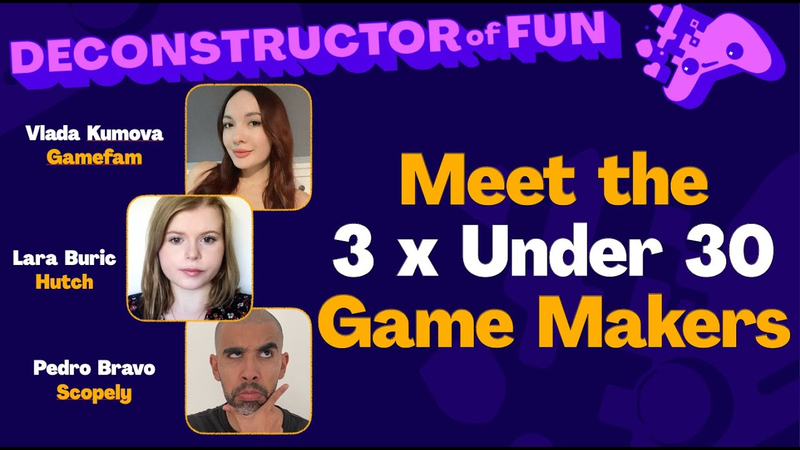
Breaking In & Leveling Up: Meet the Game Industry’s Next Generation
The game industry is currently navigating a critical transition in talent acquisition and workplace culture, driven by a disconnect between the demand for junior developers and the lack of structured mentorship programs.
- The industry faces a hiring paradox where studios demand prior experience that entry-level candidates cannot obtain, forcing new talent to gain initial experience at indie studios or startups.
- Sustainable growth requires eliminating toxic crunch culture and adopting modern management practices, such as four-day work weeks, to improve long-term employee retention and productivity.
- Studios must move away from rigid hiring criteria that prioritize traditional 'hardcore gamer' backgrounds and instead focus on diverse, modern skill sets.
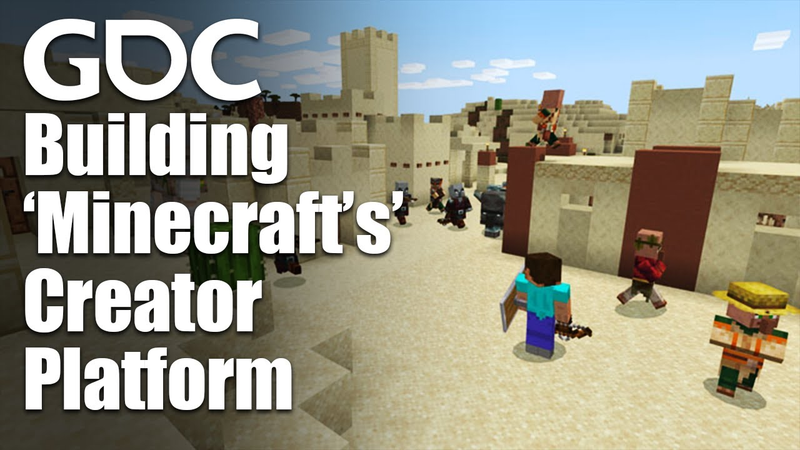
Building the 'Minecraft' Creator Platform Block-by-Block
Minecraft has successfully transformed from a sandbox game into a professional creator ecosystem by formalizing user-generated content through the Bedrock platform.
- Since launching in 2015, the Minecraft Marketplace has generated over $500 million in gross revenue and facilitated more than 1.7 billion downloads, supporting a professional creator ecosystem.
- Mojang Studios categorizes its user base into players, hobbyists, and professional creators, with the latter group transitioning from intrinsic motivation to business-oriented content production.
- To address the limitations of the C++ Bedrock codebase, Mojang is developing a formal Creator API and tooling to match the extensibility previously only available through Java decompilation.
Toward a History of Emulation: Five Eras for Videogame Emulators
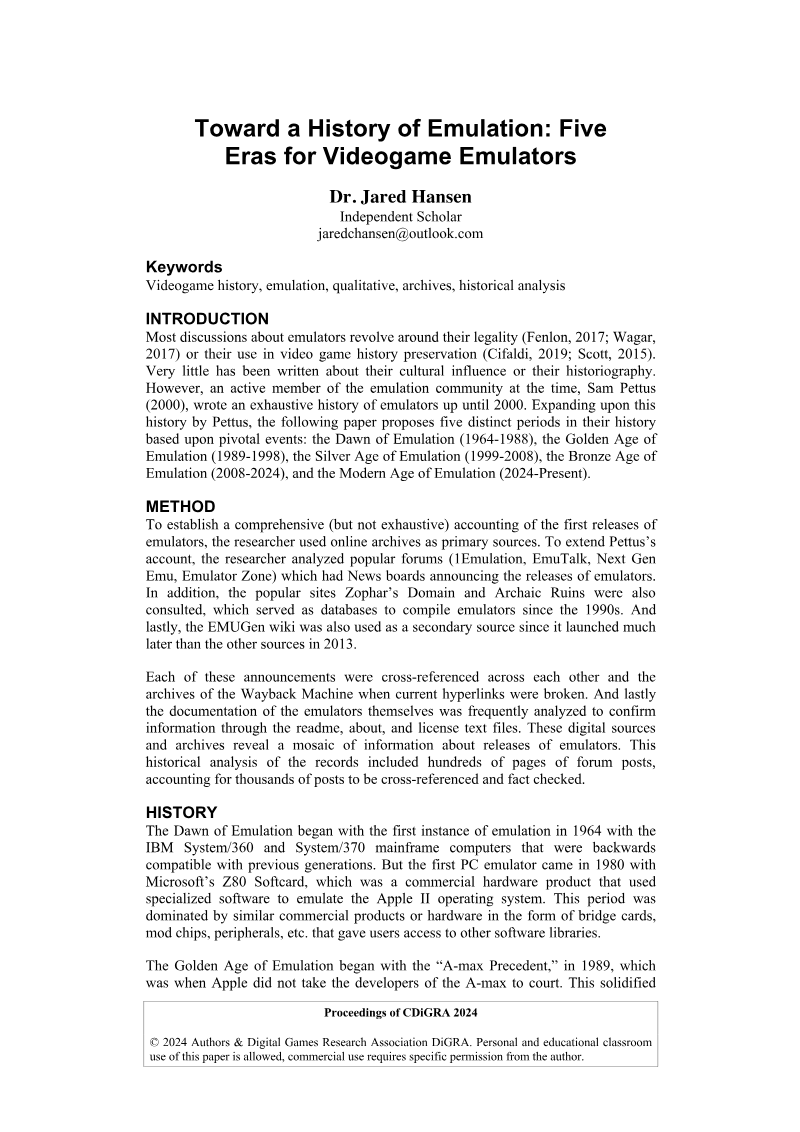
This paper proposes a periodization of videogame emulator history, extending Sam Pettus's 2000 account to the present.
- The paper argues that scholarship on emulators has focused overwhelmingly on legality and preservation while neglecting their cultural influence and historiography, and proposes a five-era periodization extending Sam Pettus's 2000 account to the present.
- The five eras are the Dawn of Emulation (1964–1988), Golden Age (1989–1998), Silver Age (1999–2008), Bronze Age (2008–2024), and Modern Age (2024–present), each anchored to a pivotal event such as the 1964 IBM System/360 or the Nintendo vs. Yuzu case.
- Emulator development shifted from commercial hardware and bridge cards in the Dawn era, to a proliferation of short-lived hobbyist projects in the Golden Age, to an underground focus on refining existing emulators after legal takedowns in the Silver Age.

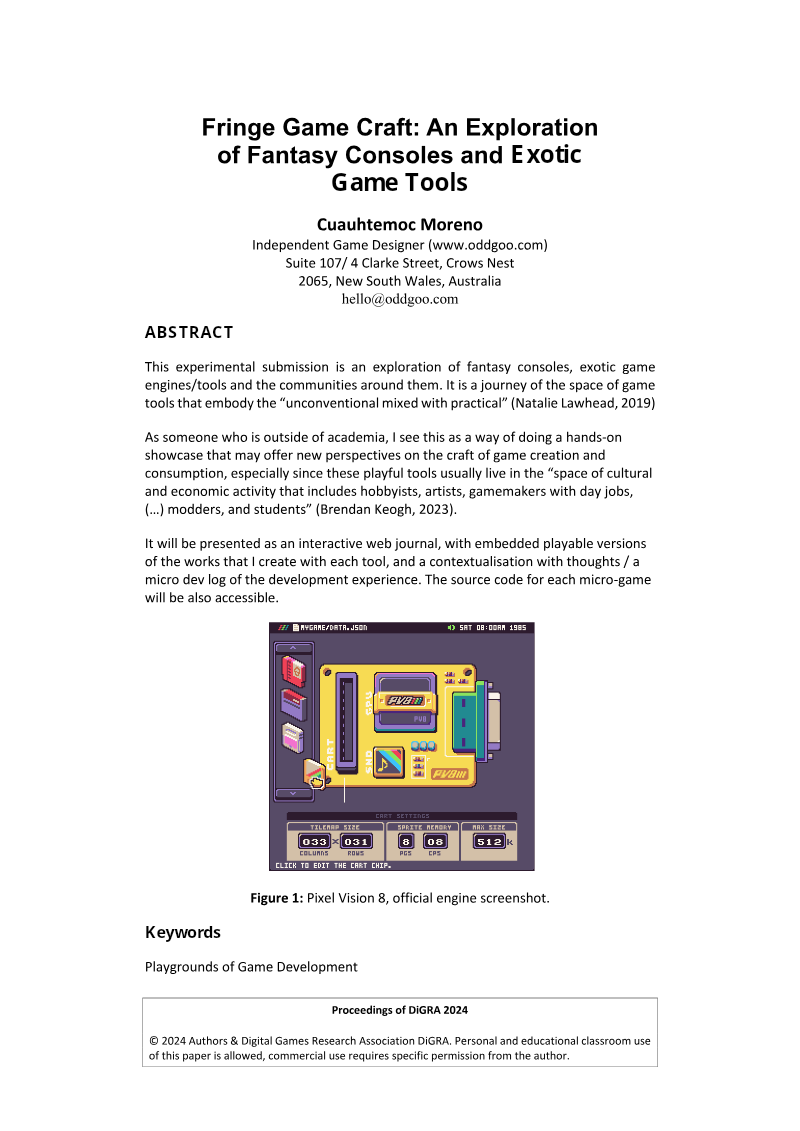
Fringe Game Craft: An Exploration of Fantasy Consoles and Exotic Game Tools
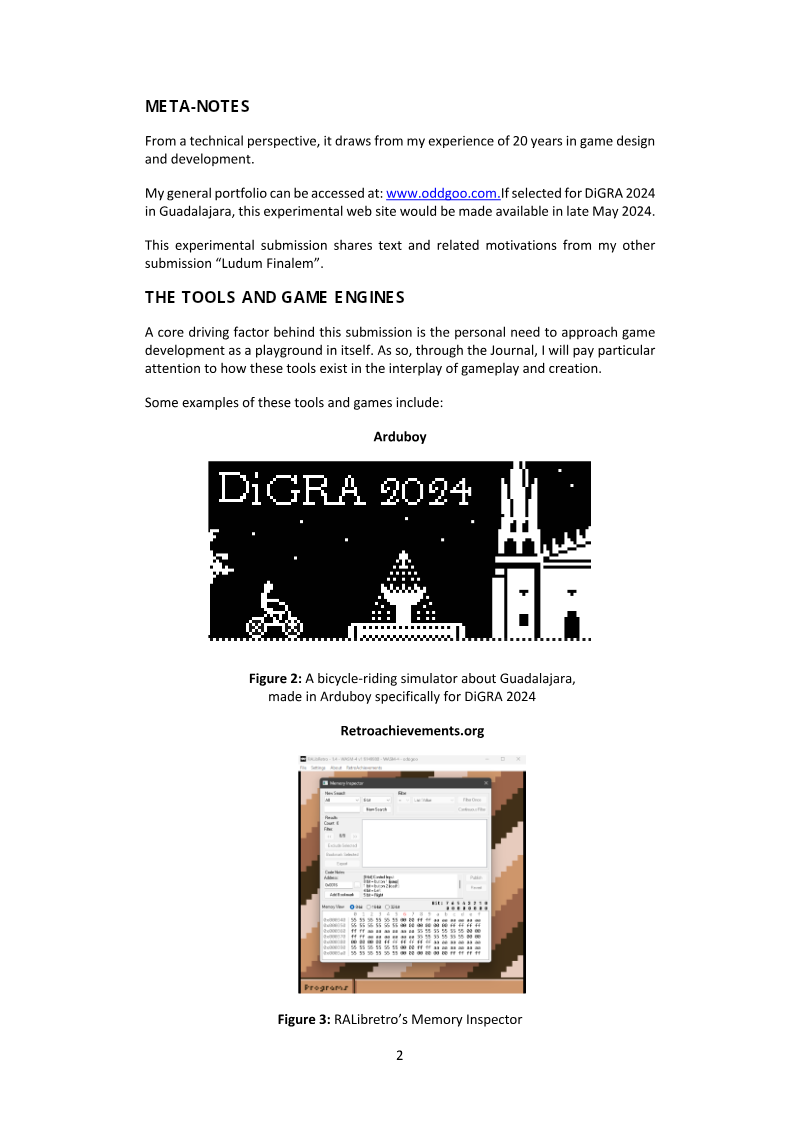
The document explores "fringe game craft," focusing on fantasy consoles, exotic game engines, and their associated communities.
- The report argues that fantasy consoles and unconventional game engines deserve recognition as legitimate sites of game creation, positioned outside commercial production and sustained by hobbyist, artist, and modder communities.
- The author, independent designer Cuauhtemoc Moreno, grounds the work in roughly twenty years of personal game design and development experience rather than systematic data collection.
- The submission contains no survey sample, quantitative statistics, or formal empirical methodology; its method is reflective and practice-based, drawing on personal portfolio work and hands-on tinkering.

Interviewed Workers and Industry Worldviews at Ubisoft Montréal's Assassin's Creed
This study investigates how worldviews are incorporated into large-scale video game productions, specifically focusing on Ubisoft Montréal's Assassin's Creed franchise.
- The study centres on who decides to build particular worldviews into videogames and how, combining cultural-sociological analysis of individual workers with political-economic analysis of AAA production, a pairing the author presents as a gap in the literature.
- Based on 22 interviews with people who worked on Ubisoft Montréal's Assassin's Creed series from its 2007 debut through Assassin's Creed Odyssey (2018), including nearly all Creative Directors and most of the Brand Team, supported by five months of ethnographic fieldwork in Montréal and document analysis.
- The author finds the franchise originated with a distinctly anti-religious, anti-dogmatic vision associated with original creator Patrice Désilets, which later gave way to a standardized, codified manufacturing process over time.
Machine Learning Analysis of Player Reviews and Video Game Development: What Information Is Useful for Games Developers?
This research investigates how machine learning techniques can extract useful information from player reviews to inform video game development processes.
- Developers find detailed bug reports, sometimes supplemented by gameplay videos, among the most useful player reviews, while complaints about core mechanics or fundamental design are considered unconstructive because they fall outside realistic development scope.
- The study combines BERTopic neural topic modelling of anonymised Steam reviews from participating companies with semi-structured interviews of developers at five companies, ranging from independent studios to global publishers.
- Binary likes/dislikes and numeric aspect ratings are seen as useful for summarising player satisfaction at a glance.
Remakes, Remasters, and Paratextual Revisits
This paper explores remakes and remasters in the video game industry through the lens of paratextuality, a concept originally developed by Genette to analyze textual material surrounding a main text that influences its perception and consumption.
- The paper argues that remakes and remasters are paratextual objects that shape how players perceive and value original games, not merely hypertextual transformations of them, with the label itself creating an implicit contract inviting players to compare two texts through play.
- Remakes are defined as new code with updated presentation and mechanics, while remasters retain original code and mechanics and update only presentation; the paper notes that these industry labels are often shaped by marketing narratives.
- Drawing on Švelch's notion of the 'corrective' function of updates, the author suggests remakes and remasters present themselves as the authoritative, up-to-date way to play a game and can become the only practical means of access once originals become obsolete.

Crunch on the Playground: Long Hours of Work in Game Development
This extended abstract presents preliminary findings from a scoping review on the characteristics of "crunch" in the game development industry, aiming to address a gap in research despite its long-reported prevalence.
- Crunch in game development typically means 10–12 hour workdays or 60–80 hour weeks, sustained over weeks, months, or even years, and occurs in both small and large teams.
- Reported crunch prevalence ranges from 45% to 85% across samples of developers and game postmortems.
- The documented consequences of crunch are predominantly negative, including burnout, stress, sleep disruption, fatigue, work-family conflict, and in some studies depression and suicidal tendencies.
Dynamical-meaning Focused Design: Overcoming Ludonarrative Dissonance
The document presents a stylistic game design document/bible for an original game concept called "Elapse," which aims to address and overcome ludonarrative dissonance through a "dynamical meaning-focused design" approach.
- The paper treats ludonarrative dissonance, the clash between a game's mechanics and its story, as a design problem to be solved rather than an inherent property of games, and distinguishes it from the broader ludology versus narratology debate.
- Its proposed remedy is a dynamical-meaning focused approach, building on Jonathan Blow's concept of dynamical meaning and research on choice poetics about how choices and narrative can harmonize.
- The subject is Elapse, an original narrative game conceived by Jasmine Liang as an undergraduate exploration of design process, positioned in conversation with Braid and Undertale.

Production Dynamics in Indigenous Latin American Games: From, With or About
This paper examines how Indigenous Latin American cultures are represented in video games, focusing on the production dynamics that separate games developed "with" Indigenous communities from those developed "about" them without direct participation.
- The paper's central thesis is that games developed 'with' Indigenous communities produce more authentic, respectful, and enriching representations than games developed 'about' Indigenous cultures without community involvement, which risk superficiality and stereotyping.
- Two case studies from Chihuahua, Mexico-based indie studio Lienzo anchor the analysis: Mulaka (2018), developed in close collaboration with the Rarámuri community, is presented as a model of collaborative production, while Aztech: Forgotten Gods (2021), made without direct Indigenous collaboration, is characterized as less authentic.
- Indigenous representation in Latin American games has grown over the past decade, particularly in Mexico and Peru, while Indigenous participation in the actual development process remains limited.


Acousmatics, Video Games, and Situating Play
This analysis explores how video games increasingly rely on "remix" by incorporating elements from other games, creating a form of "embodied literacy" that shapes player expectations and experiences.
- The paper introduces "virtual acousmatics," a condition in which players perceive a remixed mechanic, camera technique, or visual convention without seeing its source, yet still recognize its implied play, adapting Pierre Schaeffer's concept of acousmatics to games.
- The central claim is that remixing references orients players toward particular modes of engagement, shaping how they navigate and interpret a game's space before they consciously register the reference.
- Using Signalis as its main case, the paper argues that its top-down camera echoes Metal Gear Solid to imply stealth and vulnerability, while its pseudo first-person fixed view during puzzles recalls Myst and invites tactile tinkering.
What Is a National Video Game?
The document, "What Is a National Video Game?", explores the complex and often ambiguous criteria used to define the national status of video games.
- There is no single objective definition of a national video game; classification depends on which criteria are chosen, and the paper aims to map markers rather than fix one binding definition.
- Developer location is the most common marker of national status in the reviewed literature, yet it is rarely specified, leaving unclear whether it means legal registration, tax jurisdiction, funding source, main studio location, or staff nationality.
- These developer-based criteria increasingly conflict for games made by transnational companies and outsourced teams, so a game can be national by one measure and foreign by another.
Writers
Games and companies
Games