Game Development reports and market data
Documents
Remakes, Remasters, and Paratextual Revisits
This paper explores remakes and remasters in the video game industry through the lens of paratextuality, a concept originally developed by Genette to analyze textual material surrounding a main text that influences its perception and consumption.
- The paper argues that remakes and remasters are paratextual objects that shape how players perceive and value original games, not merely hypertextual transformations of them, with the label itself creating an implicit contract inviting players to compare two texts through play.
- Remakes are defined as new code with updated presentation and mechanics, while remasters retain original code and mechanics and update only presentation; the paper notes that these industry labels are often shaped by marketing narratives.
- Drawing on Švelch's notion of the 'corrective' function of updates, the author suggests remakes and remasters present themselves as the authoritative, up-to-date way to play a game and can become the only practical means of access once originals become obsolete.
Crunch on the Playground: Long Hours of Work in Game Development
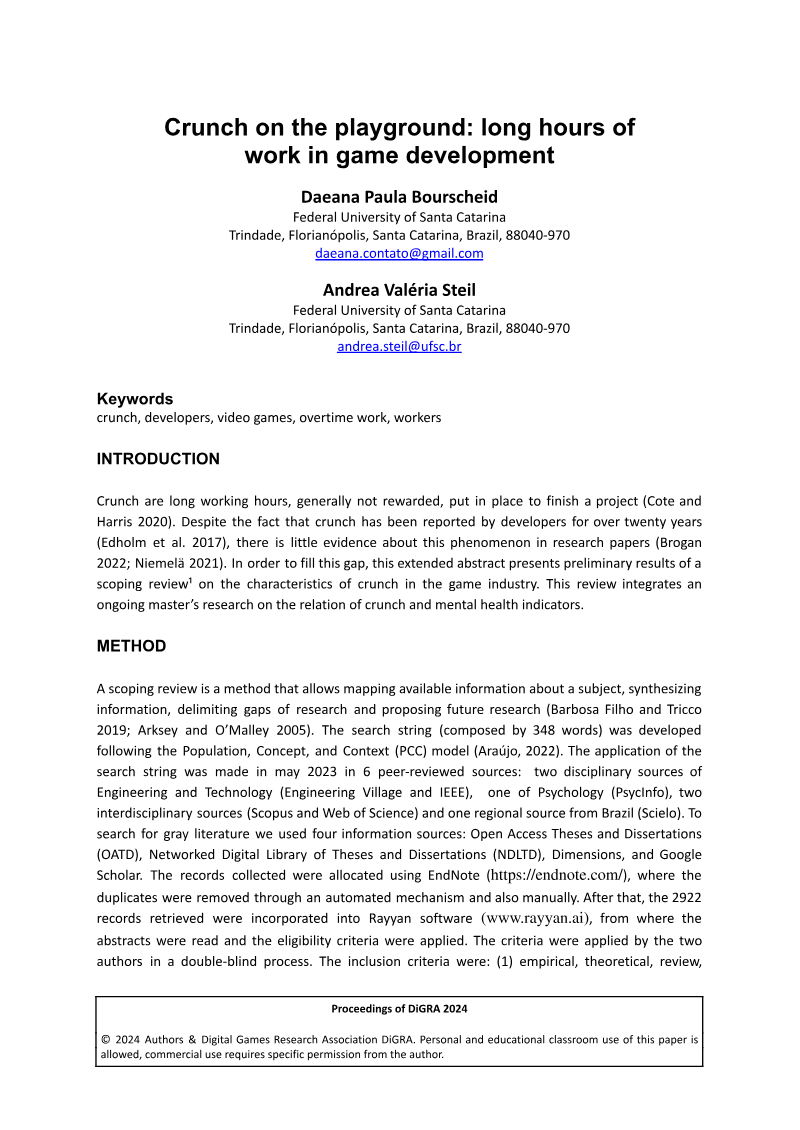
This extended abstract presents preliminary findings from a scoping review on the characteristics of "crunch" in the game development industry, aiming to address a gap in research despite its long-reported prevalence.
- Crunch in game development typically means 10–12 hour workdays or 60–80 hour weeks, sustained over weeks, months, or even years, and occurs in both small and large teams.
- Reported crunch prevalence ranges from 45% to 85% across samples of developers and game postmortems.
- The documented consequences of crunch are predominantly negative, including burnout, stress, sleep disruption, fatigue, work-family conflict, and in some studies depression and suicidal tendencies.
Dynamical-meaning Focused Design: Overcoming Ludonarrative Dissonance
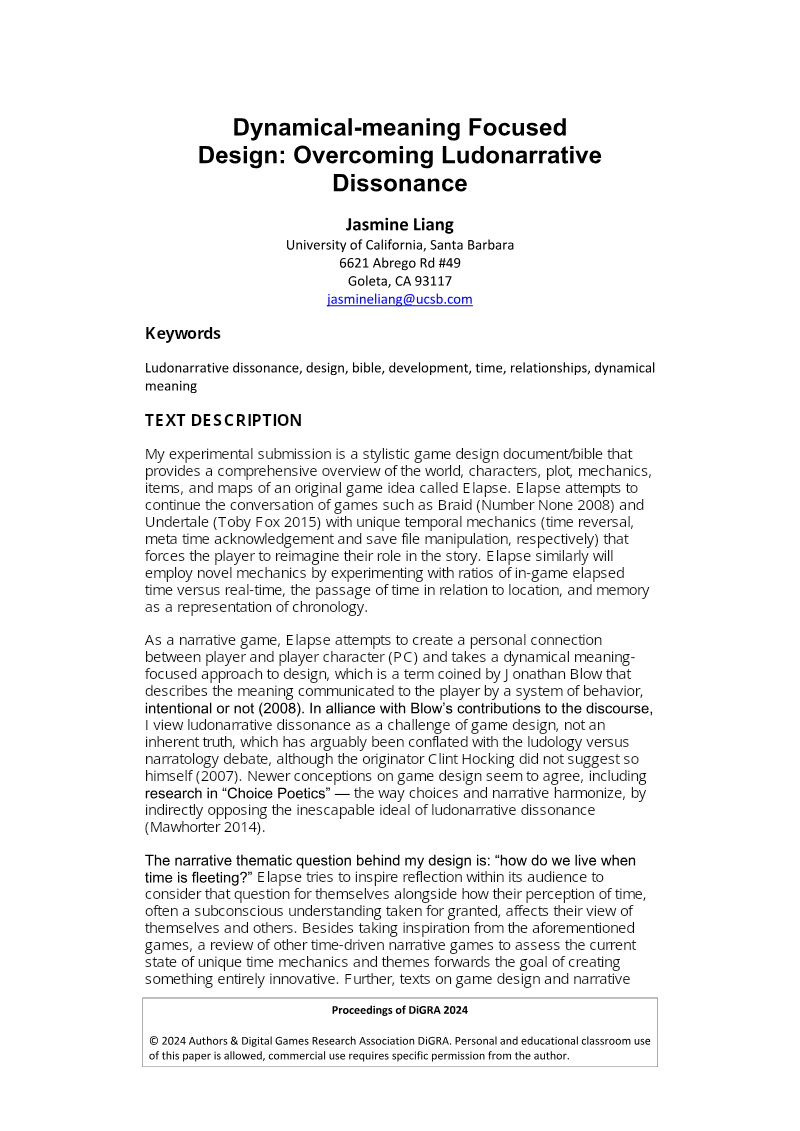
The document presents a stylistic game design document/bible for an original game concept called "Elapse," which aims to address and overcome ludonarrative dissonance through a "dynamical meaning-focused design" approach.
- The paper treats ludonarrative dissonance, the clash between a game's mechanics and its story, as a design problem to be solved rather than an inherent property of games, and distinguishes it from the broader ludology versus narratology debate.
- Its proposed remedy is a dynamical-meaning focused approach, building on Jonathan Blow's concept of dynamical meaning and research on choice poetics about how choices and narrative can harmonize.
- The subject is Elapse, an original narrative game conceived by Jasmine Liang as an undergraduate exploration of design process, positioned in conversation with Braid and Undertale.

Production Dynamics in Indigenous Latin American Games: From, With or About
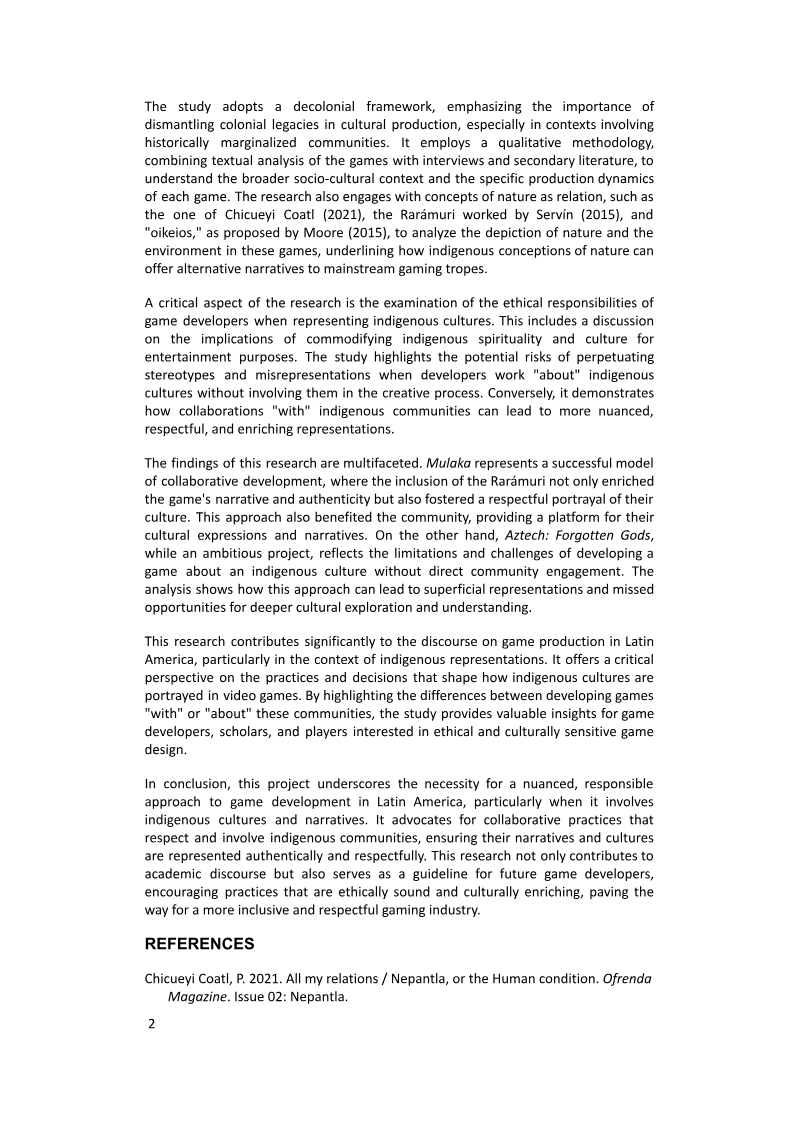
This paper examines how Indigenous Latin American cultures are represented in video games, focusing on the production dynamics that separate games developed "with" Indigenous communities from those developed "about" them without direct participation.
- The paper's central thesis is that games developed 'with' Indigenous communities produce more authentic, respectful, and enriching representations than games developed 'about' Indigenous cultures without community involvement, which risk superficiality and stereotyping.
- Two case studies from Chihuahua, Mexico-based indie studio Lienzo anchor the analysis: Mulaka (2018), developed in close collaboration with the Rarámuri community, is presented as a model of collaborative production, while Aztech: Forgotten Gods (2021), made without direct Indigenous collaboration, is characterized as less authentic.
- Indigenous representation in Latin American games has grown over the past decade, particularly in Mexico and Peru, while Indigenous participation in the actual development process remains limited.
Acousmatics, Video Games, and Situating Play
This analysis explores how video games increasingly rely on "remix" by incorporating elements from other games, creating a form of "embodied literacy" that shapes player expectations and experiences.
- The paper introduces "virtual acousmatics," a condition in which players perceive a remixed mechanic, camera technique, or visual convention without seeing its source, yet still recognize its implied play, adapting Pierre Schaeffer's concept of acousmatics to games.
- The central claim is that remixing references orients players toward particular modes of engagement, shaping how they navigate and interpret a game's space before they consciously register the reference.
- Using Signalis as its main case, the paper argues that its top-down camera echoes Metal Gear Solid to imply stealth and vulnerability, while its pseudo first-person fixed view during puzzles recalls Myst and invites tactile tinkering.
What Is a National Video Game?
The document, "What Is a National Video Game?", explores the complex and often ambiguous criteria used to define the national status of video games.
- There is no single objective definition of a national video game; classification depends on which criteria are chosen, and the paper aims to map markers rather than fix one binding definition.
- Developer location is the most common marker of national status in the reviewed literature, yet it is rarely specified, leaving unclear whether it means legal registration, tax jurisdiction, funding source, main studio location, or staff nationality.
- These developer-based criteria increasingly conflict for games made by transnational companies and outsourced teams, so a game can be national by one measure and foreign by another.
Greek Game Developers' Opinions on the Representation and Reception of (Ancient) Greece in Games: An Exploratory Interview Pilot Study
This exploratory pilot study investigates Greek game developers' perceptions of the representation and reception of (ancient) Greece in video games, aiming to bridge classical reception studies with regional game studies.
- The study is an exploratory pilot based on twelve semi-structured interviews with Greek game developers (eleven video game, one analog game) conducted in autumn 2023, averaging about 49 minutes each.
- It addresses a gap in scholarship by combining classical reception studies with regional game studies, since prior work has focused mainly on North American and Western European games.
- Participants included staff at Greek studios, freelancers, and Greek nationals in senior creative roles at non-Greek companies, and interviews covered motivations, historical accuracy, personal affinity with Greek history, and who should create such games.
Firewatch: (Studying) the Anatomy of a Game Design Process
This paper outlines a structured approach for analyzing game design processes, specifically focusing on the development of the game Firewatch.
- The paper proposes a rapid method for studying game design processes by combining game jam practice with development timelines, using publicly available sources such as interviews, developer logs, podcasts, and developer talks to map a game's creation quickly.
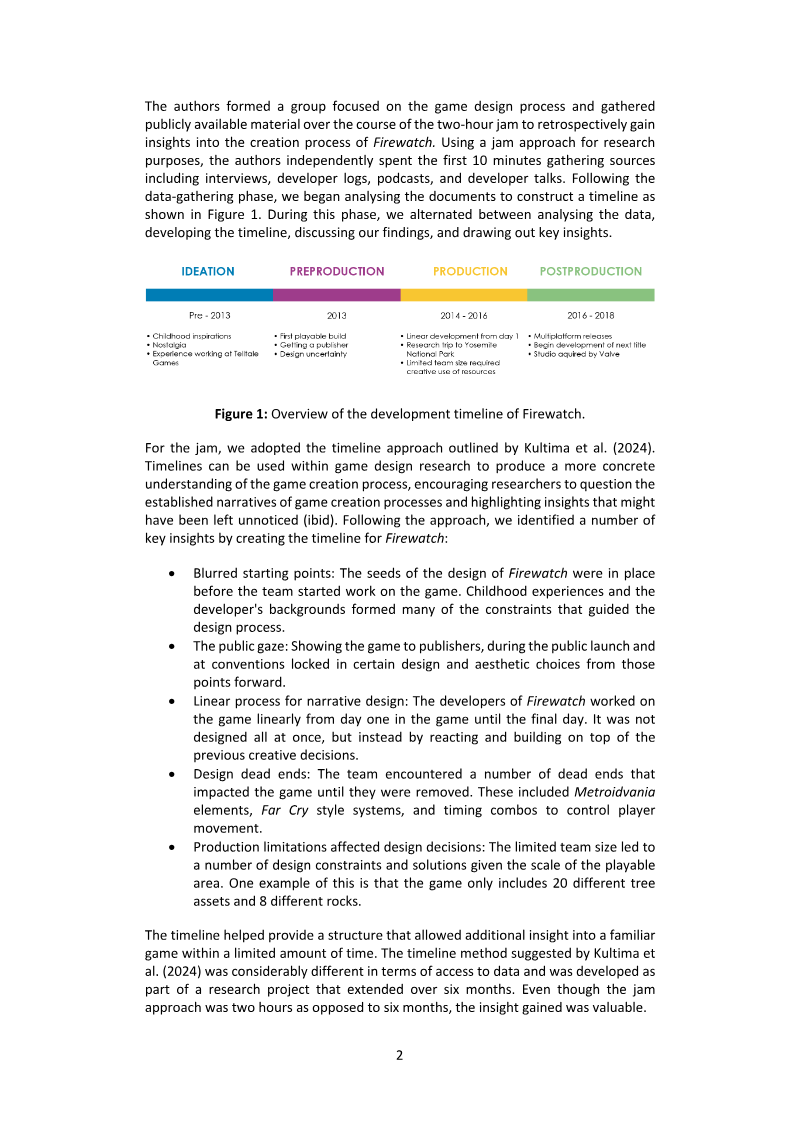
- The method was tested on Campo Santo's 2016 narrative adventure Firewatch during a two-hour session at the Multi Method Analysis Jam at DiGRA 2022, producing a timeline spanning ideation, preproduction, production, and postproduction.
- Firewatch's design process was linear rather than fully pre-planned, and several directions were abandoned, including Metroidvania elements and Far Cry-style systems.
Newsgames as a Case Study for the Value and Challenges of Archiving Digital Games
This analysis explores the value and challenges of archiving digital newsgames, drawing insights from a research team's archive of 101 newsgames.
- Newsgames are shaped by low budgets and a perceived disposability akin to print news, making them especially vulnerable to loss.
- Only 27% of the 101-game collection was identified as allowing contemporary public play as of 2023, a rate the authors find troubling given their ties to established news and academic institutions.
- The academic record suffers from selection bias: free, web-playable, widely distributed newsgames are far more likely to be documented in scholarship, while paid, platform-specific, or locally confined titles are often omitted.
Playable Archive: The Management of Data in the FIFA/EA Sports Franchise
The document explores how data is managed and presented within the FIFA/EA Sports FC video game franchise, examining its impact on the perceived authenticity by both developers and players.
- The paper frames the FIFA/EA Sports franchise as a "playable archive": a historical artifact that both reproduces and reshapes the real structures, players, clubs, and history of association football.
- Its central thesis is that authenticity in the franchise is not fixed but a shifting construction that varies across game modes and is increasingly mixed with fantasy elements.
- Core modes such as Kick-Off and Pro Teams stay closely tied to reality, while Ultimate Team delivers authenticity mainly through "inform" cards that reward strong real-world performances.
Understanding Content Creation: An Exploration of the Social, Technical, and Professional Elements of Video Game Content Creation
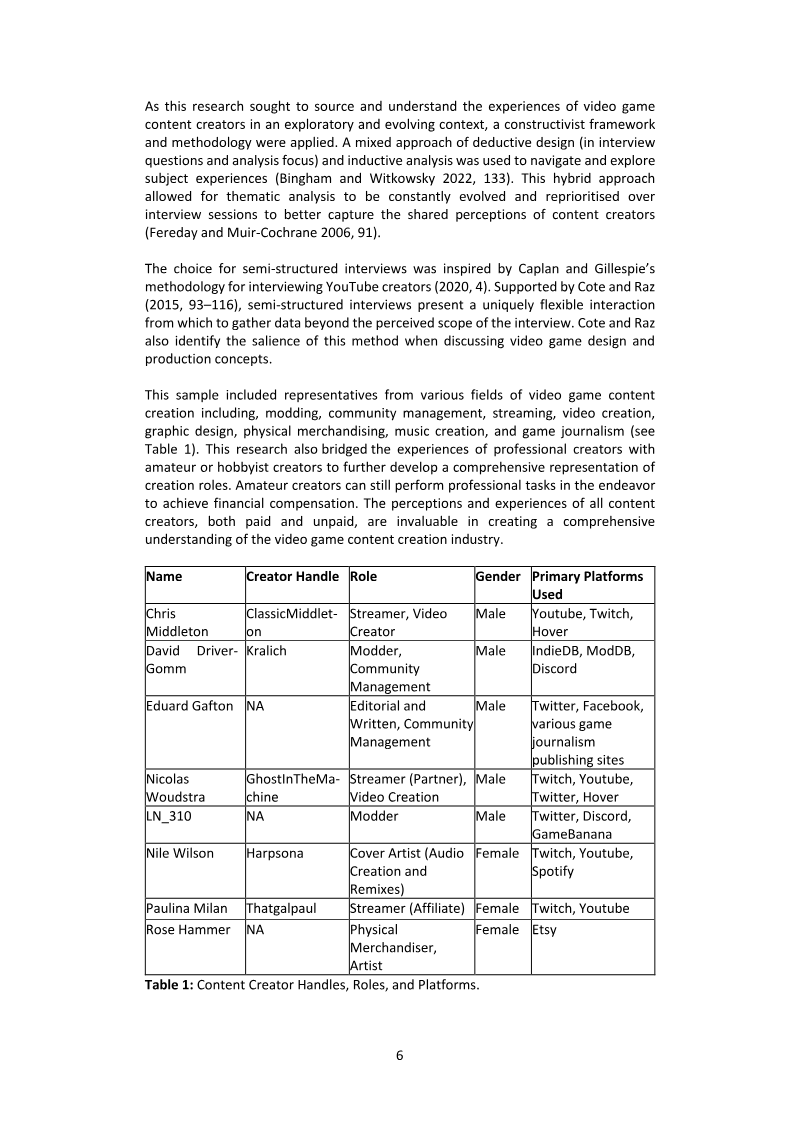
This exploratory study by Thomas Byers and Bjørn Nansen of the University of Melbourne examines how eight video game content creators experience the social, technical, and professional elements of their work.
- The authors report that interviewees found no instruction from platforms or games for early skill development and instead turned to wider online networks and community spaces.
- Participants described parasocial experiences with platform-originated audience members, including invasion of personal space at a convention and short periods of stalking.
- The authors found that interviewees felt a pervasive, uniform concern that content acceptable today could be taken down tomorrow, with little proactive engagement with legal resources.
Queering Data and Dating: AroAce Modding and File System Playgrounds in Stardew Valley
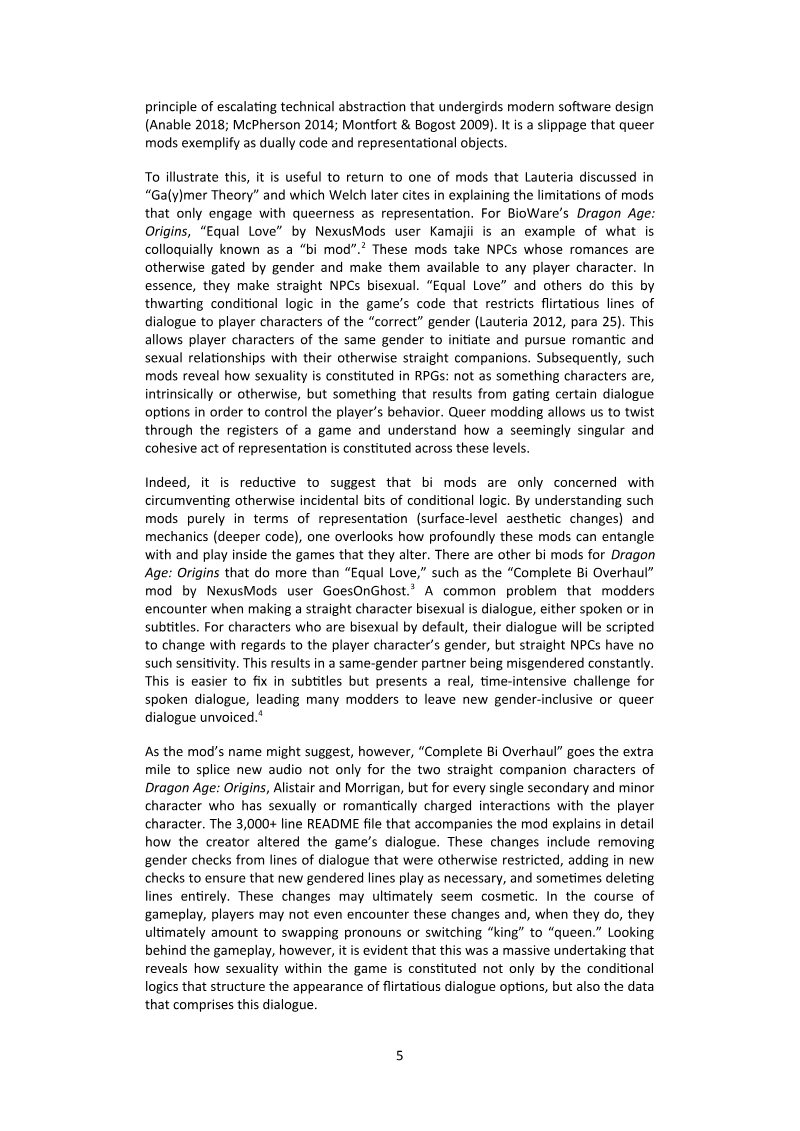
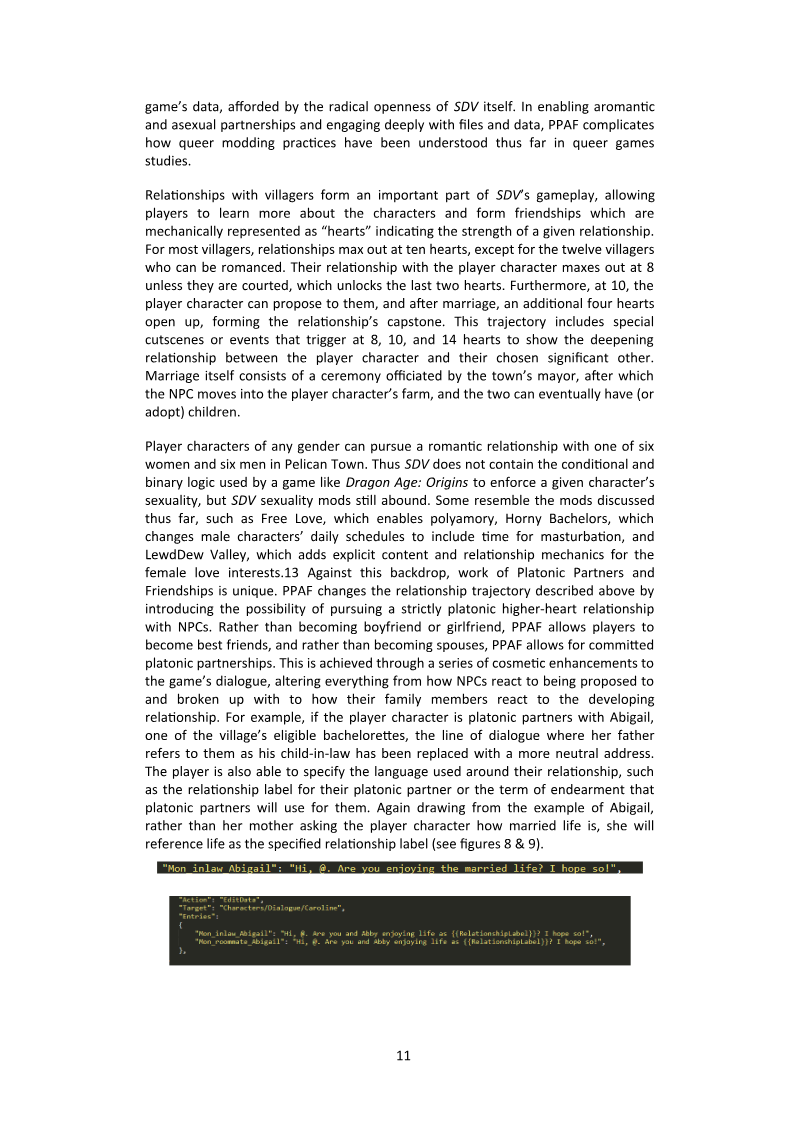
Cass Zegura, of the University of Michigan, presents a paper published in the Proceedings of DiGRA 2024 that examines queer modding of video games, focusing on an aromantic and asexual (aroace) mod for Stardew Valley (Eric Barone, 2016).
- Stardew Valley was made without a game engine, which the paper credits with making its files and code easier for modders to access and alter.
- Stardew Valley is described as the fifth most popular game to mod by unique downloads on NexusMods, outranked only by Bethesda games like Skyrim and Fallout: New Vegas.
- Dragon Age: Inquisition's Frostbite-based files made gay and lesbian romance mods straighten NPCs rather than make them bisexual, according to the paper.
Writers
Games and companies
Games