1 free read left. Create a free account for unlimited reading + AI research.
Create free accountWhitepaper DiGRA
1 free read left. Create a free account for unlimited reading + AI research.
Create free accountWhitepaperDiGRA
The range is reported across the reviewed literature.
Wide range. Reported crunch prevalence ranges from 45% to 85% across samples of developers and game postmortems.
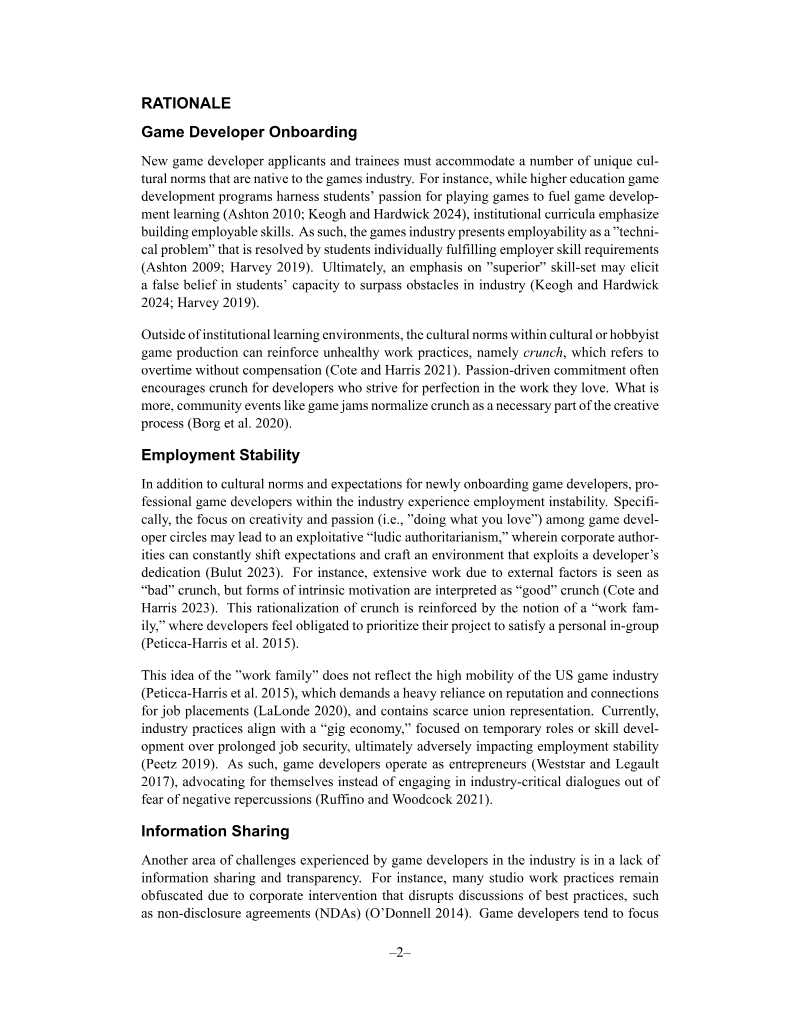
This extended abstract presents preliminary findings from a scoping review examining crunch, the practice of long, typically unpaid working hours used to finish game development projects. Its purpose is to map existing research on crunch in the game industry, identify gaps in the evidence base, and propose directions for future study. The review is part of an ongoing master's project investigating the relationship between crunch and mental health indicators. The search, conducted in May 2023, drew on six peer-reviewed databases and four gray literature sources, yielding 2,922 initial records that were screened by two authors using double-blind eligibility criteria. Of the 41 studies ultimately included, 17 empirical studies form the basis of this abstract.
The reviewed literature describes crunch as involving 10 to 12 hour workdays or 60 to 80 hour weeks, sustained over weeks, months, or even years, and occurring in both small and large teams. Reported prevalence ranges from 45% to 85% across samples of developers and game postmortems. Researchers distinguish several forms, including continuous, final, mini, and "delusional" crunch, as well as self-imposed versus company-imposed and "good" versus "bad" crunch. Common antecedents include poor management, passion-driven work cultures, unrealistic deadlines, unstable project scope, and implicit organizational expectations, with mobile and live-service games particularly prone to prolonged crunch periods.
The consequences documented in the literature are predominantly negative, encompassing burnout, stress, sleep disruption, fatigue, work-family conflict, and, in some studies, depression and suicidal tendencies. For organizations, crunch may increase costs or reduce product quality without necessarily improving schedules, although some evidence suggests benefits such as higher output in less time and stronger team cohesion. Suggested mitigations include labor unions, no-crunch policies combined with public policy, as seen in Finland, and self-employment as an exit strategy. The authors caution that most existing studies are qualitative, of limited generalizability, and concentrated in the global north, and they call for quantitative research, health-focused scholarship, and investigation of Global South contexts.

DiGRA · 2026

DiGRA · 2026



DiGRA · 2026



DiGRA · 2026



DiGRA · 2026



DiGRA · 2026



DiGRA · 2026



DiGRA · 2026

DiGRA · 2026



DiGRA · 2026



DiGRA · 2026

DiGRA · 2026

Breda University of Applied Sciences · 2026