Game Development reports and market data
Documents

Creating a BOSS (Unity Basics!)
The process of designing complex boss characters in Unity requires a multi-disciplinary approach that integrates illustration, animation, and programming.
- Use animation events to trigger external functions like particle effects or screen shakes directly from the animation timeline, avoiding the need to hardcode every interaction.
- Implement a modular design by separating visual behavior in the Unity Animator tree from the underlying movement and difficulty logic managed by programmers.
- Utilize rigging tools like Spine to establish skeletal structures from Photoshop layers, ensuring a cohesive workflow between illustration and animation.
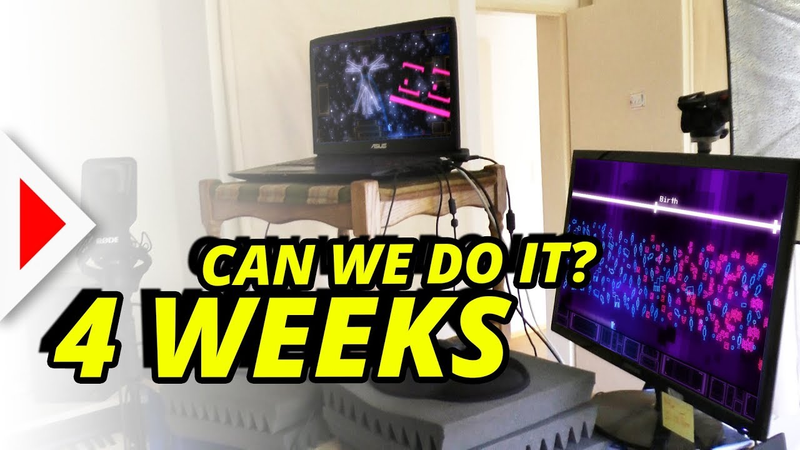
Can I Finish my Indie Game in 4 Weeks? | Devlog
The primary objective of this project is to finalize the development of the indie game Will You Snail within a structured four-week timeframe.
- The developer is executing a four-week final production sprint for the indie platformer 'Will You Snail' while maintaining a sustainable work schedule of six hours per day to prevent burnout.
- The core gameplay mechanic features an antagonistic AI that predicts player movement to spawn obstacles in real-time.
- The narrative integration phase involves implementing a system that triggers approximately 64 unique voice lines based on specific player behaviors, such as death patterns and idle states.
One Year of Sokpop Games Subscription on Patreon
The Sokpop Collective has established a sustainable independent development model by leveraging a Patreon-based subscription service that delivers a new, polished game every two weeks for a monthly fee of three dollars.
- The Sokpop Collective generates approximately $4,000 in recurring monthly revenue by maintaining a base of 1,000 Patreon subscribers who pay $3 per month.
- The studio sustains its output through a strict four-week development cycle, releasing a new, polished game every two weeks.
- Financial stability is achieved by combining the subscription model with freelance work and occasional full-scale commercial releases, ensuring creative autonomy.
Changing the Time Between Shots for the Sniper Rifle from 0.5 to 0.7 Seconds for Halo 3
Game balance is fundamentally defined by a game’s long-term stability and player engagement rather than a rigid, scientific process.
- The Halo 3 sniper rifle fire rate was adjusted from 0.5 to 0.7 seconds between shots to prevent it from functioning as a 'newbie hammer' in close-quarters combat.
- Designers should avoid making incremental changes; instead, they should implement drastic adjustments to verify if a mechanic is truly broken before fine-tuning.
- Balance is a state of the game rather than a process, and designers must guard against internalizing the game so deeply that their perception diverges from the actual player experience.
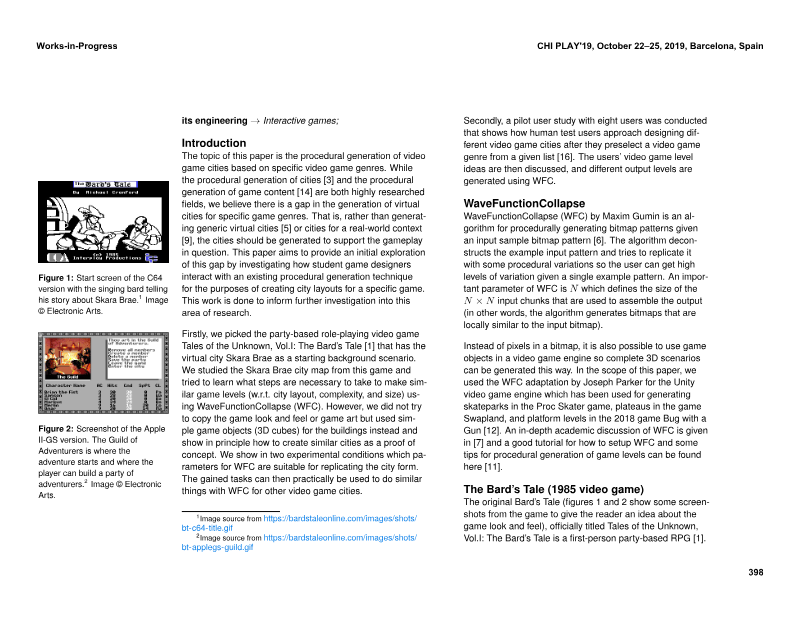
Procedural Generation of Video Game Cities for Specific Video Game Genres Using WaveFunctionCollapse
This research explores the application of the WaveFunctionCollapse (WFC) algorithm for the procedural generation of virtual cities tailored to specific video game genres.
- WaveFunctionCollapse (WFC) effectively generates varied, locally consistent game environments from small, manually created input patterns, making it a viable framework for rapid prototyping.
- The algorithm's output is highly sensitive to the N parameter, where N=2 produces intricate, maze-like passages and N=3 facilitates the creation of larger, open-space environments.
- WFC does not inherently guarantee gameplay-specific constraints, such as ensuring map walkability or the logical placement of unique objectives.
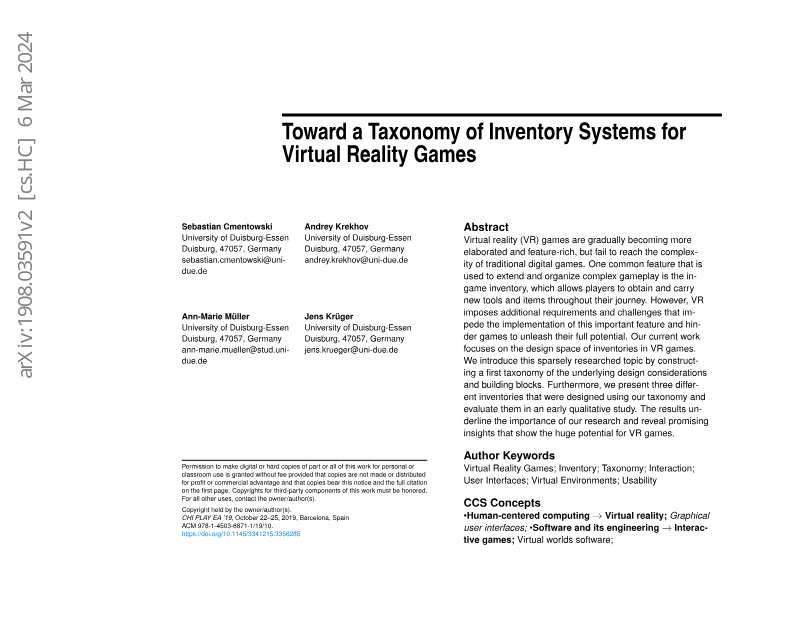
Toward a Taxonomy of Inventory Systems for Virtual Reality Games
This research establishes a foundational taxonomy for inventory systems in virtual reality (VR) games, addressing the gap between the increasing complexity of VR environments and the limitations of current interface design.
- VR inventory design should prioritize physical, spatial engagement over abstract, button-based interactions to maximize player presence and satisfaction.
- A study of eight participants identified the 'Magnetic Surface'—a free-form, scale-preserving placement system—as the most preferred inventory design.
- While 2D grid overlays remain efficient for loot-heavy gameplay, they are increasingly viewed as less immersive compared to naturalistic, 3D-embedded alternatives.
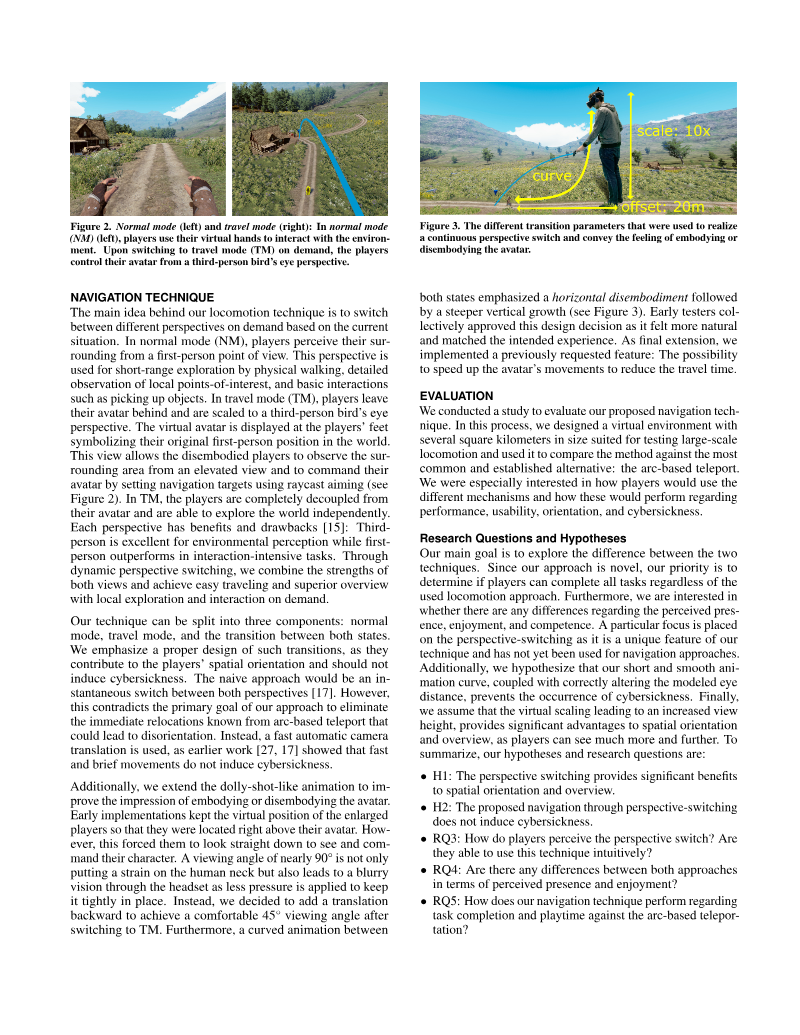

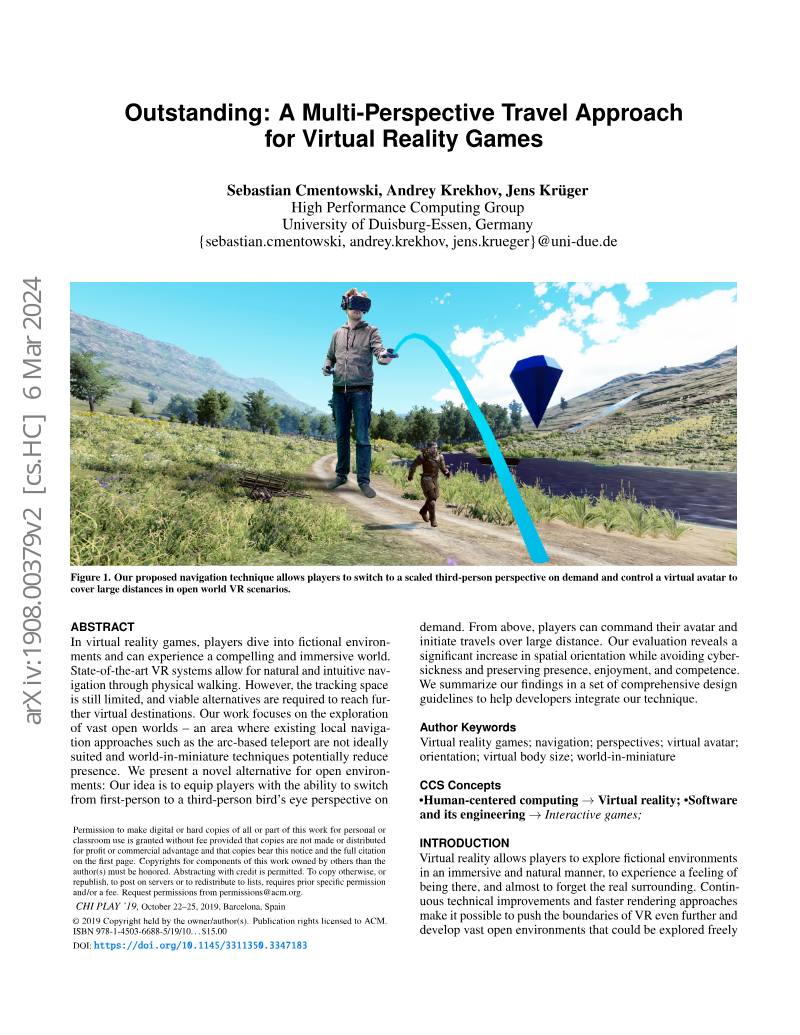
Outstanding: A Multi-Perspective Travel Approach for Virtual Reality Games
The paper, by Sebastian Cmentowski, Andrey Krekhov and Jens Krüger of the University of Duisburg-Essen, presents "Outstanding", a VR navigation technique for large open worlds.
- Participants using the perspective-switching technique reported significantly better orientation in the game world than teleport users, with mean ratings of 5.07 versus 3.67.
- Players reported needing significantly less time to reorient after each relocation with the new technique, with a mean rating of 1.13 compared with 3.80 for teleport.
- The new technique reduced target aiming operations by 57% compared with the teleport control group.
From Red to Rukey: Building and Animating Characters in 'Transistor' and 'Pyre'
Character animation in independent game development thrives on a philosophy of simplicity, modularity, and iterative design.
- Supergiant Games utilizes a 2D-engine workflow where characters are rendered from 60 to 64 camera angles, requiring approximately 2,500 PNG files per animation sequence.
- To manage complexity, characters are broken down into individual modular sections—such as body, platform, and accessories—allowing for independent rigging and simplified animation adjustments.
- The animation process relies on a locator-based system for translation and rotation, which allows for precise synchronization with game effects and easy character swapping without re-animating timing.
Did Level Scaling Break Games? - Leveling in Open World Design - Extra Credits
Level scaling in open-world RPGs serves as a mechanism to balance player freedom with consistent challenge, ensuring that users encounter appropriate difficulty regardless of their chosen path.
- Level scaling is intended to balance player freedom with consistent challenge, but blanket implementation often undermines the core RPG progression fantasy by making character growth feel static.
- Uniform scaling flattens the open-world experience, stripping away the sense of danger and mystery by ensuring enemies remain equally difficult regardless of the player's level.
- The Elder Scrolls IV: Oblivion serves as a primary case study for failed scaling, where the system penalized non-combat skill progression and created narrative dissonance by populating the world with low-level enemies wearing rare, high-value armor.

Making the Sale with Michael Volpe | Game Dev Unchained Episode 207
The gaming industry relies on a symbiotic relationship between hardware innovation and software development, where peripheral manufacturers like IOGEAR facilitate cross-platform play and streamer performance through specialized tools such as KVM switches.
- The gaming industry is shifting toward the integration of cybernetic and bio-implanted technology, with future hardware development focusing on wellness-oriented augmented reality and wearable devices.
- Streamers must transition from treating their channels as casual hobbies to operating them as structured media businesses to avoid burnout and achieve long-term professional success.
- Orange County has emerged as a primary gaming and technology hub, attracting major industry players like Blizzard and Amazon Studios by providing a less congested alternative to Los Angeles.

F2P Sales & Merchandising | Best Practices for Mobile Games
Modern free-to-play mobile gaming success increasingly hinges on sophisticated sales and merchandising infrastructure rather than relying solely on user acquisition.
- Success in modern free-to-play mobile gaming is increasingly driven by sophisticated merchandising and maximizing the lifetime value of existing players rather than relying exclusively on user acquisition.
- The TTO framework—targeting, timing, and offer structures—serves as the core strategy for creating personalized, high-converting monetization environments.
- Effective player segmentation requires moving beyond demographics to utilize behavioral and psychographic analysis, including RFM analysis, k-means clustering, and machine learning models.
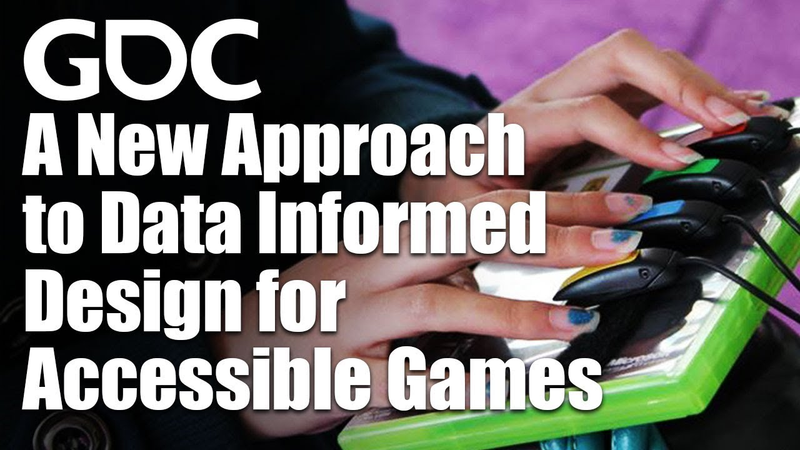
Accessible Player Experiences: A New Approach to Data Informed Design for Accessible Games
Between 13% and 22% of the global population lives with a disability, representing a substantial and highly engaged gaming demographic.
- Between 13% and 22% of the global population lives with a disability, representing a significant and highly engaged segment of the gaming market.
- Accessibility features like key remapping and subtitles are utilized by both disabled and non-disabled players, proving that inclusive design functions as a universal usability improvement.
- The industry is shifting from rigid, checklist-based compliance toward an Accessible Player Experience (APX) framework that uses data to inform flexible, early-stage design.
Writers
Games and companies
Games