Game Development reports and market data
Documents
Co-Development: An Inside Look with Tim Bennison, COO of Hot Head Games
The mobile gaming industry has undergone a significant strategic shift, moving away from a reliance on self-publishing toward a hybrid model that emphasizes co-development and work-for-hire partnerships.
- The mobile gaming industry is shifting from self-publishing to a hybrid co-development model to mitigate financial volatility caused by rising user acquisition costs and complex privacy regulations.
- Co-development partnerships provide studios with the stable, long-term contracts necessary to maintain a consistent, full-time workforce and preserve institutional knowledge.
- Top-tier clients prioritize speed, quality, and geographic alignment over low costs, requiring studios to act as strategic, transparent extensions of the client's own team.

How to write a good prompt to generate assets for a mobile game?
Effective asset generation for mobile games relies on a structured approach to prompting that prioritizes the subject, followed by context, environmental details, artistic style, and lighting.
- Effective asset generation requires a structured prompt hierarchy: prioritize the subject first, followed by context, environmental details, artistic style, and lighting.
- Developers can maintain stylistic consistency across game assets by utilizing image-to-image generation, which allows existing assets to serve as reference points.
- PicFinder has generated over 190 million images in its first six months, functioning as a high-speed search engine for rapid prototyping and brainstorming.

'Dark Pictures: Season 1': 4 games in 4 years: Audio Systems for Narrative Horror
Supermassive Games successfully navigated the challenges of an aggressive annual release schedule for the Dark Pictures Anthology by shifting from traditional, linear audio pipelines to systemic, procedural frameworks.
- Supermassive Games developed a systemic, runtime-driven audio architecture for 'The Dark Pictures Anthology' to deliver cinematic quality without relying on linear, pre-rendered cutscene pipelines.
- To manage performance in titles like 'House of Ashes,' which featured up to 50 enemy soldiers and 11 friendlies, the team implemented a distance-based culling system for audio events and emitters to respect CPU constraints.
- The studio developed a '50% Center Bias' panning system for dialogue and Foley, which prevents immersion-breaking harsh cuts by constraining audio panning to half of the character's actual position relative to the listener.

Inworld AI Raise / Playtika Acquires Youda / EA Earnings / BattleBit Remastered
The gaming industry is currently undergoing a structural transformation characterized by the rapid integration of artificial intelligence, the consolidation of legacy assets, and a definitive shift toward digital-only distribution.
- Inworld AI has reached a $500 million valuation, highlighting a significant industry-wide investment in generative AI tools to enhance NPC development and operational efficiency.
- The gaming industry is shifting toward a digital-only distribution model, effectively ending the viability of physical media as retailers prioritize shelf space for more profitable goods.
- The market is increasingly bifurcated into a barbell structure: high-budget, IP-driven blockbusters on one end and agile, low-fidelity hits like BattleBit Remastered on the other.
👑 Our Game Thronefall is OUT NOW!
Thronefall, a minimalist medieval base defense game developed by Grizzly Games, has officially launched into Early Access on Steam.
- Grizzly Games has launched its minimalist medieval base defense title, Thronefall, into Steam Early Access.
- The game aims to distill complex real-time strategy mechanics into a bite-sized, accessible format focused on balancing economic development with nightly defensive waves.
- Thronefall has generated significant market interest, with pre-launch wishlist numbers substantially outperforming the developer's previous title, Will You Snail.
Your Game Will Suck Without Zero Knowledge Proofs - Frank Chen, Aleo
Decentralized gaming aims to eliminate the need for trusted third parties, protecting players from asset theft, data surveillance, and arbitrary service termination.
- Zero-knowledge (ZK) proofs are essential for decentralized gaming because they enable players to verify moves and game states without exposing private data or strategies.
- Public blockchain ledgers are currently unsuitable for genres like real-time strategy, shooters, and card games because they expose player inputs, which ruins games reliant on imperfect information.
- Existing privacy solutions are inadequate: trusted execution environments rely on vulnerable hardware, fully homomorphic encryption is too computationally intensive, and commit-and-reveal schemes lack long-term privacy.
Integrate Web3 With Ease: The Tools you Need for Seamless Player Experiences
The integration of Web3 technology into gaming presents significant technical and user experience hurdles that often impede mass adoption.
- Developers must prioritize Web2-style onboarding features—such as social logins, credit card on-ramps, and gasless transaction relayers—to eliminate the technical friction that currently hinders mass Web3 adoption.
- The industry is transitioning to all-in-one developer platforms that utilize account abstraction to simplify wallet creation and blockchain interaction for the end user.
- Adopting the ERC-1155 token standard enables more efficient and scalable management of diverse in-game assets like skins and trading cards compared to older standards.
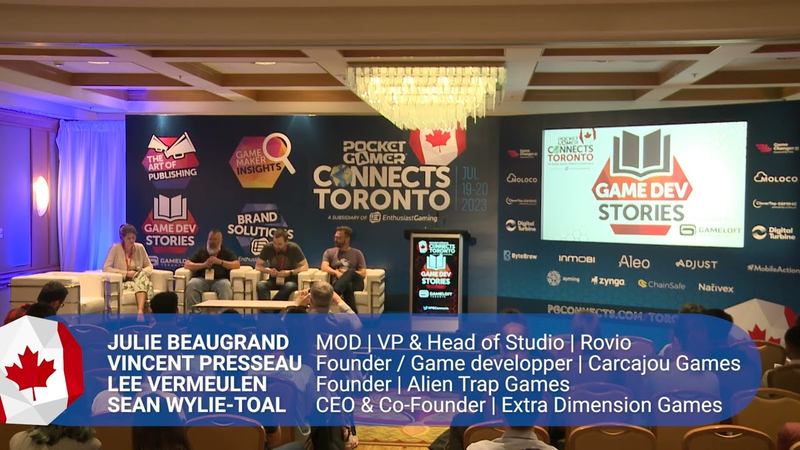
PANEL: Learning from Mistakes: The Big 'NOs!' in Game Development.
Game development success relies heavily on the ability to transform operational failures into strategic growth.
- Prioritize shipping imperfect products over indefinite development cycles to avoid the trap of projects that fail to meet key performance indicators.
- Distinguish between productive persistence and the sunk-cost fallacy by using objective, data-driven analysis to decide when to pivot or abandon failing concepts.
- Achieve long-term stability by evolving incrementally within established genres and cultivating a consistent brand identity rather than attempting to reinvent genres with every release.

How Canada’s Biggest Independent Studio Went Global - Luc Duchaine, Behaviour Interactive.
Behaviour Interactive, Canada’s largest independent video game studio, has successfully transitioned from a work-for-hire service provider to a global publisher of original intellectual property.
- Behaviour Interactive transitioned from a work-for-hire service provider to a global publisher by launching the original IP Dead by Daylight in 2016, which has since reached over 50 million players.
- The studio maintains a dual-revenue model that balances original game development with a work-for-hire division, providing financial stability and opportunities to refine technical expertise on global brands.
- Founded in 1992, the studio has scaled to over 1,200 employees with a physical presence in Montreal, Toronto, Seattle, and the United Kingdom.

PANEL: The Path to Indie Success & Sustainability.
Achieving long-term success in the independent game industry requires a fundamental shift from viewing creative output as the sole metric of viability toward a model that prioritizes financial sustainability and operational discipline.
- Indie studios must transition from a creative-only focus to a model that prioritizes financial sustainability and operational discipline to avoid the risks of relying on single-hit titles or perpetual grant funding.
- Developers should adopt a diversified revenue strategy by balancing the creation of original intellectual property with external service work to ensure consistent cash flow.
- Strategic business planning, including rigorous financial management and realistic project scoping, must be integrated into daily operations from the inception of the studio.

Fireside Chat: Virtual Production: A Peek Behind the Curtain for Game Devs & 3D Artists
Virtual production represents a significant technological convergence between the gaming industry and traditional filmmaking.
- Virtual production leverages real-time game engines like Unreal Engine and Unity to display 3D environments on LED volumes, enabling in-camera visual effects (ICVFX) that replace traditional green screens.
- The Virtual Art Department (VAD) serves as the essential bridge between traditional art departments and technical teams, focusing on optimizing 3D assets for real-time performance on LED walls.
- Industry organizations such as SMPTE are currently working to establish necessary standardization protocols for metadata, color science, and interoperability between game development tools and film production requirements.

Maximizing Your Player Reach by Building for Different Platforms - Lucie Lalumière, & Michael Stolls
The transition toward cross-platform development represents a strategic evolution for studios traditionally rooted in mobile gaming.
- Transitioning from mobile to cross-platform development requires a fundamental shift in design philosophy, moving from short, frequent mobile sessions to the longer, immersive experiences expected by PC and console players.
- Successful multi-platform expansion depends on early-stage research and focus group testing to ensure that monetization models—whether free-to-play or premium—align with the specific expectations of each platform's audience.
- Developers must optimize user interfaces and experiences to balance the technical constraints of mobile hardware against the higher performance capabilities of consoles and PCs.
Writers
Games and companies
Games