Mobile reports and market data
Documents
GOAT: Jakub Remiar on Mobile Gaming, Gacha Mechanics, and Trends | Full Interview
Jakub Remiar, a mobile gaming strategist and co-host of the Two & a Half Gamers podcast, provides an analytical overview of the mobile gaming industry, focusing on the intersection of behavioral psychology, monetization mechanics, and market trends.
- Gacha mechanics function as complex engines requiring sophisticated progression design, with successful implementation often involving a balance between binary drop outcomes and strategic utility, such as the 'rock-paper-scissors' element seen in character collection games.
- Supercell's design approach in Clash Royale represents a major breakthrough in gacha mechanics, moving away from pure randomness toward more structured progression systems.
- The mobile game Whiteout Survival demonstrates high-level innovation in both 4X strategy mechanics and user acquisition (UA) strategies, making it a benchmark for current industry performance.

How do Playtika and Wooga nail their Live Ops strategies?
Successful Live Ops strategies in the modern casual gaming market rely on a layered framework that integrates social interaction, engagement mechanics, and data-driven monetization.
- Top-performing casual games now utilize collectible frameworks, such as albums and multi-stage missions, in 75 percent of titles to unify progression and reduce player cognitive overload.
- Successful Live Ops strategies are shifting from large-scale clan structures to intimate, one-on-one partnerships that leverage social accountability and psychological triggers like the prisoner’s dilemma.
- Monetization models have evolved from static purchasing to gamified, effort-based bundles that are dynamically tailored to a player’s specific progression stage.

TWIG #315 TikTok Ban and Matthew Ball's State of the Market Report
The global gaming industry is transitioning into a mature phase characterized by slow, single-digit growth and heightened operational risks.
- The global gaming industry has entered a mature phase of slow, single-digit growth, shifting the focus from rapid expansion to incremental optimization and production efficiency.
- Chinese developers are currently the primary drivers of industry growth, accounting for 42% of global spending increases and successfully capturing market share in the West.
- Legislative uncertainty regarding a potential U.S. TikTok ban is forcing developers to diversify marketing spend away from platform-dependent strategies toward more stable ecosystems like Meta.

Project R.I.S.E Alpha Test First Look: Gameplay & impressions! What's next for @supercell?
Project R.I.S.E. represents a strategic shift for Supercell as it explores the cooperative PVE roguelite genre.
- Supercell is diversifying its portfolio by developing Project R.I.S.E., a cooperative PVE roguelite built on Unreal Engine that marks a strategic departure from the company's traditional PVP-focused titles.
- The game features a complex meta-progression system centered on the 'Tower Forge,' which utilizes a currency-based economy and gacha-style mechanics for skill upgrades.
- Technical performance is a critical barrier, with alpha testers reporting severe hardware issues including rapid battery depletion and device overheating.
The Problem with Traditional VC Funding in Gaming—and Jetapult’s Solution
Traditional venture capital models often prioritize rapid, capital-intensive expansion, which frequently undermines the long-term sustainability of gaming studios.
- A partnership-driven funding model acts as a co-founder to provide a hybrid of equity-based and low-risk scaling capital, allowing studios to maintain creative control while professionalizing operations.
- Studios utilizing this data-driven framework to optimize user retention, engagement, and conversion have reported performance gains exceeding 50 percent.
- The integration of AI-driven development pipelines significantly accelerates production cycles by reducing the time required for complex tasks such as 3D asset creation.
*Emergency Episode* TikTok is Banned in the US! Now what?
The recent legislative and judicial developments surrounding the potential ban of TikTok in the United States highlight the extreme volatility of the current digital advertising and user acquisition landscape.
- The U.S. government’s mandate for TikTok to divest to an American entity or face a total ban creates extreme volatility for mobile game user acquisition strategies.
- A temporary service suspension forced major gaming titles to immediately pause all marketing campaigns, demonstrating the high risk of relying on a single advertising channel.
- TikTok resumed U.S. operations within 13 hours of the initial ban after securing a 90-day extension to negotiate a potential sale.

TWIG #314 Market Predictions, Nintendo Leaks and an Award Ceremony
The gaming industry is currently navigating a period of significant volatility, characterized by a stark contrast between high-stakes venture capital activity and widespread operational instability.
- The gaming industry is experiencing a bifurcated market where speculative capital continues to flow into Web3 and metaverse projects, exemplified by Infinite Reality’s $12.3 billion valuation, despite widespread operational instability and layoffs throughout 2024.
- Success in the hero shooter genre is increasingly dependent on high-frequency content cadences, as demonstrated by Marvel Rivals successfully challenging established titles like Overwatch and Apex Legends.
- Major industry players such as Ubisoft and Embracer Group are undergoing significant reputational and operational damage, signaling a broader market rejection of unsustainable growth models and massive corporate restructuring.
Product trends for Mobile Games in 2025 by Jakub Remiar
The mobile gaming landscape in 2025 is defined by a strategic shift toward adapting proven PC and console mechanics into mobile-friendly formats.
- Mobile game developers are shifting from simple cloning to adapting core mechanics from successful PC and console titles like Palworld and Balatro, focusing on superior UI and sophisticated progression.
- Traditional casual genres such as solitaire and hidden object games are moving away from basic ad-driven models toward high-production, level-based structures with complex meta-game loops.
- Studios are integrating 'mini-game' advertisements directly into core gameplay to improve player retention and lower cost-per-install metrics in response to rising user acquisition costs.
How To Design A Loyalty Program That Players Love
The mobile gaming industry is increasingly defined by the need for sophisticated, experiential loyalty programs that transcend simple transactional rewards.
- IP and brand collaborations are critical for growth, as 20% of players cite them as a factor for installation and retention, while over 50% of those who engage with these events make related in-app purchases.
- Loyalty programs must transition from simple transactional models, like punch cards, to experiential frameworks that prioritize player status, exclusivity, and community building.
- Developers should treat all users as valuable contributors, recognizing that players who provide time, social interaction, and ad engagement are essential to the ecosystem and deserve rewards.

State of Mobile 2025
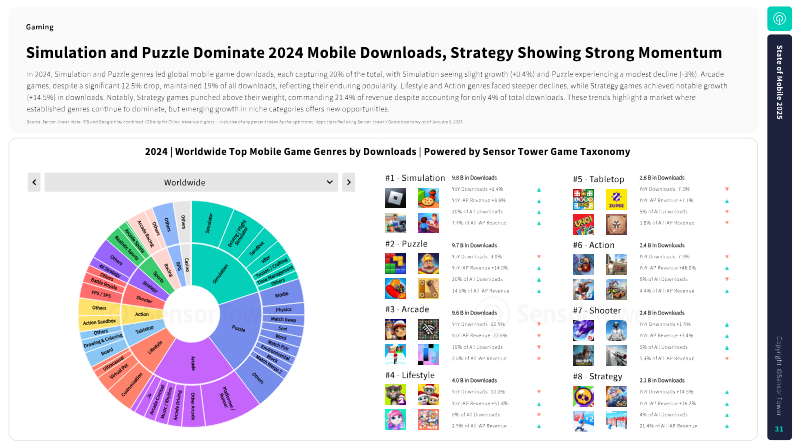
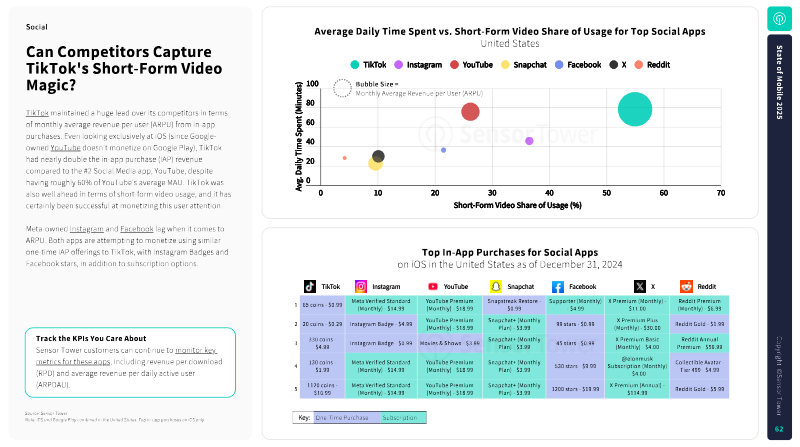
Sensor Tower's annual review of the 2024 mobile economy finds a market that is growing in revenue but maturing in usage.
- The global mobile economy reached $150 billion in consumer spend in 2024, driven by a 25% surge in non-gaming revenue despite a four-year decline in total app downloads.
- Mobile gaming revenue recovered to $80.9 billion, with 80% of earnings generated by titles older than two years and a record eleven games surpassing $1 billion in annual revenue.
- Generative AI became a primary engagement catalyst, with chatbot downloads increasing by 635 million and generating nearly $1.3 billion in revenue.

Week in Mobile Games E41 - How Scopely made $10bn, and 2025's big stories to watch
The mobile gaming industry is currently defined by a tension between established giants achieving record-breaking scale and a volatile market environment that demands constant innovation.
- Scopely reached $10 billion in lifetime revenue, a milestone driven by the seven-year development cycle and strategic refinement of Monopoly Go.
- Established intellectual property remains a primary monetization driver, evidenced by Pokémon Trading Card Game Pocket generating $400 million in its first ten weeks.
- Major gameplay overhauls can drive significant revenue spikes, as seen with Zenless Zone Zero reaching $8.6 million in daily revenue following content updates.

Inside NCSoft: Strategy, Partnerships, and Korean Gaming Trends
NCSoft’s strategic evolution reflects a broader transition within the Korean gaming industry, moving from rigid, subscription-based PC models toward diversified, globalized revenue streams.
- NCSoft shifted its business model starting around 2008, moving away from rigid subscription-based PC gaming toward diversified revenue streams driven by microtransactions and mobile platforms.
- The company’s internal transformation required integrating data science and artificial intelligence to refine player engagement and support large-scale international expansion.
- The Korean gaming market leverages high-density infrastructure and a history of PC-cafe culture to act as a primary testing ground for global-scale mobile and technological innovations.
Writers
Games and companies
Games