Mobile reports and market data
Documents

NAVIGATING GAMING MARKET: TRENDS, TRIUMPHS & TROUBLES with Tom Wijman, Newzoo'a Lead Analyst
The global gaming market is undergoing a period of stabilization and strategic recalibration as it moves past the post-pandemic volatility of recent years.
- The global gaming market is shifting from rapid expansion to stabilization, with 2023 growth primarily driven by console hardware availability and a backlog of major title releases.
- Publishers are pivoting toward live-service models and subscription platforms to combat slowing player base growth and intense competition for limited consumer time.
- Mobile gaming revenue is stagnating in mature markets due to privacy-related monetization challenges, forcing developers to target growth in Southeast Asia, the Middle East, and Latin America.

data.ai’s Lexi Sydow On Top-Grossing Genres And What It Takes To Make A Successful Game
The mobile gaming landscape is currently defined by a shift toward holistic performance metrics that prioritize a blend of acquisition, engagement, sentiment, and monetization.
- Success in the current mobile market requires a holistic strategy that integrates intellectual property with high-intent user acquisition, such as targeted paid search advertising.
- Leading titles like Monopoly GO! and FIFA Soccer sustain high revenue by leveraging real-world events and social-first experiences to build long-term player affinity.
- Modern game development must pair simple, intuitive gameplay mechanics with complex, event-based content to maintain engagement in a crowded ecosystem.

Supercell Cancels Floodrush / Gamescom Highlights / Epic’s Revenue Boost
Supercell’s decision to cancel the battle royale title Flood Rush underscores the company’s rigorous commitment to quality, as the project failed to achieve the strategic depth necessary to compete with established hits like Brawl Stars.
- Supercell canceled its battle royale title Flood Rush because it lacked the strategic depth required to compete with established games like Brawl Stars, reinforcing the company's focus on iterative quality over volume.
- Epic Games launched the 'First Run' program to challenge Steam by offering developers 100% revenue retention for six months of exclusivity, though the strategy faces skepticism regarding the potential loss of launch-day momentum on larger platforms.
- Sony is pursuing a dual strategy of hardware ecosystem expansion through the acquisition of Audeze and aggressive revenue extraction via increased PlayStation Plus subscription prices.



Store Intelligence Data Digest: Q3 2023
Mobile app and game downloads across the App Store and Google Play totaled 35.1 billion worldwide in Q3 2023, down 0.7% year over year.
- Global mobile app downloads reached 35.1 billion in Q3 2023, a 0.7% year-over-year decline driven by a 2% drop in Google Play installs despite a 6.1% increase on the Apple App Store.
- Meta dominated the quarter as Instagram secured the top global download spot, while the July launch of Threads generated nearly 40 million installs on its first day to become the fifth most downloaded app globally.
- India remains the world's largest mobile market by volume with 6.6 billion downloads, more than double the volume of the United States.


Insights into Marketing Trends of Global Mobile Games: Q3 2023
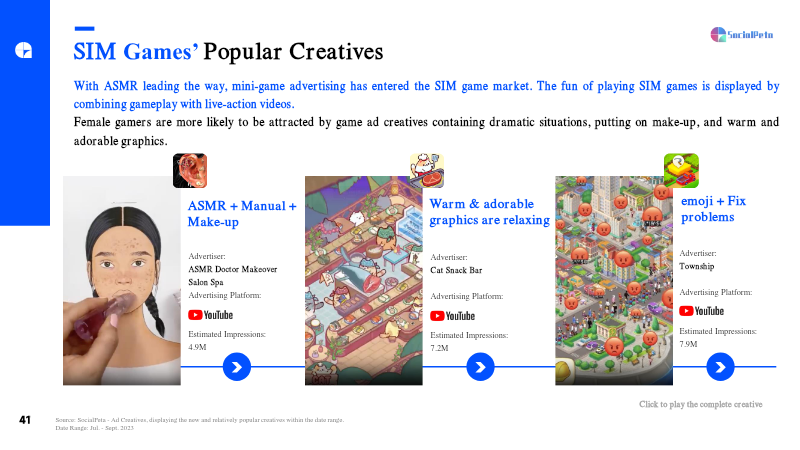
SocialPeta's Q3 2023 report examines mobile game advertising worldwide, using advertising data sampled from nearly 70 countries and regions and over 70 ad channels, covering July to September 2023.
- Global mobile game advertisers reached over 110K as of September 2023, up 72.3% YoY, while monthly creatives per advertiser fell about 38% YoY to 169.
- Advertisers releasing new creatives reached a two-year peak in Q3 2023, at 94.10% of advertisers.
- Video creatives' share of impressions fell below 80% after two consecutive years of decline, while image creatives rose to over 20%, which the document attributes to AIGC.
Mobile Games: State of the Market & Playtime Benchmarks Q3 2023
This joint Apptica and Gamelight report examines the mobile games market in Q3 2023 (July 1 to September 30, 2023).
- Worldwide iOS gaming revenue in Q3 2023 was led by RPG at $1,33B, followed by Strategy at 745M and Action at $698,97M.
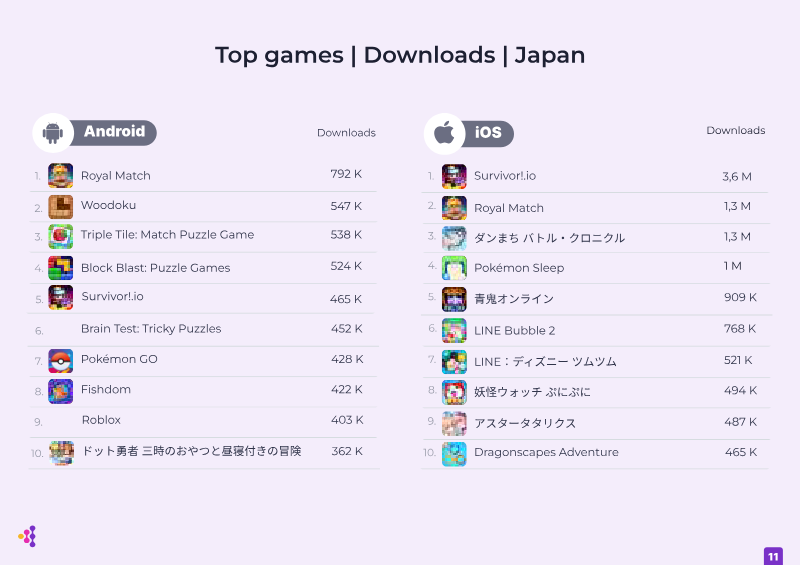
- Total gaming downloads on Android dropped 6,8% compared with the prior-year quarter, while iOS downloads fell 14,4% in the total rate.
- The six selected countries together accounted for 59% of worldwide gaming revenue, at $6,25B.

Gaming Industry Report: Q3 2023
Gaming remains a roughly $188 billion market in 2023, up 3% year over year, with a projected 8.94% CAGR to about $288 billion by 2028.
- The global gaming industry generated $46.5 billion in Q3 2023, marking a 3.2% year-over-year revenue increase driven primarily by the mobile segment, which holds 49% of the total market share.
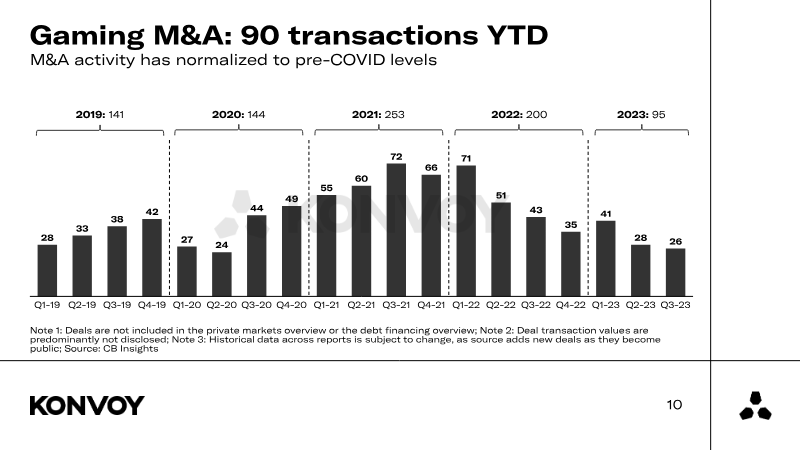
- Investment strategy has shifted toward consolidation, with $12.4 billion in total deal value despite a 15% decline in the number of transactions, as firms prioritize established intellectual property over early-stage ventures.
- Generative AI adoption is now a core operational strategy, with 65% of studios integrating these tools to streamline asset production and mitigate rising development costs.

data.ai’s Lexi Sydow Hot Gaming Trends And Ad Formats That Are Losing Steam
The mobile gaming industry is currently in a period of stabilization following a decline in consumer spending caused by economic pressures and reduced disposable income.
- Global mobile gaming consumer spending is projected to reach $108 billion in 2023, with simulation and team-battle RPGs serving as the primary drivers of market share.
- Developers are increasingly adopting cross-platform strategies across mobile, console, PC, and cloud-streamed platforms to offset economic pressures and regulatory headwinds in markets like China.
- Cloud-streamed gaming is gaining significant momentum, with time spent on mobile devices for these services expected to double in 2023, bolstered by infrastructure growth in Southeast Asia and Latin America.

ISTANBUL CONFIDENTlAL with RINA ONUR , CEO @ Spyke Games / co-Founder of Peak Games
The Turkish mobile gaming sector has evolved into a high-velocity, disciplined ecosystem, largely catalyzed by the success of foundational companies like Peak Games.
- Spyke Games maintains a competitive advantage by utilizing a centralized, on-site workforce in Istanbul, which avoids the inefficiencies of decentralized development while leveraging high compensation to attract top-tier talent.
- The studio’s success with 'Tile Busters' demonstrates a shift toward high-velocity iteration and the refinement of existing genres rather than relying on radical, unproven innovation.
- Spyke Games employs a modular, data-driven platform that enables rapid prototyping and seamless genre pivots, a strategy that allowed the team to successfully transition from social casino experiments to puzzle-mechanic games.

Moving Mountains: Speedy Level Creation as a Desperate Indie Dev
Solo independent development requires a strategic shift from the resource-heavy workflows of AAA studios toward extreme efficiency and persistent iteration.
- Solo developers should use procedural tools, such as noise generation libraries, to deform basic geometric primitives into complex, organic level shapes efficiently.
- Maintain a mechanic-tracking matrix to ensure an even distribution of gameplay features across all levels and to identify gaps where mechanics are underutilized.
- Design levels with a 'main path' for accessibility and 'optional paths' containing collectibles to provide challenge for advanced players without blocking progress for a wide audience.

Strategic Cross-Promo for Mobile Publishers - A HyperBeard Case Study
HyperBeard, a prominent Mexico-based mobile game developer and publisher, has successfully optimized its user acquisition and monetization strategies by leveraging advanced data analytics tools.
- HyperBeard achieved a 35% increase in portfolio lifetime value (LTV) and a 15% to 20% improvement in return on ad spend (ROAS) by shifting to cross-portfolio performance tracking.
- The publisher increased total ad spend by approximately 300% in a single quarter by justifying higher cost-per-install (CPI) bids based on a user's total contribution to the entire game ecosystem.
- By integrating Tenjin and Growth FullStack, HyperBeard centralized data to bypass privacy-centric measurement limitations and track user migration between their 30+ titles.

Mobile UA Landscape Impact on Gaming Companies (Pixels & Profits #7) ft. Matej Lancaric
The mobile gaming industry is undergoing a fundamental transformation in user acquisition strategies, moving away from traditional interest-based targeting toward sophisticated, event-based optimization.
- Mobile user acquisition is shifting from interest-based targeting to event-based optimization and modeled conversions due to the deprecation of IDFA and the end of fingerprinting.
- Developers are prioritizing financial discipline by shortening payback periods to between 30 and 90 days to ensure immediate profitability.
- Successful studios are increasingly utilizing web shops to circumvent platform fees and adopting genre-bending mechanics inspired by Asian market trends to improve monetization.
Writers
Games and companies
Games