Global reports and market data
Documents
Contexts, Pleasures and Preferences: Girls Playing Computer Games
This study investigates the gaming preferences of girls, arguing that these preferences are dynamic, context-dependent, and shaped by an "assemblage" of past experiences, access, and peer culture, rather than being solely attributable to gender.
- Preferences are not fixed: over one school term, the nine participating girls expanded their favourite-game lists from 26 titles to include 16 newly encountered games, suggesting that simply offering new games in a new context was enough to alter stated tastes.
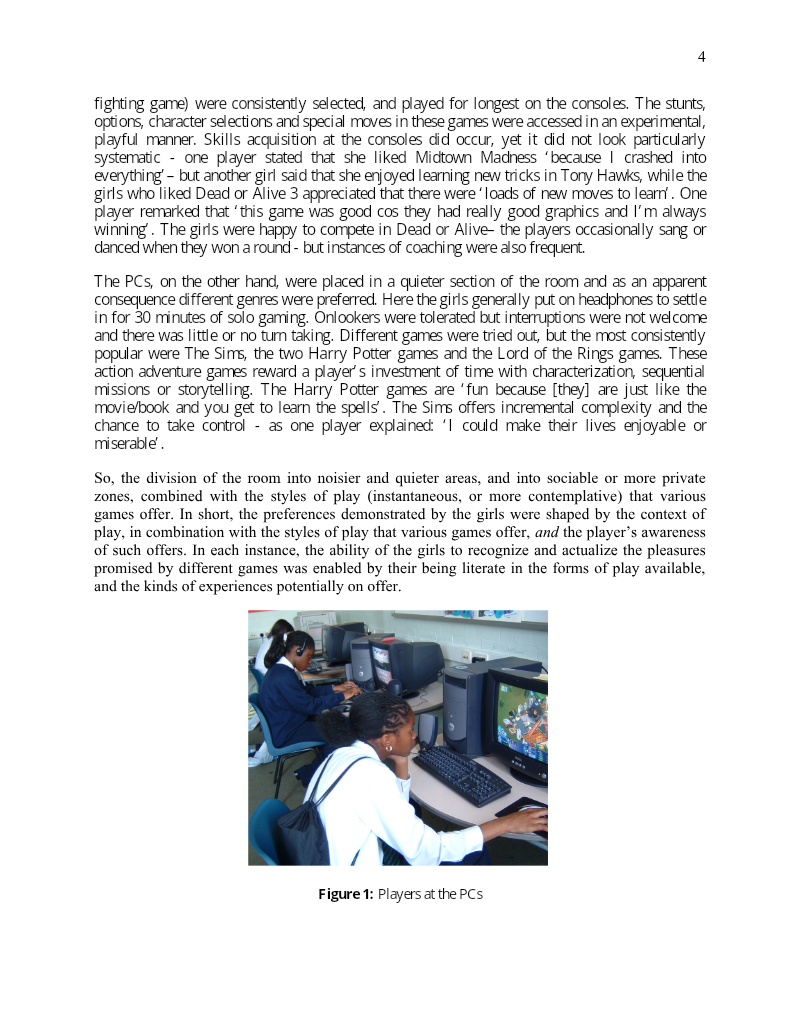
- Physical site features shaped genre choice: consoles placed near the noisy social area drew girls to instantly gratifying, turn-taking games such as Tony Hawk's Pro Skater 4 and Dead or Alive 3, while the solitary PC corner favoured narrative-driven titles like The Sims and the Harry Potter and Lord of the Rings games.
- Avatar gender mattered less than assumed: the girls showed little interest in female-led games, and questionnaire responses about ideal characters rarely specified gender, with those who did sometimes choosing male avatars, most pronounced among girls with the greatest home access.

The Psychophysiology of Video Gaming: Phasic Emotional Responses to Game Events
This study explores the phasic psychophysiological responses to specific game events, aiming to demonstrate how emotion-related physiological data can inform game design.
- The study shifts from tonic, averaged physiological measures to phasic, event-level responses, arguing that tonic measures cannot separate the varied emotions elicited by specific moments of play.
- Physiological data (facial EMG, skin conductance, and cardiac interbeat intervals) were recorded from 36 participants playing Monkey Bowling 2 and synchronized with video at roughly single-frame accuracy.
- Falling off the lane and knocking down pins both produced positive-valence responses, and falling off the lane also elicited high arousal, suggesting active participation can make even failure emotionally rewarding.
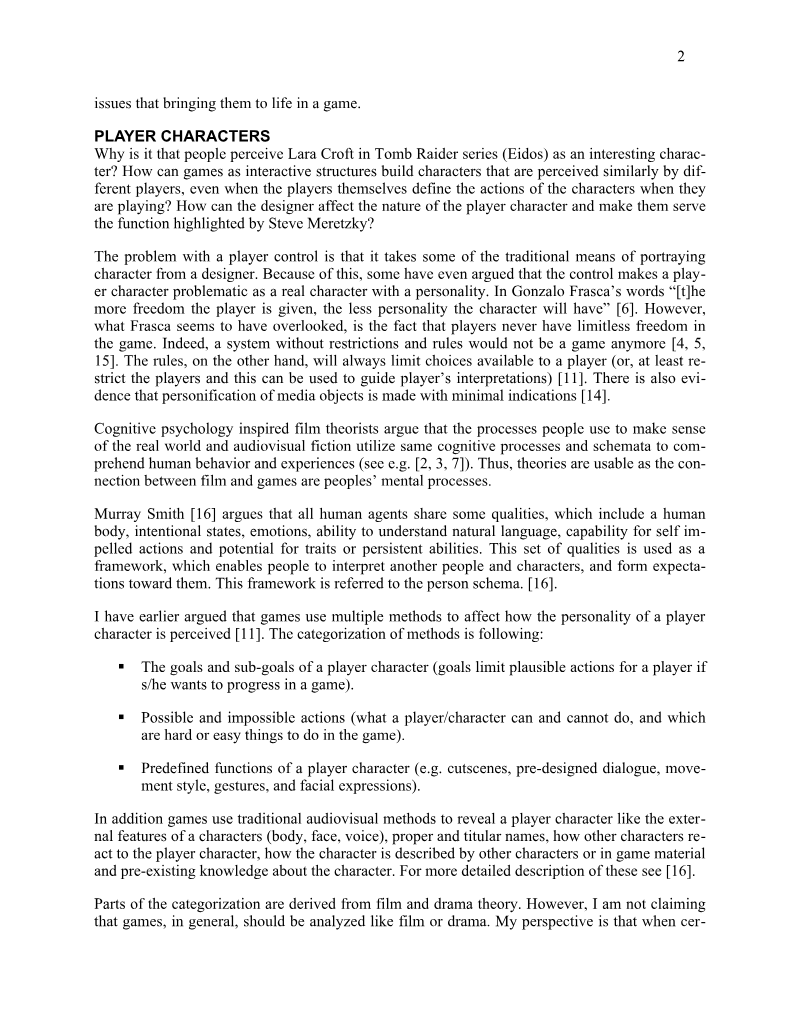
Building and Reconstructing Character: A Case Study of Silent Hill 3
This paper presents a case study of character building in the game Silent Hill 3, analyzing how the player character, Heather, is constructed and perceived.
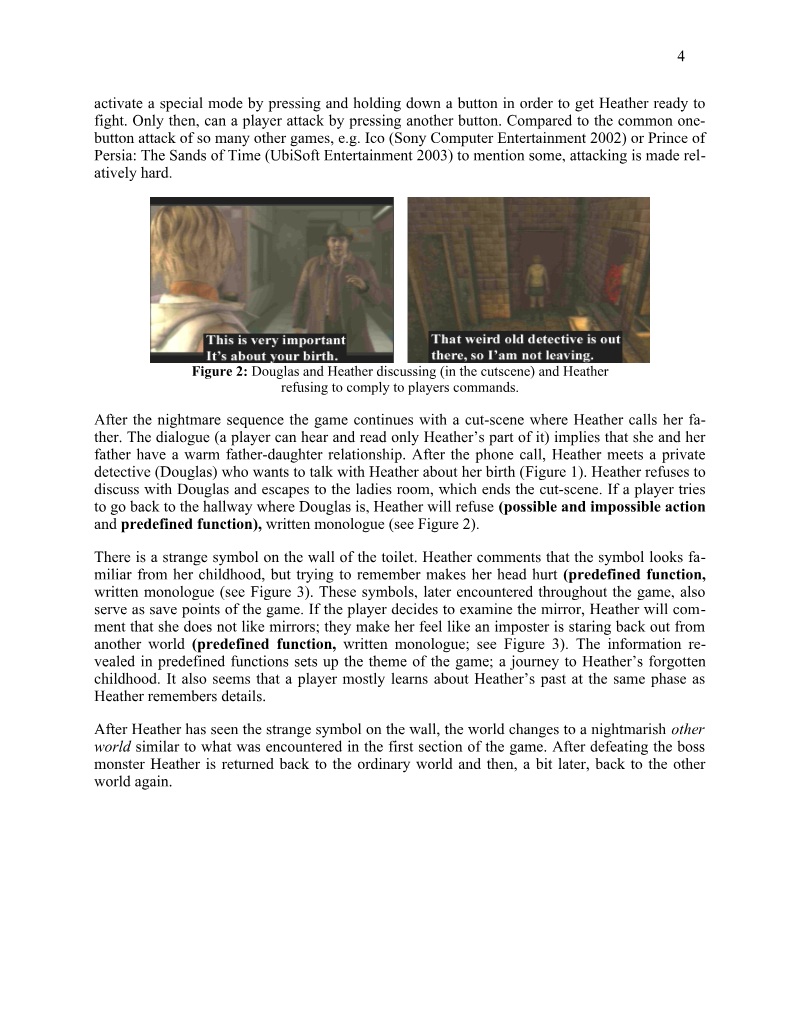
- Predefined functions such as cutscene dialogue and written monologue are the primary means by which Heather's nature is revealed in Silent Hill 3, while goals play only a minor role.
- Possible and impossible actions frequently reinforce the characterization conveyed by predefined functions, operating through the game's control design.
- The opening user guide, the playable nightmare sequence, and the first cutscenes are especially important for setting the player's interpretive expectations of the character.
Playing in the Sandbox: Developing Games for Children with Disabilities
This study investigates the preferences and needs of children with disabilities regarding computer games, challenging the notion that special games are required for special needs.
- The principal barrier for children with disabilities, especially those with cerebral palsy, is physical rather than a lack of suitable content: console controllers for Xbox and PlayStation require two dexterous hands, and many of these children lack them.
- The author argues these children do not primarily need specially designed games; they want to play the same commercial titles as their peers, so the priority is accessible input hardware for mainstream multiplayer games.
- Informal interviews with cerebral palsy students aged 18 to 21 at a centre attached to a mainstream high school reported that games made them happier, improved self-esteem, and gave a sense of social belonging, with one student believing driving games helped him control a powered wheelchair.
Games for Learning: Are Schools Ready for What's To Come?
This 2005 pilot study, presented at the DiGRA conference and conducted by researchers at the University of Calgary, examines whether K-12 teachers are ready to integrate digital games into classroom instruction.
- Seventy percent of surveyed K-12 teachers reported using simulations or games in class, and 57 percent used games specifically, mostly for learning.
- The main barriers to classroom game use were inadequate hardware and software, insufficient time, and lack of knowledge about integrating games into curricula, rather than resistance to games themselves.
- Willingness to try game-related applications was generally high, with educational downloads and simulations rated most favorably and commercial off-the-shelf games receiving more mixed responses.
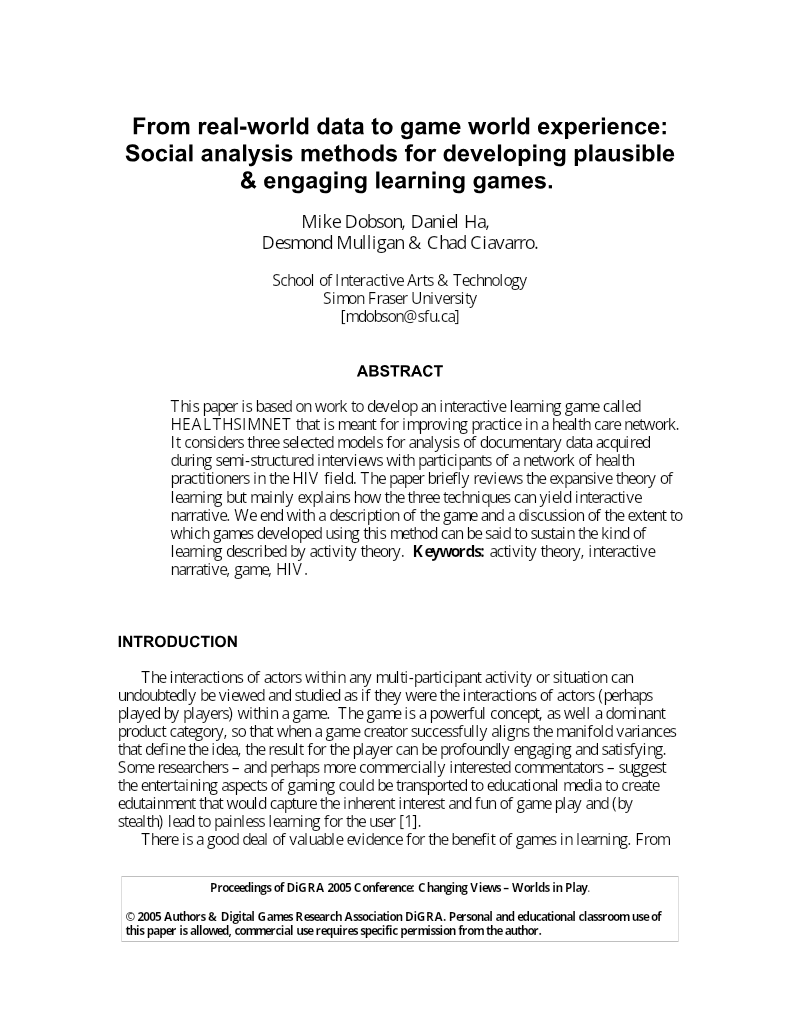
From Real-World Data to Game World Experience: Social Analysis Methods for Developing Plausible & Engaging Learning Games
The document outlines a methodological approach for developing plausible and engaging learning games by transforming real-world social data into interactive narratives.
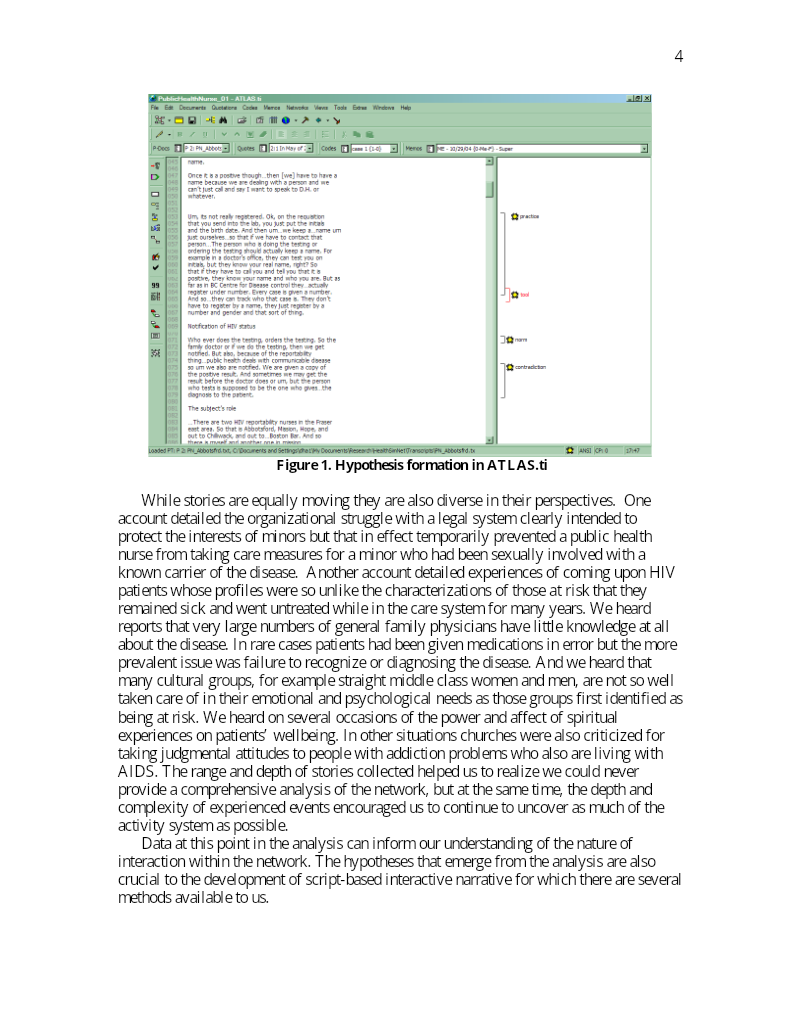
- The report's core method converts qualitative interview data into causally structured game narratives using cultural-historical activity theory, grounded theory coding in ATLAS.ti, action-relevant episodes, and TEAMVIEW representations, so that tensions within activity systems can be resolved in multiple ways to produce varied plot developments.
- The central case is HEALTHSIMNET, a prototype for improving practice within an HIV health care network in British Columbia, built from interviews with network participants.
- Interviews surfaced consequential design issues including legal barriers to public health action, widespread gaps in family physician knowledge about HIV, underserved patient populations, and spiritual and judgmental influences on care.
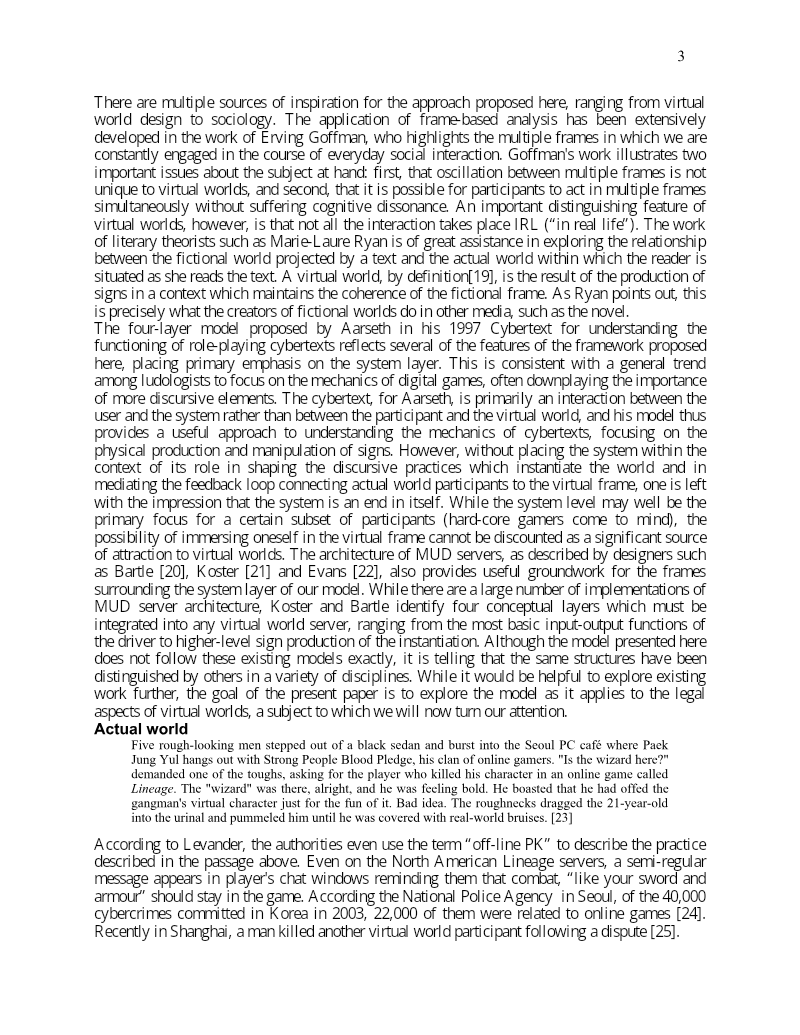
Framing Virtual Law
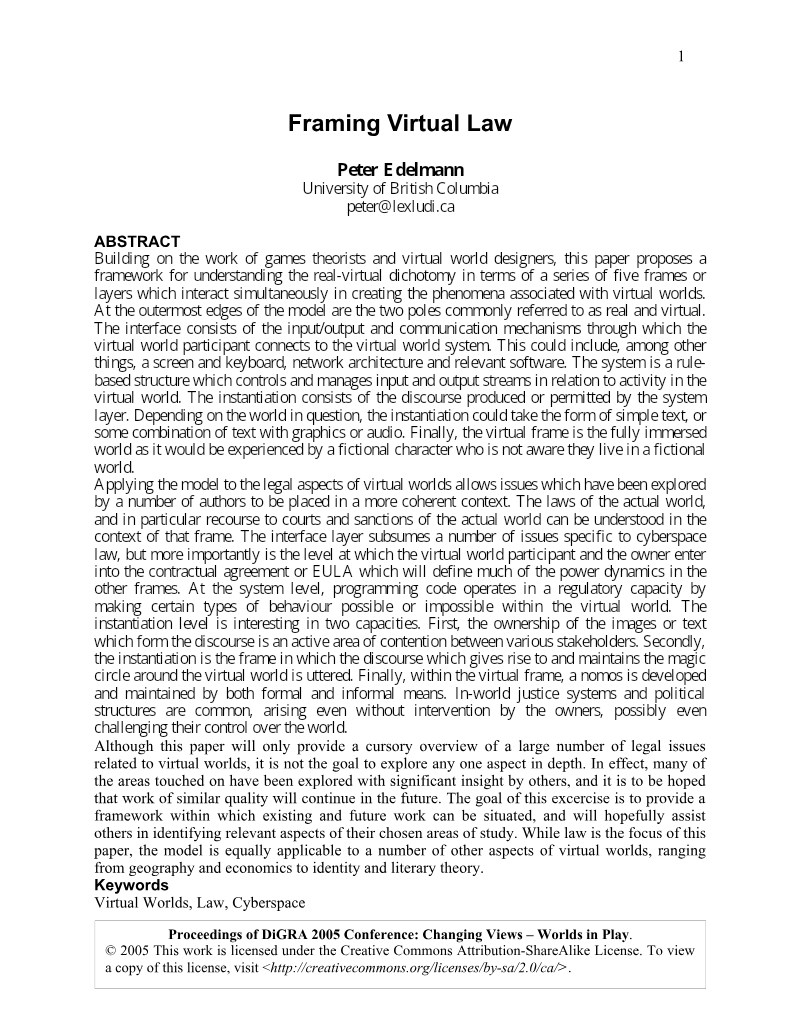
"Framing Virtual Law" establishes a five-layer analytical framework—Actual, Interface, System, Instantiation, and Virtual—to dissect the complex legal and normative landscape of virtual worlds.
- The paper replaces the real-versus-virtual dichotomy with a five-layer model (actual, interface, system, instantiation, virtual) and argues that control over virtual worlds is distributed across these layers rather than held by a single authority.
- Actual-world law operates mainly at the outermost layer through courts and sanctions, while end-user license agreements at the interface layer often waive participants' access to courts, leaving owners largely shielded from legal challenge.
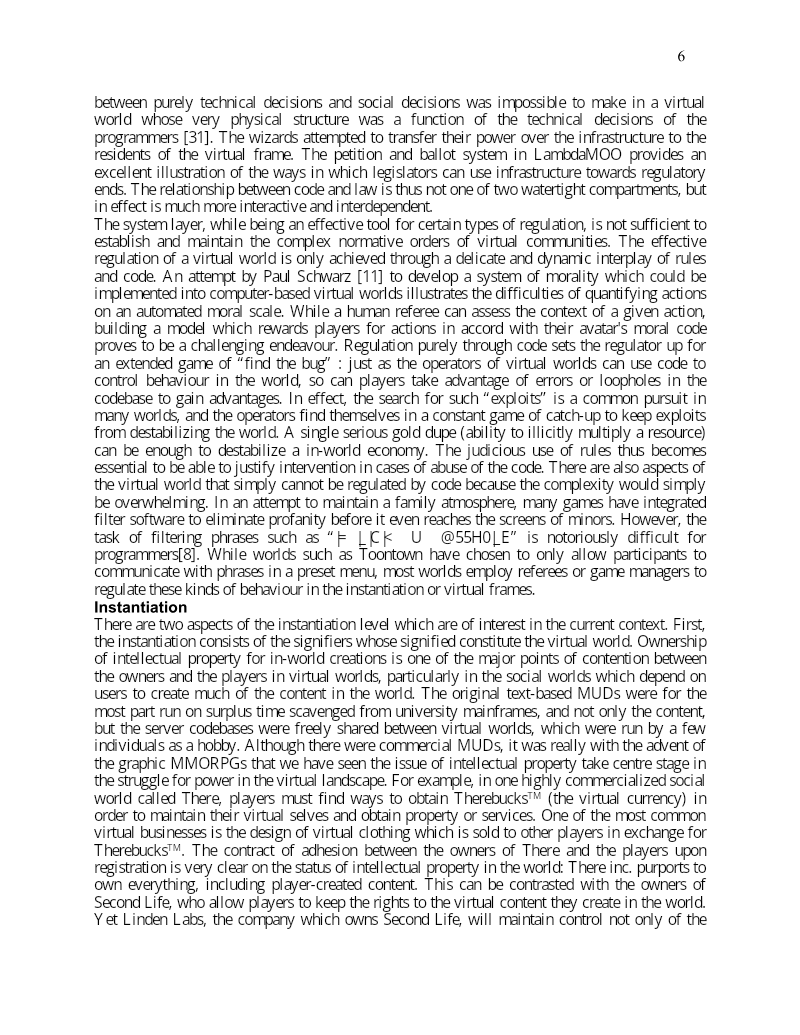
- Illustrative cases such as the Korean Lineage "off-line PK" assault and the banishment of Peter Ludlow from The Sims Online show owners excluding participants with little practical recourse.
Game Mediated Communication: Multiplayer Games as the Medium for Computer Based Communication
This document explores the increasing role of multiplayer games as a medium for computer-based communication, hypothesizing that these games are becoming a natural environment for general computer chat.
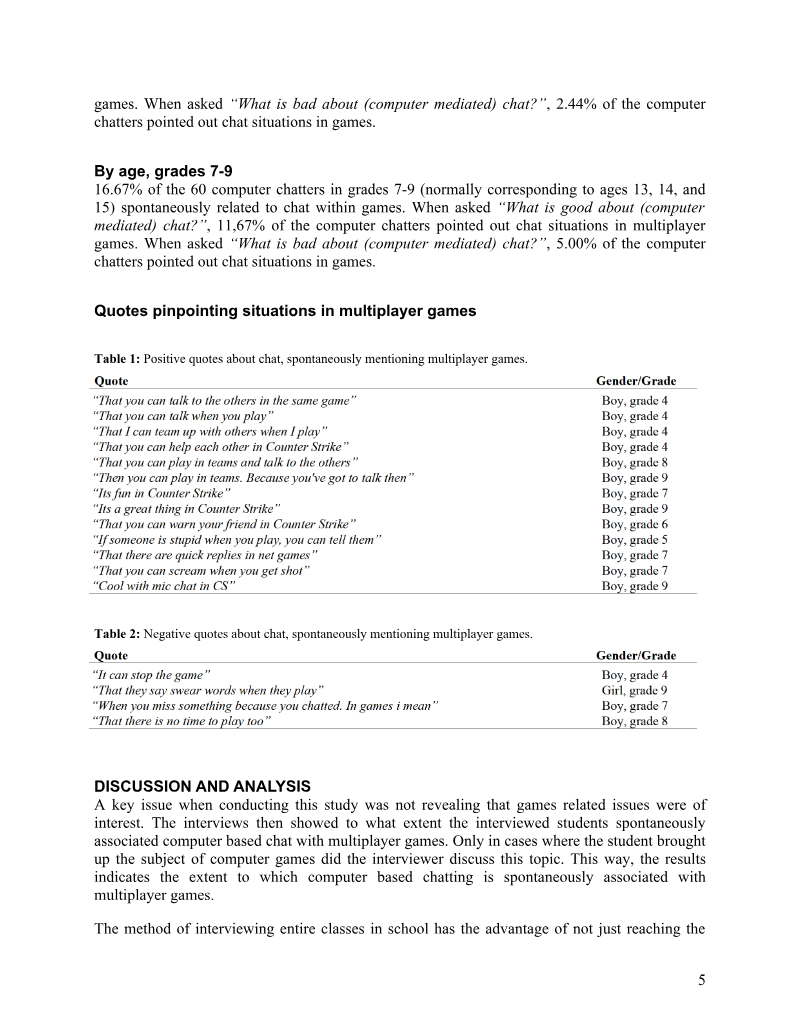
- Roughly 16.83% of computer chatters spontaneously linked chat with multiplayer games even though the interviewer never raised games, suggesting games are already a natural association for computer-mediated conversation.
- Among students aged roughly 10 to 15 at two Swedish schools, 101 of 131 interviewed reported chat use, and spontaneous game association was nearly identical for younger and older students (17.07% vs. 16.67%).
- Positive associations dominated: 76.47% of game-related answers arose from questions about the benefits of chat.
Build It to Understand It: Ludology Meets Narratology in Game Design Space
The document posits that constructing experimental games is an essential methodology for advancing game studies, particularly in resolving theoretical conflicts such as the long-standing debate between ludology and narratology.
- Mateas and Stern argue that building experimental games yields theoretical and design insights that purely analytical study of existing titles cannot reach, because analysis cannot anticipate new regions of design possibility.
- The authors contend that ludologist skepticism about combining player agency with strong narrative partly reflects the absence of successful agency-rich narratives, and they test this claim with their interactive drama Façade.
- Façade recasts story interactions as abstract social games (affinity, hot-button, and therapy games) driven by natural-language discourse acts and coordinated by a layered architecture and drama manager managing multiple narrative fronts.
Augmented Board Games: Enhancing Board Games with Electronics
This paper explores the concept of "Augmented Board Games," which integrate computational power and electronics to enhance traditional board game functionality and gameplay.
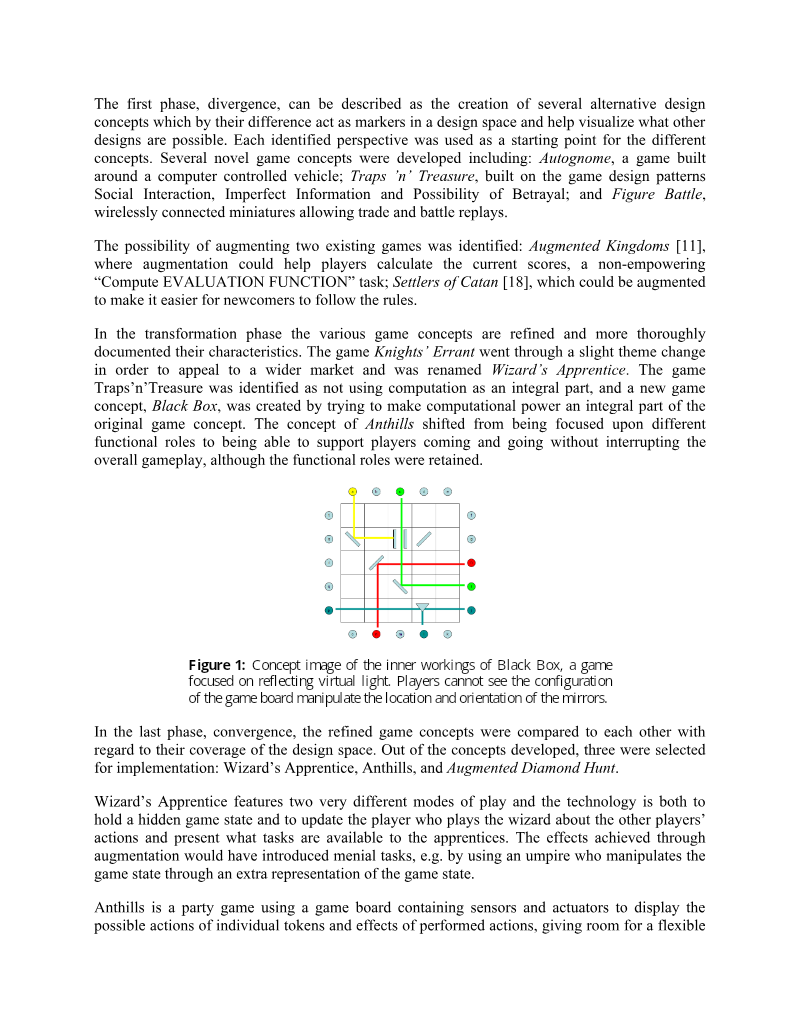
- The paper, presented at DiGRA 2005, maps the design space of augmented board games (traditional board games extended with electronics, sensors, and computing), with the goal of mapping subspaces rather than producing a complete taxonomy.
- The authors set three research priorities: minimize unempowering or tedious player activities, provide mechanics impossible or impractical without technology, and preserve the social environment of non-augmented board games.
- Purely aesthetic augmentation was deliberately excluded unless it arose as a side effect of gameplay improvements.
Player as Author: Conjecturing Online Game Creation Modalities and Infrastructure
The document proposes an "emancipatory movement" to address creative stagnation in the video game industry by empowering players to become authors in the game creation process, moving beyond a traditional producer-consumer dichotomy.
- The paper argues the videogame industry has entered creative stagnation, marked by sequels, familiar genre templates, and tight production control, and that the producer-consumer dichotomy limits innovation.
- Its central thesis is that players should be recognized and enabled as authors who create game content, scenarios, mods, and entirely new games, framed as an emancipatory movement.
- Cited examples of player authorship include user-generated machinima, photo-novel stories produced from The Sims, object scripting in Second Life, and modding communities supported by Valve and id Software.
Connecting Worlds: Fantasy Role-Playing Games, Ritual Acts and the Magic Circle
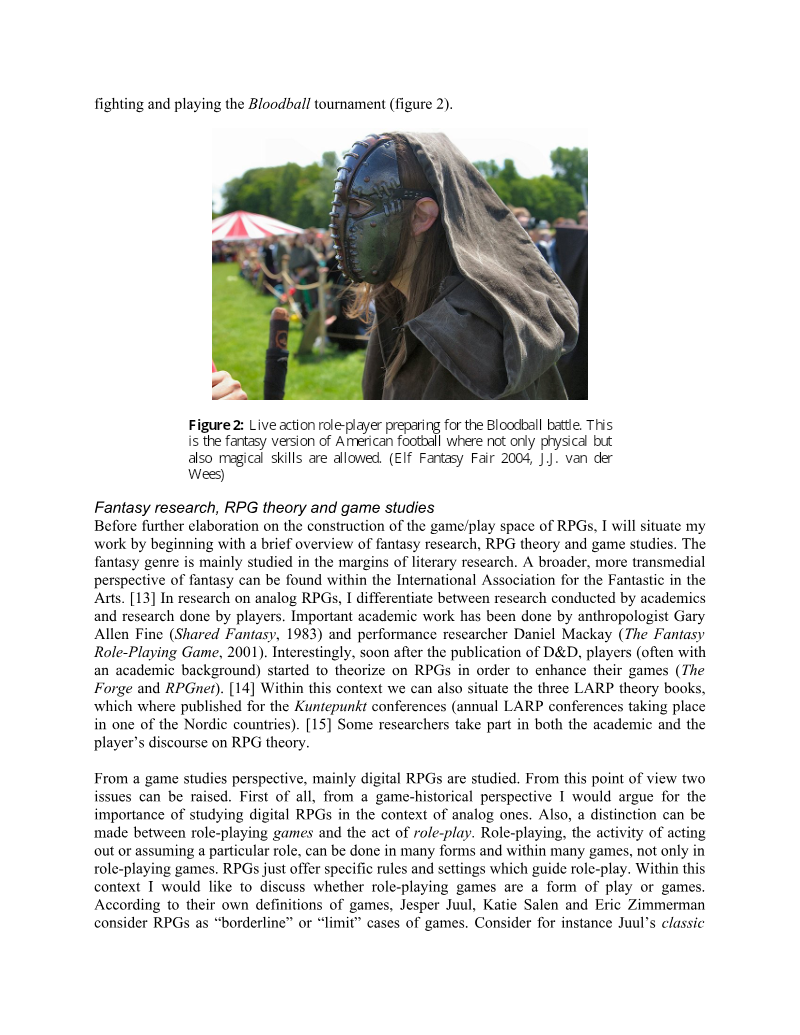
This analysis examines the intricate relationship between fantasy role-playing games (RPGs), ritual acts, and the construction of identity within the fantasy subculture in the Netherlands.
- Marinka Copier argues that fantasy role-playing games should be studied as part of a broader fantasy subculture rather than as isolated objects, and that the prevailing use of Johan Huizinga's "magic circle" concept in game studies misrepresents his original ideas.
- The paper contends that the play space is not a fixed chalk-line boundary, as Salen and Zimmerman's visualization suggests, but is actively constructed through negotiation and ritual acts such as bricolage.
- Role-playing is framed through ritual and performance theory (Turner, van Gennep, Schechner), treating RPGs as collections of performances that connect worlds rather than as activities bounded off from everyday life.