1 free read left. Create a free account for unlimited reading + AI research.
Create free accountWhitepaperInteractive Institute
It studies traditional board games extended with electronics, sensors and computational power. Its aim is to map subspaces rather than produce a complete taxonomy.
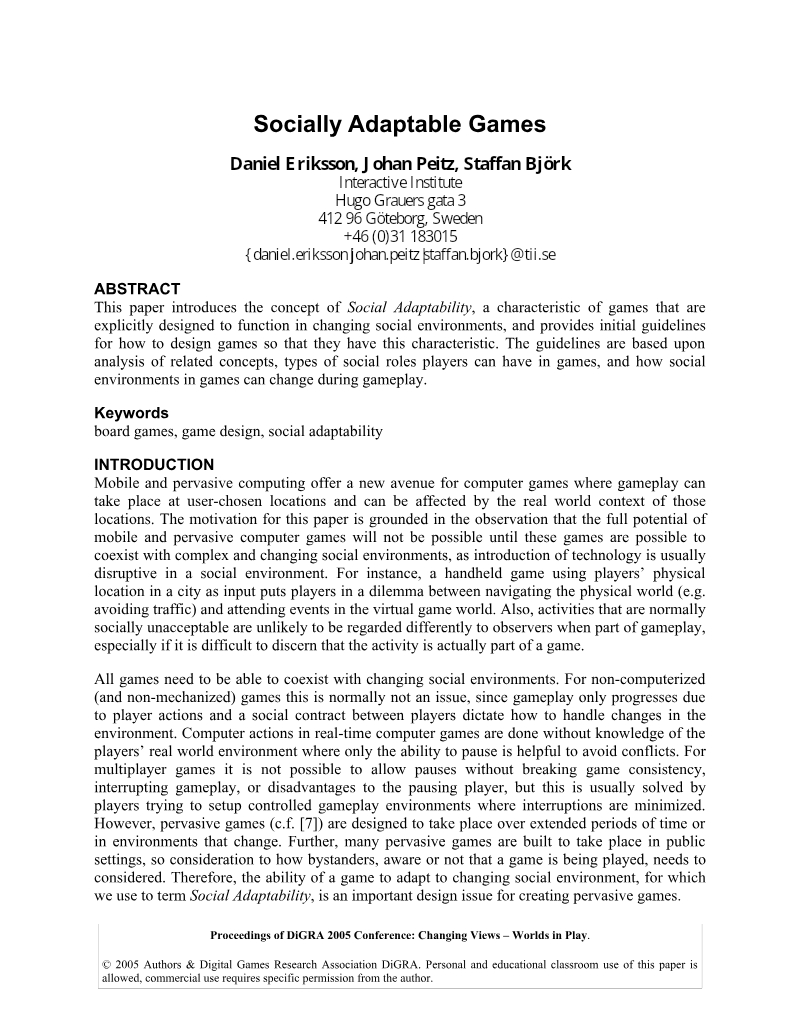
This paper, presented at DiGRA 2005, examines augmented board games: traditional board games extended with electronics, sensors, and computational power to enhance gameplay. Its central aim is to map the design space of this genre with a focus on gameplay rather than technology showcase. The authors set three research priorities: minimizing activities players find unempowering or tedious, providing mechanics that would be impossible or impractical without technology, and preserving the social environment of non-augmented board games. Purely aesthetic augmentation was deliberately set aside unless it arose as a side effect of gameplay improvements.
The methodology combined experimental interaction design with several analytical tools. A task analysis of primarily German-style board games produced a generalized set of nine player-state interaction tasks, such as taking, placing, randomizing, and computing evaluation functions, which were paired with a survey of available sensors, actuators, and communication technologies. Social adaptability guidelines supplied dimensions for social and functional roles, and Jones's divergence-transformation-convergence method structured the design process. This produced concepts such as Autognome, Black Box, Anthills, and Augmented Diamond Hunt, of which Wizard's Apprentice, Anthills, and Augmented Diamond Hunt were implemented as prototypes.
The authors conclude that augmentation enables several recurring design possibilities, including manipulable hidden game states, real-time gameplay flow adjustment, shifting rule enforcement to the system, supporting late-arriving or departing players, automating menial calculations, and subtly supporting rule compliance. Their findings are presented as an early mapping of subspaces rather than a complete taxonomy, and the paper notes that further prototyping and observation of actual play remain necessary.
Game Developers Conference · 2023