Global reports and market data
Documents

The Ability of Branded Online Games to Build Brand Equity: An Exploratory Study
This exploratory study investigates the effectiveness of branded online games, or "advergames," in building brand equity compared to traditional banner advertisements.
- An M&M's advergame achieved 32% unaided recall and 57% aided recognition, versus 3% and 14% for a banner ad, with 68% combined recall compared with 16% for the banner.
- In a paired comparison, the advergame produced significantly higher brand recall than the banner ad (t=4.53, p=0.0009), supporting the view that advergames can outperform banners in building brand awareness.
- The study's sample was small and non-representative: 37 completed responses out of 108 registrants, recruited from online game community forums.
Immersion in Game Atmospheres for the Video Game Heritage Preservation
This document proposes a method for preserving video game heritage by archiving game atmospheres, which are identified as a crucial, yet often overlooked, element of players' memories.
- The report argues that the physical atmosphere of play (lighting, furniture, sounds, social context) is largely unarchived even though players often remember it as one of their strongest experiences, while software preservation through emulators and virtual museums is comparatively well developed.
- The author positions video games as a major cultural form, noting the industry has surpassed cinema economically and has existed for more than thirty years, yet physical game exhibitions remain rare because hardware and software are fragile and scarce.
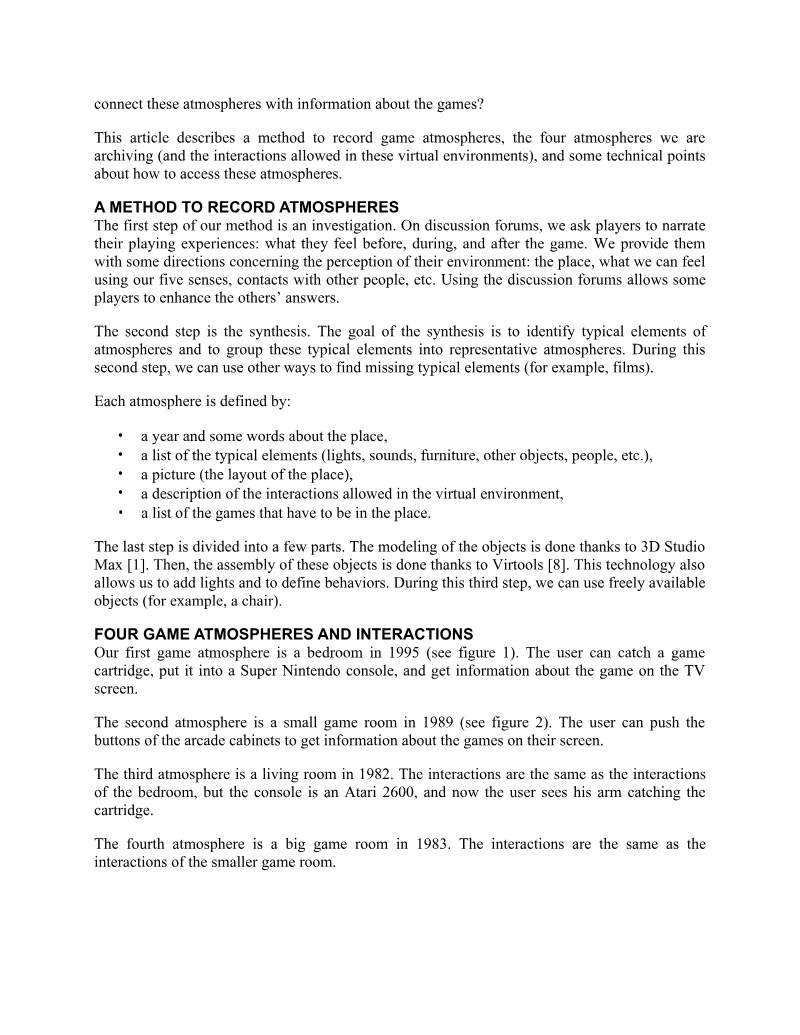
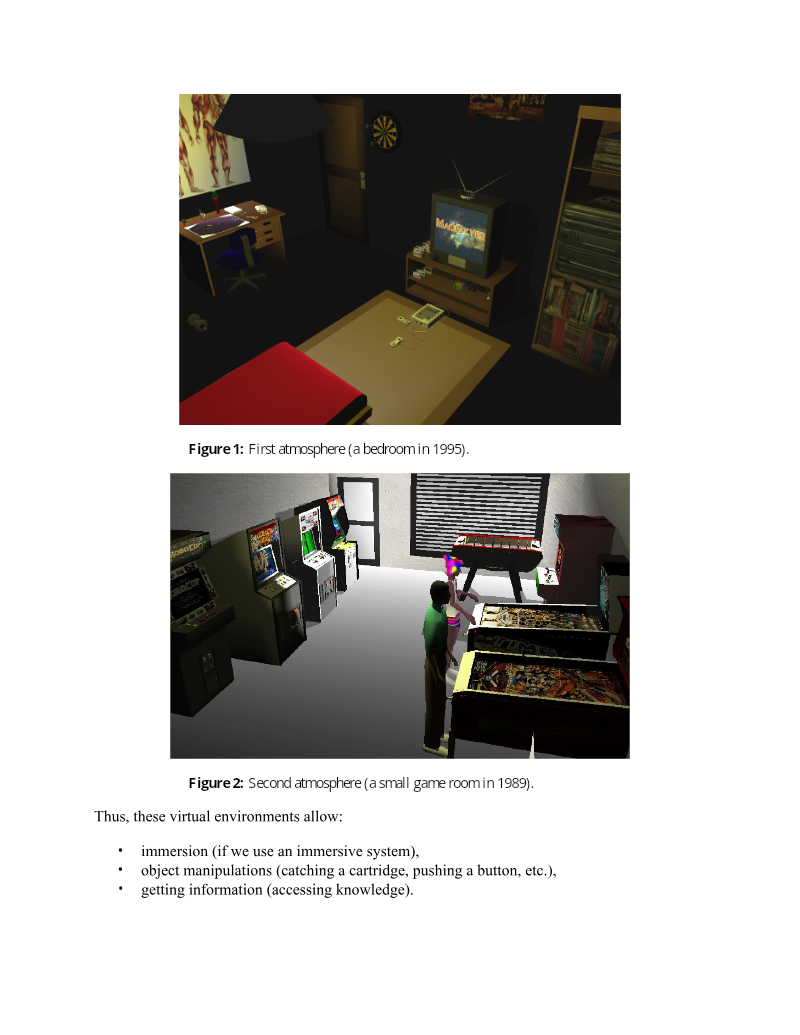
- The proposed method has three stages: forum-based player narratives about place and sensory perception, synthesis of recurring elements (lights, sounds, furniture, people) into representative atmospheres, and documentation of each atmosphere with date, description, element list, layout picture, permitted interactions, and associated games.

Motivational Factors in Game Play in Two User Groups
This study investigates the role of motivational factors in electronic game play among two distinct university student populations: computer science students and business students.
- Computer science students (n=59, median age 22) ranked electronic games as their second most favorite activity and played roughly six titles, while MBA business students (n=111, median age 26) ranked gaming sixth of seven activities and played about two titles, favoring board and card games.
- The two groups diverged most sharply on engagement and social factors, which the authors attribute largely to differences in technology exposure; a validation sample of 17 high school students resembled the computer science group more closely, supporting this interpretation.
- Computer science students favored frequent, often daily, online and multiplayer play with strangers, whereas business students preferred infrequent play with acquaintances in the same room.
Spontaneous Communities of Learning: Learning Ecosystems in Massively Multiplayer Online Gaming Environments
This paper outlines the theoretical framework for a doctoral research project investigating spontaneously emerging communities of learning within massively multiplayer online gaming (MMOG) environments, specifically focusing on City of Heroes.
- Massively multiplayer online games such as City of Heroes act as informal learning ecosystems where globally dispersed players self-organise to master complex environments.
- The authors argue that because mastery typically requires collaboration, players form symbiotic learning relationships that extend beyond the game into forums, chat channels, and face-to-face meetings.
- The framework draws on legitimate peripheral participation (Lave and Wenger), connectivism (Siemens), and distributed intelligence (Levy), positing that learning is best studied in naturally occurring contexts rather than formal classrooms.

New Design Methods for Activist Gaming
The document outlines a systematic methodology for integrating human values into the design process of games and technological systems, particularly in the context of "activist gaming."
- The paper proposes a three-phase, iterative methodology (Discovery, Translation, Verification) for embedding social and ethical values into game and technical system design, positioned as an augmentation of existing game design and HCI practices rather than a replacement.
- Discovery identifies values from four sources: definition values stated in project goals, collateral values arising from specific design choices, designer values rooted in team members' backgrounds, and user values revealed through prototyping and usability testing.
- Translation converts identified values into concrete design specifications, illustrated by a code-sharing and reward mechanism in the RAPUNSEL game that operationalized cooperation.

Realistic Agent Movement in Dynamic Game Environments
This document addresses the challenge of realistic agent movement in dynamic game environments, proposing a novel strategy to enhance traditional pathfinding algorithms using machine learning techniques.
- The paper argues that traditional pathfinding methods such as A and navigation meshes rely on static, pre-processed map representations, which become inadequate once physics middleware lets players and agents alter level geometry in real time.
- The authors propose giving agents real-time awareness via four ray-casting sensors spanning a 90-degree field of vision, feeding an artificial neural network that controls movement, with weights evolved by a genetic algorithm guided by reinforcement-style scoring.
- The approach was implemented as a test bed on the Quake 2 engine using a custom C++ AI library, with graphical tools allowing users to adjust evolution and network parameters during training.
Presence Experience in Mobile Gaming
This study investigates the "presence experience" in mobile gaming compared to PC gaming, focusing on whether the gaming experience with small-screen mobile devices is comparable to that on a large PC screen.
- Players experienced significantly higher presence on a large PC screen than on a small PDA screen, with spatial situation model scores of 3.31 versus 2.73 and self-location scores of 3.40 versus 2.10.
- Attentional engagement did not differ by device (4.23 on the PDA versus 4.20 on the PC), indicating that attention is necessary but not sufficient for presence: small-screen players can be highly engaged without feeling spatially immersed.
- Suspension of disbelief showed no significant device effect, and involvement approached but did not reach significance.
Designing Puzzles for Collaborative Gaming Experience: CASE eScape
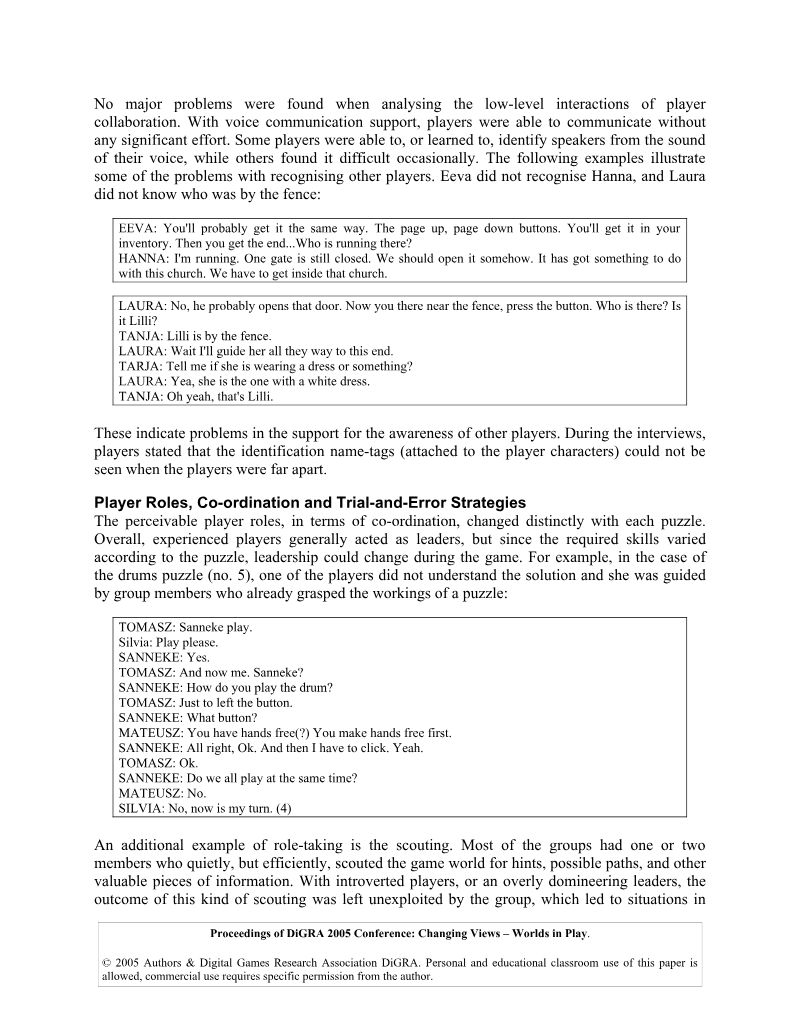
This analysis explores the design of puzzles for collaborative gaming experiences, specifically examining how to create meaningful multiplayer challenges that necessitate genuine group interaction.
- Designing multiplayer puzzles that truly require cooperation has received little systematic attention, since single-player puzzle design is well documented but collaborative puzzle guidance is scarce.
- In observations of six groups of four non-gamers playing CASE eScape, participants consistently reported stronger collaboration than the recordings showed, with puzzles such as the climbing and bee puzzles often solved by only one to three players.
- Trial-and-error approaches frequently caused coordination problems, and awareness of other players suffered partly because name tags were invisible at a distance.
The Pervasive Interface: Tracing the Magic Circle
"The Pervasive Interface: Tracing the Magic Circle" posits a redefinition of the interface concept within pervasive games, arguing it extends beyond conventional hardware and software to encompass the player's imagination and the reinterpretation of everyday reality.
- Eva Nieuwdorp's DiGRA 2005 paper argues that pervasive games, which embed fantasy within everyday physical and social settings, require rethinking the concept of an interface beyond hardware and screens.
- The paper proposes a "liminal interface" crossed in two stages: the paratelic interface, a playful state where players set aside lifeworld conventions through Goffman's rules of irrelevance, and the paraludic interface, a rule-bound structure where the game world's semiotic conventions dominate.
- The paper reworks the magic circle as a permeable, two-way boundary rather than a sealed space, and contends that the game world must feel omnipresent and internally consistent or the magic circle is pierced and the game collapses.

The Narrative and Ludic Nexus in Computer Games: Diverse Worlds II
"The Narrative and Ludic Nexus in Computer Games: Diverse Worlds II" empirically investigates the interplay between narrative and gameplay elements in contemporary computer games.
- The study analyses 80 critically acclaimed 2003 titles using Jenkins' four dimensions of narrative architecture and Aarseth, Smedstad and Sunnanå's thirteen-factor ludological typology, aiming to move past the narratology-ludology debate by examining how story and mechanics interact dynamically.
- Narrative formal systems appear in roughly three-quarters of the sampled games, with evoked and enacted narrative the most prevalent forms, while flashback and flash-forward techniques are rare and story information is predominantly presented objectively.
- Most titles feature geometrical topography, finite goal structures, real-world-paced time, and single- or two-player configurations, with deterministic responses, real-time environments, and objective-based rules common, and overcoming evil the dominant strategic objective.
The Localization of Digital Games: A Case Study in China
This paper investigates the complexities of digital game localization, specifically focusing on the Chinese market.
- Game localization is more complex than general software localization because games function simultaneously as commercial and cultural products.
- The authors propose a three-dimensional model comprising the In-Game Environment (storyline, gameplay, engagement, interface), the External Environment (social, political, legal, ideological factors), and the Users, who link the two.
- The central contention is that all three dimensions should be considered throughout the entire game design process rather than treated as a late-stage adjustment.
The Use of Video Game Technology for Investigating Perceptual and Cognitive Awareness in Sports
This paper outlines a research framework designed to investigate the transferability of perceptual and cognitive learning from video game environments to real-world sports, specifically ice hockey.
- The paper is a 2005 DiGRA conference proposal, not a completed study, and it reports no empirical results; its planned experiment's outcome remains untested.
- The authors argue that expert athletes and skilled video game players both build advanced perceptual and decision-making abilities through immersive practice, with ice hockey as the focal sport domain.
- The central claim is that expertise depends on holding and shifting between multiple knowledge types (cue utilization, pattern recognition, visual search, situational probability assignment) within ecologically realistic contexts rather than isolated lab trials.