1 free read left. Create a free account for unlimited reading + AI research.
Create free accountWhitepaper DiGRA
1 free read left. Create a free account for unlimited reading + AI research.
Create free accountWhitepaperDiGRA
Marinka Copier argues that these games should not be studied as isolated objects but as part of a wider fantasy subculture.
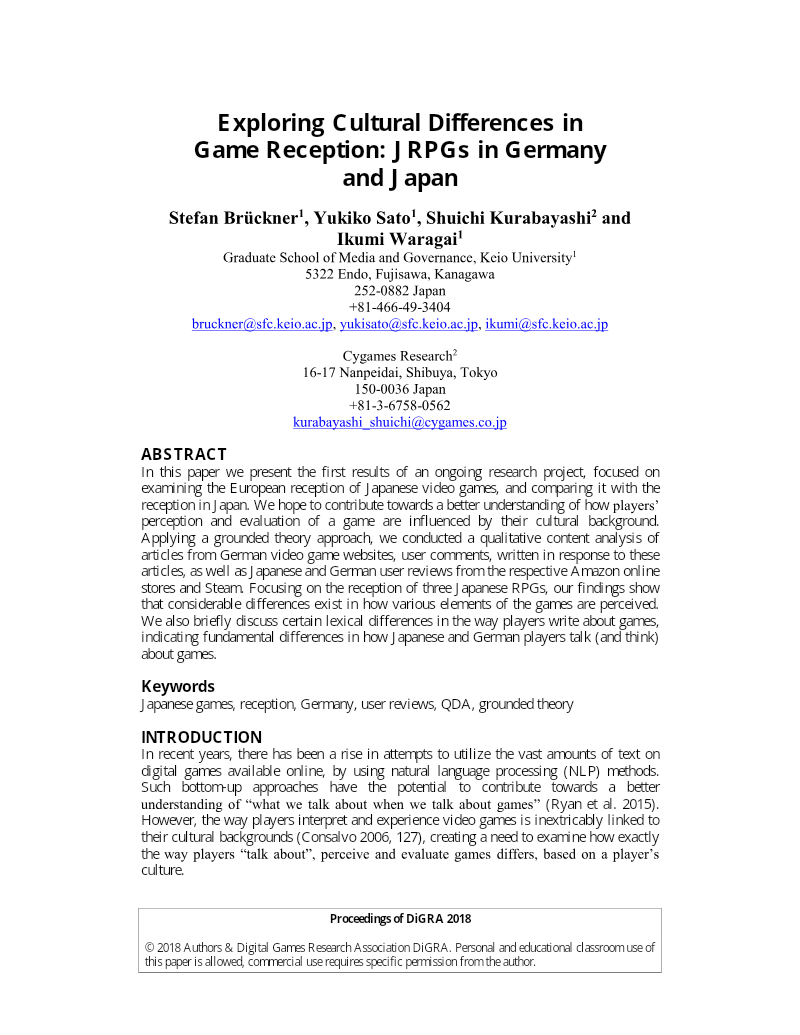
Marinka Copier's paper argues that fantasy role-playing games should not be studied as isolated objects but as part of a broader fantasy subculture, and that the prevailing use of Johan Huizinga's "magic circle" concept in game studies misrepresents his original ideas. Drawing on ethnographic fieldwork, interviews, and self-play across tabletop RPGs, live-action RPGs (LARPs), and MMORPGs, the author contends that role-playing is best understood through the lens of ritual and performance rather than through fixed boundaries separating play from everyday life.
The empirical grounding comes largely from the Elf Fantasy Fair, where attendance rose from 7,500 in 2001 to 21,400 in 2005. Survey data from 2003 and 2004 indicate that digital RPGs were the most widely played form (roughly 38 to 40 percent), followed by tabletop RPGs (about 30 percent) and live-action RPGs (11 to 13 percent), with the Dutch LARP community estimated at around 2,000 participants. These figures are presented as supporting context rather than as the core of the argument.
The central theoretical claim is that the play space is not a predetermined chalk-line boundary, as Salen and Zimmerman's influential visualization suggests, but is actively constructed through negotiation and through ritual acts such as bricolage. Drawing on anthropological and performance theorists including Turner, van Gennep, and Schechner, the author frames fantasy role-playing as collections of performances that connect worlds. The paper concludes that RPGs are borderline cases for game definitions, since they often lack quantifiable outcomes, and that analysis should center on players, their activities, and their cultural contexts, drawing across multiple disciplines.
DiGRA · 2018
DiGRA · 2018
DiGRA · 2018
DiGRA · 2018
DiGRA · 2018
DiGRA · 2018
DiGRA · 2018
DiGRA · 2018
DiGRA · 2018
DiGRA · 2018
DiGRA · 2018
DiGRA · 2018
DiGRA · 2016