1 free read left. Create a free account for unlimited reading + AI research.
Create free accountWhitepaper DiGRA
1 free read left. Create a free account for unlimited reading + AI research.
Create free accountWhitepaperDiGRA
The study uses close reading grounded in the author's playthrough at normal action and riddle difficulty levels. Unlockable content and references to other Silent Hill titles were deliberately excluded.
Scope. The findings are interpretive and rest on a single game and one researcher's playthrough.
This paper, by Petri Lankoski of the University of Tampere, examines how the player character Heather is constructed in Silent Hill 3, a 2003 survival horror game. Its central aim is to test and refine a previously proposed categorization of the methods games use to convey a player character's personality, which includes goals and sub-goals, possible and impossible actions, predefined functions such as cutscenes and dialogue, and traditional audiovisual cues. The analysis argues that this framework is a useful tool for both interpretation and design, while also identifying that it needs extension to account for belongings and space as means of characterization.
The study uses a close-reading method grounded in the author's own playthrough at the normal action and riddle difficulty levels, deliberately excluding unlockable content and references to other Silent Hill titles. Its findings indicate that predefined functions, particularly cutscene dialogue and written monologue, are the primary means of revealing Heather's nature, with possible and impossible actions frequently reinforcing them through control design. Goals play only a minor role. The opening user guide, the playable nightmare sequence, and the first cutscenes are highlighted as especially important for setting interpretive expectations. Force feedback that conveys Heather's heartbeat is noted as a distinctive means of making her physical state perceptible.
The paper also identifies inconsistencies in Heather's abilities, the depiction of the game world, and dialogue from other characters, which the author reads as producing a dreamlike, subjective space that metonymically represents Heather's mental state. Design implications are drawn for creating player characters that communicate personality despite player agency. The analysis is qualitative and interpretive, relying on a single game and the researcher's own experience rather than survey or sample data.
Each row is a game or company this document names, each column a document, oldest first. A mark means that document names it. Select a row to see those documents.
DiGRA · 2016
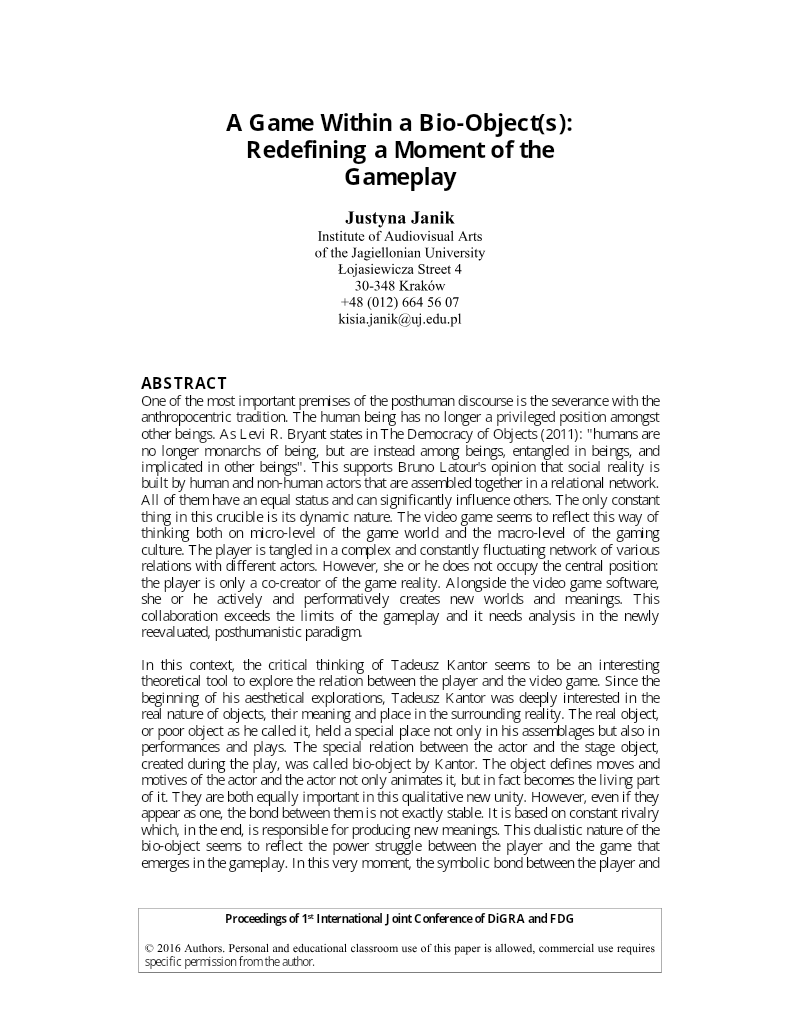
DiGRA · 2016
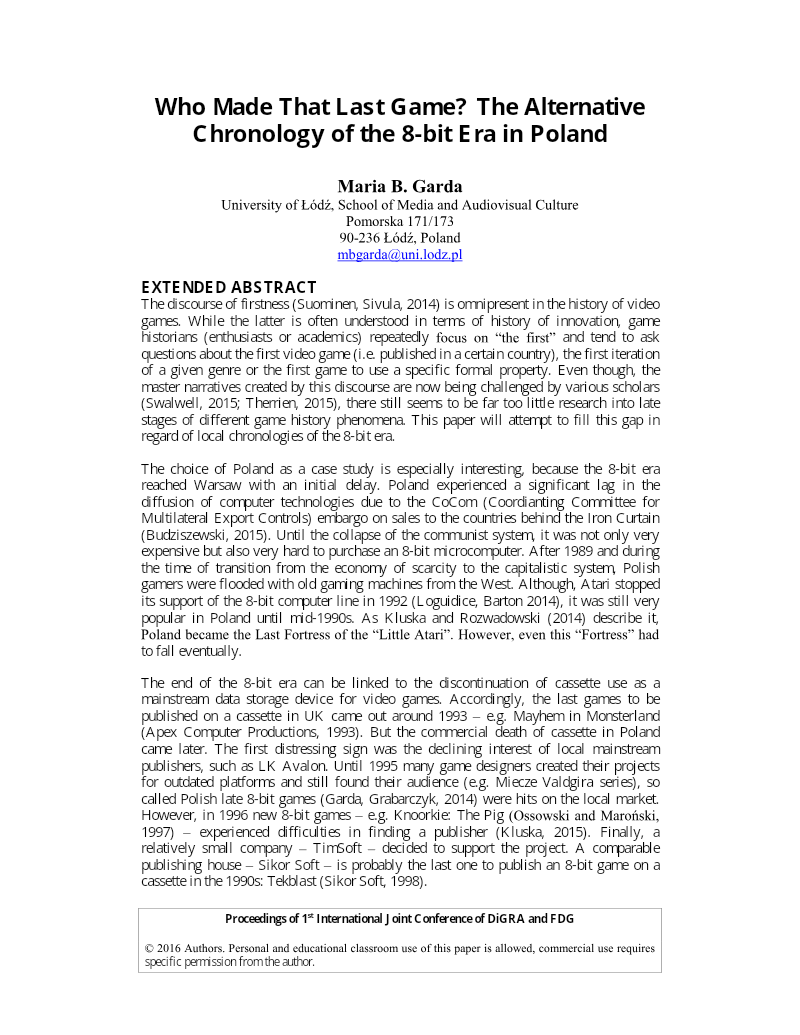
DiGRA · 2016
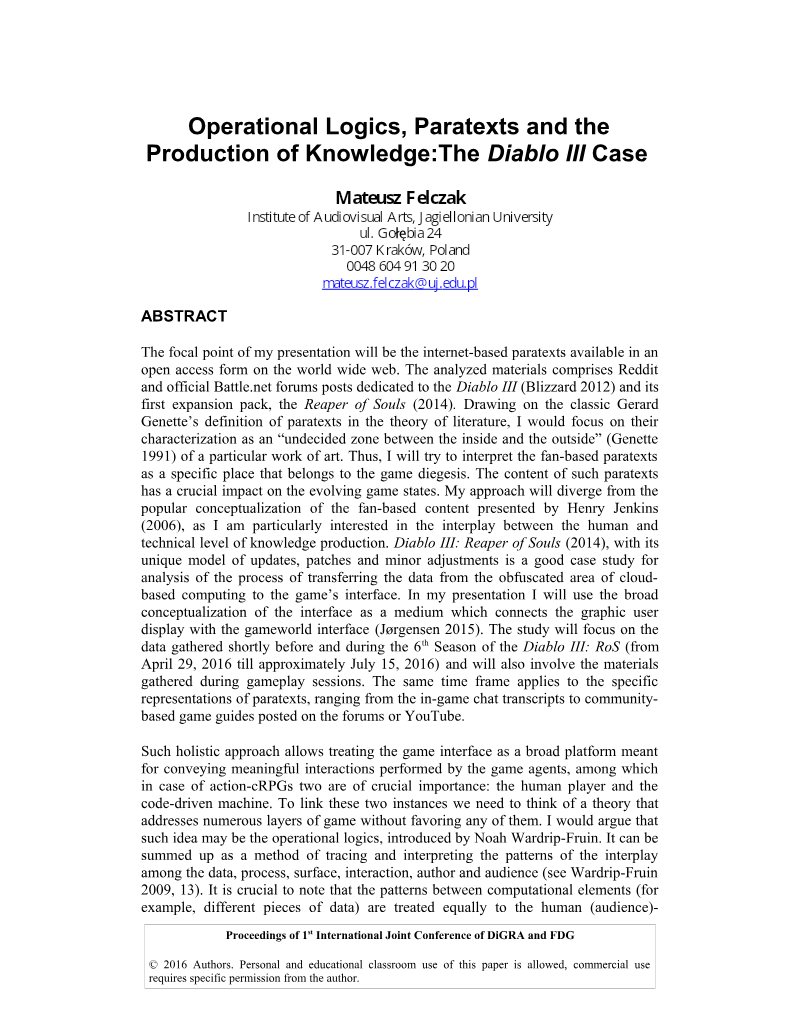
DiGRA · 2016

DiGRA · 2016

DiGRA · 2016



DiGRA · 2016

DiGRA · 2016

DiGRA · 2016

DiGRA · 2016

DiGRA · 2016

DiGRA · 2016
Thomas Brush · 2025