Global reports and market data
Documents
A Character in Your Hand: Puppetry to Inform Game Controls
The document proposes a novel approach to virtual reality (VR) game control design by leveraging traditional puppetry control schemes.
- Puppetry offers a practical design model for VR character controls because puppets and game characters both sit between imagined and factual worlds, inviting players to project themselves into them.
- VR controllers excel at tracking position and orientation but lack the finger-level precision that detailed puppet manipulation demands, which drove the authors to develop tailored control schemes.
- The authors mapped traditional rod, marionette, and hand puppet control mechanisms, drawn from the Center for Puppetry Arts archive, onto HTC Vive controllers using Kaplin's distance model as their design logic.



Contextualizing Pathological Gaming: A Proof-of-Concept Study
This study critically examines the effectiveness of current screening tools for "pathological gaming," specifically Gentile's (2009) questionnaire, by applying it to individuals engaged in professional gaming.
- The study argues that Gentile's (2009) 11-item pathological gaming questionnaire, largely adapted from substance-abuse criteria, may not measure what it intends and risks labeling healthy, committed players as problematic.
- Four eSports players and streamers completed the instrument and then explained their answers in semi-structured interviews, revealing specific points of misfit between the items and their lived experience.
- Ambiguous wording caused misinterpretation: the two-part "try to play less" item led one participant to answer "No" because they had never tried to cut down, not because they were unable to.



Preliminary Poetics of Procedural Generation in Games
The document, "Preliminary Poetics of Procedural Generation in Games," establishes a critical framework for analyzing the aesthetic principles and player experiences derived from procedural content generation (PCG) in games.
- The paper argues that existing taxonomies of procedural content generation describe how generators are built but not why they produce particular aesthetic effects, and proposes a poetics to fill that gap.
- It introduces the Apollonian (rule-governed coherence) and Dionysian (chaotic, noise-driven variation) as non-exclusive aesthetic qualities, so the most sophisticated generators can exhibit both at once within a multidimensional space rather than a single continuum.
- Aesthetic effects arise from the balance between randomness (Perlin noise, dice rolls, shuffles) and structural order (e.g., cellular automata like Conway's Life), with perception shaped by tension among repetition, gestalt, and individual artifacts.



Overwatch as a Shared Universe: Game Worlds in a Transmedial Franchise
The document analyzes the Overwatch franchise to propose a revised understanding of multi-platform narratives, moving beyond the traditional concept of a "transmedial world."
- Joleen Blom argues that transmedia storytelling theory (Jenkins, Klastrup and Tosca, Wolf, Ryan) does not adequately account for games, and uses Blizzard's Overwatch franchise to propose a different framing.
- The paper's central thesis is that Overwatch's game, comics, and short films do not form a single coherent transmedial storyworld; instead the franchise is a "shared universe" whose connections are constructed imaginatively by players, drawing on Benedict Anderson's concept of imagined communities.
- Following Aarseth, the paper contends that game arenas are objectively explorable, rule-bound, and often isolated and non-cumulative, so maps do not build into a continuous geography as fictional storyworlds do.
Markers of Subjective Perception in Larp
Mochocki's paper extends Jan-Noël Thon's framework of subjective representation, originally developed for film, comics, and video games, to live-action role-playing (larp).
- Mochocki argues that spatial point-of-view goes unmarked in larp because players physically inhabit their characters' perspectives, so subjectivity markers in larp signal only other forms of subjectivity, and the paper adds a fourth, "metasymbolic" marker category to cover what Thon's film/comics/video-game framework misses.
- The paper stresses player-character perceptual unity and warns that mishandled subjectivity markers cause metalepses, breaches of diegetic coherence.
- Narratorial markers (generated by gamemasters or players, including metatechniques like the monologue box) and content markers (live acting and tangible elements introduced by the gamemaster) each carry their own metaleptic risks for perceptual unity.



Presence at History: Toward an Expression of Authentic Historical Content as Game Rules and Play
The document proposes a significant evolution in historical game design, advocating for developers to adopt a historian's methodology, employing practice-led research to integrate authentic historical content directly into game rules and player experiences.
- Game developers are increasingly acting as historians, using practice-led research to build authentic historical experiences instead of treating the past as decorative backdrop.
- The authors argue that a newer wave of historical games pursues authenticity as living socio-cultural systems rather than mere accuracy of surface detail.
- Some recent titles embed historical research directly into rules and mechanics: Assassin's Creed: Origins was built with Egyptologists and linguists, 1979 Revolution: Black Friday drew on more than forty interviews with people who were present, and Kingdom Come: Deliverance reconstructed combat from medieval fighting manuals with martial arts experts.



Localization from an Indie Game Production Perspective: Why, When and How?
This analysis explores the strategic approach to localization among independent game developers, examining the motivations, methodologies, and outcomes within resource-constrained environments.
- Steam's Simplified Chinese share rose from 8.97% in December 2016 to 63.9% in December 2017, a rapid market shift that motivated the study of how indie developers handle localization.
- Indie developers pursue localization chiefly to broaden audience reach rather than for immediate financial return, and resource constraints largely determine which localization decisions they make.
- Swedish developers often recognized localization's value only after early-access feedback revealed a global player base, and several said deferring it, due to assumptions about English proficiency or limited resources, led to later rework.



Is My Avatar MY Avatar? Character Autonomy and Automated Avatar Actions in Digital Games
The paper "Is My Avatar MY Avatar?
- Willumsen argues that the question of whether an avatar's action expresses player agency or a fictional character's independent will can be analyzed through two separately measured dimensions: avatar control and character complexity.
- The central claim is that avatar control and character complexity are not zero-sum, so they must be assessed independently before being compared.
- The framework distinguishes 'automated avatar actions' (mechanical behaviors handled by the game so players can focus on play) from 'character autonomy' (moments where character complexity is foregrounded while player control is deliberately reduced).
On Striated Wilderness and Prospect Pacing: Rural Open World Games as Liminal Spaces of the Man-Nature Dichotomy
The document, "On Striated Wilderness and Prospect Pacing: Rural Open World Games as Liminal Spaces of the Man-Nature Dichotomy," examines how rural open-world video games construct and mediate players' experiences of nature.
- Marc Bonner argues that rural open-world games such as Horizon Zero Dawn and Assassin's Creed Origins carry a long Western tradition of staging a constructed, pristine 'striated wilderness,' tracing its lineage to Puritan man-nature dichotomy thinking, colonial terra nullius logic, and the U.S. Wilderness Act of 1964.
- The paper's core concept, 'prospect pacing,' describes how staggered horizons and vantage points structure navigation and evoke a tourist-style romantic gaze, offering players an illusion of free, smooth roaming while channeling them through designed patterns, waypoints, and markers.
- Drawing on historical scholarship, Bonner notes the Americas were far more densely populated before European contact than romantic wilderness imagery suggests, with indigenous populations falling by roughly 90 percent through disease.

Good Game Feel: An Empirically Grounded Framework for Juicy Design
The document establishes an empirically grounded framework for "juicy design" and "good game feel" in video games, aiming to provide a more precise and actionable definition for these often vaguely understood concepts.
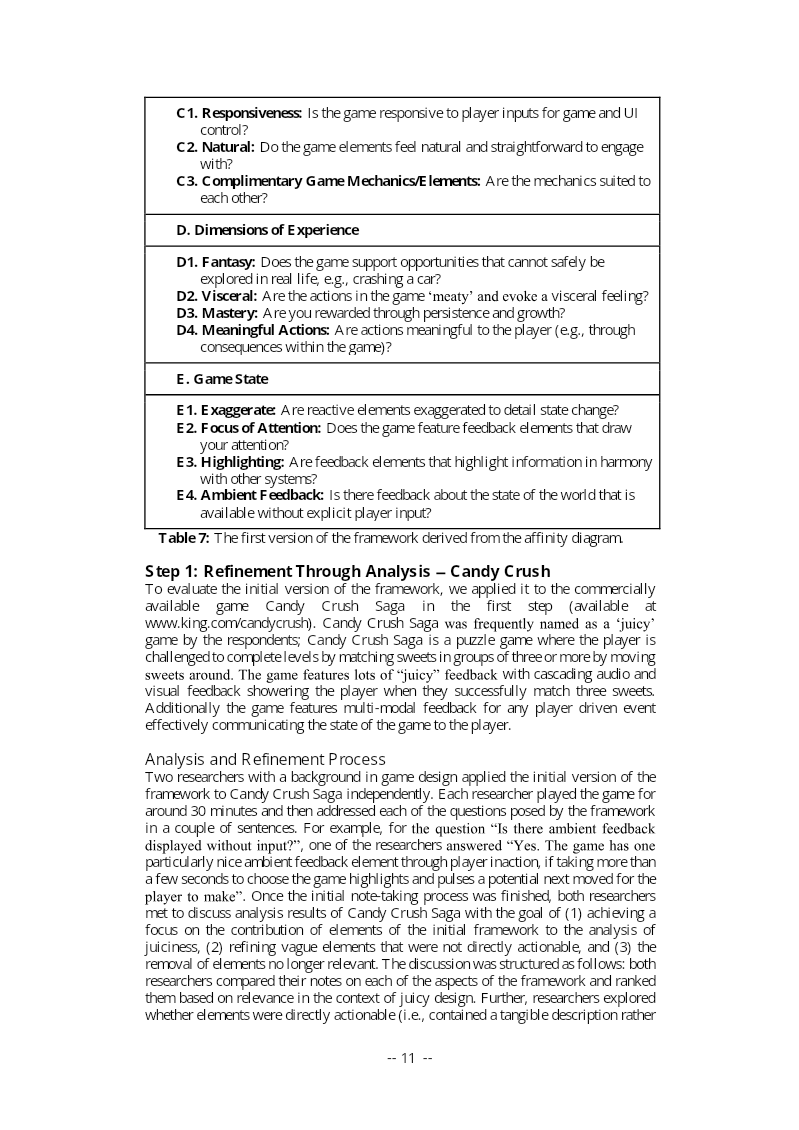
- The paper addresses the vague definition of "juicy design" by grounding it in a survey of 17 professional game developers, whose responses were organized via an affinity diagram into categories such as game characteristics, dimensions of experience, direct feedback, redundancy, and slickness.
- Developers stressed that juice must be integrated holistically with all game elements and matched to genre, since feedback alone is insufficient; effective feedback is exaggerated, multimodal, relevant, and non-overwhelming.
- The final analytical framework has three parts (Game Characteristics, Game State, and Direct Feedback) and 11 actionable questions, refined through two rounds of case analysis of Candy Crush Saga and Downwell.

Understanding Media Rights in Esports
This document analyzes the evolving landscape of media rights in esports, projecting significant growth and identifying key monetization strategies.
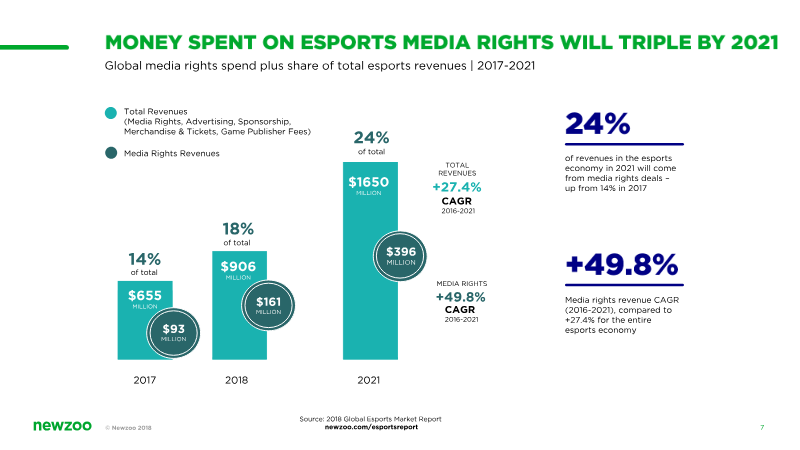
- Esports media rights revenue is projected to grow from 14% of total industry revenue in 2017 to 24% by 2021, with market value expected to rise from nearly $100 million to $400 million in the same period.
- North America dominates the global market with a 44% share of media rights revenues, bolstered by an established sports culture and the influence of major media conglomerates.
- The industry is increasingly adopting traditional sports business models, such as those used by the UFC, to maximize the value of esports properties.

Global Mobile Market Report 2018
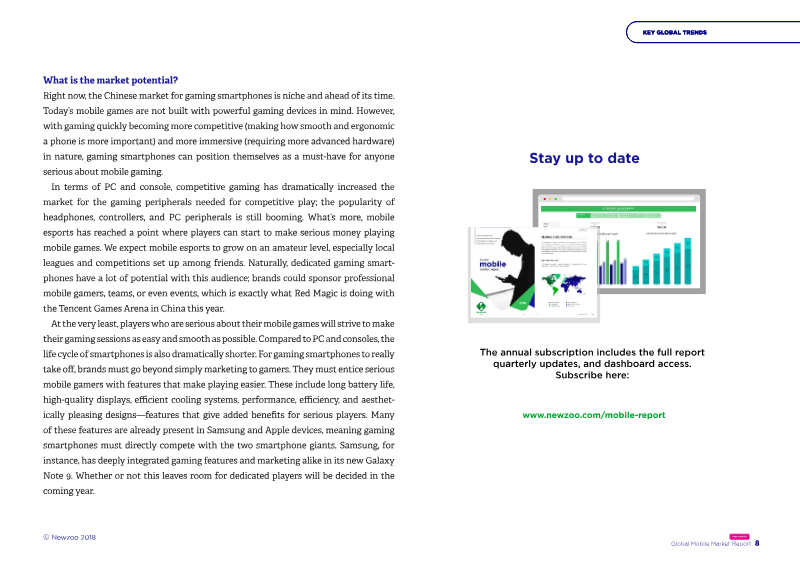
The "Global Mobile Market Report 2018" provides a comprehensive analysis of the mobile market, asserting that it is undergoing substantial expansion, primarily propelled by mobile gaming and increasing consumer engagement with digital content.
- Mobile gaming generated $70 billion in 2018, representing 76 percent of the $92.1 billion total global app store revenue.
- Global smartphone adoption is projected to reach 3.8 billion users by 2021, with the Asia-Pacific region serving as the primary driver of market penetration.
- The mobile market is shifting toward immersive, competitive gaming experiences and subscription-based service models.
Writers
Games and companies
Games