Loading the document
1 free read left. Create a free account for unlimited reading + AI research.
Create free accountWhitepaper DiGRA
1 free read left. Create a free account for unlimited reading + AI research.
Create free accountWhitepaperDiGRA
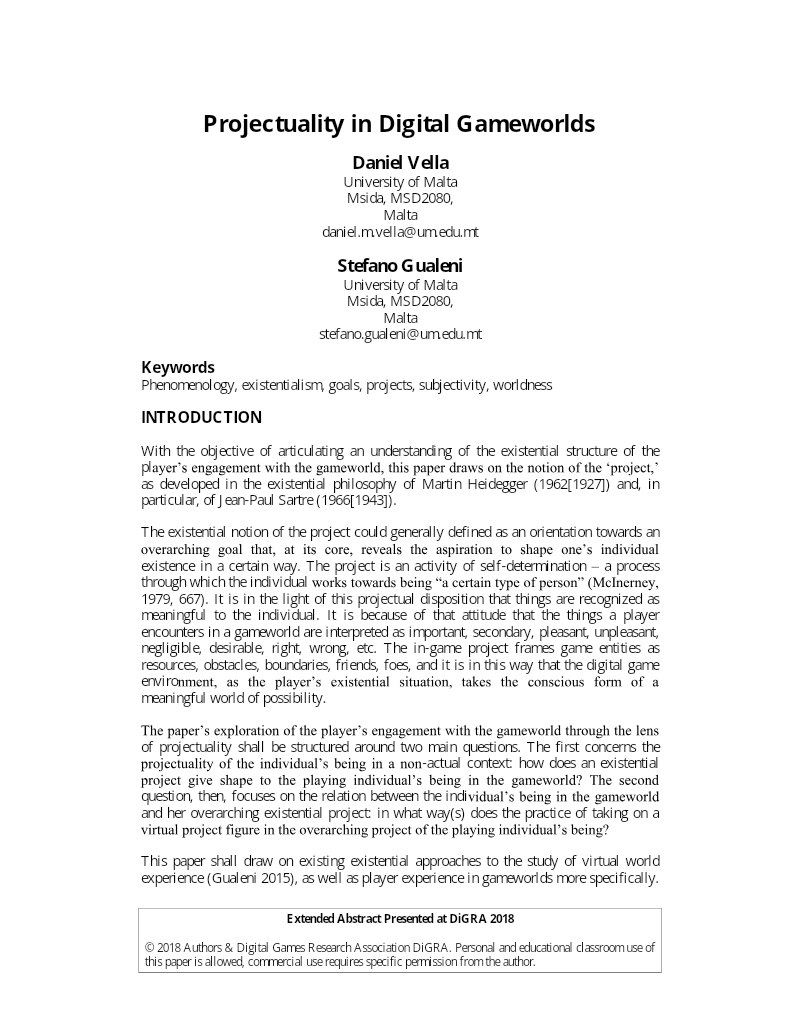
The authors use the existential notion of the project, an orientation toward an overarching goal, to examine player engagement with digital gameworlds.
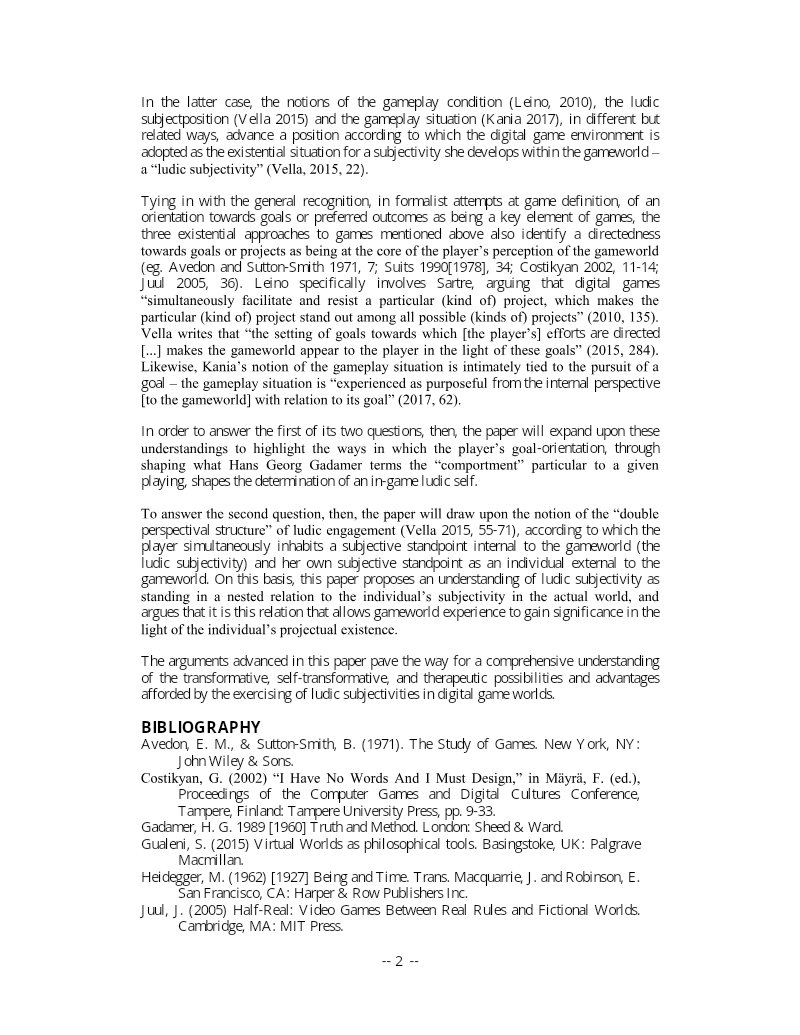
This paper explores the existential structure of player engagement with digital gameworlds through the philosophical concept of "projectuality," drawing primarily from the works of Martin Heidegger and Jean-Paul Sartre. The central thesis posits that a player's orientation towards overarching goals, or "projects," within a gameworld shapes their individual existence and perception of meaning within that virtual environment. This projectual disposition determines how in-game entities are interpreted as resources, obstacles, or foes, thereby transforming the digital environment into a meaningful world of possibility for the player.
The analysis addresses two key questions: how an existential project shapes an individual's being in a non-actual context, and how virtual projects relate to the player's overarching existential project in the actual world. It builds upon existing existential approaches to virtual world experience, including notions of the gameplay condition, ludic subject-position, and gameplay situation, all of which recognize goal-directedness as fundamental to player perception. The paper expands on these ideas to illustrate how goal-orientation influences the determination of an in-game "ludic self."
To address the second question, the paper introduces the concept of a "double perspectival structure" in ludic engagement, where players simultaneously inhabit a subjective standpoint within the gameworld (ludic subjectivity) and their own external subjective standpoint. It argues that ludic subjectivity is nested within the individual's actual-world subjectivity, allowing gameworld experiences to gain significance in the context of the individual's broader projectual existence. The insights presented are intended to lay groundwork for understanding the transformative, self-transformative, and therapeutic potential of exercising ludic subjectivities in digital game worlds. The paper is an extended abstract presented at DiGRA 2018, indicating its scope as a theoretical exploration within game studies.

DiGRA · 2026

DiGRA · 2026



DiGRA · 2026



DiGRA · 2026



DiGRA · 2026



DiGRA · 2026



DiGRA · 2026



DiGRA · 2026



DiGRA · 2026

DiGRA · 2026



DiGRA · 2026



DiGRA · 2026
University of York · 2026

Comments