Global reports and market data
Documents
Games of Social Control: A Sociological Study of Addiction to Massively Multiplayer Online Role-Playing Games
This research proposes a sociological study of addiction to Massively Multiplayer Online Role-Playing Games (MMORPGs), aiming to complement existing psychological explanations with a focus on social control.
- The project challenges dominant social-psychological explanations of game addiction, which attribute compulsive gaming to low self-esteem and weak social relations, by arguing that social networks within MMORPGs exert social pressure that leads players to neglect offline friends, family, school, and work.
- The authors frame the phenomenon through the sociological concept of social control, positing that shared in-game norms and obligations can restrict individual agency much as offline groups do.
- The abstract cites a reported 53 percent of frequent gamers playing multiplayer titles and states that MMORPG players average around 23 hours of play per week, with some sessions lasting ten hours or more.

The Significance of True Line of Sight in Warhammer 40,000
The document explores the concept of "true line of sight" (TLOS) in the tabletop wargame Warhammer 40,000 (W40k), analyzing its significance beyond a mere game mechanic to encompass player perception, bodily engagement, and the hobbyist's creative process.
- True line of sight (TLOS) is a Warhammer 40,000 rule that determines which miniatures can see and attack one another, requiring players to trace a line from a model's head or weapon to a target's body.
- The paper argues that vision in wargaming is inherently tied to violence, since TLOS only has meaning within the shooting and damage resolution rules that follow it.
- Because the rule takes models and terrain positions at face value, a miniature's size, shape, and pose directly affect its vulnerability: a crouching figure is harder to shoot but less able to fire, while an exposed figure invites more fire, making modeling decisions strategically consequential.

Save the Park, Punish the Traitors: Games as Historical Documents
The paper argues that video games produced during periods of social and political turmoil can serve as historical documents, much as political cartoons and opinion pieces do.
- Video games made during periods of social and political turmoil can be treated as historical documents in their own right, similar to political cartoons and opinion pieces, rather than only as later depictions of past events.
- Timely games capture the perceptions, emotions, and political climate of the moment they were made, and they often disappear from circulation quickly, making them easy to lose as records.
- The study is a qualitative, illustrative case study comparing short reactive games from two Turkish episodes: the 2013 Gezi Park protests and the aftermath of the July 15, 2016 coup attempt, based on close readings rather than large samples or survey data.

The Sacred and the Mundane: Video Games in the Convenience Store
This paper examines the unique play spaces created by coin-operated video game cabinets in convenience stores, bodegas, and corner shops.
- The paper is a conceptual and theoretical DiGRA 2018 extended abstract, not an empirical study: it presents no survey data, sample sizes, or quantitative findings.
- Its central thesis is that coin-operated video game cabinets in corner shops, bodegas, and convenience stores produce a distinctive mode of consumption with an intimate, ludic, and sacred quality, framed as a small shrine embedded in everyday commerce.
- The cabinet is positioned as tensioned between two roles: an object of consumption, like the snacks and necessities around it, and a site of potentially transformative play.

Characteristically Tensive: The Unreal in Poetic Gaming
This extended abstract, presented at DiGRA 2018, argues that the perceived tension between the ludic and literary elements in poetry games is not a paradox but a characteristic feature of both poetry and, to a lesser extent, computer games in general.
- The paper argues that tension between ludic and literary elements in poetry games is not a flaw to be resolved but a coherent expression of poetics, and that this tensive quality is characteristic of poetry itself.
- It challenges Astrid Ensslin's model of poetry games as a paradox between deep and hyper attention, arguing the dualistic model is too crude because many game genres already require players to shift between menus, 3D environments, cut scenes, and decision trees.
- Drawing on Philip Wheelwright, Roman Jakobson, and John Shoptaw, the paper extends principles of poetic tension from written language to game components such as levels, sprites, and textures, which gain semantic meaning only through interaction.
Next Gen? A Critical Examination of Historical Periodization in Video Games
This extended abstract critically examines how video game history is periodized, focusing on the widely used notion of "platform generations" as a case study.
- The paper argues that periodization is a foundational act of historical sense-making, since naming a period presumes beginning and ending points along with implicit spatial, social, and cultural assumptions.
- Existing video game historiography has been shaped by linearity and US-Japan centrism, and the authors seek to open discussion of alternative periodization methods.
- The 'platform generation' model remains dominant in gaming press, encyclopedias, and game databases despite academic skepticism, and the paper treats generations more as marketing than as precise historical categories.
Incentivizing Correct Waste Sorting by Game Design
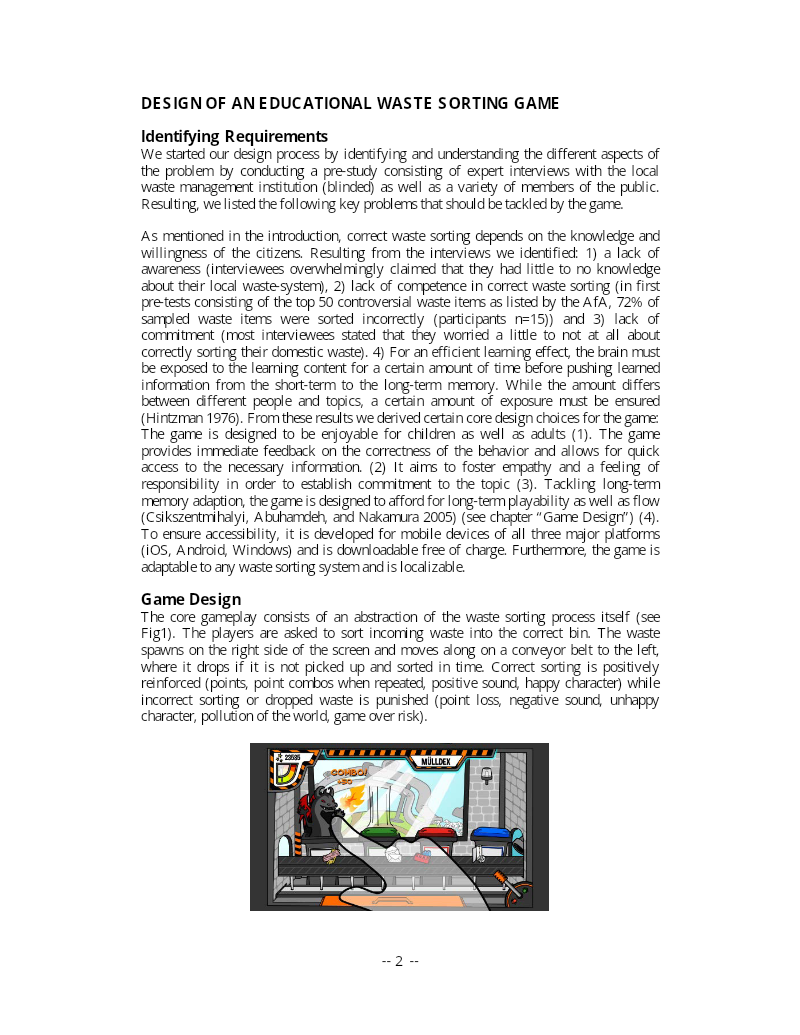
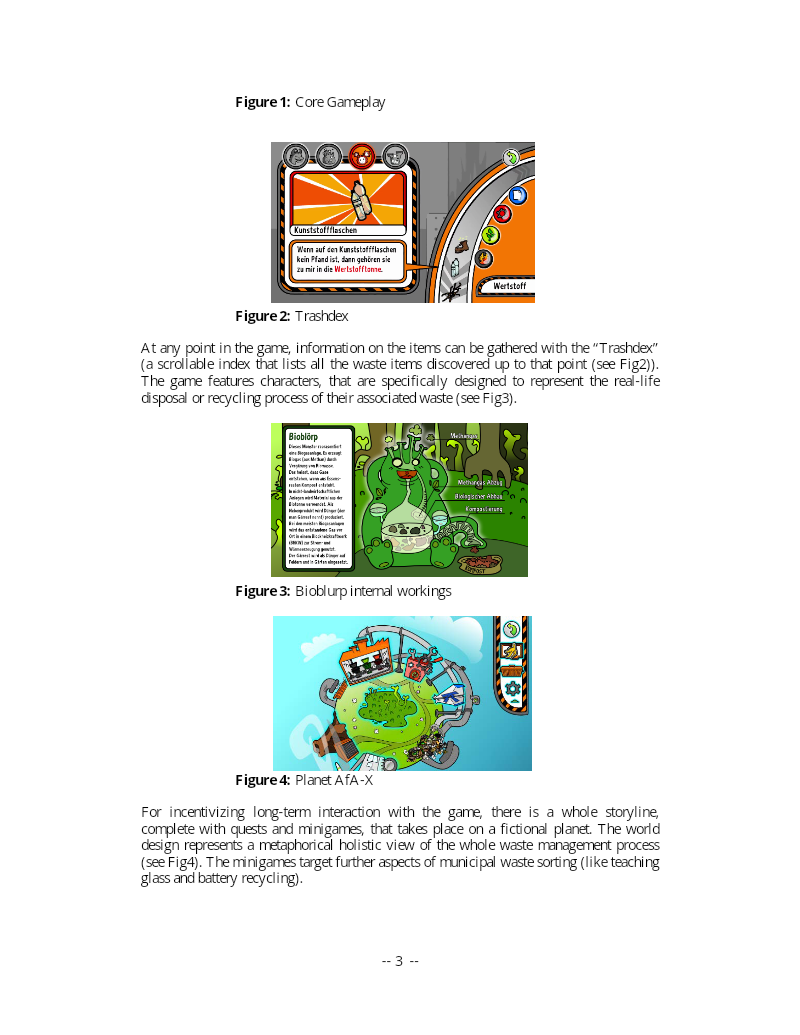
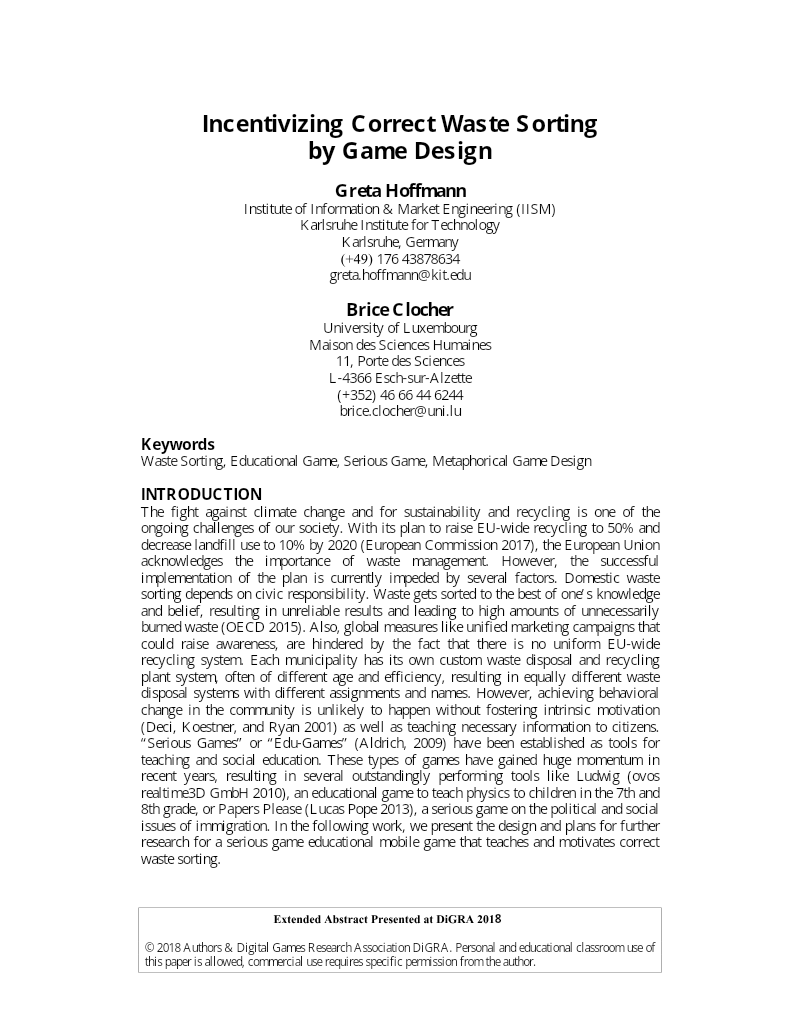
This document outlines the design and preliminary evaluation of a serious mobile game aimed at incentivizing correct waste sorting.
- A pre-test found 72% of 50 controversial waste items were sorted incorrectly by 15 participants, and most interviewees reported little knowledge of their local sorting system or concern about sorting correctly.
- The authors frame citizen sorting errors as stemming from three gaps (low awareness, weak competence, and limited commitment), and argue game design can address all three.
- Because EU municipal waste systems differ, the authors propose a localizable app that adapts to any local sorting scheme as a substitute for the absence of a uniform EU-wide recycling system.
Games Biting Back: Anatomy and Ecofeminism
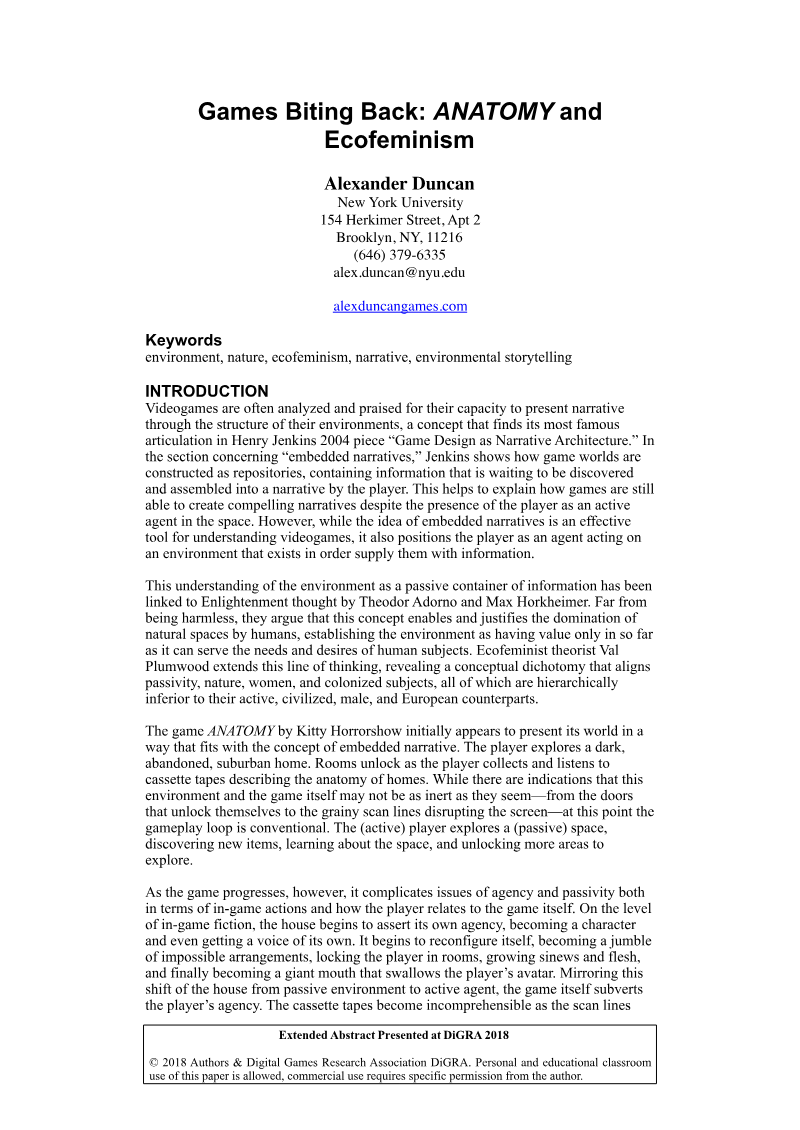
This extended abstract, presented at DiGRA 2018, analyzes the videogame ANATOMY by Kitty Horrorshow through an ecofeminist lens, challenging conventional understandings of game environments as passive narrative containers.
- Alexander Duncan's DiGRA 2018 extended abstract reads the indie horror game ANATOMY by Kitty Horrorshow through an ecofeminist lens, arguing it exposes rather than reinforces the hierarchy that casts environments as passive and subordinate to an active, male, European subject.
- Duncan builds on Henry Jenkins's concept of embedded narrative, arguing that its framing of game worlds as inert repositories waiting for the player still positions the environment as passive.
- The paper draws on Adorno and Horkheimer's critique of Enlightenment domination of nature and Val Plumwood's ecofeminist account of dichotomies linking passivity, nature, women, and colonized peoples.
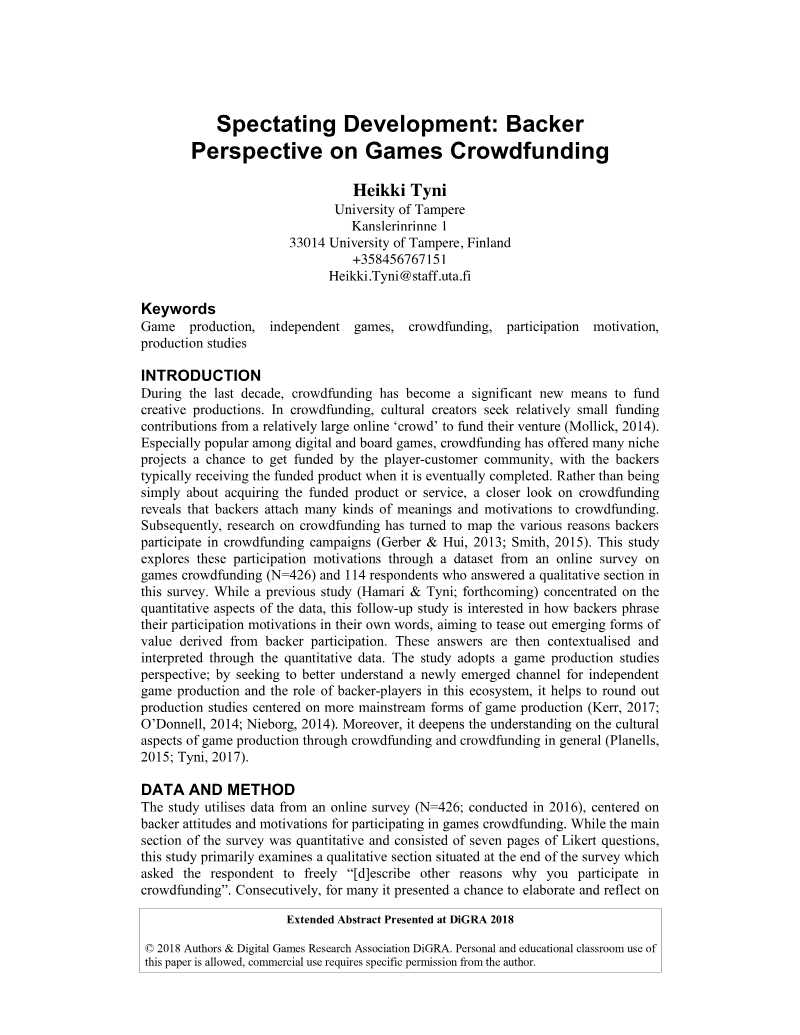
Spectating Development: Backer Perspective on Games Crowdfunding
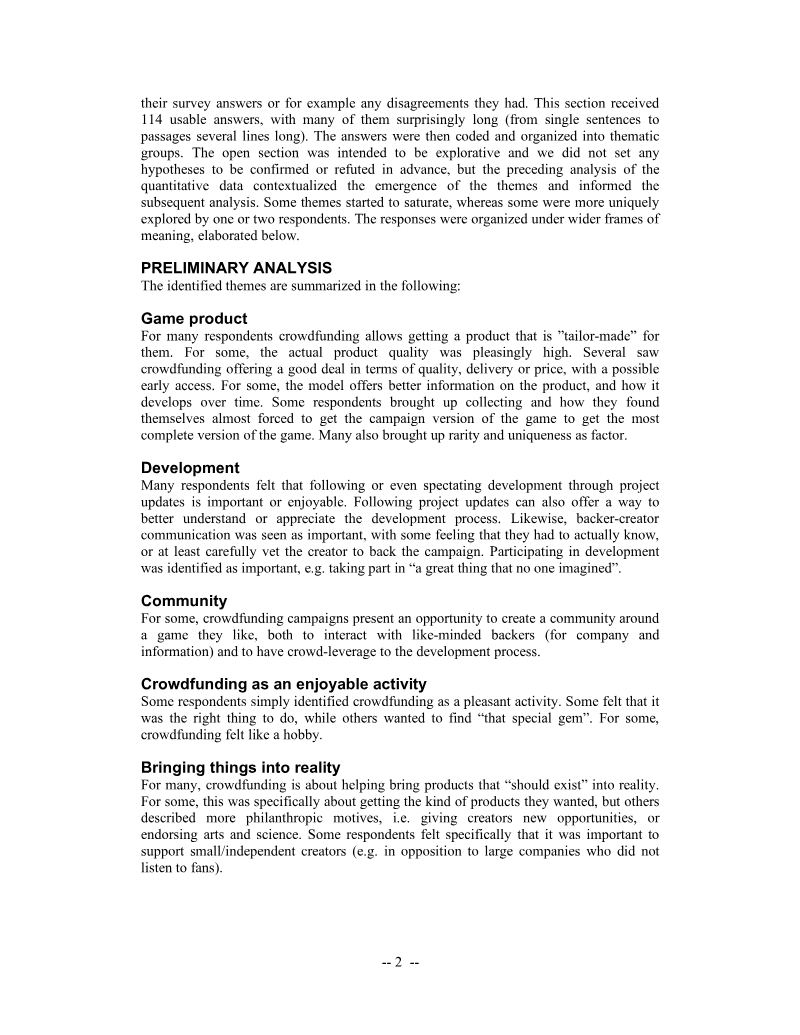
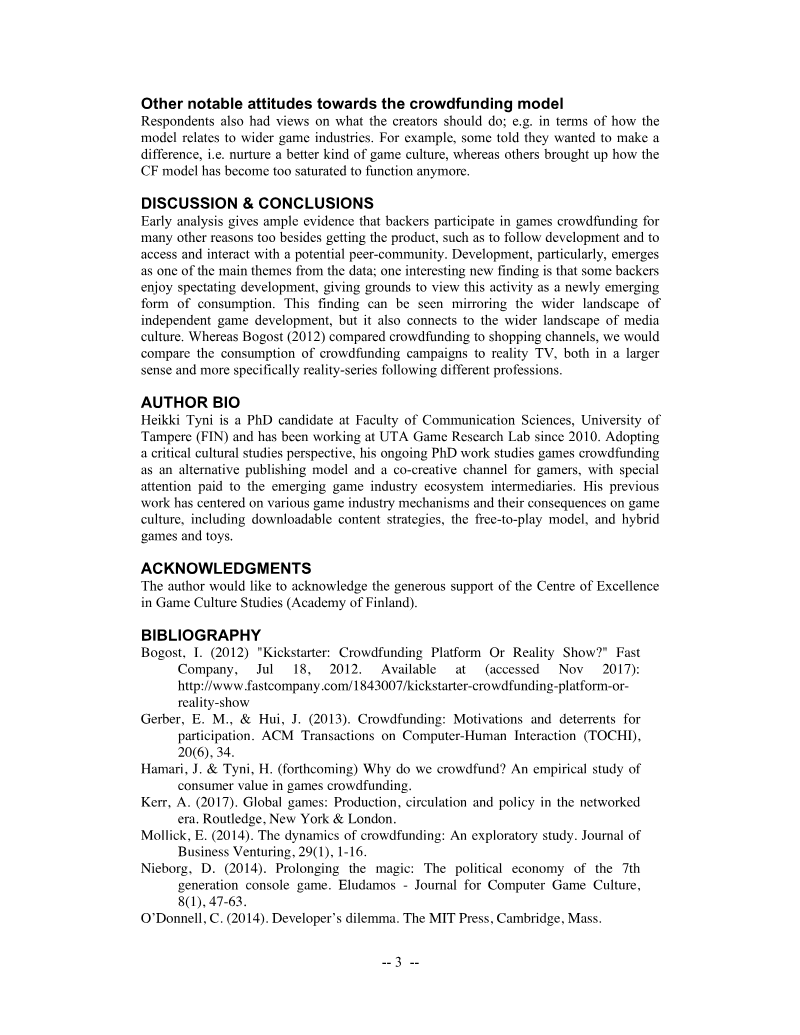
This study investigates backer motivations for participating in games crowdfunding, moving beyond the simple acquisition of a product to explore deeper forms of value.
- Backers value games crowdfunding for far more than receiving a product: many enjoy following development through project updates, which they describe as enjoyable and educational.
- The study draws on an online survey of 426 respondents conducted in 2016, with qualitative analysis focused on 114 open-ended answers describing motivations in respondents' own words.
- Motivations identified include obtaining tailor-made or rare products, perceived good deals on quality, price, or early access, and feeling compelled to back campaigns to secure the most complete version of a game.
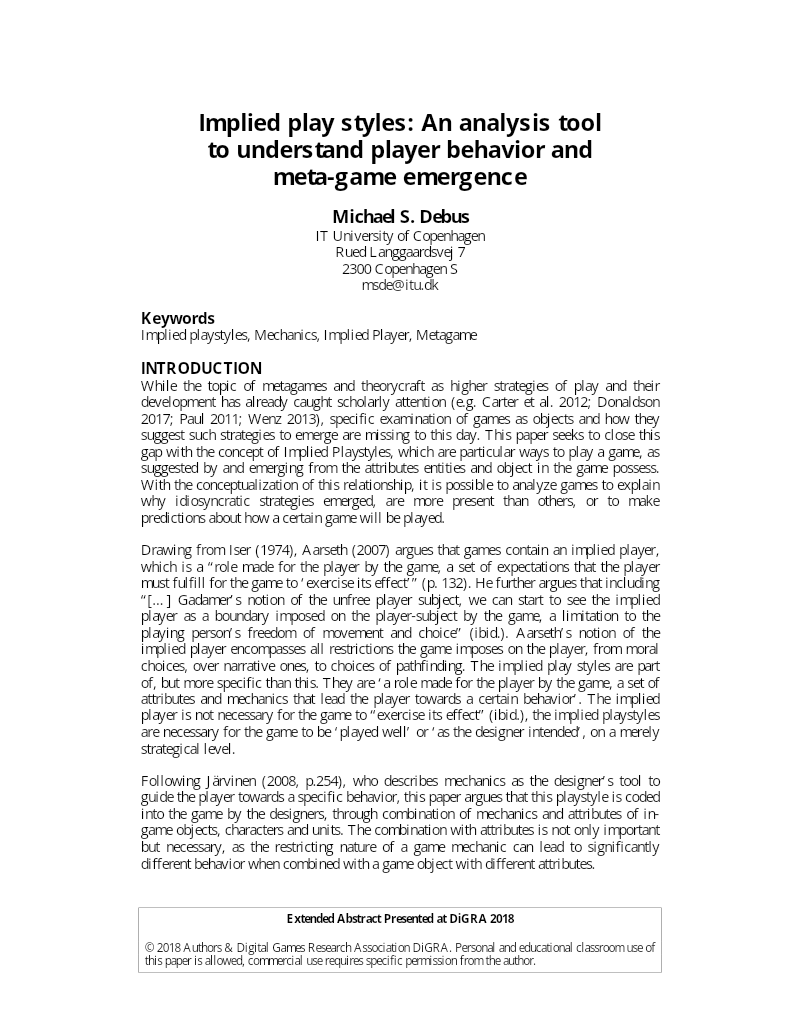
Implied Play Styles: An Analysis Tool to Understand Player Behavior and Meta-Game Emergence
The document introduces the concept of "Implied Playstyles" as an analytical tool to understand player behavior and the emergence of meta-games.
- Implied playstyles are proposed as a narrower construct than general player freedom: the strategic behaviors a game must elicit for it to be played "well" or as its designers intended, building on Iser's implied reader and Aarseth's implied player.
- Designers encode implied playstyles through the combination of mechanics and object attributes, so the same mechanic can produce markedly different behavior depending on the properties of the objects it acts upon.
- The framework is illustrated with units from StarCraft II: Legacy of the Void and Sins of a Solar Empire, each featuring three visually and mechanically distinct factions, selected partly because the author is familiar with them.

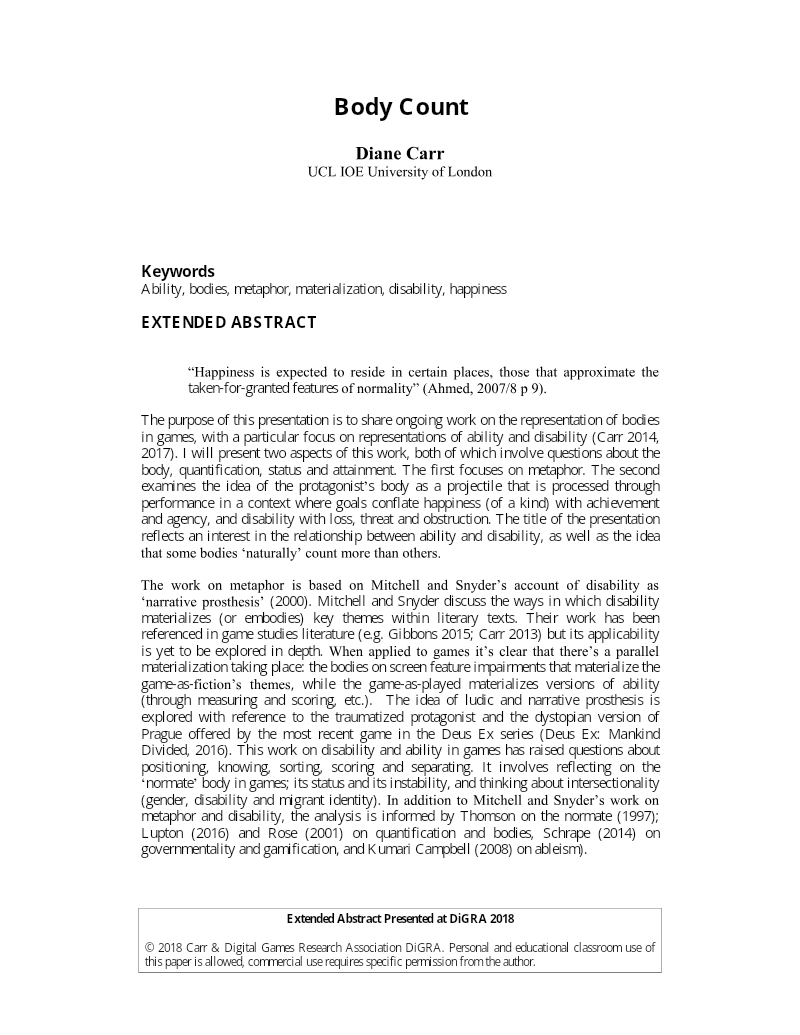
Body Count
The document, an extended abstract for a presentation titled "Body Count," explores the representation of bodies, particularly focusing on ability and disability, within video games.
- Games materialize themes in two ways: through on-screen bodies whose impairments embody the fiction's concerns, and through the game-as-played, where ability is rendered via measuring, scoring and performance.
- Drawing on Mitchell and Snyder's 'narrative prosthesis,' the author extends the concept into 'ludic and narrative prosthesis,' using Deus Ex: Mankind Divided (2016) and its traumatized protagonist Adam Jensen and dystopian Prague setting as the central case.
- The analysis challenges the 'normate' body as presumed stable when it is in fact unstable, examining how games position, sort, score and separate bodies and linking disability with gender and migrant identity through intersectionality.
The Moral Calculus of Vocational Passion in Digital Gaming
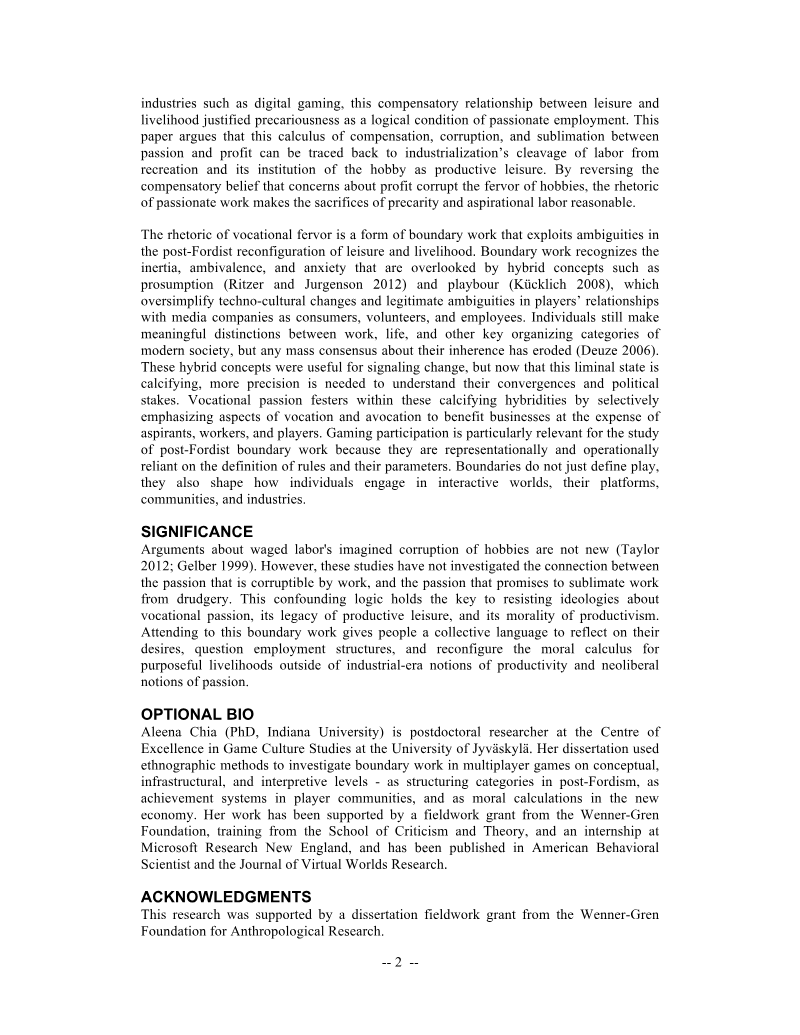
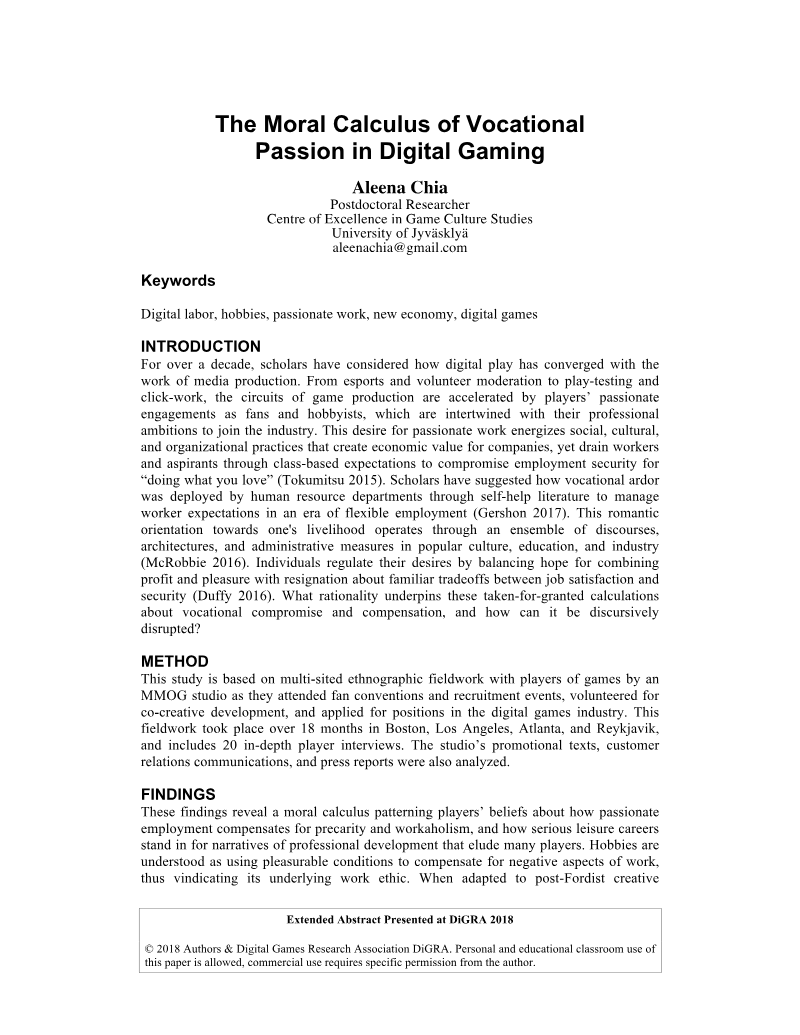
The document explores the "moral calculus" that shapes players' beliefs about vocational passion in the digital games industry, arguing that this calculus justifies precarious employment conditions.
- The paper argues that players rationalize precarious, passion-driven gaming labor (esports, volunteer moderation, play-testing, aspirational job-seeking) by treating hobbies as pleasurable compensation for work's hardships, which legitimizes insecurity as a reasonable tradeoff.
- In post-Fordist creative industries like digital gaming, the compensatory relationship between leisure and livelihood makes precariousness appear a logical condition of passionate employment, a dynamic the author frames as boundary work exploiting ambiguities between vocation and avocation.
- The study draws on eighteen months of multi-sited ethnographic fieldwork across Boston, Los Angeles, Atlanta, and Reykjavik with players of an MMOG studio, supplemented by twenty in-depth player interviews and analysis of the studio's promotional, customer relations, and press materials.
Writers
Games and companies
Games