1 free read left. Create a free account for unlimited reading + AI research.
Create free accountWhitepaper DiGRA
1 free read left. Create a free account for unlimited reading + AI research.
Create free accountWhitepaperDiGRA
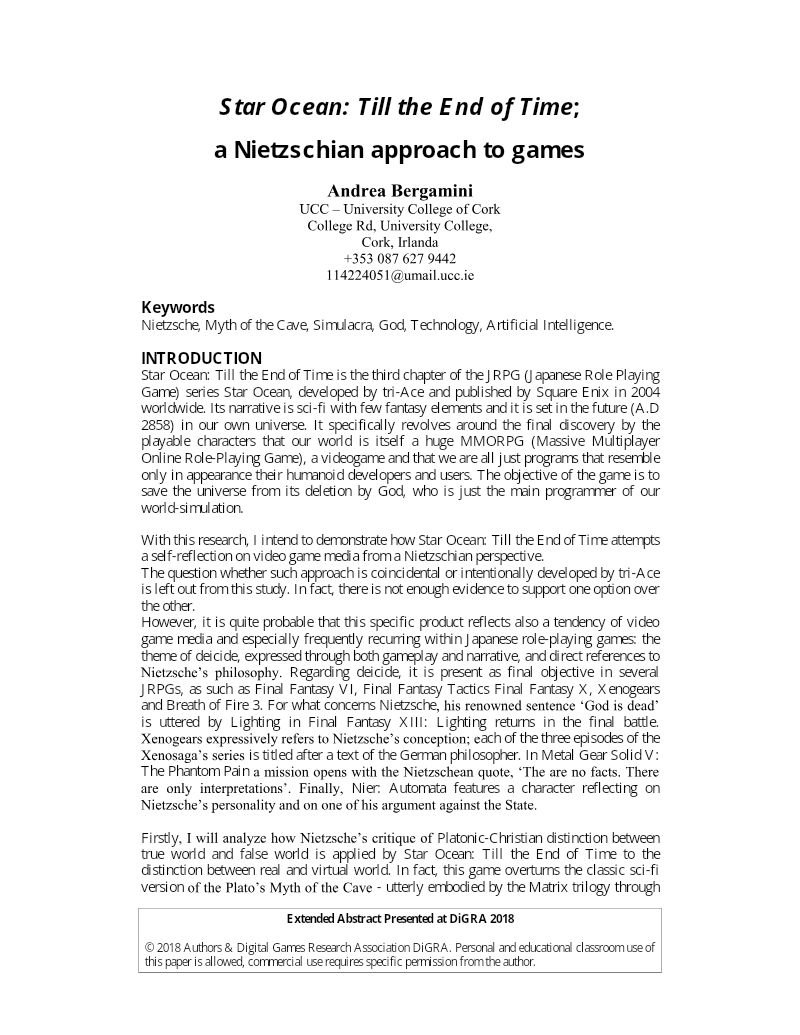
Andrea Bergamini's extended abstract argues the game reflects on video game media itself. Its characters' world is revealed to be a simulated MMORPG run by a programmer-God.
Andrea Bergamini's extended abstract, presented at DiGRA 2018, argues that Star Ocean: Till the End of Time (tri-Ace, 2004) engages in a self-reflection on video game media through a Nietzschian lens. The game's central revelation, that the characters' world is itself a simulated MMORPG run by a programmer-God, allows the author to examine two interlocking themes: the overturning of Plato's Myth of the Cave in the sci-fi tradition, and the atheistic, emancipatory stance associated with Nietzsche's declaration that God is dead. The paper situates the game within a broader tendency of Japanese role-playing games to stage deicide and to quote Nietzsche directly, citing examples such as Final Fantasy VI, Xenogears, Xenosaga, and Metal Gear Solid V.
The analysis proceeds in three parts. The first examines how the game's holographic tutorial, which the playable characters experience before learning the truth of their universe, fuses gameplay and narrative. The author reads this as a positive acceptance of a simulacral condition, aligned with Deleuze and set against Baudrillard's more pessimistic view of simulation. The second part catalogues recurring depictions of religion throughout the game and analyzes the final boss fight, in which a multicultural team of characters unites against the divine programmer. The author argues this reflects a practical, emancipatory atheism, one that rejects any obligation to bow before a superior entity regardless of whether that entity exists, rather than a purely ontological denial.
In its conclusion, the paper extends these readings to the relationship between humanity and technology, particularly artificial intelligence, drawing on Bruno Latour's call to care for technological creations. The work presents itself as a contribution to game studies on two grounds: it demonstrates the emancipatory potential of games and it suggests that games can prompt reflection on how humans should relate to technology, with care and caution rather than fear or worship.
DiGRA · 2026
DiGRA · 2026