Game Development reports and market data
Documents
European Video Games Industry Insights Report: 2019
The 2019 European Video Games Industry Insights Report provides a comprehensive overview of the video game sector within EU Member States, aiming to quantify its economic impact, employment landscape, and supporting infrastructure.
- The European video games industry generated approximately €12 billion in combined developer and publisher revenue during 2019.
- France, Sweden, and Finland served as the primary revenue drivers, while Eastern European markets represent significant untapped growth potential.
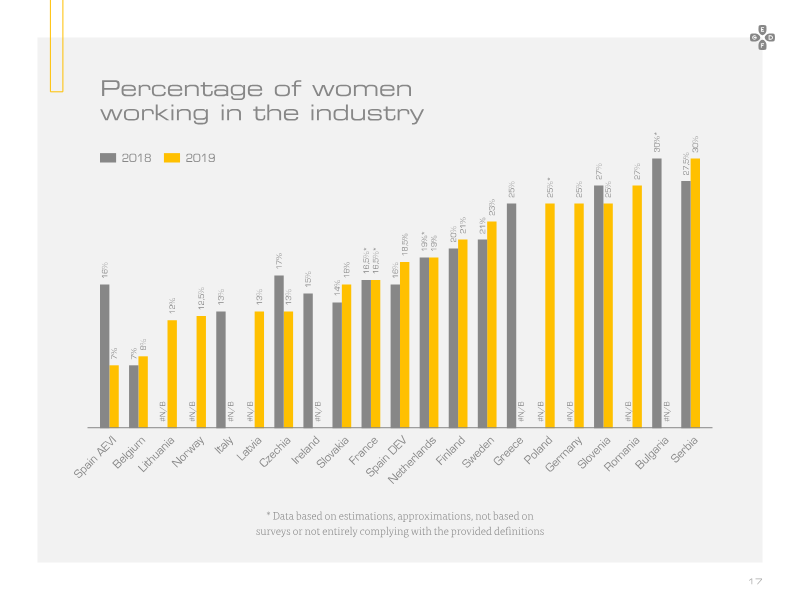
- Gender diversity remains a systemic challenge, with no European nation reporting a female workforce participation rate exceeding 30 percent.
Revenue & Top Companies: Romania 2025
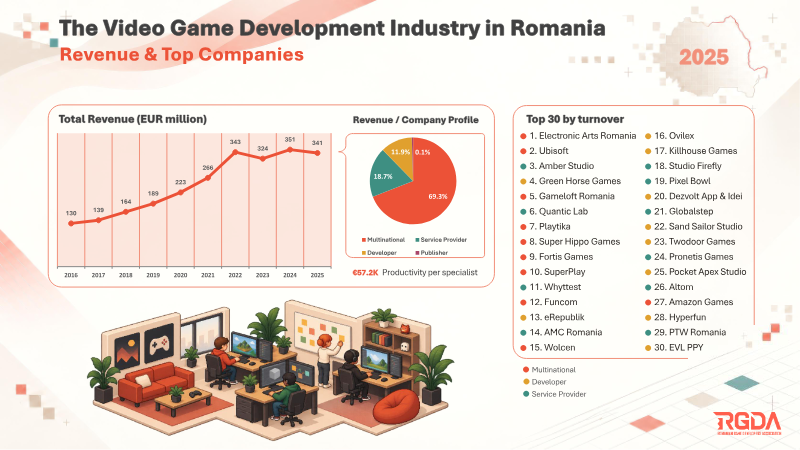
The Romanian game industry is projected to reach €351 million in total revenue by 2025, continuing a growth trend from €130 million in 2016, with a slight dip observed in 2023.
- The Romanian video game industry reached a total revenue of 351 million EUR in 2025, supported by a workforce of 6,000 professionals.
- The sector has shifted from a service-heavy model to a balanced mix of development and publishing, resulting in a 2.5-fold increase in game releases over the last two years.
- The industry is comprised of 234 active studios, with major international players like Electronic Arts Romania, Ubisoft, and Gameloft ranking among the top 30 companies by turnover.

A Deep Dive into Deep Links: The All-in-One Handbook for Mobile App Marketers, Developers, and Product Managers
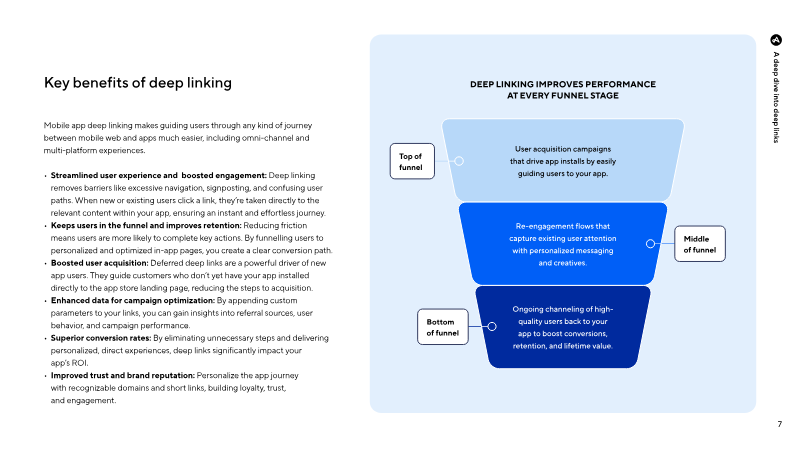
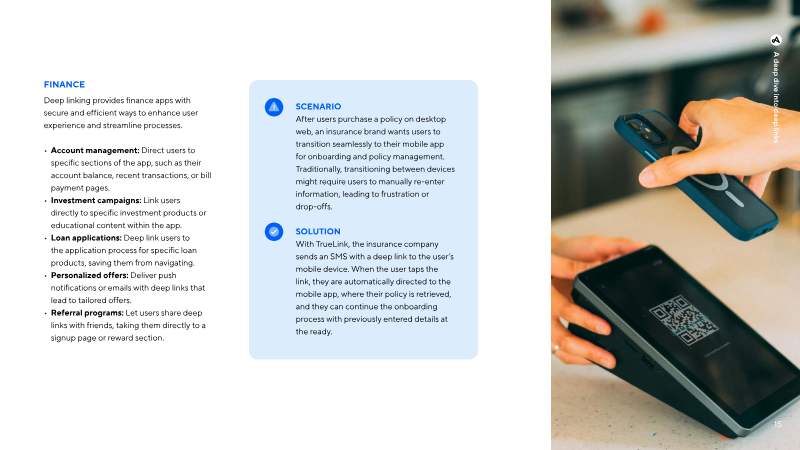
Adjust's handbook explains deep linking as the mobile equivalent of website URLs, routing users from ads or external sources to specific in-app content, and makes the case for its TrueLink product as the solution for marketers, developers, and product managers.
- Deep linking significantly improves app performance, with CleverTap data showing that users attributed to deep links achieve 81% higher activation rates, 2.5x higher retention rates, and 2x higher conversion rates compared to those using standard links.
- Deep linking technology functions by routing users directly to specific in-app content or screens upon clicking an ad or link, utilizing standards such as Apple Universal Links, Android App Links, and URI schemes.
- Deferred deep linking drives user acquisition by directing individuals who have not yet installed the app to the appropriate app store landing page, thereby reducing friction in the installation process.


La Industria del Videojuego en España: Anuario 2025
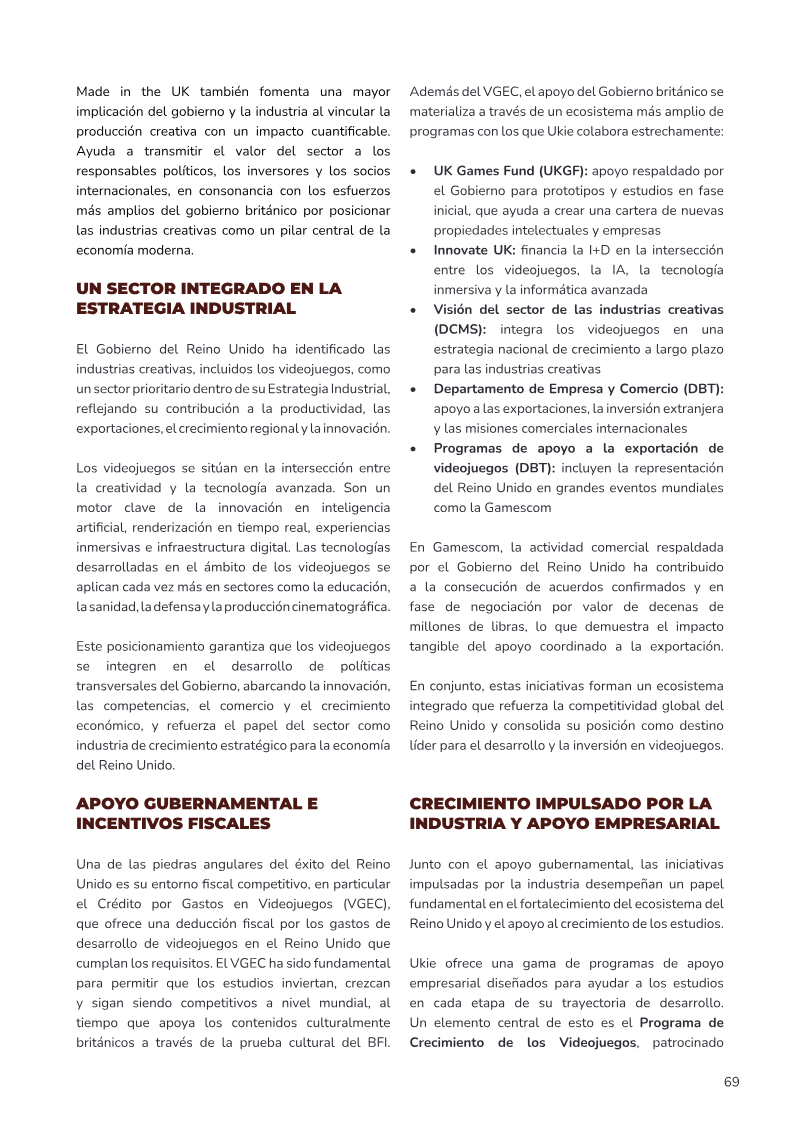
The "Anuario 2025" provides a comprehensive overview of the Spanish video game industry, detailing its economic performance, player demographics, technological advancements, and strategic initiatives.
- The Spanish video game industry generated 2.293 billion euros in 2025, a 3.2% year-over-year decline driven by a contraction in digital content spending.
- Digital sales remain the primary revenue driver, accounting for 61.9% of total market income.
- The sector serves a player base of 22.8 million people, with mobile devices being the most popular platform, reaching 18 million users.
The Alumni Effect: Studios Founded by Ex-Activision, Blizzard, and King Employees
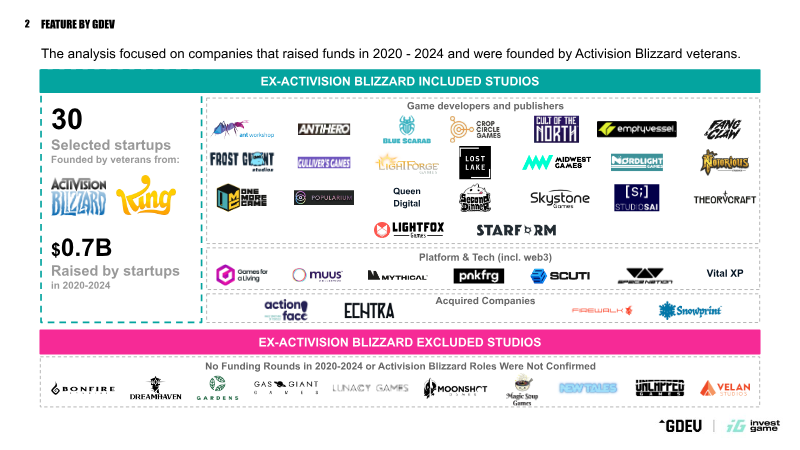
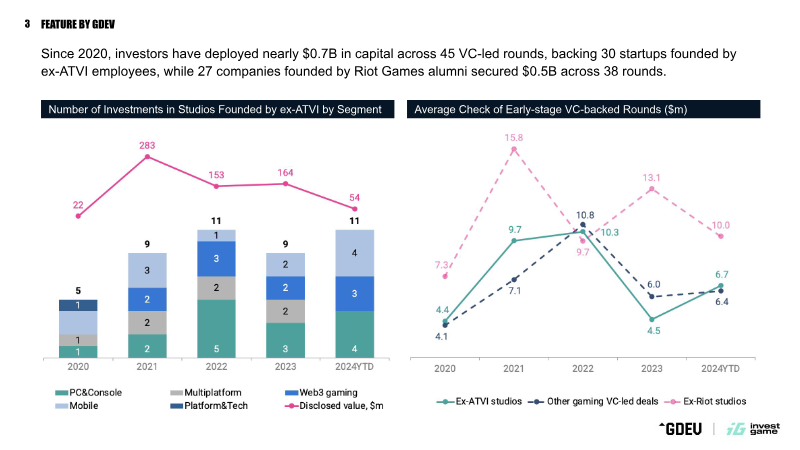
The analysis examines the "alumni effect" within the gaming industry, specifically focusing on studios founded by former employees of Activision, Blizzard, and King (collectively, ex-ATVI).
- Between 2020 and 2024, 30 studios founded by former Activision Blizzard employees secured approximately $0.7 billion in venture capital across 45 funding rounds.
- Ex-Activision studios demonstrate a 'first-round momentum' effect, being roughly four times more likely than peer startups to secure a second round of financing within the same calendar year.
- Investor confidence in alumni teams peaked in 2021, when 43% of ex-Activision studios raised a subsequent round compared to only 9% of broader gaming startups.

Game Data: Building vs Buying
The document analyzes the strategic decision for game studios and publishers regarding whether to build an in-house data pipeline or purchase a third-party solution.
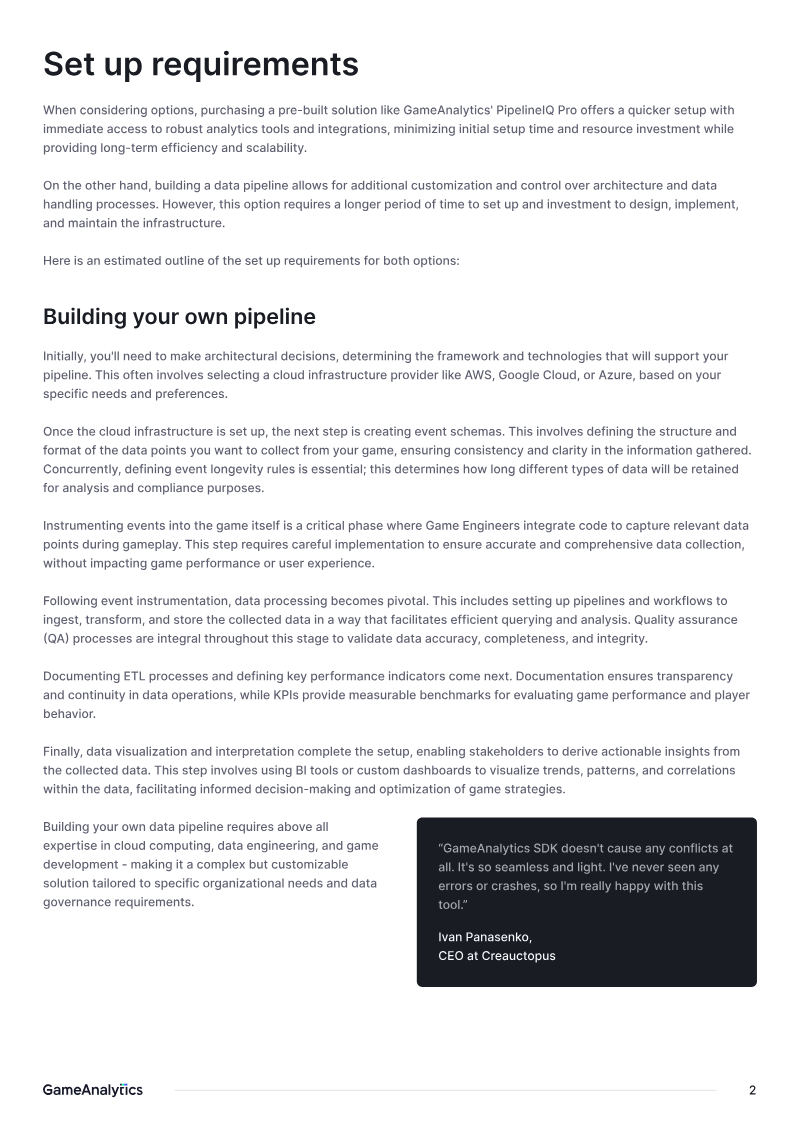
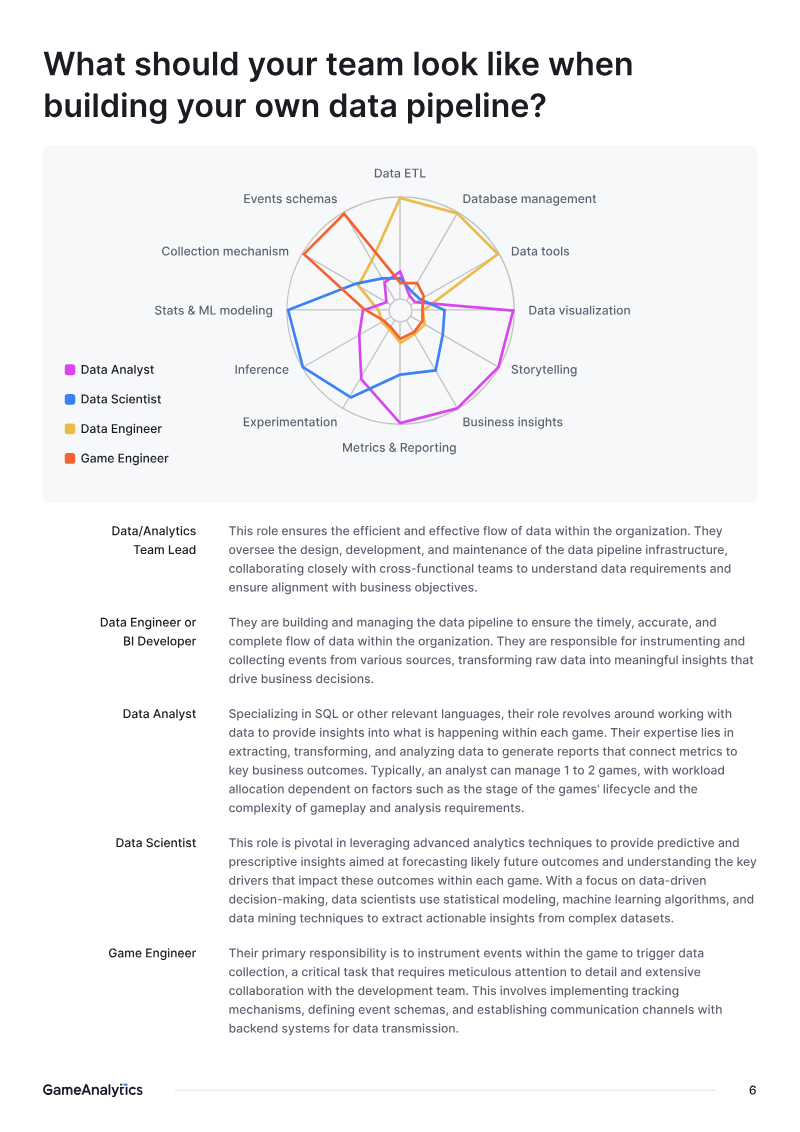
- Building an in-house data pipeline for a studio with 5 million MAU costs approximately $50,000 per month, compared to $5,900 per month for a third-party solution like GameAnalytics’ PipelineIQ Pro.
- Human capital is the primary cost driver for both approaches, accounting for 89% of the budget for in-house builds and 78% for vendor-managed pipelines.
- Third-party solutions offer significantly faster deployment timelines, ranging from hours to days, whereas custom in-house pipelines typically require months to implement.
A Shortcut to Your Own Game Insights Platform
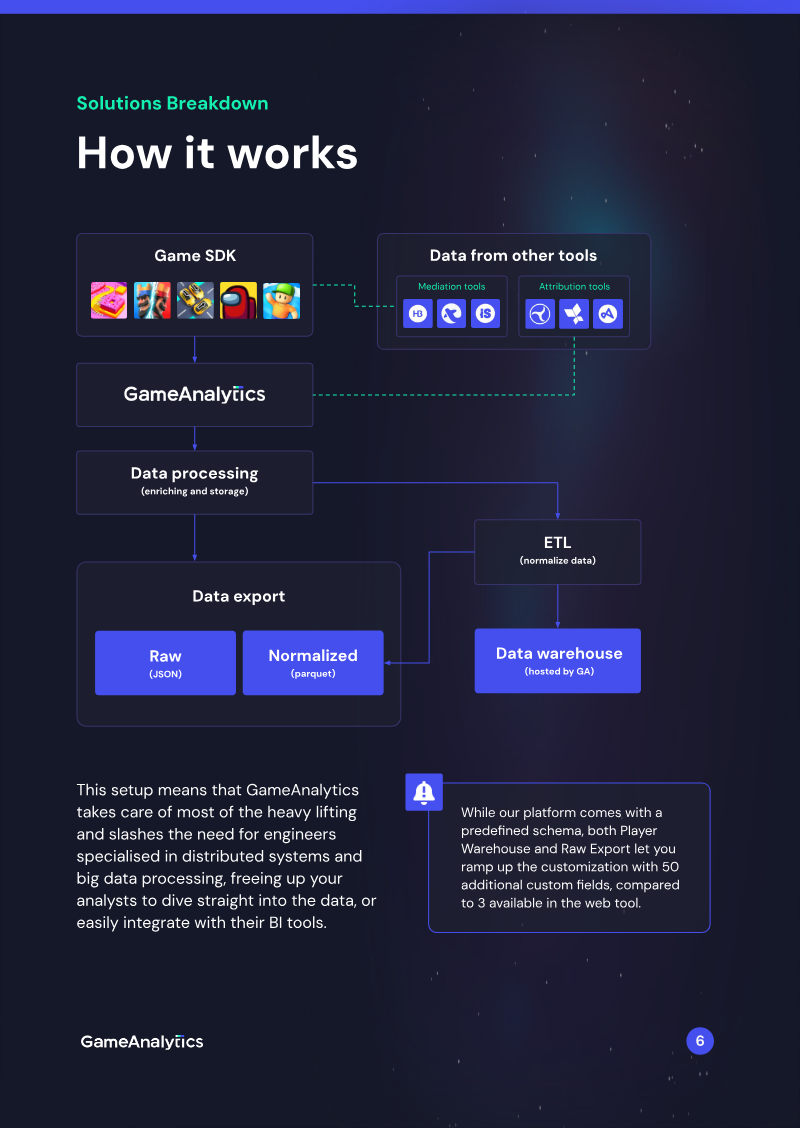
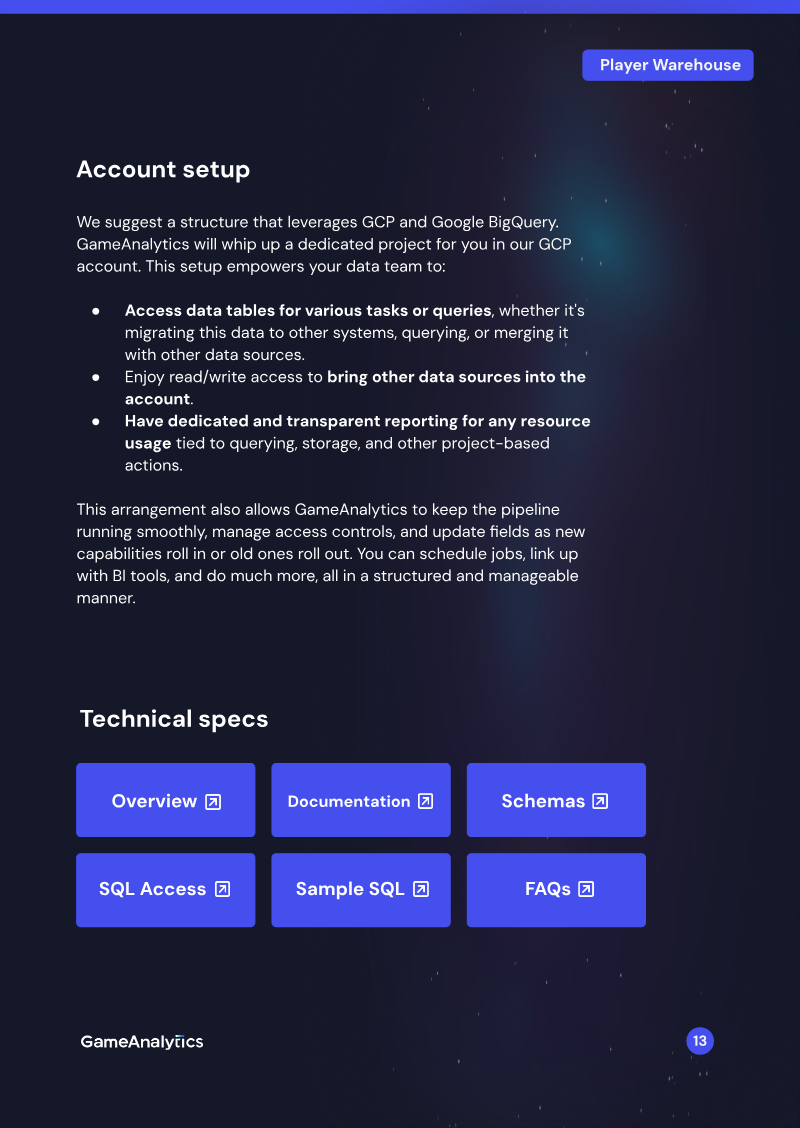
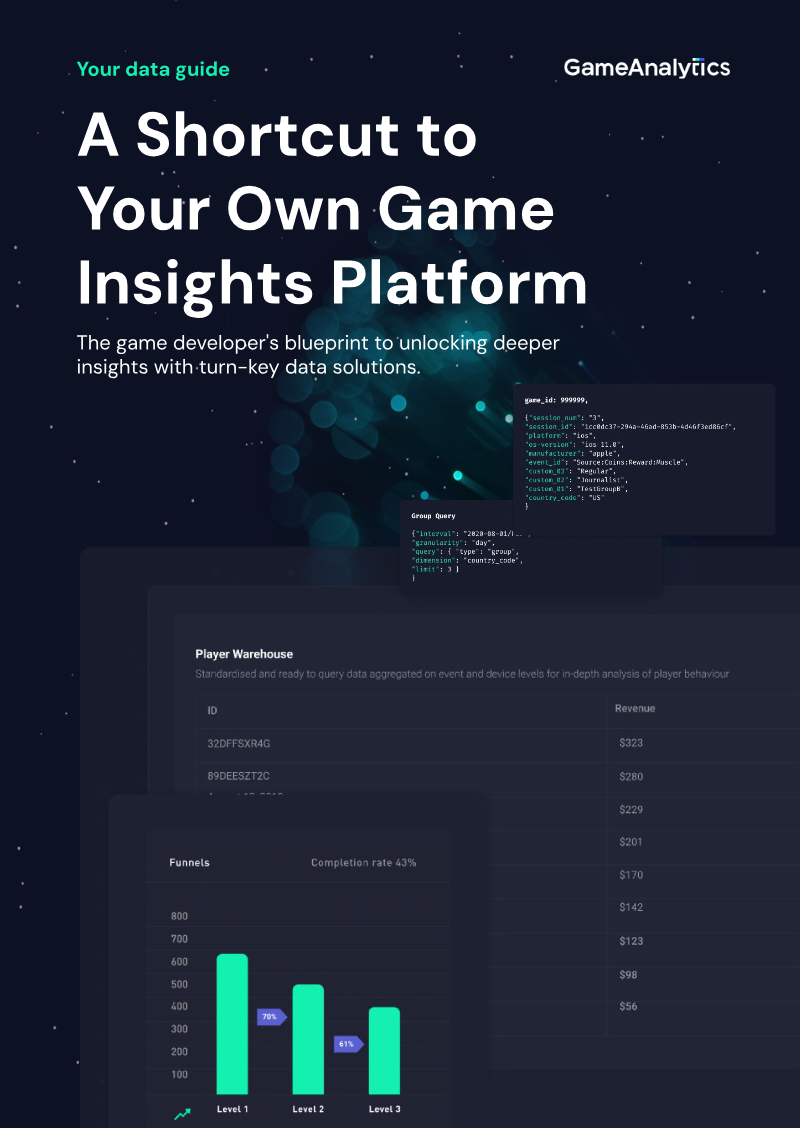
This document outlines GameAnalytics' turn-key data solutions, "Player Warehouse" and "Raw Export," designed to provide game developers with deeper, more flexible access to their game data.
- GameAnalytics provides a turnkey data pipeline that eliminates the need for custom ETL development, proprietary SDKs, and ongoing infrastructure maintenance.
- The platform offers two primary data delivery methods: Player Warehouse for daily refreshed, SQL-ready event tables and Raw Export for real-time JSON streaming.
- A publisher utilizing Raw Export achieved a 50% increase in lifetime value (LTV) across 19 titles, while a VR MMO leveraged Player Warehouse to improve player engagement.


Your Data Tracking Plan: A Step-by-Step Guide for GameAnalytics
GameAnalytics presents a structured framework for designing and implementing data tracking within games, emphasizing the creation of a comprehensive tracking plan that aligns analytics teams with development stakeholders.
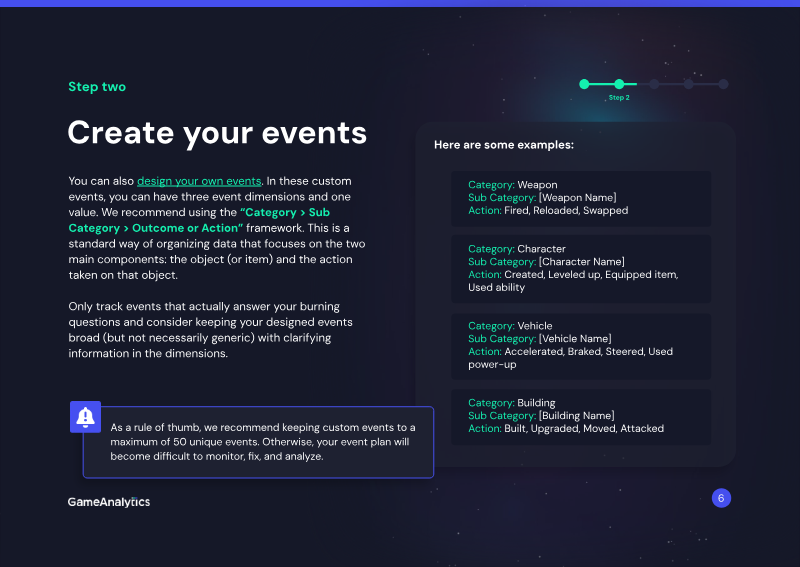
- Establish a structured tracking plan by aligning business objectives and player behavior questions with seven predefined event categories: Session, Business, Resource, Progression, Error, Ads, and Impression.
- Limit custom events to a maximum of 50 unique identifiers to maintain data integrity and prevent system clutter.
- Adopt a consistent Category > Sub-Action naming framework to ensure clarity and prevent redundant or misleading data collection.

Capital Markets Event 2025: Coffee Stain Group
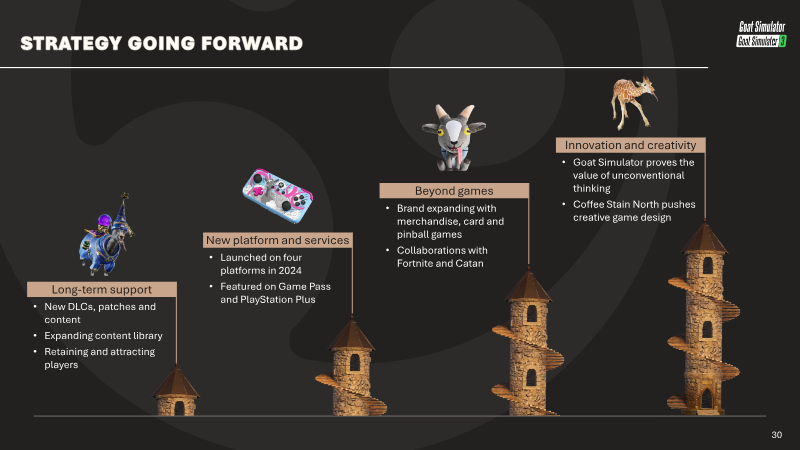
The Coffee Stain Group's Capital Markets Event 2025 document outlines a compelling investment thesis centered on a "gameplay first" development strategy, lean team structures, and deep community engagement to create enduring, high-quality games for global audiences.
- Coffee Stain Group maintains strong financial health with a 34% net-sales CAGR to SEK 1.2 bn, a 44% cash EBIT margin, and 120% cash conversion.
- The company holds SEK 472 m in cash reserves with zero external debt, providing significant flexibility for future M&A and capital allocation.
- Ninety percent of net sales are generated by a core portfolio of flagship titles—Goat Simulator, Deep Rock Galactic, and Satisfactory—which consistently maintain review scores above 96%.
The Rise and Reset of Sweden's $19B Gaming Capital Machine
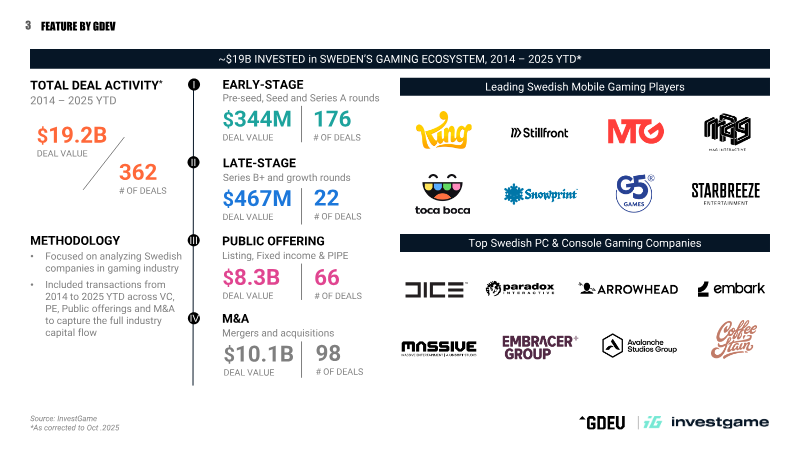
This document analyzes the capital flow and evolution of Sweden's gaming industry from 2014 to 2025 YTD, identifying it as a significant global gaming capital.
- Sweden’s gaming sector has matured into a $19 billion ecosystem comprising 1,100 companies, with Swedish developers producing five of Steam’s global top-10 bestsellers in 2024–25.
- Swedish studios contribute approximately 20% of Steam’s projected 2025 gross revenue, cementing the country's status as a dominant global gaming hub.
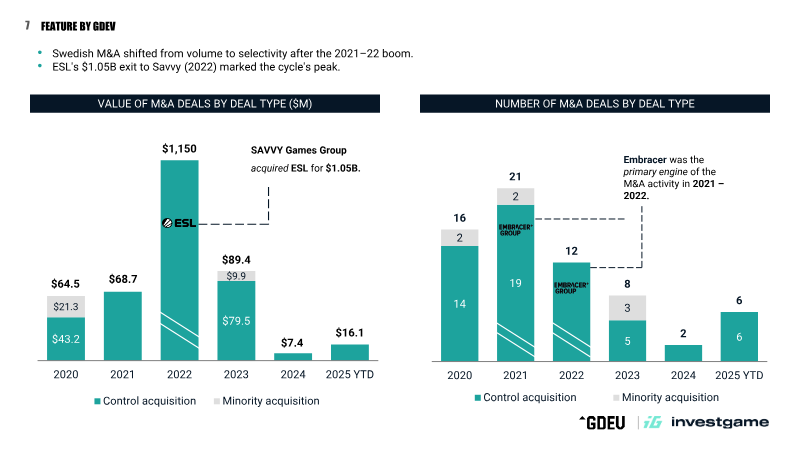
- M&A activity is highly concentrated, with three major deals—King ($5.9 billion), Mojang ($2.5 billion), and ESL ($1.05 billion)—accounting for 93% of the total transaction value.

What Good Are AI NPCs?: Lessons from a Large-scale Player Study
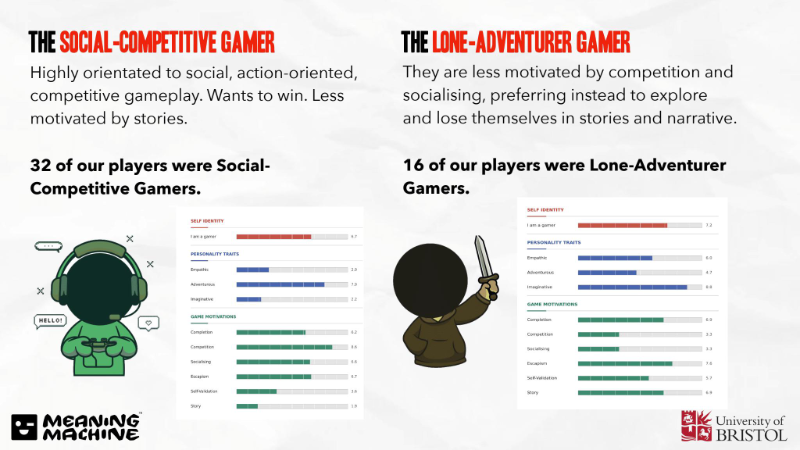
The study demonstrates that generative AI-driven non-player characters can deliver deeply engaging, emotionally resonant gameplay.
- Generative AI NPCs drive high player engagement, with 97% of participants reporting high immersion and 96% rating their overall enjoyment as high.
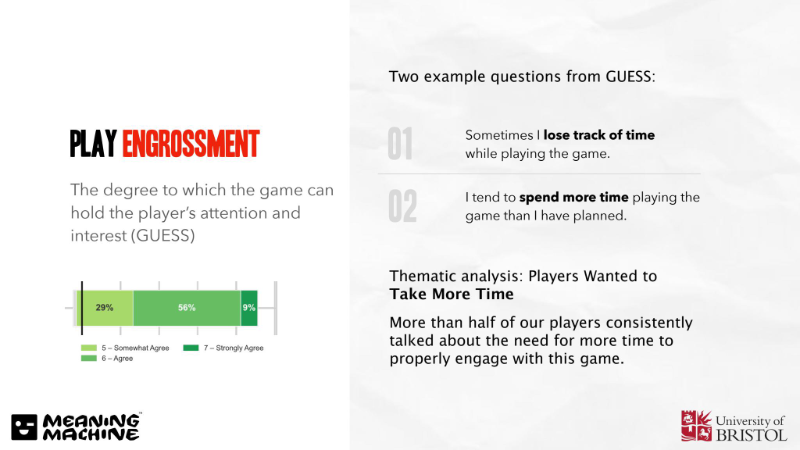
- The integration of AI NPCs maintains a balance between agency and guidance, as evidenced by 80% of players achieving top scores for play engrossment and 90% praising the creative freedom of the open-ended design.
- Cognitive load remains manageable during AI-driven interactions, with participants reporting NASA-TLX mental demand scores of 64.7 and performance scores of 52.7.
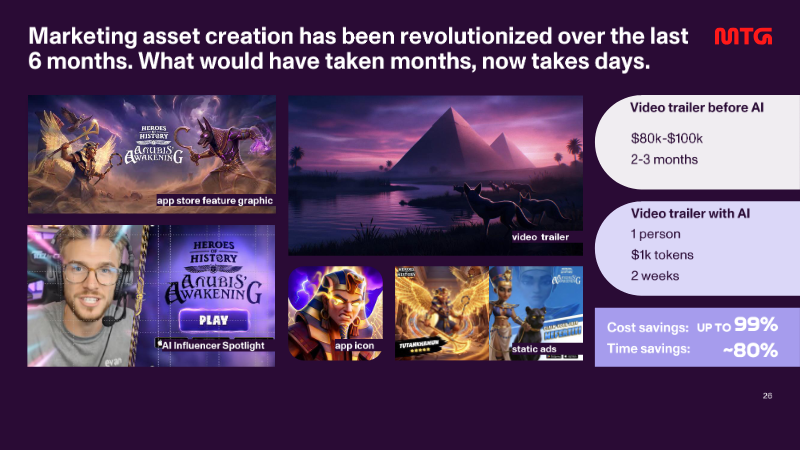

AI in MTG: Moving Beyond Theory
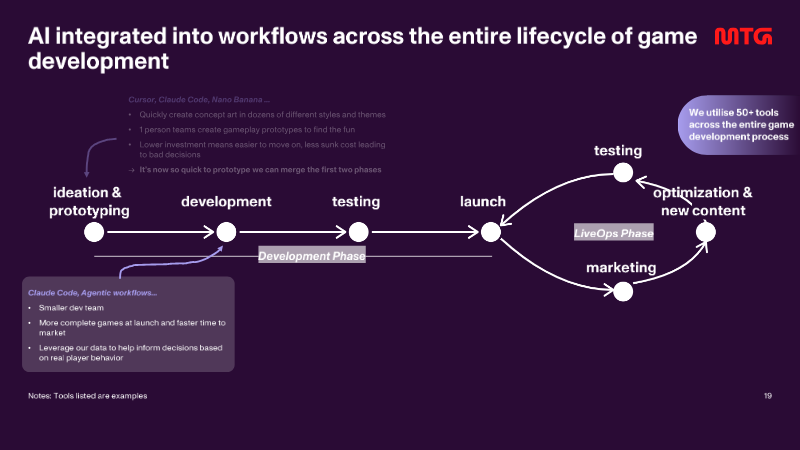
The document, "AI in MTG: Moving Beyond Theory," outlines a strategic integration of AI across the entire game development lifecycle, emphasizing its role in enhancing efficiency, reducing costs, and accelerating content delivery.
- Adopting an 'AI-first' development approach enabled the launch of five new mobile games in 2026, facilitating rapid iteration and simultaneous production of specialized content.
- AI integration has achieved significant operational efficiencies, including a 99% reduction in marketing asset costs and an 80% time saving on influencer spotlight production.
- Data analysis turnaround times have been reduced by 75% by utilizing AI agents to query large-scale datasets, allowing analysts to focus on high-level strategy.