Updated Jun 1, 2026 by InvestGame
Report
Published by InvestGame
The analysis focused on companies that raised funds in 2020 - 2024 and were founded by Activision Blizzard veterans. <u>EX-ACTIVISION BLIZZARD INCLUDED STUDIOS</u> Game developers and publishers ENG 30 ROP CULT OF THE ant workshop CIRCLE NORTH emp BLUE SCARAB GAMES Selected startups FROST GLSNT ...
#5 FEATURE BY eE2 The Alumni Effect: Studios Founded by Ex-Activision, Blizzard, and King Employees AAE invest
2 FEATURE BY GDEV The analysis focused on companies that raised funds in 2020 - 2024 and were founded by Activision Blizzard veterans. EX-ACTIVISION BLIZZARD INCLUDED STUDIOS rs and publishers Game developers and publishers ENG 30 ROP CULT OF THE ant workshop CIRCLE NORTH emp BLUE SCARAB GAMES Selected startups FROST GLSNT LOST Founded by veterans from: GULLIVER'S GAMES T MIDWEST ORDLIGHT NOTORiOUs LAKE GAMES ACIIVISION studios LiGHIFORGE E GAMES STUDIOS- BILZARD ung POPULARIUM Queen Second Skystone [S;] THEORYCRAFT Digital DinneR Games STUDIOSAI $0.7B Platform & Tech (incl. web3) Raised by startups Games for muus pnkfrg SCUT Vital XP in 2020-2024 a Living action Acquired Companies EX-ACTIVISION BLIZZARD EXCLUDED STUDIOS No Funding Rounds in 2020-2024 or Activision Blizzard Roles Were Not Confirmed
> **[Chart page]** This page contains visual data — view in PDF for the best experience. 3 FEATURE BY GDEV Since 2020, investors have deployed nearly $0.7B in capital across 45 VC-led rounds, backing 30 startups founded by ex-ATVI employees, while 27 companies founded by Riot Games alumni secured $0.5B across 38 rounds. Number of Investments in Studios Founded by ex-ATVI by Segment Average Check of Early-stage VC-backed Rounds ($m) 283 15.8 153 164 13.1 22 11 54 10.8 9 1 9 11 9.7 9.7 10.3 10.0 3 3 2 4 7.3/ 6.0 6.7 5 2 2 2 3 7.1 6.4 1 2 2 4.4 4.5 1 2 5 3 4.1 2020 2021 2022 2023 2024YTD 2020 2021 2022 2023 2024YTD PC&Console Multiplatform Web3 gaming
4 FEATURE BY GDEV We observe the same effect as with ex-Riots Studios' financing: market averages for next-year financing during the peak period of 2021-2022 were roughly half the rate of companies founded by ex-ATVI employees. Share of VC-backed Companies That Raised Funds After the First Round of Financing Ex-ATVI Studios Other VC-backed Gaming Startups Year of subsequent funding Year or subsequent funding 2021 2022 2023 2024YTD 2021 2022 2023 2024YTD 20 20 2020 40% 20% 20% 20% 20 20 2020 11% 9% 3% 1% 2021 43% 29% 0% 2021 9% 5% 4% 2022 0% 14% 2022 6% 6% 2023 33% 2023 8%
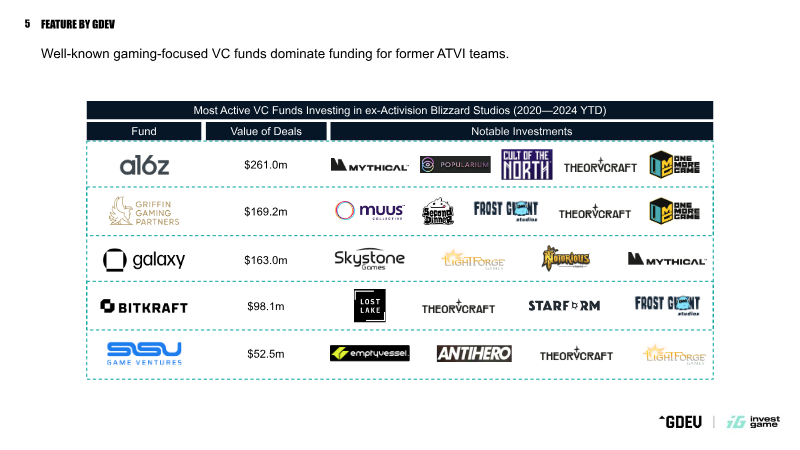
5 FEATURE BY GDEV Well-known gaming-focused VC funds dominate funding for former ATVI teams. Most Active VC Funds Investing in ex-Activision Blizzard Studios (2020—2024 YTD) Fund Value of Deals Notable Investments Notable Investments aloz CULT OF THE $261.0m POPULARIUM ORT THEORYCRAFT CAME GRIFFIN FROST GLSNT muus Second FROST GINT THEORYCRAFT ONE GAMING $169.2m MORE PARTNERS COLLECTIVE DinneR studios CAME galaxy $163.0m Skystone NOTORiOUs Games STUDIOS- LiGHIFORGE LOST THEORYCRAFT FROST GLSNT $98.1m LAKE studios SSSU $52.5m ANTIHERO THEORYCRAFT LiGHIFORGE
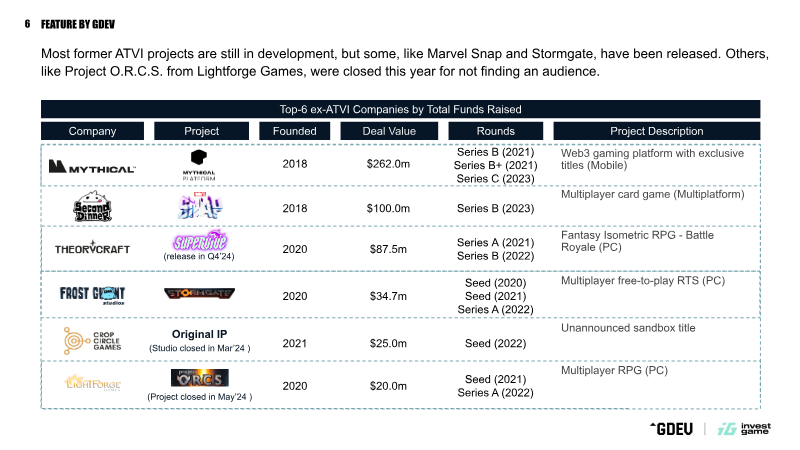
6 FEATURE BY GDEV Most former ATVI projects are still in development, but some, like Marvel Snap and Stormgate, have been released. Others, like Project O.R.C.S. from Lightforge Games, were closed this year for not finding an audience. Top-6 ex-ATVI Companies by Total Funds Raised Company Project Founded Deal Value Rounds Project Description 2018 $262.0m Series B (2021) Web3 gaming platform with exclusive MYTHICAL Series B+ (2021) titles (Mobile) PLATFORM Series C (2023) Second ENAP 2018 $100.0m Series B (2023) Multiplayer card game (Multiplatform) DinneR THEORYCRAFT sipertue Series А (2021) Fantasy Isometric RPG - Battle (release in Q4’24) 2020 $87.5m Series B (2022) Royale (PC) FROST GLSNT $34.7m Seed (2020) Multiplayer free-to-play RTS (PC) studios 2020 Seed (2021) Series A (2022) CIRCLE Original IP Unannounced sandbox title GAMES (Studio closed in Mar’24 ) 2021 $25.0m Seed (2022) project 2020 $20.0m Seed (2021) Multiplayer RPG (PC) LiGHIFORGE (Project closed in May’24 ) Series A (2022) ct closed in Ma
It was never just “entertainment.” What Square Enix once brought to life was a “culture” that shaped an era, and an “industry” that fascinated the world. Eitd3 B04 LELTX 2 2 1F SQUARE ENIX is Square Enix really giving birth to something genuinely new? Or has Square Enix turned away from the challenges before it, and let 25I=oy35U-EZ7- 130 5E 300754# lae USH7HEUEELO ISTEMSER5RPERAANEEMANHAMELHT For Square Enix, every “ch...
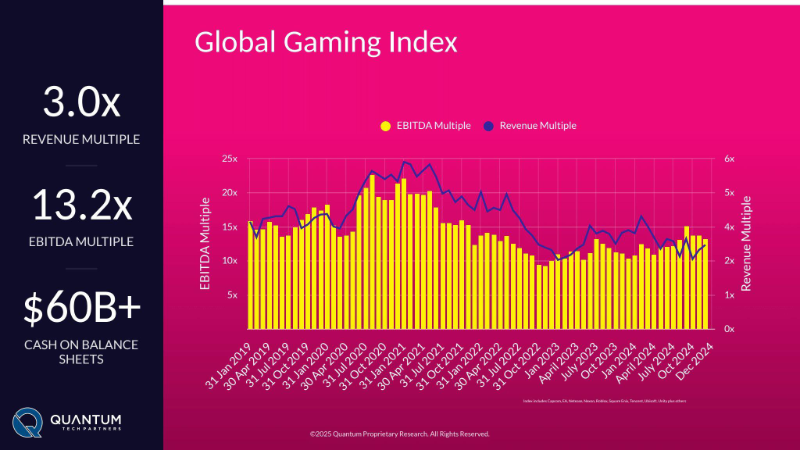
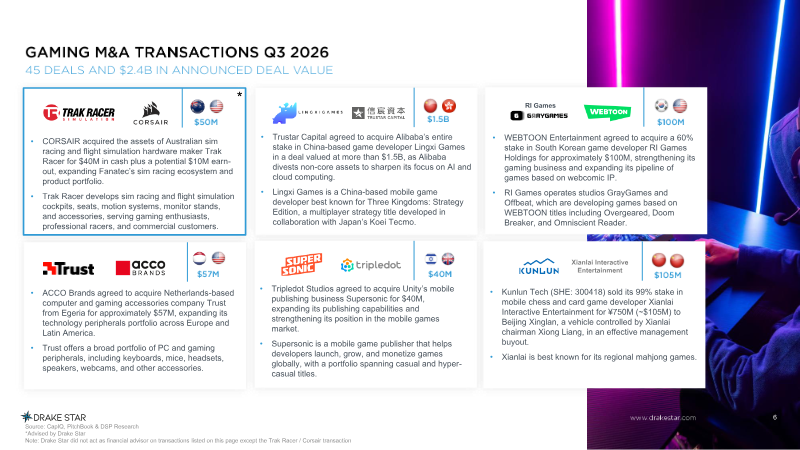
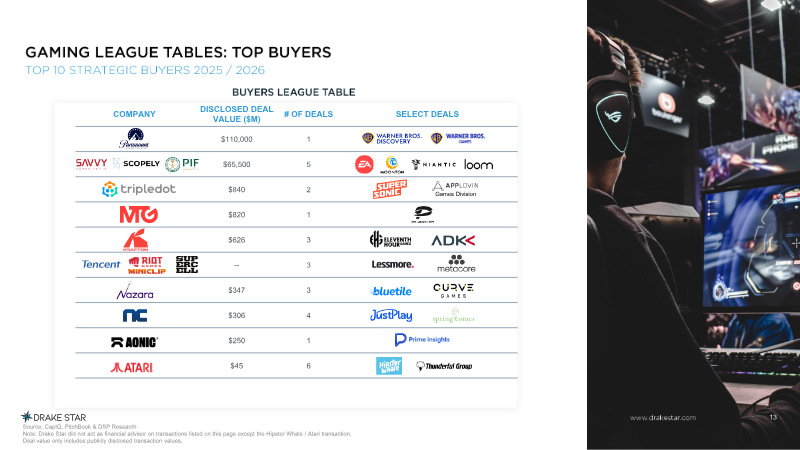
The global gaming industry experienced a notable resurgence in early 2025, characterized by a rebound in merger and acquisition activity and sustained interest in private financing. During the first quarter, 48 announced acquisitions reached a total value of $4.4 billion, anchored by the significant $3.5 billion acquisition of Niantic’s games division by Scopely. Simultaneously, the private placement market remained active, recording 149 deals worth $3.5 billion. These investments were primarily concentrated in mobile-focused developers and companies integrating artificial intelligence into their entertainment platforms, with major strategic entities like Savvy Games Group and Tencent continuing to drive market momentum. Despite this activity, the financial landscape remains bifurcated. While the broader sector shows signs of recovery, with the Drake Star Gaming Index posting a 16.37% gain, performance remains highly volatile across the top 35 public gaming companies. Valuation disparities are particularly pronounced; industry leaders such as NVIDIA and AppLovin command premium revenue multiples, while many other firms face a more challenging environment. Furthermore, while early-stage funding remains accessible, later-stage financing continues to present significant hurdles for companies seeking capital. Looking forward, the industry is positioned for a gradual increase in consolidation as public markets stabilize. Strategic focus is shifting toward the integration of AI and advanced technological platforms, which are expected to serve as primary catalysts for future growth. As market conditions improve, the sector is likely to see a renewed pipeline of initial public offerings, signaling a transition toward a more mature and diversified investment climate for global gaming stakeholders.
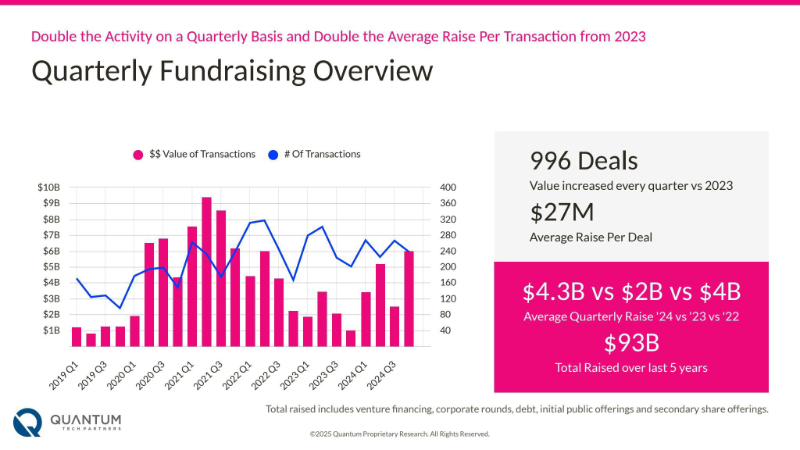
The analysis tracks global venture‑capital activity in the video‑game sector from the first quarter of 2019 through the second quarter of 2024, focusing on deals funded by VCs, strategic investors and publishers. It quantifies total capital deployed and deal counts, revealing a rapid expansion from $2 billion across 117 transactions in 2019 to a peak of $5.3 billion in 2021 (186 deals), followed by a sharp contraction in 2022 to $1.8 billion (126 deals) and a further dip to $874 million in 2023 (148 deals). Early‑stage financing remained relatively stable throughout, while the decline was driven primarily by fewer Series A‑plus rounds, creating a scarcity of growth‑stage capital. The report notes a modest rebound in 2024, with new funds entering the market and higher expected returns despite lingering marketing and user‑acquisition challenges. Geographically, investors increasingly target emerging regions such as South America, Eastern Europe, Southeast Asia and China, seeking cost‑efficient teams and pre‑seed opportunities. Mobile games continue to dominate the funding landscape, yet interest in mid‑tier “AA” titles is growing, reflecting a shift toward projects that promise shorter payback periods and stronger ROI. The pandemic‑driven hyper‑casual boom accelerated user‑acquisition technology, while post‑pandemic privacy changes (e.g., Apple’s IDFA restrictions) and macro‑economic headwinds have dampened overall spend and slowed M&A and IPO activity. Methodologically, the 2019 figures are derived from the Games Fund team’s synthesis of publicly available sources, while data for 2020‑2024 come from the investgame.net analytical platform. The combined dataset provides a comprehensive view of deal volume, value and regional distribution, supporting the conclusion that the gaming VC market exhibits pronounced cyclical dynamics, with early‑stage resilience and emerging‑region optimism offset by a constrained growth‑stage pipeline and broader economic uncertainty.
The November 2024 Game Developer Collective Survey examines how game developers allocate resources to software tools and services, focusing on the adoption of game engines, cloud platforms, and ancillary technologies. The central thesis is that while the market now offers a broader array of solutions than ever before, studios face divergent realities: many are eager to leverage these options to boost efficiency and output, yet a substantial portion confronts tightening budgets that limit further investment. This tension is reflected in the “Industry Conditions and Performance” findings, which portray a challenging commercial environment for the sector. Key observations indicate that developers increasingly view diversified toolsets as pathways to improved productivity, but cost pressures are intensifying across regions. The survey highlights a split between studios that can expand their technology stack and those that must defer additional spending, underscoring a growing disparity in capability to innovate. The analysis also signals that forthcoming research on “Working Environments,” slated for release in January 2025, will delve deeper into how these financial constraints intersect with workplace dynamics and talent management. The study spans a global developer base, encompassing respondents from the Americas, Europe‑Middle East‑Africa, and Asia‑Pacific, and captures sentiment as of November 2024. Although specific sample sizes and data sources are not disclosed in the excerpt, the findings are presented under the Omdia research umbrella, with standard disclaimer language indicating that the material is provided “as‑is” and reflects the original publication date. The survey’s conclusions serve as a barometer of current investment trends and the fiscal pressures shaping the game development landscape.