Updated Jun 1, 2026 by GameAnalytics
Whitepaper
Published by GameAnalytics
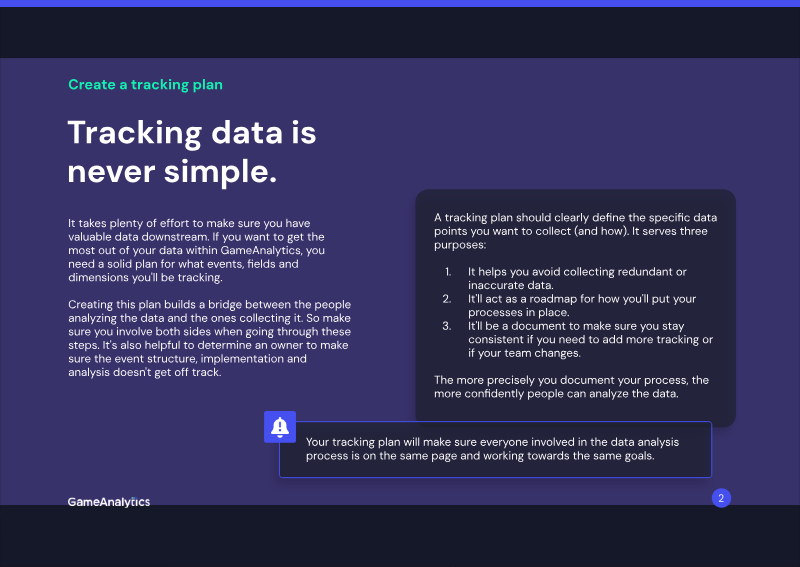
A Step-by-Step Guide for GameAnalytics Step for GameAnalytics It takes plenty of effort to make sure you have valuable data downstream. If you want to get the most out of your data within GameAnalytics, you need a solid plan for what events, fields and dimensions you'll be tracking. Creating this plan builds a bridge between the people analyzing the data and the ones collecting it. So make sure you involve both sides when going through these steps.
GameAnalytics Your data tracking plan Designing your events A Step-by-Step Guide for GameAnalytics A Step-by- Guide Step for GameAnalytics
Create a tracking plan Create a tracking plan Tracking data is never simple. It takes plenty of effort to make sure you have valuable data downstream. If you want to get the most out of your data within GameAnalytics, you need a solid plan for what events, fields and dimensions you'll be tracking. Creating this plan builds a bridge between the people analyzing the data and the ones collecting it. So make sure you involve both sides when going through these steps. It's also helpful to determine an owner to make sure the event structure, implementation and analysis doesn't get off track. A tracking plan should clearly define the specific data points you want to collect (and how). It serves three purposes: 1. It helps you avoid collecting redundant or 2. inaccurate data. It'll act as a roadmap for how you'll put your 3. processes in place. It'll be a document to make sure you stay consistent if you need to add more tracking or if your team changes. The more precisely you document your process, the more confidently people can analyze the data. more confidently people can analyze the data. Your tracking plan will make sure everyone involved in the data analysis process is on the same page and working towards the same goals. process is on the same page and working towards the same goals. GameAnalytics
GameAnalytics One last thing Contents Contents What’s inside? Keep an eye out for: 1 Brainstorm your burning questions Brainstorm your burning questions duplicate (and mis 2 Using multiple eve Five steps to get you from your questions to Create your events some answers. that nobody unde cracking, Before you get here are some common Putting your event pitfalls we've spotted 3 Define your dimensions and attributes 4 Plug in your game 5 Keep updating your plan
Step one Step 1 Step one Step 1 Brainstorm your burning questions For example, you might come up with: For example, you might come up with: Get everyone in a room and ask them: What ● What do I need to know about my players? questions do we have? Start by thinking about what ● Why are we collecting this data? you need to know about your players and why. It’s ● What are we working towards? ● How long does it take to finish the tutorial? also helpful to break down those burning questions ● What stops people from buying our in-app into sub-questions. purchases? ● How much are players willing to pay for X? ● What are the most (or least) used by active players: levels, items or guilds? ● What IAP packages convert free users into paying users? ● Do players see the weapon stashed in the • corner? Figuring out what questions you have helps you see corner? what you need to measure (your metrics) and how you’ll measure them (your events. and how you'll measure them (your events. GameAnalytics 4
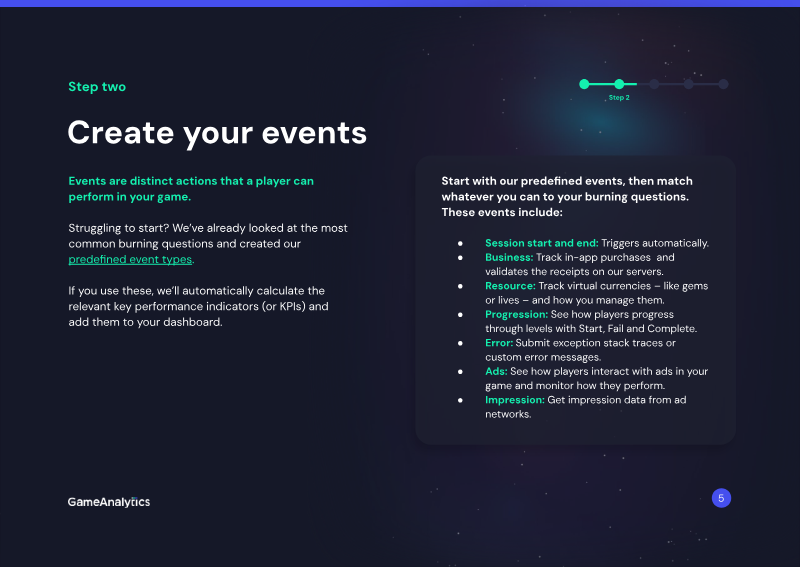
Step two Step 2 Step two Step 2 Create your events Events are distinct actions that a player can Start with our predefined events, then match Events are distinct actions that a player can Start with our predefined events, then match perform in your game. whatever you can to your burning questions. These events include: Struggling to start? We’ve already looked at the most common burning questions and created our ● Session start and end: Triggers automatically. predefined event types. ● Business: Track in-app purchases and validates the receipts on our servers. If you use these, we’ll automatically calculate the ● Resource: Track virtual currencies – like gems relevant key performance indicators (or KPIs) and or lives – and how you manage them. add them to your dashboard. ● Progression: See how players progress through levels with Start, Fail and Complete. ● Error: Submit exception stack traces or custom error messages. ● Ads: See how players interact with ads in your game and monitor how they perform. ● Impression: Get impression data from ad networks. networks. GameAnalytics 5
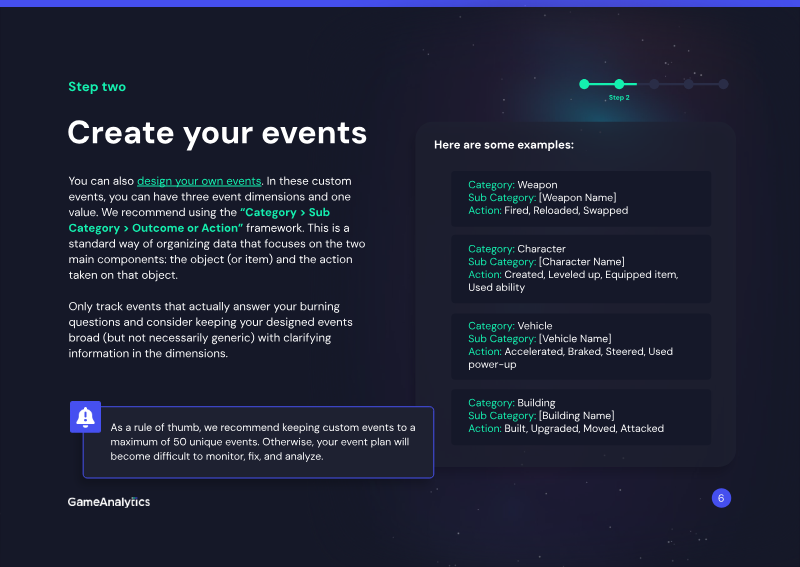
Step two Step 2 Step two Step 2 Create your events Here are some examples: Here are some examples: You can also design your own events. In these custom Category: Weapon You can alsodesign your own events. In these custom Category: Weapon events, you can have three event dimensions and one Sub Category: [Weapon Name] value. We recommend using the “Category > Sub Action: Fired, Reloaded, Swapped Category > Outcome or Action” framework. This is a standard way of organizing data that focuses on the two Category: Character main components: the object (or item) and the action Sub Category: [Character Name] taken on that object. Action: Created, Leveled up, Equipped item, Used ability Only track events that actually answer your burning questions and consider keeping your designed events Category: Vehicle broad (but not necessarily generic) with clarifying Sub Category: [Vehicle Name] information in the dimensions. Action: Accelerated, Braked, Steered, Used power-up power-up Category: Building As a rule of thumb, we recommend keeping custom events to a Sub Category: [Building Name] Action: Built, Upgraded, Moved, Attacked maximum of 50 unique events. Otherwise, your event plan will Action: Built, Upgraded, Moved, Attacked become difficult to monitor, fix, and analyze. become difficult to monitor, fix, and analyze. GameAnalytics 6
This analysis explores the current state and future trajectory of quality assurance (QA) within the video game industry, specifically focusing on the integration of artificial intelligence and automation. The central thesis posits that modern game development—characterized by the complexity of games-as-a-service and accelerated release cycles—has outpaced traditional manual QA capabilities. Consequently, there is a critical need for AI-driven solutions to bridge the gap between increasing content volume and stagnant testing budgets. The findings are based on a September 2024 survey of 303 US-based game development professionals across various disciplines, including QA, production, and design, supplemented by interviews with industry experts from companies such as Netflix and Indium Play. Data indicates a significant strain on current resources: 77% of developers admit to conducting less QA than necessary for their most recent releases, and 50% believe budgets are failing to keep pace with game complexity. While 94% of studios use some form of non-AI automation, there is a near-unanimous consensus (94%) that AI will be essential for the future of the field. Key statistics highlight a strong industry appetite for AI adoption, with 88% of respondents viewing AI as equal to or better than traditional methods for bug detection. Developers identify faster bug detection, automated reporting, and 24/7 testing as the primary advantages of the technology. However, a significant implementation gap exists; while 87% of studios feel "somewhat ready" for AI, only 18% feel fully prepared. Primary barriers to adoption include setup complexity, high initial costs, and a lack of skilled staff. The analysis concludes that while AI is vital for scalability and stress testing, it serves as a complement to—rather than a replacement for—human intuition and creative exploratory testing.
The pursuit of a successful game remake requires a delicate equilibrium between honoring the original creative spirit and meeting the heightened technical expectations of modern audiences. Analysis of high-profile titles released through 2024, including Metroid Prime Remastered and Resident Evil 4, indicates that critical and fan reception serves as the primary metric for quality, often superseding raw financial performance. Developers find the most success when they rebuild visual assets from scratch, leveraging contemporary lighting and 3D environments to recreate the atmospheric immersion that original technical constraints once limited. Modernization strategies vary based on the age and mechanical relevance of the source material. While some titles benefit from subtle control refinements, others require a total overhaul of core systems to remain viable. Capcom’s approach to the Resident Evil series exemplifies this by replacing dated tank controls and fixed cameras with fluid 3D movement and strategic lighting. Similarly, Square Enix transitioned the static backgrounds and turn-based combat of Final Fantasy VII into expansive environments and action-oriented hybrid systems. These shifts demonstrate that adhering to the "pillars of experience" is more vital than preserving obsolete functional elements. Ultimately, the most effective remakes prioritize the recreation of a specific feeling or "spirit" over mere resolution increases. While visual fidelity must be modernized to maintain immersion, gameplay adjustments should be handled selectively to avoid alienating the core fanbase. Industry leaders like Nintendo and specialized external development partners emphasize that leveraging modern hardware to amplify a game's original intent is the most reliable path to critical acclaim. By focusing on atmospheric depth and evolved control schemes, developers can ensure that classic titles resonate with both nostalgic players and new audiences within the current AAA landscape.
24 March 2026 ("ev everplay group plc Unaudited Final Results for the year ended 31 December 2025 everplay, a leading global independent ("indie") developer and publisher of premium video games, working simulation games and children's edutainment apps is pleased to announce its unaudited final results for the year ended 31 December 2025 ("FY 2025").
H O W A I + G A M E D E S IG N THEWORLD OF CONSUMER TECH IS CHANGING 1990 2007 2023 2026 INTERNET MOBILE AI APPS AI APPS ERA ERA 1 .0 2 .0 The web goes Computing moves Chat w rappers. A A gents, interfaces, public. Everything into the pocket. new wave of and entirely new gets connected.