Updated Jun 1, 2026 by InvestGame
Report
Published by InvestGame
The game developer's blueprint to unlocking deeper insights with turn-key data solutions. game_id: 999999, "session_id": "1cc0dc37-294a-46ad-853b-4d46f3ed86cf", "event_id": "Source:Coins:Reward:Muscle", Standardised and ready to query data aggregated on event and device levels for in-depth analysis of player behaviour ID Revenue 32DFFSXR4G $323 89DEESZT2C $280 Funnels Completion rate 43...
Your data guide A Shortcut to Your Own Game Insights Platform The game developer's blueprint to unlocking deeper insights with turn-key data solutions. game_id: 999999, {"session_num": "3", "session_id": "1cc0dc37-294a-46ad-853b-4d46f3ed86cf", "platform": "ios", "os-version": "ios 11.0", "manufacturer": "apple", "event_id": "Source:Coins:Reward:Muscle", "custom_03": "Regular, "custom_02": "Journalist", "custom_01": "TestGroupB", "country_code": "us" Group Query {"interval": "2020-08-01/t_ granularity": "day" "query": { "type": "group" "dimension": "country_code", limit": 3 Player Warehouse Standardised and ready to query data aggregated on event and device levels for in-depth analysis of player behaviour ID Revenue 32DFFSXR4G $323 89DEESZT2C $280 $229 $201 Funnels Completion rate 43% $170 800 $142 700 $123 600 $98 400 70% $56
Contents Contents Overview 3 What’s Overview 3 Why a data pipeline 4 inside? Why a data pipeline? 4 How it Works 5 How it Works 5 C Platform overview 6 ● Explore this guide to transform ● Cost savings 7 your data into insights using our ● Advanced use-cases 8 turn-key data solutions. ● Integrations 9 Player Warehouse 10 ● What is it? 11 ● Use cases 12 ● Account setup 13 ● Case study 14 Raw Export 15 ● What is it? 16 O Use cases 17 ● C Case study 18 ● Case study 18 C Privacy-enabled 19 Privacy-enabled 19 Get Started 20 Get Started 20
Overview Overview Your data, your rules Today's successful studios are Today's successful studios are driven by data in all areas — from testing prototypes, to game economy balancing and monetization. GameAnalytics helps studios thrive by tapping into this data at every stage. Our analytics solutions are budget-friendly compared to market alternatives, and our web tool is packed with features that help studios on their growth journey. However, as studios scale, reporting flexibility and data ownership become more crucial. That's why we offer a versatile package That’s why we offer a versatile package of tools that help you access and extract event-level data, player-level data, and raw data from our web platform. This frees you from the limitations of black-box analytics solutions and helps you to bring your reporting in-house, driving your studio’s success. With our affordable warehousing solutions and export services, any growing game studio can establish its own proprietary reporting pipeline. Integrate one of our official SDKs for all major engines and environments, then access player and event-level insights with unmatched detail. It's like having an in-house data engineering team, but at a fraction of the cost. GameAnalytics Powerful, free analytics Powerful, free analytics Warehouse solutions Export services Player warehouse Real-time raw export Player warehouse Real-time raw export
Why a data pipeline? Why a data pipeline? Turn data into insights Even with the solid features of our web tool, there comes a point where Even with the solid features of our web tool, there comes a point where you’ll likely want more customization. Web-based solutions can sometimes be restrictive, confining data and limiting reporting flexibility. This leads many to build in-house data solutions. While many aspire to such a setup, the journey often involves high While many aspire to such a setup, the journey often involves high infrastructure and engineering costs, lengthy development cycles, and challenges in delivering expected business value on time. In the long term, this may lead to hard-to-maintain codebases and, as your studio or games scale, hefty bills from cloud providers due to data processing inefficiencies. In comparison, our data tools gives any team a turn-key data warehouse or data lake which works at scale, at low cost, and where data from external sources like mediation and attribution platforms can be combined. This quickly enables your BI team to perform custom analysis and improve your decision-making. With our data tools, you bypass the “ usual challenges and pitfalls, gaining the data flexibility you need in just a The data tools that GameAnalytics few hours. Say goodbye to the offer are incredibly powerful. We headaches of infrastructure setup, now have access to an enormous maintenance, scaling, and the amount of data through BigQuery. engineering complexities typically It requires some good knowledge of associated with data collection and transformation.
oodbye to the offer are incredibly powerful. We headaches of infrastructure setup, now have access to an enormous maintenance, scaling, and the amount of data through BigQuery. engineering complexities typically It requires some good knowledge of associated with data collection and transformation. We handle the SQL, but it’s the way to go if you heavy lifting—from building custom want to dig deep into the product SDKs and collecting data to and what happens to these users. processing and bug fixing—all in a Once you understand the different privacy-compliant package from databases and workflow, you can GameAnalytics. get incredibly granular and hone in GameAnalytics. on any specific ” point in the game. David Smit on any specific point in the game. CPO at Roamer Games David Smit CPO at Roamer Games
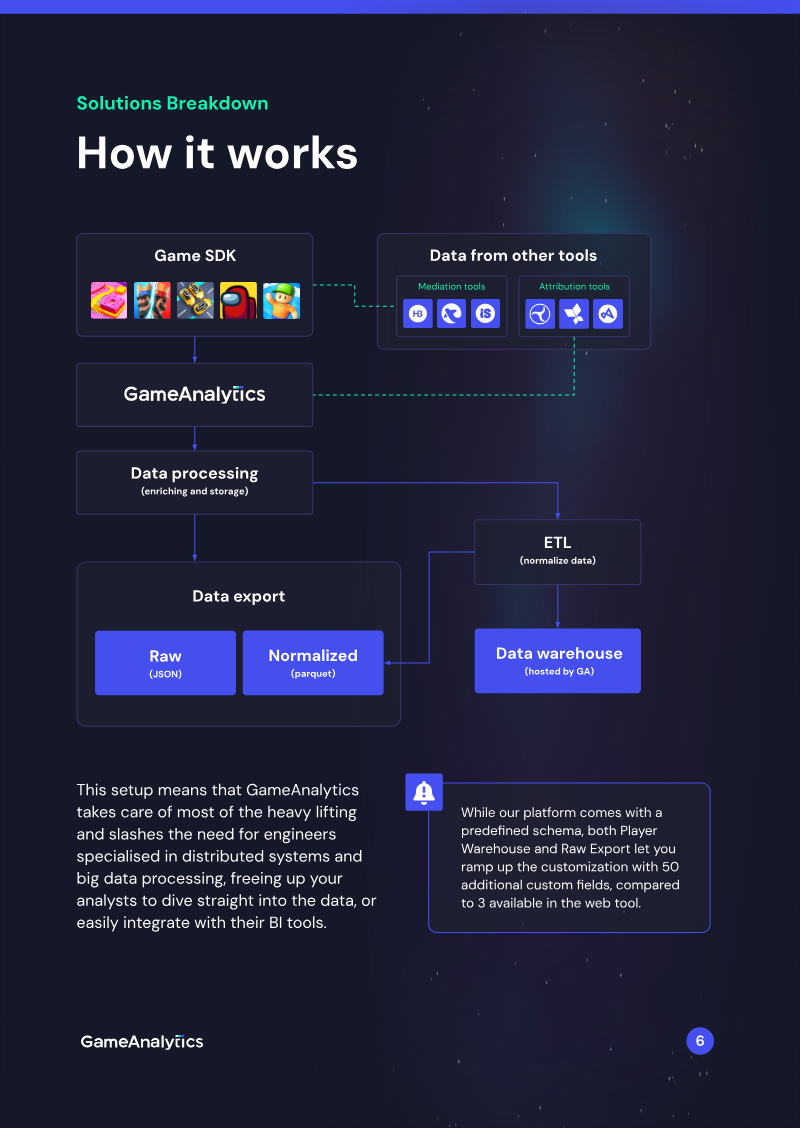
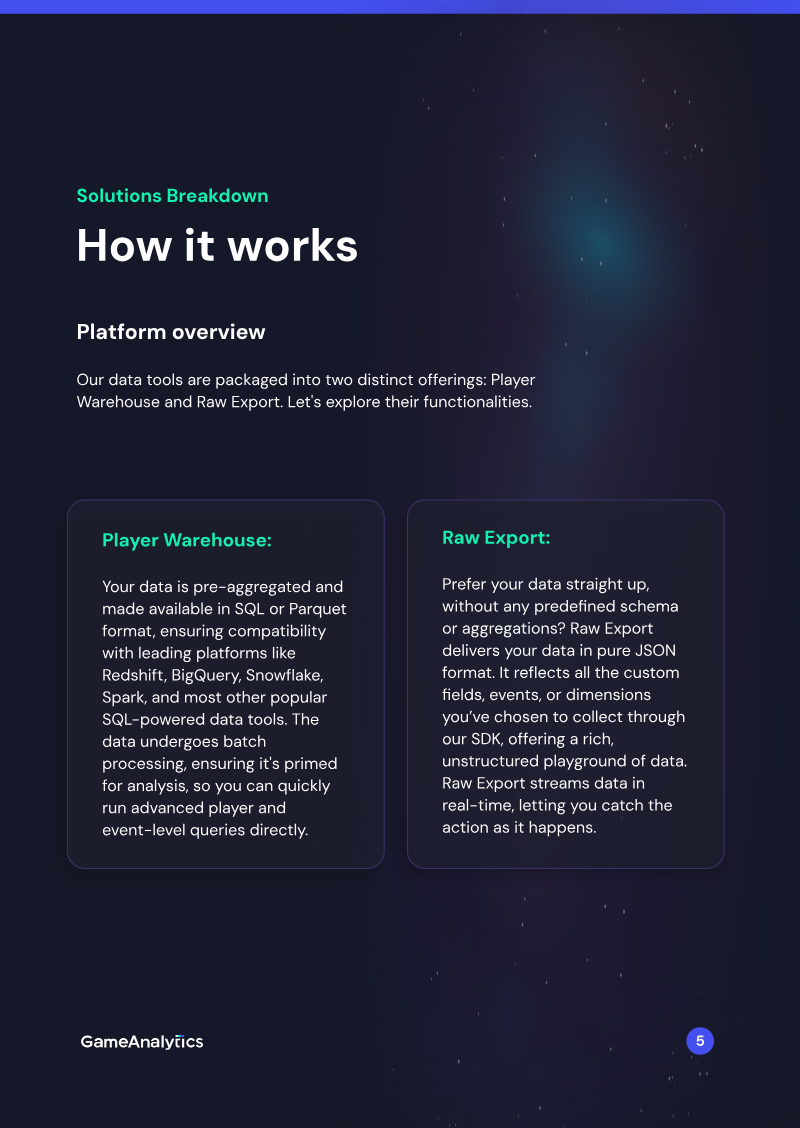
Solutions Breakdown Solutions Breakdown How it works Platform overview Platform overview Our data tools are packaged into two distinct offerings: Player Our data tools are packaged into two distinct offerings: Player Warehouse and Raw Export. Let's explore their functionalities. Player Warehouse: Raw Export: Your data is pre-aggregated and made available in SQL or Parquet format, ensuring compatibility with leading platforms like Redshift, BigQuery, Snowflake, Spark, and most other popular SQL-powered data tools. The data undergoes batch processing, ensuring it's primed for analysis, so you can quickly run advanced player and event-level queries directly. event-level queries directly. Prefer your data straight up, without any predefined schema or aggregations? Raw Export delivers your data in pure JSON format. It reflects all the custom fields, events, or dimensions you’ve chosen to collect through our SDK, offering a rich, unstructured playground of data. Raw Export streams data in real-time, letting you catch the action as it happens. action as it happens.
The global gaming industry in 2023 is defined by a strategic shift toward development efficiency and long-term player retention. Studios are increasingly prioritizing speed to market, with 62% of indie developers now shipping titles in under a year. This acceleration is largely fueled by the widespread adoption of premade assets and a reduction in average developer hours. While large studios are expanding their reach through a 16% increase in multiplatform development, indie studios remain predominantly focused on single-platform desktop releases. Simultaneously, there is a notable pivot toward mobile production, where global daily active users have risen by 8% despite a slight decline in the number of paying players. Monetization strategies are evolving to address this shift in player behavior, moving toward a balanced model where ad-supported structures and in-app purchases hold nearly equal weight. To ensure financial viability, 70% of studios now integrate monetization and LiveOps within the first 30 days of development. This early focus on the product lifecycle has contributed to a 33% increase in the average game lifespan, supported by frequent core content updates and a 27% rise in battle pass adoption. Emerging markets, particularly in regions like Kazakhstan, are driving a 15.7% year-over-year increase in total game builds, signaling a lower barrier to entry for new creators. Looking forward, the industry is embracing generative AI and user-generated content to streamline workflows and deepen engagement. The rise of "hybrid-casual" mobile games reflects a broader trend of blending accessible mechanics with sophisticated retention loops. Success in the current economic climate requires rigorous scope control and a transition from simple user acquisition to the maintenance of long-term player relationships. By leveraging achievements, community building, and real-time operational updates, developers are successfully extending the relevance and profitability of their titles in an increasingly competitive global market.
The first‑quarter fiscal 2015 results show net sales of ¥25.4 billion and operating income of ¥6.4 billion, a decline in sales but a flat operating margin compared with the previous quarter due to a ¥1.4 billion cut in advertising costs. Net sales fell 9.9% year‑over‑year, driven by softer performance of existing titles in Japan and overseas markets. EBITDA rose modestly to ¥8.01 billion, while ordinary income increased by ¥2.27 billion largely from a ¥17.2 billion exchange gain on USD‑denominated loans. An extraordinary loss of ¥2.03 billion was recorded from write‑downs of assets related to discontinued titles, reducing net income to ¥3.48 billion. Cost structure analysis indicates a 7% reduction in total costs to ¥19.0 billion, largely from advertising (down 13% QoQ) and commission fees. Variable costs fell by ¥1.19 billion, while fixed costs decreased marginally. The company’s strategy focuses on accelerating native game development, having shifted resources from web games and added 12 new production lines. Three first‑party native titles are slated for launch in the winter, and partnerships with LINE and KDDI aim to expand cross‑border reach. For FY15 first half, the company forecasts net sales of ¥49.0 billion and operating income of ¥10.5 billion, assuming minimal seasonal impact and continued cost control. The outlook emphasizes native hit titles as the primary growth driver, with web games supporting earnings and new ventures in mobile video advertising and venture capital investments.
($ millions) $1,658 $1,842 Revenue $1,259 $1,405 <u>$1,842</u> ($ millions) $835 $999 $1,159 <u>$1,259</u> <u>$1,405</u> <u>$1,658</u> $406 $504 $576 $678 $711 <u>$835</u> $999 <u>$1,159</u> $406 <u>$504</u> <u>$576</u> <u>$678</u> $711 Q223 Q323 Q423 Q124 Q224 Q324 Q424 Q125 Q225 Q325 Q425 Q126 Q223...
The 2026 State of Gaming analysis demonstrates a shifting landscape in which mobile gaming remains the largest driver of downloads—approximately 50 billion in 2025—but its growth rate is slowing. Revenue, however, continues to climb as monetization models mature and lifetime value deepens, especially within hybrid‑casual titles that now generate the most incremental income. In contrast, PC and console platforms experience record revenue growth, with Steam’s premium segment up 32 % and blockbuster releases such as Battlefield 6 capturing significant market share from incumbents. Shooter downloads on these platforms have plateaued, suggesting new titles are primarily cannibalizing existing audiences rather than expanding the category. Genre‑specific dynamics reveal that strategy games are the only mobile genre to grow in downloads, driven by 4X titles from Eastern developers. Action and shooter games dominate PC/console gains, while hyper‑casual remains the largest download engine but shows a notable lift in time spent, particularly in Tier 2 markets. Casual titles face declining day‑7 retention, indicating a stickiness challenge that could erode long‑term player value. Live‑ops and acquisition strategies have evolved toward retention‑focused events, multi‑tier season passes, and expedition‑style rewards. These mechanisms now represent the most reliable revenue drivers across competitive genres such as RPG, action, and simulation. Advertising spend remains concentrated on social channels—YouTube, Facebook/Instagram—and high‑attention formats like video, playable, and rewarded ads. Battlefield 6’s pre‑launch spend surpassed Call of Duty titles, leveraging Facebook, Reddit, and desktop display, while its post‑launch strategy pivoted to YouTube with cinematic, celebrity‑hook creatives. Geographically, the U.S. market shows a skew toward lifestyle and puzzle categories despite lower IAP shares, whereas casino titles exhibit higher spend‑to‑revenue efficiency. Overall, the industry is moving from acquisition toward deeper monetization per user, with indie shooters and simulation titles gaining traction amid intense competition in the shooter segment.