Updated Jun 1, 2026 by InvestGame
Report
Published by InvestGame
Sweden accounts for 20% of STEAM® KATHYRAIN 2 Gross Revenue in 2025. SOOTHSAYER R.E.P.O GREAT CIRCLE. GOD Hedemora Uppsala ARC PEAK SPLIT FICTION BREAKERS BATTLEFIELD 6 aiders Skövde Stockholm MDNIGHI FRIKSHOLM Skövde Stockholm KEEP Lostin Gothenburg EURPA ...
GAMES MADE IN SWEDEN 2024 - 2025 AM⑧ Sweden accounts for 20% of STEAM® KATHYRAIN 2 Gross Revenue in 2025. SOOTHSAYER R.E.P.O GREAT CIRCLE. AIBYSSUS RV THERE YET? GOD Hedemora Uppsala ARC PEAK SPLIT FICTION BREAKERS BATTLEFIELD 6 aiders Skövde Stockholm MDNIGHI FRIKSHOLM Skövde Stockholm WALK KEEP Lostin Gothenburg EURPA HASTE Random g BROKEN WORLDS DRIVING The Eternal Die UNIVERSALIS JUMP SPACE eliver D HEROES AT AALL COSTS
~$19B INVESTED in SWEDEN’S GAMING ECOSYSTEM, 2014 – 2025 YTD* TOTAL DEAL ACTIVITY* I EARLY-STAGE Leading Swedish Mobile Gaming Players 2014 – 2025 YTD Pre-seed, Seed and Series A rounds 19.2B 344M 176 lung l> Stillfront MO DEAL VALUE # OF DEALS MAG INTERACTIVE DEAL VALUE 362 II LATE-STAGE Series B+ and growth rounds G5 R # OF DEALS $467M 22 Snowprint STARBREEZE boca GAMES ENTERTAINMENT DEAL VALUE # OF DEALS toca METHODOLOGY III PUBLIC OFFERING Top Swedish PC & Console Gaming Companies • Focused on analyzing Swedish Listing, Fixed income & PIPE companies in gaming industry $8.3B 66 • Included transactions from DEAL VALUE Sparadox embarl 2014 to 2025 YTD across VC, # OF DEALS INTERACTIVE PE, Public offerings and M&A IV M&A to capture the full industry capital flow Mergers and acquisitions Coffec $10.1B 98 EMBRACER Avalanche DEAL VALUE # OF DEALS Source: InvestGame
HISTORY OF SWEDISH GAMING INDUSTRY 1990-1999 2000-2006 2006-2012 2012-2016 2016-2019 2019-2023 2023-2025 Engineering First Talent Migration Capital Discipline Exit Validation Listing Flywheel Industrial Roll-Up Efficiency Reset Demoscene and Ericsson’s collapse Mojang and King King $5.9B and Listings by THQ Zero rates and Rising rates and LAN culture forged released thousands of scaled profitably Mojang $2.5B Nordic, Stillfront, COVID demand slowing growth an engineering-first elite network engineers with minimal or no validated capital and peers turned rewarded scale collapsed the Sweden DNA. into gaming. venture capital. efficiency at scale. public markets into over profitability. multiple arbitrage The 1997 Home PC Spray's sale freed Bootstrapped Founder-led growth capital. Embracer-led roll- model. Reform accelerated future King founders. success proved outcomes recycled Public equity became ups expanded Embracer’s 2023 mass PC adoption, DICE’s 2006 sale scale without capital and acquisition currency, rapidly until macro reset set the sector embedding technical seeded a founder venture–fueled burn. expertise back into accelerating scale conditions shifted. template: divest literacy nationwide generation boosting Sweden’s gaming and portfolio assets, cut costs – a decade before gaming ecosystem. ecosystem. expansion. and restructuring competitors. portfolios. l> Stillfront IRRACER:
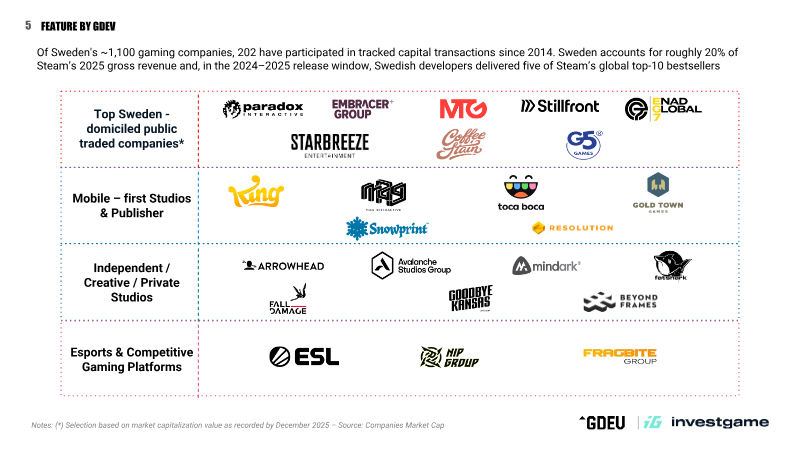
Of Sweden's ~1,100 gaming companies, 202 have participated in tracked capital transactions since 2014. Sweden accounts for roughly 20% of Steam’s 2025 gross revenue and, in the 2024–2025 release window, Swedish developers delivered five of Steam’s global top-10 bestsellers *Nparadox GROUP VO LOBAL Top Sweden - INTERACTIVE domiciled public STAI traded companies* STARDREELE taun GAMES ENTERTAINMENT Mobile – first Studios ung m2s hd & Publisher MAG INTERACTIVE toca boca GOLD TOWN GAMES Snowprint RESOLUTION Independent / Avalanche mindark(R Creative / Private V Studios Group fatshark Studios GOODBYE BEYOND FALL KANSAS Esports & Competitive A NIP Gaming Platforms GRDUP FRACBITE GROUP Notes: (*) Selection based on market capitalization value as recorded by December 2025 – Source: Companies Market Cap
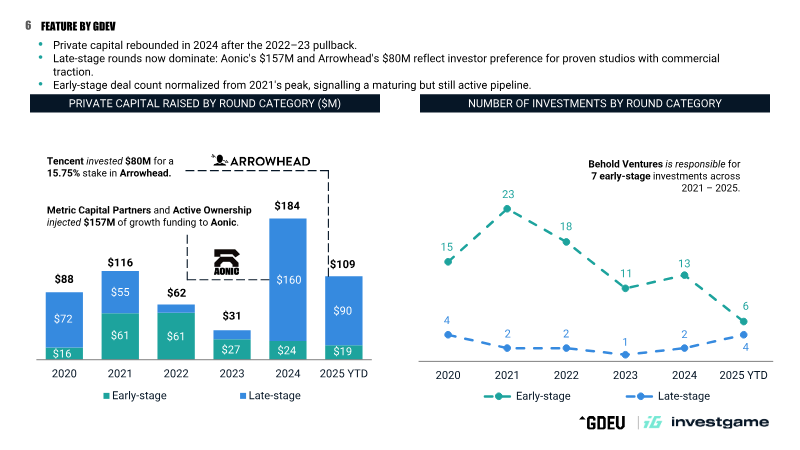
• Private capital rebounded in 2024 after the 2022–23 pullback. • Late-stage rounds now dominate: Aonic's 157M and Arrowhead's 80M reflect investor preference for proven studios with commercial • traction. Early-stage deal count normalized from 2021's peak, signalling a maturing but still active pipeline. PRIVATE CAPITAL RAISED BY ROUND CATEGORY ($M) NUMBER OF INVESTMENTS BY ROUND CATEGORY Tencent invested $80M for a Behold Ventures is responsible for 15.75% stake in Arrowhead. 7 early-stage investments across Metric Capital Partners and Active Ownership $184 23 2021 – 2025. injected $157M of growth funding to Aonic. 18 116 F 109 15 11 13 88 55 62 AONIG 160 $90 6 72 61 61 4 31 4 2 2 1 2 4 16 27 24 19 2020 2021 2022 2023 2024 2025 YTD 2020 2021 2022 2023 2024 2025 YTD Early-stage Late-stage Early-stage Late-stage
> **[Chart page]** This page contains visual data — view in PDF for the best experience. • Swedish M&A shifted from volume to selectivity after the 2021–22 boom. • ESL's $1.05B exit to Savvy (2022) marked the cycle's peak. VALUE OF M&A DEALS BY DEAL TYPE ($M) NUMBER OF M&A DEALS BY DEAL TYPE 220 $1,150 SAVVY Games Group 200 acquired ESL for $1.05B. 25 Embracer was the 190 21 primary engine of the 180 M&A activity in 2021 – 170 20 2 2022. 150 ESL 16 130 2 EMBRACER GROUP 120 15 110 $89.4 12 90 64.5 68.7 $9.9 10 19 8 70 14 EMBRACER* 6 60 $21.3 3 40 79.5 16.1 5 2 30 43.2 7.4 5 6 0 0 2020 2021 2022 2023 2024 2025 YTD 2020 2021 2022 2023 2024 2025 YTD Control acquisition Minority acquisition Control acquisition Minority acquisition
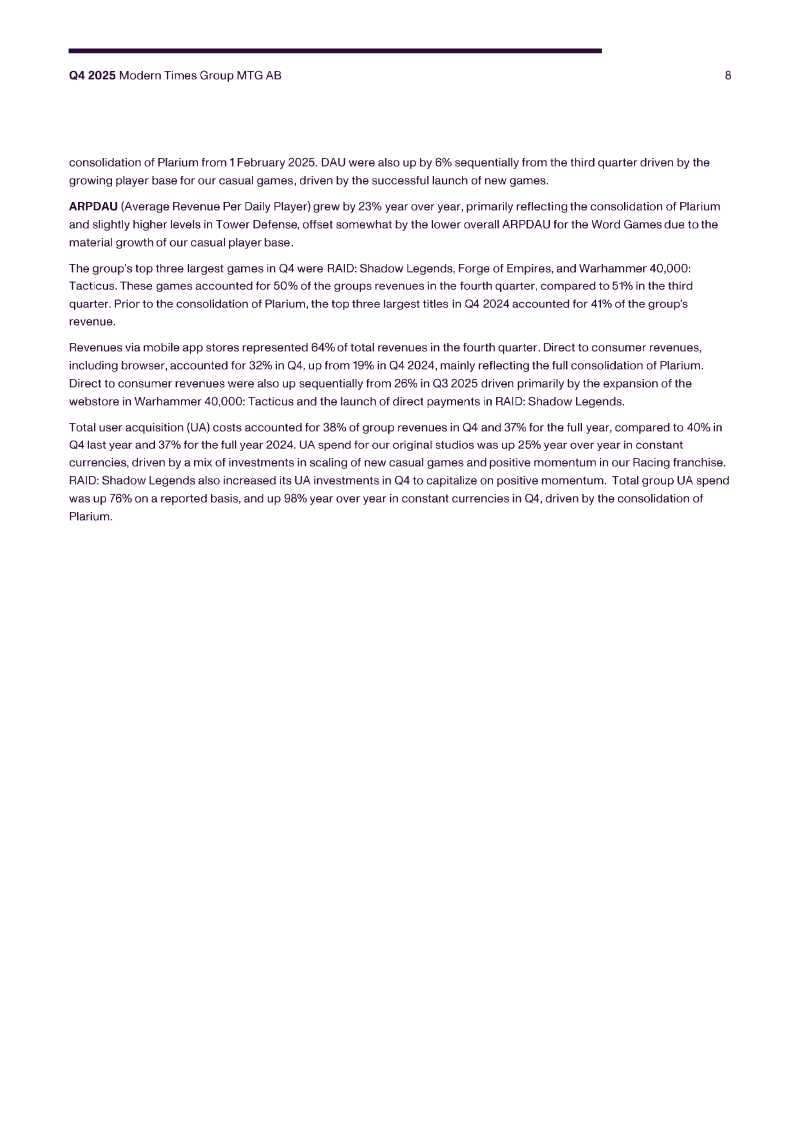
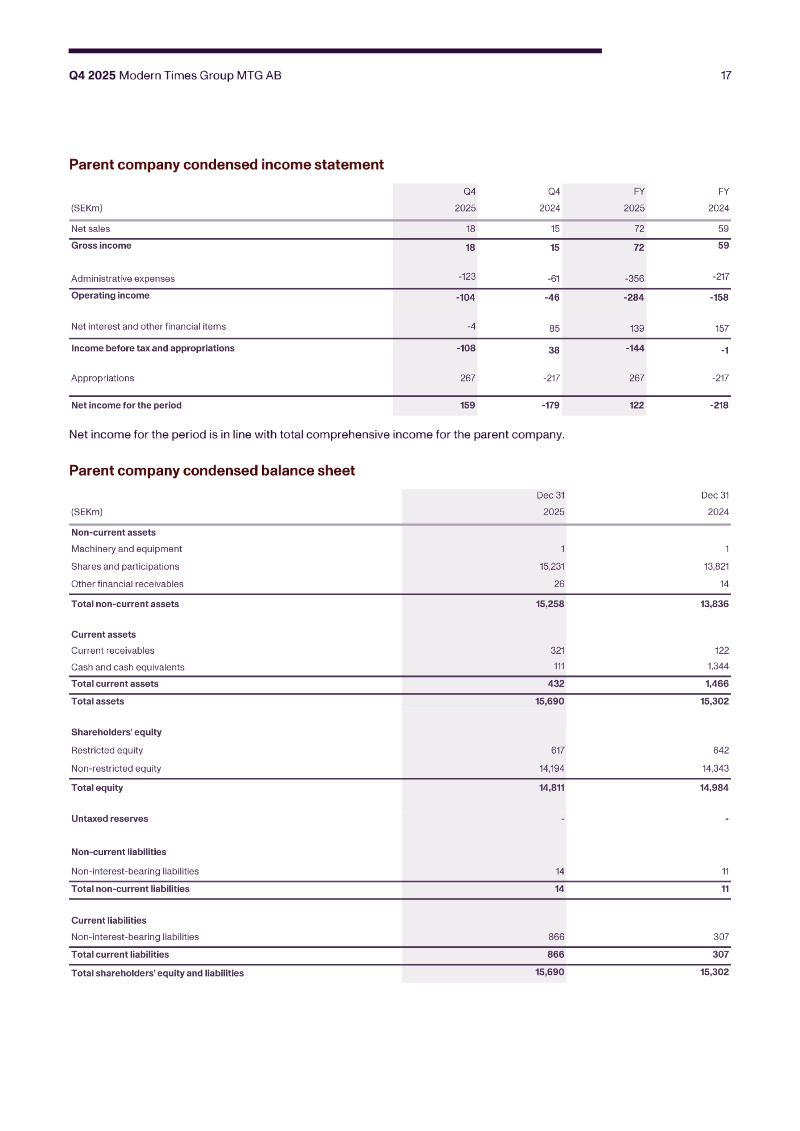
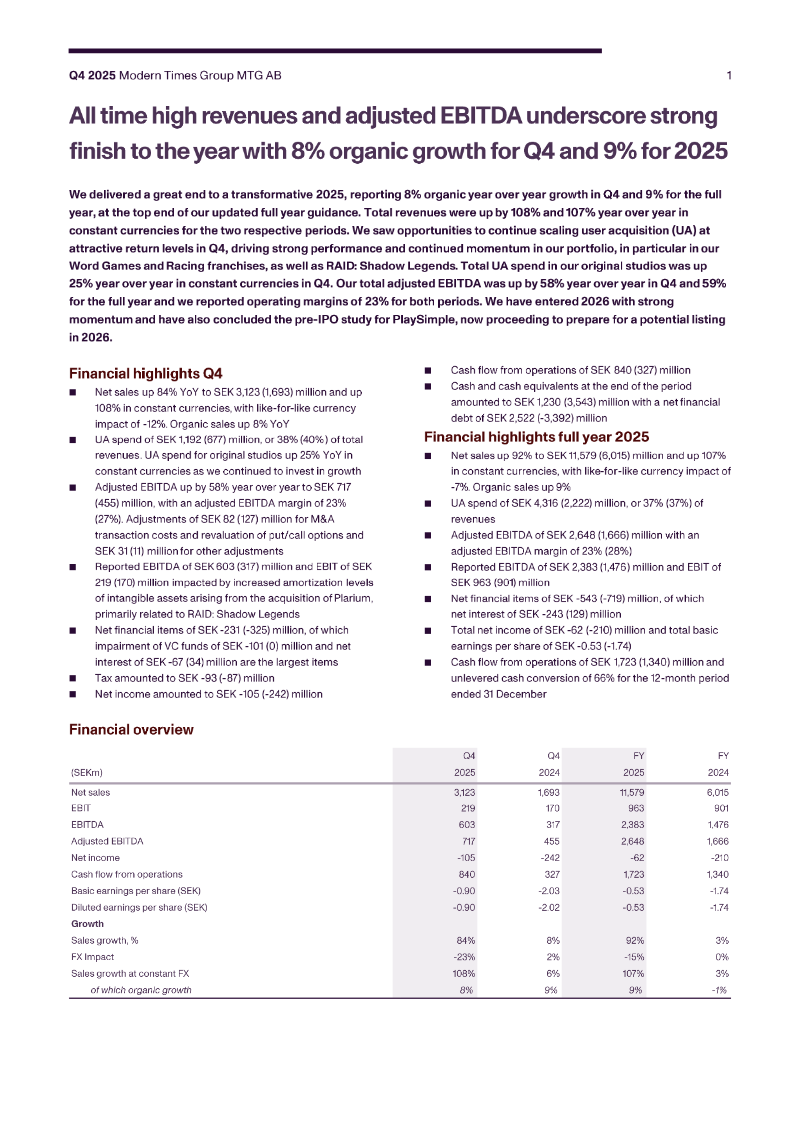
Modern Times Group delivered a record‑setting performance for the fourth quarter of 2025, underscoring the company’s momentum in the digital entertainment sector. Organic revenue expanded by 8 percent, which translates to a 108 percent increase when measured in constant‑currency terms, and net sales reached SEK 3.1 billion. These figures reflect the strength of the group’s core portfolio and its ability to generate growth despite a volatile macro‑economic environment. A pivotal element of the results was the integration of Plarium, which was completed on 12 February 2025 and consolidated from 31 January. The acquisition contributed SEK 5,384 million in sales for the quarter and produced SEK 495 million of income before tax, after accounting for SEK 786 million of purchase‑price amortisation. When the acquisition is modelled as if it had been in place from the start of the year, total sales for 2025 would have risen to SEK 12,137 million, with pre‑tax income of SEK 398 million, albeit offset by SEK 1,269 million of amortisation. The combined impact of robust organic growth and the strategic addition of Plarium positions Modern Times Group as a leading player in the global gaming market. The financial outcomes demonstrate that the company’s acquisition strategy is delivering immediate scale and profitability, while its underlying business continues to expand at a pace that exceeds prior expectations. This performance suggests a durable growth trajectory for the remainder of the fiscal year and beyond.
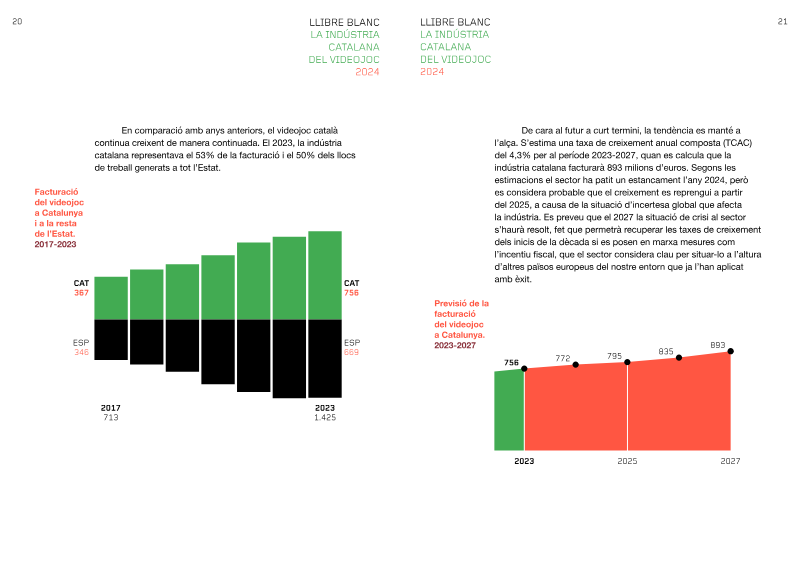
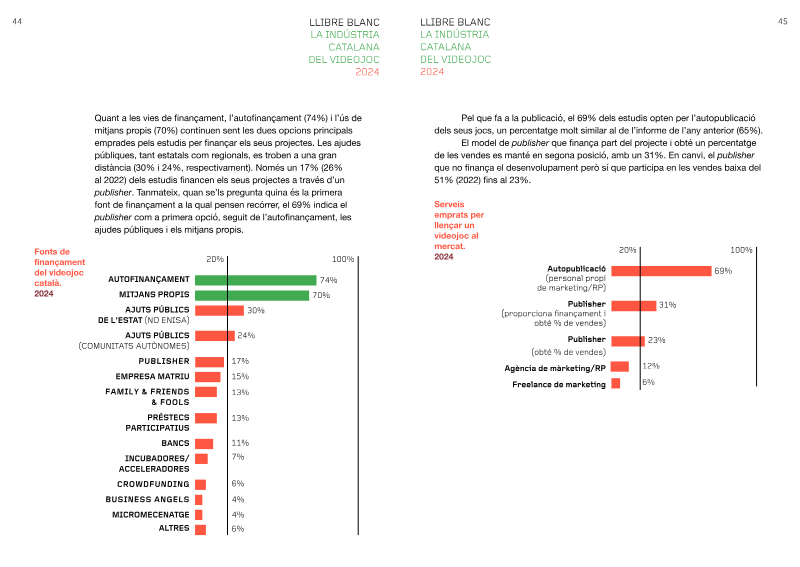
I’m ready to combine the section summaries into a cohesive overview, but I’ll need the remaining sections to capture the full scope, key data points, and conclusions of the 2024 Catalan video‑game industry analysis. Could you please provide the rest of the section summaries?
The financial results for the first quarter of 2025 detail the operational and fiscal performance of PCF Group S.A., a global video game developer. The data reflects a period of strategic transition, characterized by rising quarterly revenues alongside shifting profitability margins. Total revenue for the first quarter of 2025 reached 63.0 million PLN, an increase from 56.9 million PLN in the same period of the previous year. Despite this growth, the group reported a net loss of 3.9 million PLN for the quarter, compared to a narrow loss of 0.9 million PLN in the first quarter of 2024. Adjusted EBITDA also saw a decline from 11.0 million PLN to 1.7 million PLN year-over-year. The financial performance was influenced by several key operational factors, including the integration of PCF Chicago into PCF US and the inclusion of new projects such as Project Delta and Project Echo. Conversely, profitability was impacted by lower revenues from Project Gemini and the recognition of costs related to Project Bifrost within the cost of goods sold. The group’s workforce remained stable at 675 employees as of March 31, 2025, with a significant concentration of developers in Warsaw and North American studios. In the virtual reality segment, the subsidiary Incuvo continues to manage Green Hell VR, which saw a successful co-op mode launch in late 2024. The group plans to release Project Bison in the fourth quarter of 2025, which is intended to be the final VR title published by PCF Group. Geographically, the group maintains a strong presence across Europe and North America, with its primary development hubs located in Poland and Canada. The methodology relies on consolidated financial data and internal project tracking as of the end of the first quarter of 2025.
The Flemish game industry stands at a critical juncture, requiring a strategic pivot from project-based support toward comprehensive business scaling and economic consolidation. While the sector has seen a rise in the number of studios between 2020 and 2024, growth remains heavily concentrated among a few major players, creating a fragile ecosystem characterized by a lack of mid-sized companies. To ensure long-term viability and competitiveness within the global market—which is currently valued at approximately 187.7 billion dollars—Flemish policy must evolve to address the "missing middle" by facilitating access to private capital and fostering entrepreneurial maturity. Current support mechanisms, including the VAF/Gamefonds and the Tax Shelter, have been instrumental in initial development but are increasingly viewed as insufficient for the demands of international scaling. Global competition, driven by aggressive fiscal incentives in regions like Canada and France, necessitates a more robust and integrated financial instrumentarium. Stakeholders emphasize that while talent development remains a strength, the sector suffers from a lack of commercial focus, high production costs, and difficulties in retaining intellectual property. Consequently, there is a clear mandate to shift policy priorities toward attracting foreign investment, enhancing international promotion, and streamlining governance through a centralized strategic body. Ultimately, the objective for the 2026–2030 period is to transition the Flemish games sector into a more stable, economically diverse industry. This requires a dual approach: optimizing existing public funding to better support commercial growth and implementing new, flexible economic tools that bridge the gap between early-stage prototyping and market-ready maturity. By aligning educational outputs with industry needs, fostering cross-sectoral collaboration, and prioritizing business development over isolated project subsidies, the region can mitigate the risks of brain drain and build a resilient, internationally recognized gaming hub.