Updated Jun 1, 2026 by InvestGame
Report
Published by InvestGame
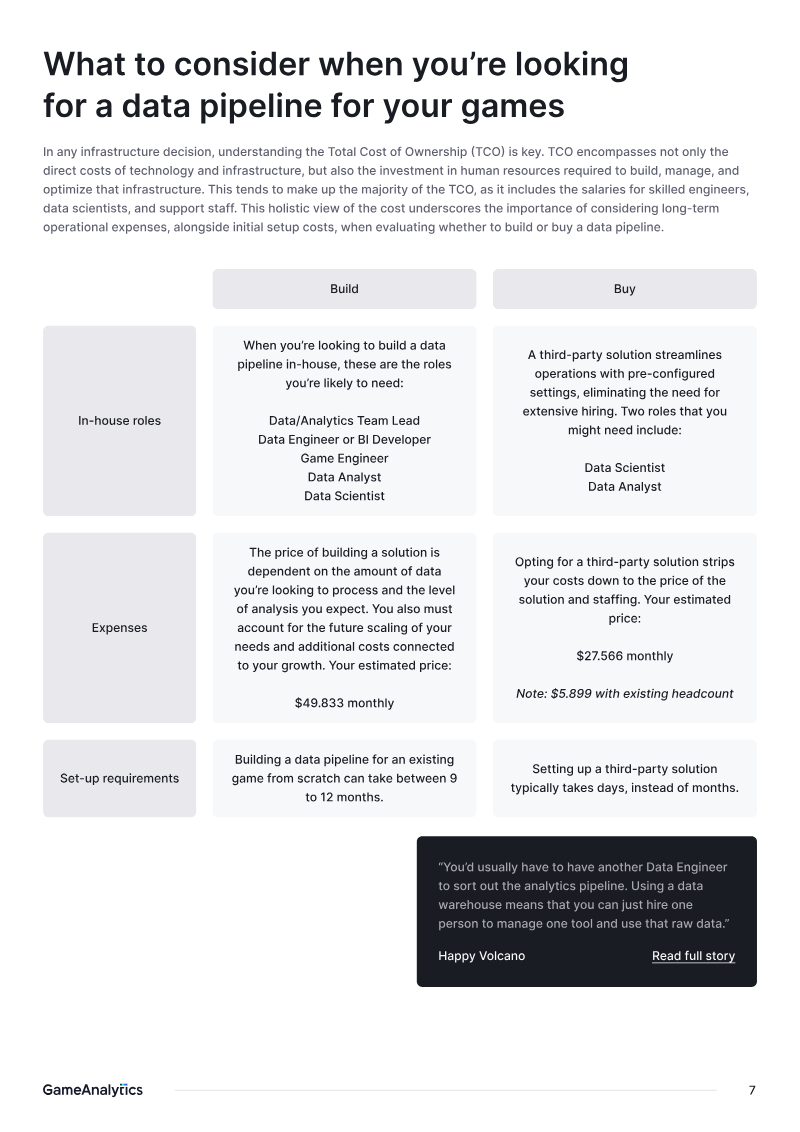
When considering data analytics for your games, should you build your own data pipeline or venture into buying a proven solution? Building your own data pipeline can be appealing tostudios and publishers seekingfullcontrol and customization. However, itcomes with significant challenges and considerations thatoften outweigh the Initially, building your own pipeline requires substantial upfront investment in infrastructure, technology, and personnel.
Game data Building vs buying When considering data analytics for your games, should you build your own data pipeline or venture into buying a proven solution?
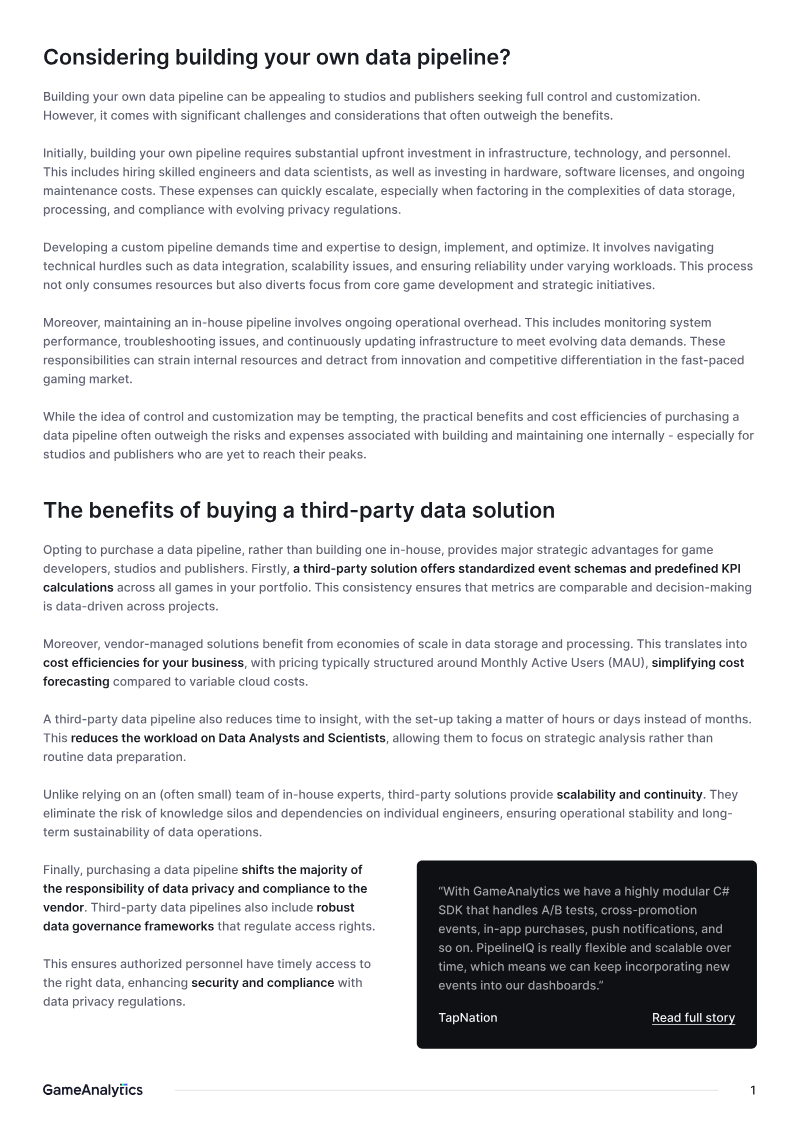
Building your own data pipeline can be appealing tostudios and publishers seekingfullcontrol and customization. However, itcomes with significant challenges and considerations thatoften outweigh the Initially, building your own pipeline requires substantial upfront investment in infrastructure, technology, and personnel. This includes hiring skilled engineers and data scientists, aswell as investing in hardware, software licenses, and ongoing maintenance costs. These expenses can quickly escalate, especially whenfactoring inthe complexities of data storage, processing, and compliance with evolving privacy Developing a custom pipeline demands time and expertiseto design, implement, and optimize. It involves navigating technical hurdles such as data integration, scalability issues, and ensuring reliability under varying workloads. This process not only consumes resources butalso diverts focus from core game development and strategic Moreover, maintaining an in-house pipeline involves ongoing operational overhead. This includes monitoring system performance, troubleshooting issues, and continuously updating infrastructure to meet evolving data demands. These responsibilities can strain internal resources and detract from innovation and competitive differentiation in thefast-paced gaming While the idea of control and customization may be tempting, the practical benefits and cost efficienciesof purchasing a data pipeline often outweigh therisks and expenses associated with building and maintaining one internally -especially for studios and publishers whoare yet toreachtheir peaks. The benefits of buying a third-party data solution
tempting, the practical benefits and cost efficienciesof purchasing a data pipeline often outweigh therisks and expenses associated with building and maintaining one internally -especially for studios and publishers whoare yet toreachtheir peaks. The benefits of buying a third-party data solution Opting to purchase a data pipeline, rather than buildingone in-house, provides major strategic advantagesfor game developers, studios and publishers. Firstly, a third-party solution offers standardized eventschemas and predefined KPI calculations across all games in your portfolio. This consistency ensures that metrics are comparable and decision-making is data-driven across Moreover, vendor-managed solutions benefit from economies of scale in data storage and processing. This translates into cost efficienciesfor your (MAU), business ,with pricing typically structured around Monthly Active Users simplifying cost forecasting compared to variable cloud A third-party data pipeline also reduces time to theinsight, with set-up taking a matter of hours or days instead ofmonths. This reduces the workload on Data Analysts and Scientists allowing , them to focus on strategic analysis rather than routine data Unlike relying on an (often small) team of in-house experts, third-party solutions provide scalability and continuity. They eliminate therisk of knowledge silos and dependencies on individual engineers, ensuring operational stability and term sustainability of data operations.
r than routine data Unlike relying on an (often small) team of in-house experts, third-party solutions provide scalability and continuity. They eliminate therisk of knowledge silos and dependencies on individual engineers, ensuring operational stability and term sustainability of data operations. Finally, purchasing a data pipeline shiftsthemajority of the responsibility of data privacy and compliance to the vendor . Third-party data pipelines also include robust data governance frameworks that regulate access This ensures authorized personnel have timely access to the right data, enhancing security and compliance with data privacy regulations. TapNation Read full story
requirements When considering options, purchasing a pre-built solutionlike GameAnalytics' PipelineIQ Pro offers a quicker setup with immediate accesstorobust analytics tools and integrations, minimizing initial setuptimeand resource investmentwhile providing long-term efficiency and On the other hand, building a data pipeline allowsfor additional customization and controlover architecture and data handling processes. However, this option requires a longer period of time to setup and investment to design, implement, and maintain the Here is an estimated outlineof the setup requirements for both options: Building your own pipeline Initially, you'll need to makearchitectural decisions, determining theframework and technologies that will support your pipeline. This ofteninvolves selecting a cloud infrastructure providerlikeAWS, Google Cloud, or Azure, based on your specific needs and Once thecloud infrastructure is setup, the next step is creating event schemas. This involves defining thestructure and format of thedata points you want to collect from your game, ensuring consistency and clarity intheinformation gathered. Concurrently, defining event longevityrulesis essential; this determines how long different types of data willbe retained for analysis and compliance Instrumenting events intothe game itselfis a critical phase where Game Engineers integratecode to capture relevant data points during gameplay. This steprequires careful implementation to ensure accurate and comprehensive data collection, without impacting game performance or user
and compliance Instrumenting events intothe game itselfis a critical phase where Game Engineers integratecode to capture relevant data points during gameplay. This steprequires careful implementation to ensure accurate and comprehensive data collection, without impacting game performance or user Following event instrumentation, data processing becomes pivotal. This includes setting up pipelines and workflowsto ingest, transform, and store thecollected data in a way that facilitates efficient querying and analysis. Quality assurance (QA) processes are integral throughout this stagetovalidate data accuracy, completeness, and Documenting ETL processes and defining key performance indicators come next.Documentation ensures transparency and continuity in data operations, whileKPIs provide measurable benchmarks for evaluating game performance and player Finally, data visualization and interpretation completethesetup, enabling stakeholders to derive actionable insights from the collected data. Thisstep involves using BI tools or custom dashboards tovisualize trends, patterns, and correlations within thedata, facilitating informed decision-making and optimization of game strategies. Building your own data pipeline requires above all expertise in cloud computing, data engineering, and game development -makingit a complexbut customizable solution tailored to specific organizational needs and data governance requirements. Ivan CEO at Creauctopus
24 March 2026 ("ev everplay group plc Unaudited Final Results for the year ended 31 December 2025 everplay, a leading global independent ("indie") developer and publisher of premium video games, working simulation games and children's edutainment apps is pleased to announce its unaudited final results for the year ended 31 December 2025 ("FY 2025").
FRONTIER REALMS ANNUAL REPORT AND ACCOUNTS 2023 GROWING AND EVOLVING ANNUAL REPORT HEADLINES CONTENTS Frontier is a leading independent developer and publisher of video games See a summary of our progress in FY23 including 01 Headlines founded in 1994 by David Braben, co-author of the iconic Elite game.
GungHo Online Entertainment’s FY 2025 financial briefing outlines a strategic pivot from Japan‑centric mobile development toward global expansion, emphasizing action titles on consoles and PCs. The company reports a 64.1 % overseas net‑sales ratio in FY 2025, up from 47.7 % in 2019 and 56.2 % in 2020, reflecting intensified sales in North America and Europe through new releases such as “Let It Die: Inferno” on PlayStation 5, Steam, and Nintendo Switch. The launch of nine global titles in 2025, including the “Ragnarok” series and “Puzzle & Dragons,” is highlighted as a key growth driver, with the latter celebrating its 5 000‑day anniversary and hosting cross‑platform events to boost user activity. Financially, consolidated net sales fell by 1.3 % YoY to ¥125.3 billion, driven mainly by declines in mobile titles and “Ragnarok”‑related revenue under subsidiary Gravity. Operating profit contracted by 9.3 % YoY to ¥276 million, as SG&A expenses rose due to increased advertising spend and personnel costs following the full acquisition of Alim in December 2024. Non‑consolidated results remained flat, but mobile sales slipped and Gravity’s “Ragnarok” titles underperformed, contributing to the consolidated loss. The briefing covers a global geographic scope—North America, Europe, Latin America, and Asia—with a 2025 focus on launching titles in over 150 countries. Methodologically, data derive from consolidated financial statements and quarterly performance metrics, with a clear emphasis on aligning product development with international market demand.
The briefing clarified GREE’s strategic outlook for FY2019, emphasizing a steady domestic game portfolio while pursuing growth overseas. In Japan, the company expects no major shift in performance for existing titles but plans to broaden multiplatform distribution and launch new releases in the second half of FY2019, projecting an earnings uptrend. Internationally, GREE is developing and self‑distributing overseas versions of current titles, targeting markets with high profitability potential. Human resource allocation reflects this focus: sufficient staff are dedicated to overseas distribution and new title development, while existing titles receive concentrated support for top performers and operational stability for less successful ones. China is identified as a priority market, with preparations underway to initiate operations and marketing. The company also highlights the Facebook Messenger platform as a high‑potential channel for new titles, indicating an expansion into social media gaming. Advertising strategy will be selective; overseas launches of self‑distributed titles will receive targeted, efficient campaigns rather than broad mass media spend. Regulatory compliance and consumer protection are addressed through company‑wide measures to prevent gacha system issues, including strengthened evaluation protocols and employee training. The REALITY livestreaming platform for VTubers is in an exploratory phase, with ongoing data collection on technology, planning, and marketing to build know‑how for future content expansion. Overall, GREE’s FY2019 strategy balances domestic stability with aggressive international diversification and platform innovation.