Updated Jun 1, 2026 by Modern Times Group
Presentation
Published by Modern Times Group
AI supercharges our execution and reinforces our competitive + World class teams and creativity + E vergreen IPs with dedicated player bases + AI as a way of work ing, not just a ₜₒₒₗ Notes: Image generated with the help of Midjourney and Scenario 16 ideation prototyping development testing launc <u>h</u> new <u>co</u> ntent AI integrated into workflows across the entire lifecycle of game Cursor, Claude Code, Nano Banana ...
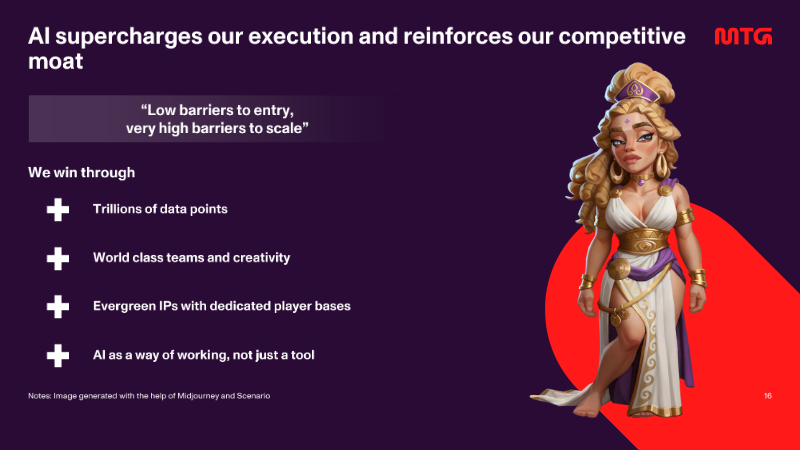
AI supercharges our execution and reinforces our competitive moat “Low barriers to entry, very high barriers to scale” We win through + Trillions of data points + World class teams and creativity + E vergreen IPs with dedicated player bases + AI as a way of work ing, not just a ₜₒₒₗ Notes: Image generated with the help of Midjourney and Scenario 16
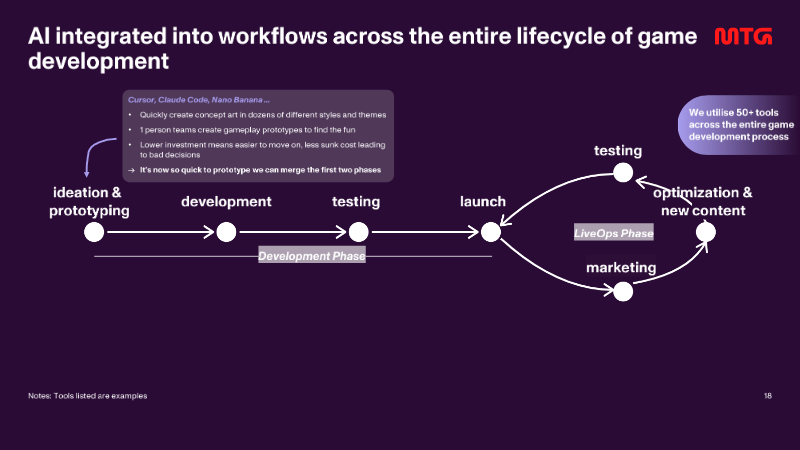
The lifecyle of a game testing op timization & ideation prototyping development testing launc h new co ntent LiveOps Phase Development Phase marketing
AI integrated into workflows across the entire lifecycle of game development Cursor, Claude Code, Nano Banana ... • Quickly create concept art in dozens of different styles and themes We utilise 50+ tools • 1 person teams create gameplay prototypes to find the fun across the entire game • Lower investment means easier to move on, less sunk cost leading testing development process to bad decisions → It's now so quick to prototype we can merge the first two phases → It’s now so quick to prototype we can merge the first two phases ideation & development testing launch op timization & prototyping new co ntent LiveOps Phase Development Phase marketing Claude Code, Agentic workflows... ComfyUl, Scenario, Suno, Typingmind, Seedance .. Cursor, Claude Code, ComfyUI ... Smaller dev team More marketing assets to reach a wider audience Notes: Tools listed are examples 18
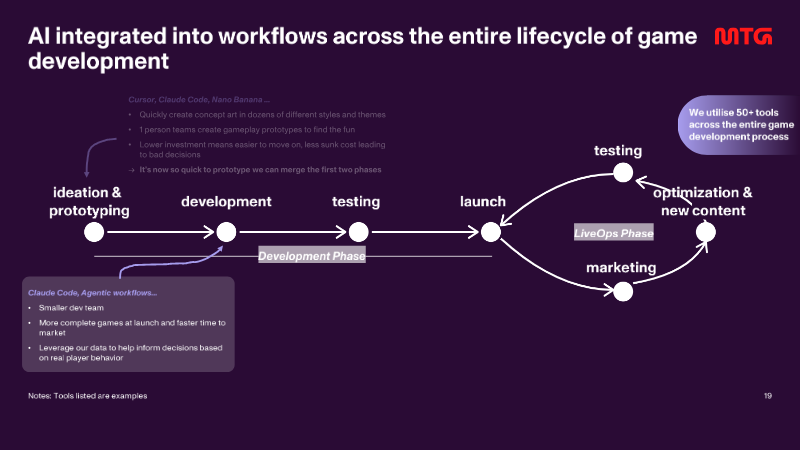
AI integrated into workflows across the entire lifecycle of game development We utilise 50+ tools across the entire game development process to bad decisions testing → It's now so quick to prototype we can merge the first two phases ideation & development testing launch op timization & prototyping new co ntent LiveOps Phase Development Phase marketing Claude Code, A gentic workflows... ComfyUl, Scenario, Suno, Typingmind, Seedance .. Cursor, Claude Code, ComfyUI ... • Smaller dev team More marketing assets to reach a wider audience • Smaller dev team More complete game s at launch and faster time to market • Leverag e our data to help inform decisions based on real player behavior Notes: Tools listed are examples 19
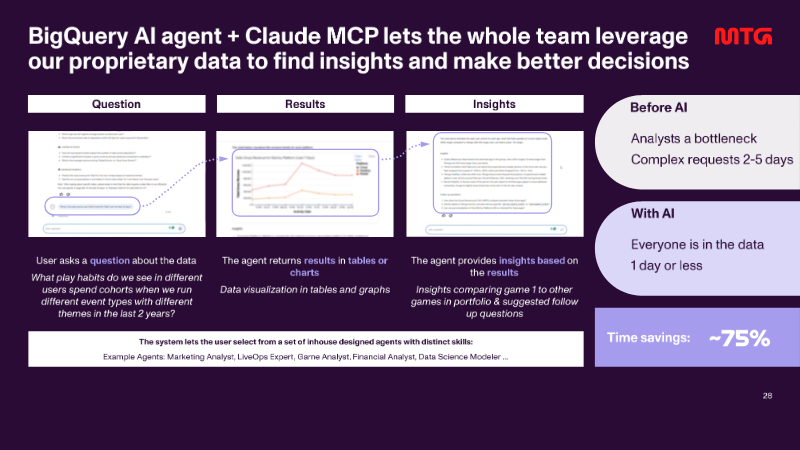
AI integrated into workflows across the entire lifecycle of game development BigQuery AI agent + Claude MCP ... • AI agents test parts of the game and feedback • based on player archetypes built from real data We utilise 50+ tools Analyze the AB tests we run across the entire game • Suggested tests development process to bad decisions testing → It's now so quick to prototype we can merge the first two phases ideation & development testing launch op timization & prototyping new co ntent LiveOps Phase Development Phase marketing Claude Code, Agentic workflows... ComfyUl, Scenario, Suno, Typingmind, Seedance .. Cursor, Claude Code, ComfyUI ... Smaller dev team More marketing assets to reach a wider audience Notes: Tools listed are examples 20
AI integrated into workflows across the entire lifecycle of game development We utilise 50+ tools across the entire game development process to bad decisions testing → It's now so quick to prototype we can merge the first two phases ideation & development testing launch op timization & prototyping new co ntent LiveOps Phase Development Phase marketing Claude Code, Agentic workflows... Comfy UI, Scenario, Suno, Typing mind, Seedance ... Cursor, Claude Code, ComfyUI ... • More marketing assets to reach a wider audience Smaller dev team • More marketing assets to reach a wider audience More creates means more chance of lowering CPI • Leveraging opportunities we have with IP and Big Beats better • UGC style and localized content allowing more geo focused campaigns Notes: Tools listed are examples 21
This research, conducted by Google Cloud and The Harris Poll in mid-2025, examines the transformative role of generative AI within the global games industry. Based on a survey of 615 developers across the United States, South Korea, Norway, Finland, and Sweden, the study finds that 97% of professionals believe generative AI is actively reshaping the sector. The primary thesis suggests that while the industry faces rising development costs and market saturation, AI serves as a critical tool for innovation, democratization, and operational efficiency. Key findings indicate that 90% of developers have already integrated AI into their workflows, primarily to automate repetitive tasks and accelerate playtesting, localization, and coding. A significant trend is the rise of AI agents—autonomous systems capable of reasoning and planning—which 44% of respondents use for content optimization and 34% for advanced NPC behavior. These technologies are shifting player expectations, with 89% of developers noting that gamers now demand more lifelike, responsive, and personalized experiences. Furthermore, 94% of developers anticipate that AI will lead to long-term reductions in development costs over the next three years. Despite this optimism, the industry faces notable hurdles regarding legal and ethical standards. Approximately 63% of developers expressed concerns over data ownership and intellectual property, while 35% cited worries regarding player data privacy. To navigate these challenges, the study recommends that studios start with small-scale pilots, align AI use with their core creative visions, and invest in staff upskilling. Ultimately, the data portrays AI not just as a productivity booster, but as a fundamental shift in game design that enables smaller studios to compete more effectively while fostering new levels of player immersion.
The global game industry entered 2025 defined by a paradox of technological advancement and profound structural instability. While PC remains the dominant platform for 80% of projects, the workforce faces significant volatility, with 41% of developers impacted by layoffs or studio closures over the past year. This instability has triggered a shift in studio composition, marked by a decline in AAA representation to 15% and a corresponding rise in solo developers, who now constitute 21% of the workforce. Despite these pressures, the industry continues to diversify, with women and non-binary individuals making up 32% of the workforce and LGBTQ+ representation reaching 25%. Operational trends indicate a cooling of the initial fervor surrounding generative AI. Although 52% of developers utilize the technology, 51% express deep ethical concerns regarding intellectual property theft and job displacement, leading 27% of companies to abandon interest in the tools entirely. Simultaneously, the market is pivoting away from the live-service model due to saturation and burnout, with 42% of developers expressing no interest in the format. This strategic shift coincides with a tightening of the financial landscape; 56% of all developers and 82% of independent creators now rely on self-funding as traditional venture capital and publishing deals become increasingly scarce. Labor conditions have tightened for the first time in several years, with the average workweek lengthening and the percentage of developers working 40 hours or less dropping to 57%. While 58% of the workforce supports unionization as a remedy for crunch and job insecurity, active organizing remains limited to 22% of respondents. Furthermore, external environmental factors are becoming a tangible operational risk, as 16% of developers report that natural disasters such as wildfires and floods have directly impacted their productivity. These combined factors suggest an industry in a state of cautious restructuring, balancing ethical and financial hurdles against a diversifying talent pool.
The report presents a comprehensive analysis of the global DevOps ecosystem, emphasizing its rapid evolution, investment dynamics, and the strategic role of emerging technologies such as artificial intelligence, low‑code platforms, and serverless computing. By integrating market performance data, transaction activity, and funding trends, it argues that DevOps has become a primary growth engine for technology firms, outpacing traditional operations and broader equity benchmarks. Quantitative findings show that Dev‑focused companies have delivered a 23 percent total return over the past four quarters, surpassing the S&P 500, while Ops‑centric peers lagged with an 11 percent gain. Revenue growth multiples for leading Dev firms range from 12‑to‑20‑times, with Atlassian, GitLab, HashiCorp and DataDog commanding premium valuations. The sector’s M&A volume rebounded to $27.6 billion in the first half of 2024, highlighted by marquee deals such as Cisco’s $31 billion acquisition of Splunk and IBM’s $7.7 billion purchase of HashiCorp. Private‑market activity remains robust, with the ten best‑funded DevOps startups raising a cumulative $4.3 billion, and low‑code solutions projected to account for more than 65 percent of new applications. Geographically, the analysis spans North America, Europe, the Middle East and Asia, covering transactions from 2013 onward and focusing on the 2023‑2024 period. Data sources include Capital IQ, Pitchbook, Gartner, DS Research and other industry databases, providing a multi‑source foundation for the performance and valuation metrics presented. The findings underscore the accelerating convergence of development and operations, driven by AI‑enhanced automation, open‑source integration, and the shift toward serverless architectures, positioning DevOps as a central pillar of modern technology investment strategies.
The report demonstrates that game technology is increasingly permeating non‑traditional sectors, with half of surveyed teams employing real‑time 3D engines beyond game development. This cross‑industry diffusion is accompanied by persistent funding constraints and collaboration bottlenecks, notably slow file transfers, remote coordination difficulties, and asset feedback challenges. The data reveal a trend toward consolidating toolsets to enhance productivity amid economic uncertainty and the rise of remote work. Engine usage remains dominated by Unreal Engine (63 %) while Unity follows at 47 %; Godot is gaining traction mainly among indie developers. Version control practices show Perforce Helix Core leading (51 %) with widespread adoption of Git‑based solutions, though Google Drive remains a common secondary storage option. Asset management practices differ markedly between AAA and indie studios. Custom‑built solutions are common in both, yet 23 % of AAA teams and 17 % of indie studios rely on them, diverting resources from core development. Indie teams more frequently use Perforce (55 %) compared to AAA studios (3 %). Generative AI adoption is high, with 65 % of respondents using an organizational AI tool; ChatGPT leads at 47 %, especially among indie/mid‑size studios (50 % versus 26 % in AAA). Other AI tools such as Midjourney, DALL‑E, and GitHub Copilot also see notable usage. Cloud infrastructure is embraced by nearly half of respondents (49 %), with AWS leading at 30 % and Azure at 18 %; hybrid cloud adoption remains minimal (6 %). Talent acquisition trends underscore a premium on specialized experience (≈95–100 %) and continuous learning ability (≈71–82 %), while presentation skills and portfolio strength, though important, receive comparatively lower emphasis. These findings highlight a shift toward adaptable, skill‑rich talent pools across highly technical industries.