Game Development reports and market data
Documents
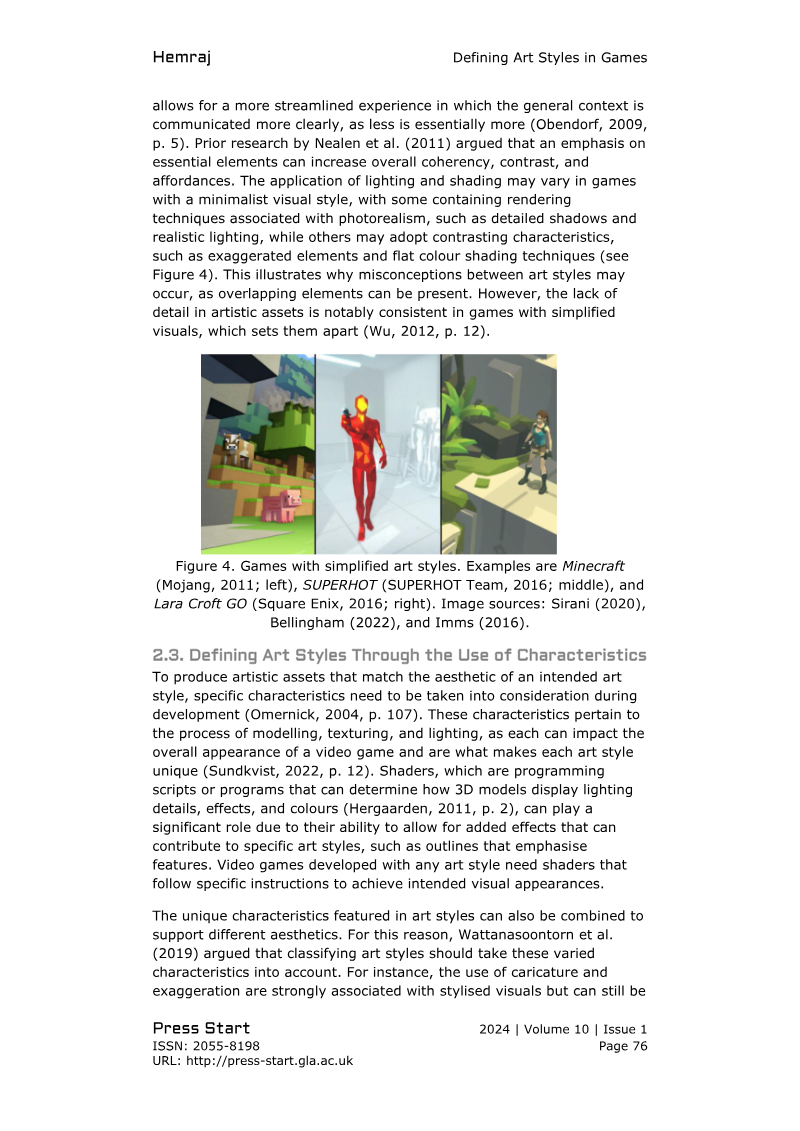
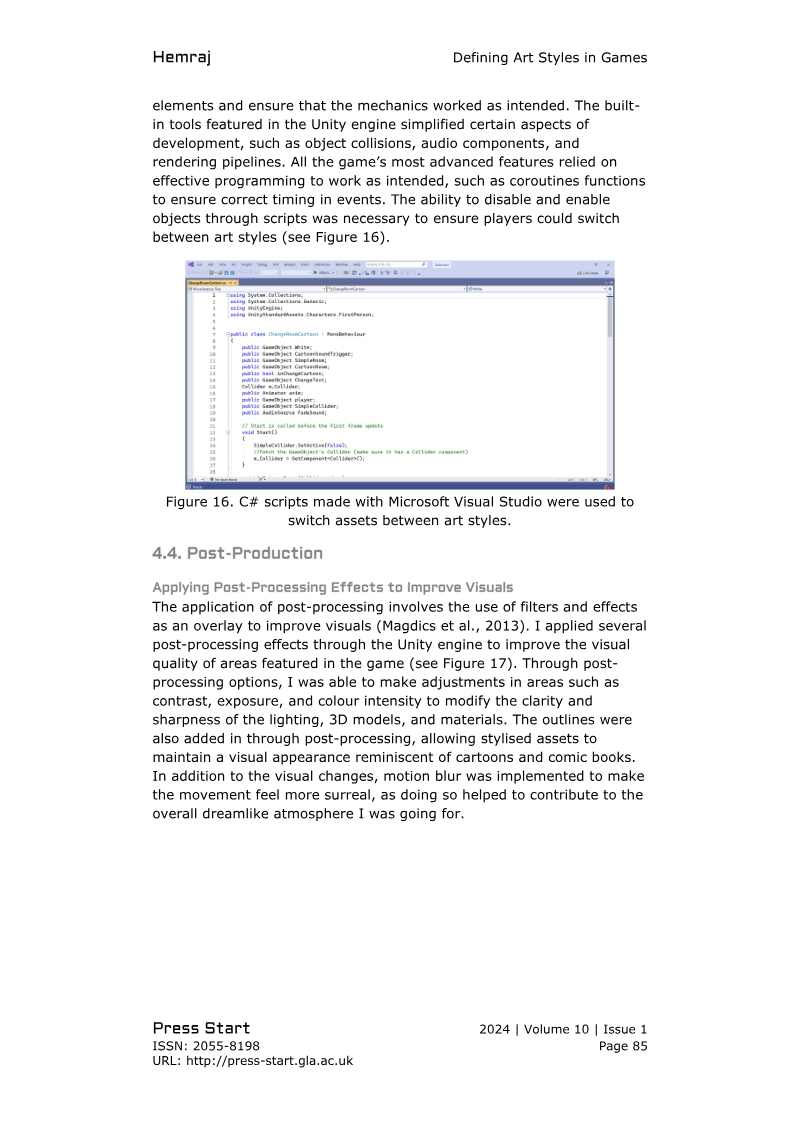
Defining Art Styles in Games: Their Influence on Creative Expression
This article, published in Press Start (Volume 10, Issue 1, 2024), a student journal of game studies published by HATII at the University of Glasgow, examines how art styles in video games can support creative expression.
- Citing Hölttä (2018) and Cardona-Rivera and Young (2013), the article notes that the choice of art style can affect how audiences perceive what a game is presenting and that visual elements highlight affordances by informing players what is possible.
- Citing Wattanasoontorn et al. (2019), the article describes the 'semi-realistic' category as one where realistic elements are strongly minimalised despite being present.
- Citing Gooch (2001), stylised visuals are described as emphasising communication through non-photorealistic rendering by creating the illusion of reality without simulating it entirely.

3 Things You MUST Do When Making Your First Game!
The development of the indie game Outbound highlights the importance of intentional market research and the strategic implementation of core hooks to achieve commercial success.
- The game 'Outbound' achieved over 100,000 wishlists by focusing on three specific hooks: a mechanical hook centered on off-grid van customization, a distinct visual style reminiscent of 'Firewatch', and a compelling narrative of off-grid living.
- Market research is essential for success; developers should identify a niche that is currently underserved while ensuring the concept aligns with a strong personal fantasy or interest.
- Early marketing assets are critical, as evidenced by the 'Outbound' trailer receiving over 400,000 views on IGN's channel, which significantly contributed to the game's initial visibility.
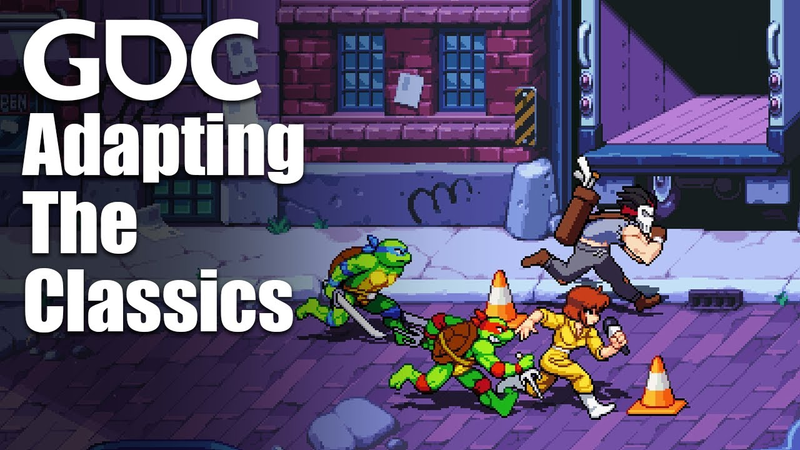
Plays Like You Remember: Adapting Classics for 'Teenage Mutant Ninja Shredder's Revenge'
The development of Teenage Mutant Ninja Turtles: Shredder’s Revenge centers on the philosophy of capturing the essence of classic arcade beat-em-ups rather than strictly replicating their technical limitations.
- To successfully adapt a classic title, developers should aim to make the game play how players remember it rather than how it actually functioned, which involves analyzing the core design strengths while discarding outdated technical limitations like sprite flickering or slowdowns.
- Tribute Games utilized an 'attack token' logic system to manage combat, where enemies must request a token to attack, allowing developers to control enemy aggression and group density for better balance.
- The team established a target pacing of 20 to 30 enemies per minute, a ratio derived from NES-era titles that provided the clearest enemy choreography and most balanced single-player experience.

Tripledot Studios' Akin Babayigit On Understanding The Business Behind Great Games
Mobile gaming represents a massive, underserved global market that rewards disciplined execution over traditional creative-first development.
- Tripledot Studios achieved rapid growth by entering the saturated solitaire market with an ad-based model, proving that superior execution in a known, high-demand category can capture significant market share despite existing competition.
- Successful mobile games are characterized by long-term retention curves, such as day 90 or day 360 metrics, which serve as more reliable indicators of commercial viability than day one retention alone.
- Mobile gaming represents over half of the estimated $300 billion global gaming market, yet the sector currently lacks a dominant, singular 'poster child' comparable to major console and PC publishers like EA or Take-Two.

The Impact of Team Size, Community, and Industry Trends on Game Development | 345
The global game industry is currently undergoing a structural correction characterized by widespread layoffs and a strategic pivot toward risk mitigation.
- The global game industry is undergoing a structural correction characterized by widespread layoffs and a strategic shift toward risk mitigation, prioritizing established franchises, sequels, and remasters over original intellectual property.
- Development is pivoting toward smaller, agile teams that utilize Early Access models to secure funding and build organic player engagement, moving away from traditional high-cost marketing.
- Large studios are currently hindered by bloated budgets, proprietary technology, and the technical debt of legacy systems, while smaller developers are finding success with high-quality, replayable titles that prioritize long-term retention.
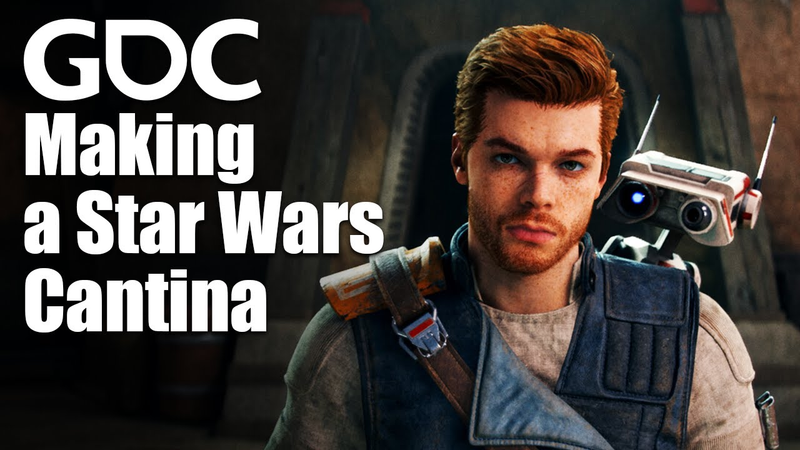
Bringing a Star Wars Cantina to Life in 'Jedi: Survivor'
Pyloon’s Saloon serves as a central, dynamic hub in Star Wars Jedi: Survivor, functioning as a narrative anchor that provides respite from the game’s darker themes.
- The narrative team structured Pyloon's Saloon into five macro states mapped to the main campaign's acts, which were further divided into granular substates to track NPC locations and evolving dialogue.
- Writers utilized a TV-style room approach, conducting brainstorming sessions, table reads, and character voice experiments to ensure consistency across three to six writers.
- The team managed dialogue complexity using a 'Dialogue Matrix' in Google Sheets that calculated character adjacencies and generated templates to ensure every character had at least one unique conversation per substate.
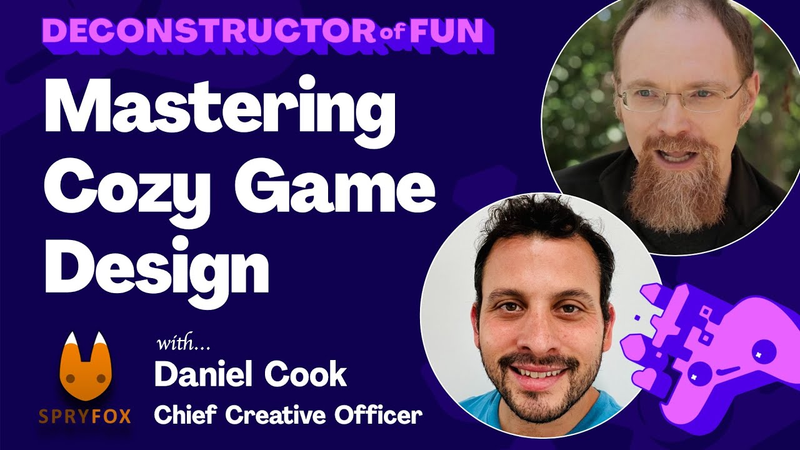
Journey Through Game Design with Spry Fox’s Daniel Cook
Game design functions as an unpredictable, iterative process that requires a synthesis of creative vision and business acumen.
- Sustainable game development relies on small, surgical iterations that amplify promising prototype elements rather than relying on high-cost, dramatic pivots.
- Designers should prioritize intrinsic human motivations—such as autonomy, mastery, and social connection—over extrinsic, stress-inducing engagement mechanics like daily login bonuses.
- Long-term market viability is best achieved by cultivating an authentic creative voice and focusing on specialized skills rather than chasing ephemeral industry trends.

The New Business of Narrative
The modern landscape of game development is undergoing a fundamental shift as a new generation of creators prioritizes narrative innovation and socially conscious storytelling.
- Developers are shifting away from high-cost cinematic cutscenes toward mechanics-driven gameplay to explore complex human experiences like cultural identity and the immigrant experience.
- Titles such as Before Your Eyes and Venba demonstrate that interactive systems can foster deep player empathy without relying on traditional branching dialogue or conventional win-loss structures.
- Narrative-focused studios are achieving commercial viability by bypassing traditional publishing models in favor of building dedicated, niche communities through social media distribution.

The #1 Trick To Make BREATHTAKING Game Art
Achieving high-quality, cinematic game art does not require innate artistic talent but rather the application of structured color theory and disciplined design constraints.
- Elevate visual quality by replacing arbitrary color choices with a limited, scientifically grounded palette that establishes clear design constraints.
- Utilize triadic color schemes to create a cohesive visual foundation and prevent the visual clutter often associated with unrestricted color selection.
- Simulate atmospheric perspective and depth by mapping colors diagonally across a gradient, transitioning from light, saturated tones in the background to darker, muted tones in the foreground.

Math in Game Development Summit: A Visual Guide to Quaternions and Dual Quaternions
Quaternions and dual quaternions serve as essential mathematical frameworks for 3D game development, offering superior alternatives to traditional 4x4 matrices for rotation and skeletal animation.
- Dual quaternions unify rotation and translation into a single six-float representation, providing a more efficient and stable alternative to traditional 4x4 matrices for skeletal animation.
- Using dual quaternions for mesh deformation eliminates the 'candy wrapper' effect, a common animation artifact where character joints lose volume during rotation.
- Quaternions enable superior interpolation compared to matrix-based transformations by preserving volume and preventing the squashing artifacts inherent in standard linear blending.

Music as Gameplay: The 'Lullaby of Life' Journey with Francisco Lara Sikorski | 344
The development of Lullaby of Life serves as a case study for the viability of small, agile teams in the modern gaming landscape.
- Small, agile teams of five to six developers are highly effective for maintaining quality control and communication in the current gaming landscape.
- The industry is shifting toward high-fidelity, cozy, and narrative-driven games that are designed to be accessible across PC, console, and portable hardware like the Steam Deck.
- Music is being elevated from a background element to a core gameplay mechanic, where dynamic systems use sound waves, timing, and note combinations to drive puzzle progression.
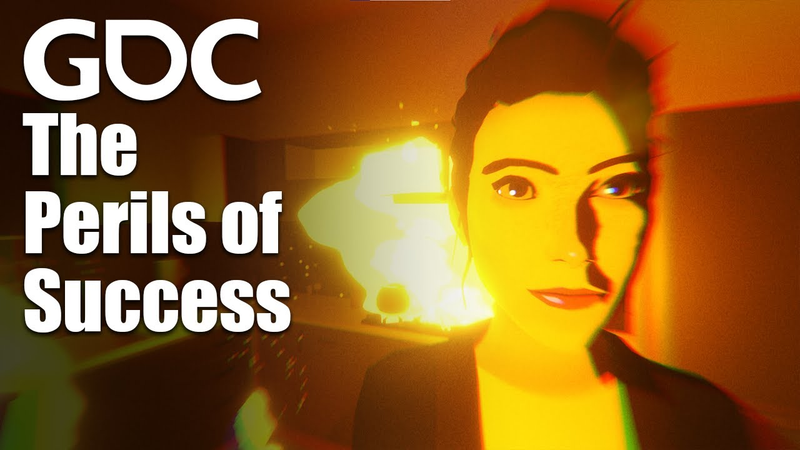
How We Almost Wrecked Our Second Game, 'The Wreck'
The transition from a successful debut title to a sophomore project often triggers a dangerous period of overconfidence, leading studios to expand teams and budgets prematurely.
- The 'second game syndrome' occurs when teams rely on past success to justify over-ambition, leading to a loss of focus and the development of a 'clunky' vertical slice that lacks a cohesive art style or clear gameplay loop.
- Effective feedback must be kind, trust-based, and provided by experienced partners, such as the investment fund Kowloon Nights, who can identify when a project's core identity is failing to translate into a playable experience.
- The 'CRY' methodology (Consider, Refocus, Yield) provides a framework for salvaging a failing project by identifying what works, discarding what doesn't, and pivoting to core strengths rather than forcing experimental mechanics.
Writers
Games and companies
Games