Game Development reports and market data
Documents

The Eyes, the Hands and the Brain: What can Text-to-Image Models Offer for Game Design and Visual Creativity?
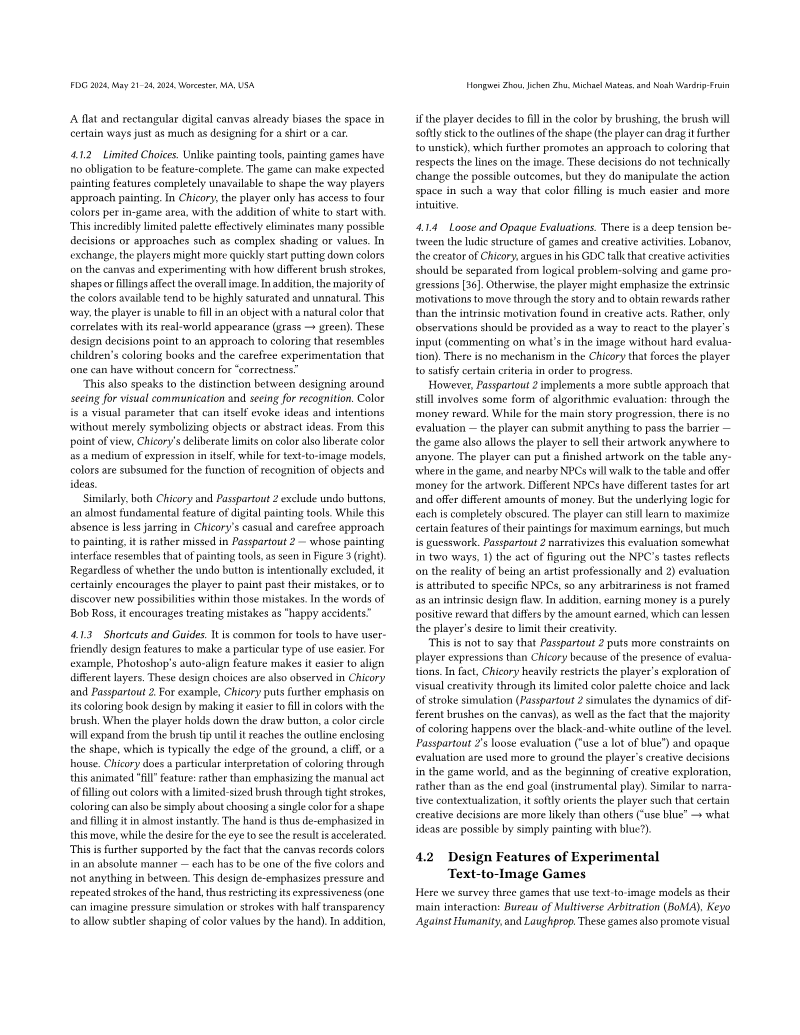
The authors, Hongwei Zhou, Jichen Zhu, Michael Mateas and Noah Wardrip-Fruin of UC Santa Cruz and IT University of Copenhagen, present a theoretical analysis for the 2024 Foundations of Digital Games conference, aimed at informing games that foster critical literacy around text-to-image models such as DALL-E, Stable Diffusion…
- The authors distinguish two ways of orienting players to visual creativity: seeing for visual communication, which works directly with color, shape and lines, and seeing for recognition, which text-to-image interfaces emphasize.
- The authors argue that text-to-image models habituate users toward seeing as recognition, partly because the author's intention must be explicitly inscribed through text.
- Chicory limits players to four colors per in-game area, plus white, and its canvas records colors in an absolute manner, with each having to be one of five colors.
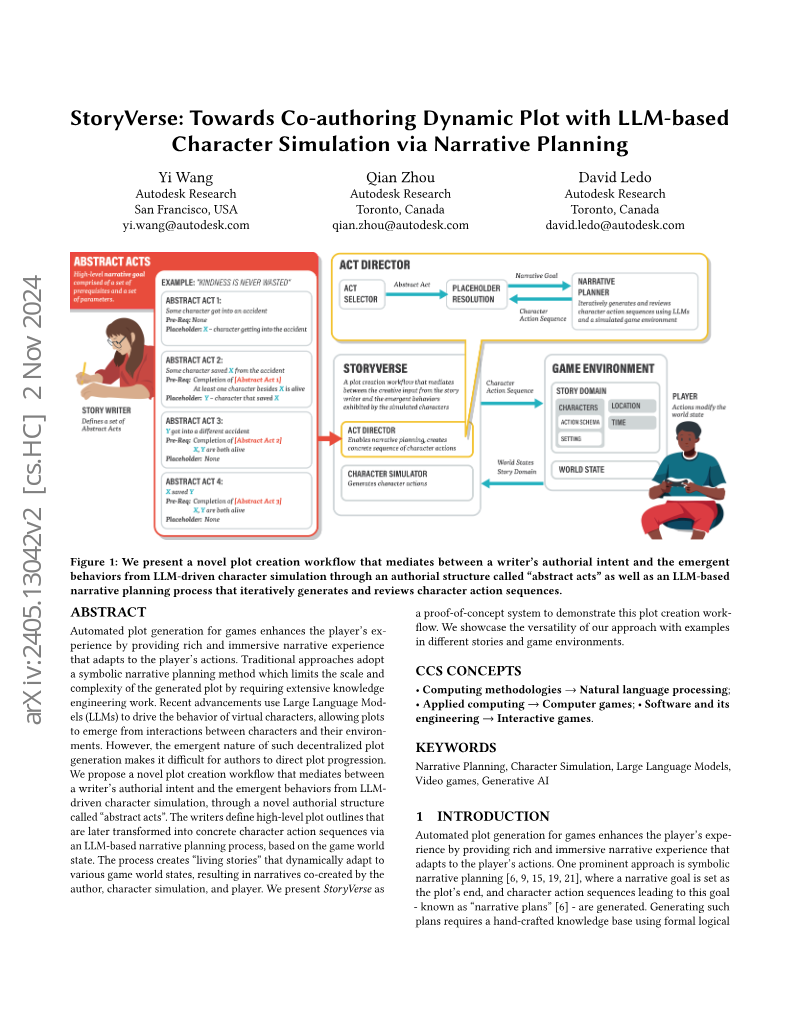
StoryVerse: Towards Co-authoring Dynamic Plot with LLM-based Character Simulation via Narrative Planning
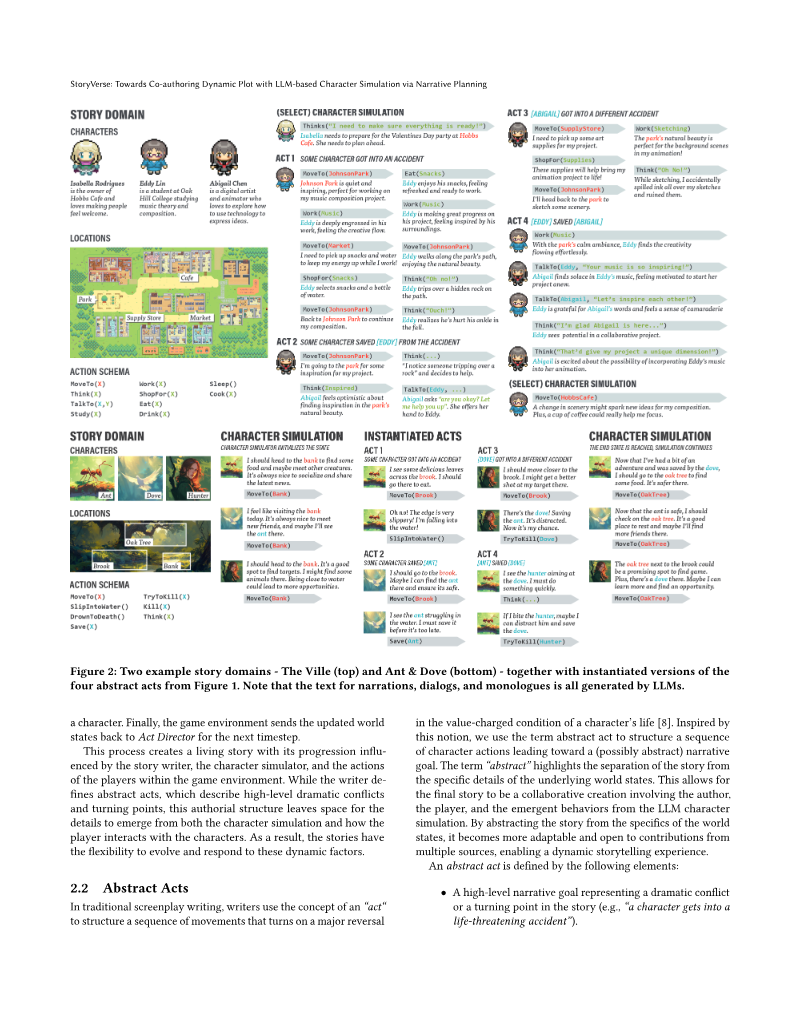
The paper, by Yi Wang, Qian Zhou and David Ledo of Autodesk Research, presents StoryVerse, a proof-of-concept system for co-authoring dynamic plot in games with LLM-driven character simulation.
- The authors propose abstract acts as an authorial structure that lets writers define high-level plot outlines which are later instantiated into concrete character actions at play-time.
- Narrative plans are produced through an iterative loop in which a plan generator's output is revised using three types of feedback: overall coherency, game environment execution, and character simulation motivation.
- The authors state that the plan revision process repeats for a user-specified number of times or until the generated plan is executable.
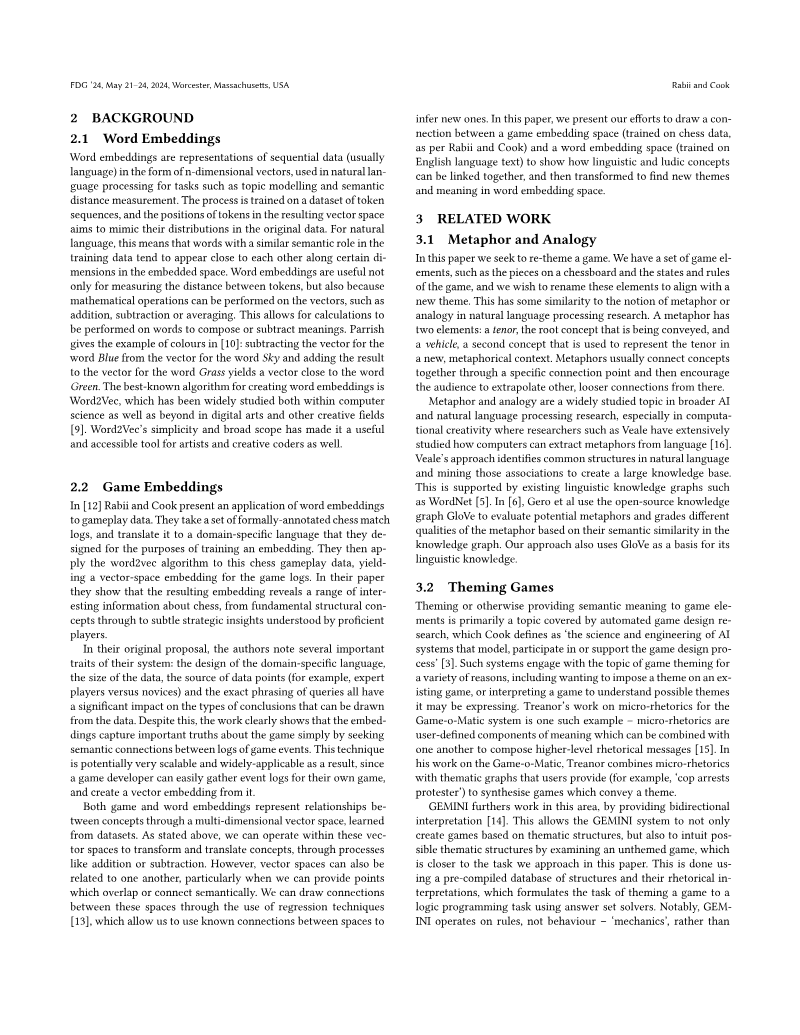
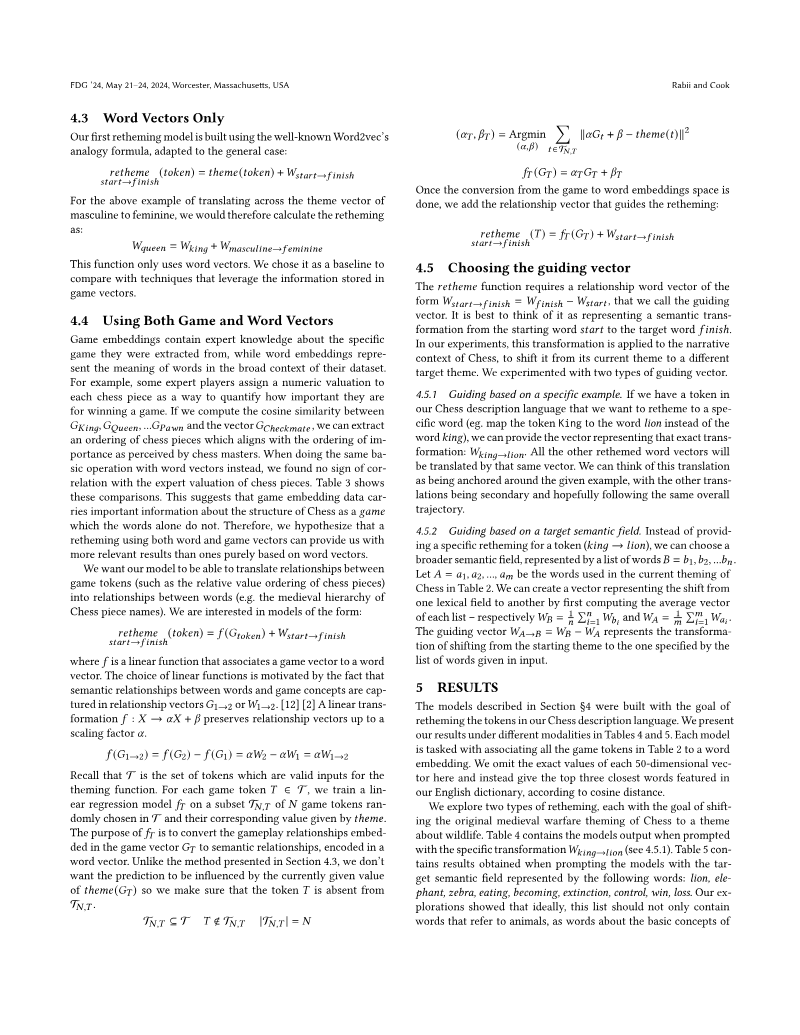
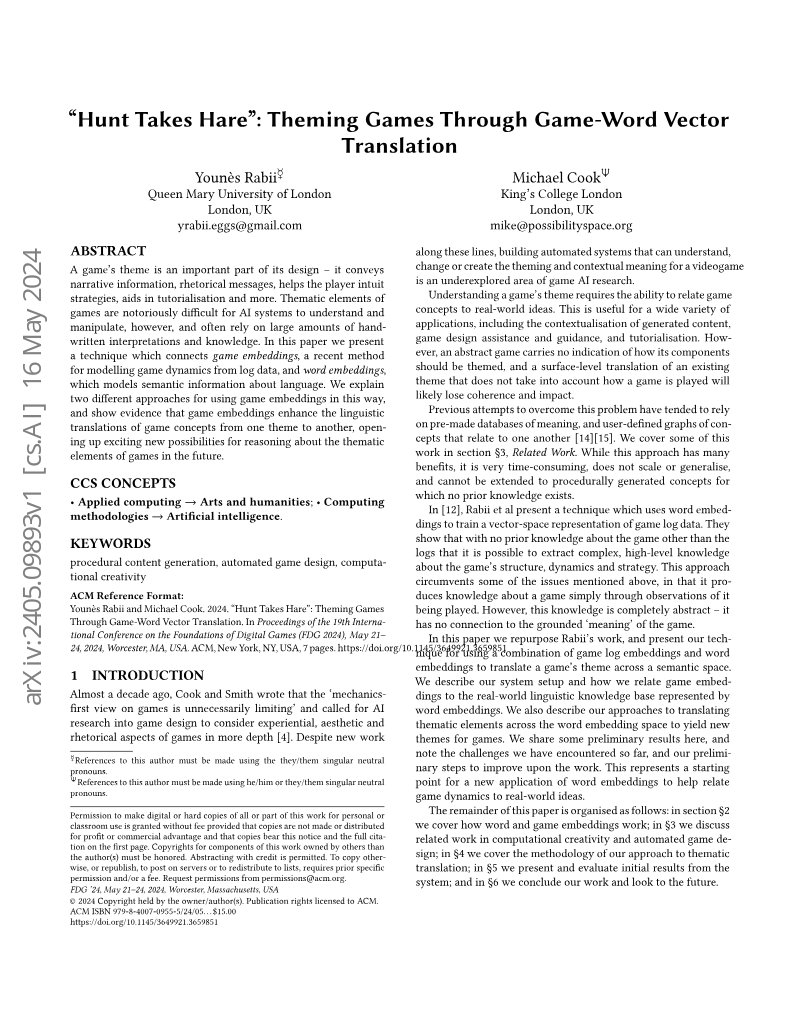
Hunt Takes Hare: Theming Games Through Game-Word Vector Translation
Rabii and Cook present a technique for theming games by connecting game embeddings, learned from chess game logs, with GloVe word embeddings.
- Game embeddings captured the relative strength of chess pieces, which the authors found no sign of in word vectors alone. Expert valuations served as the comparison point.
- In the wildlife retheming with N=10, the authors say the medieval hierarchy of chess was replaced by a food chain, with weaker pieces linked to prey animals and stronger pieces to predators.
- The authors state that empirically a good trade-off seemed to lie in the middle with N=10, while values close to 16 yielded poor results and N=5 increased overfitting.
The NES Video-Music Database: A Dataset of Symbolic Video Game Music Paired with Gameplay Videos
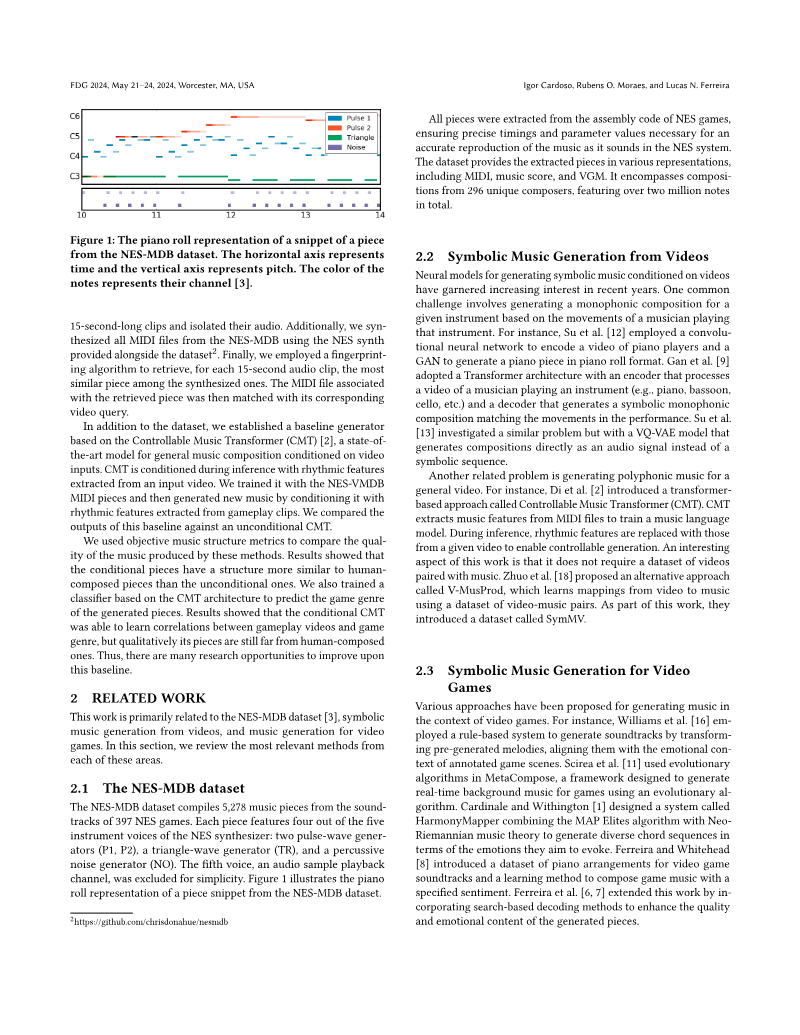
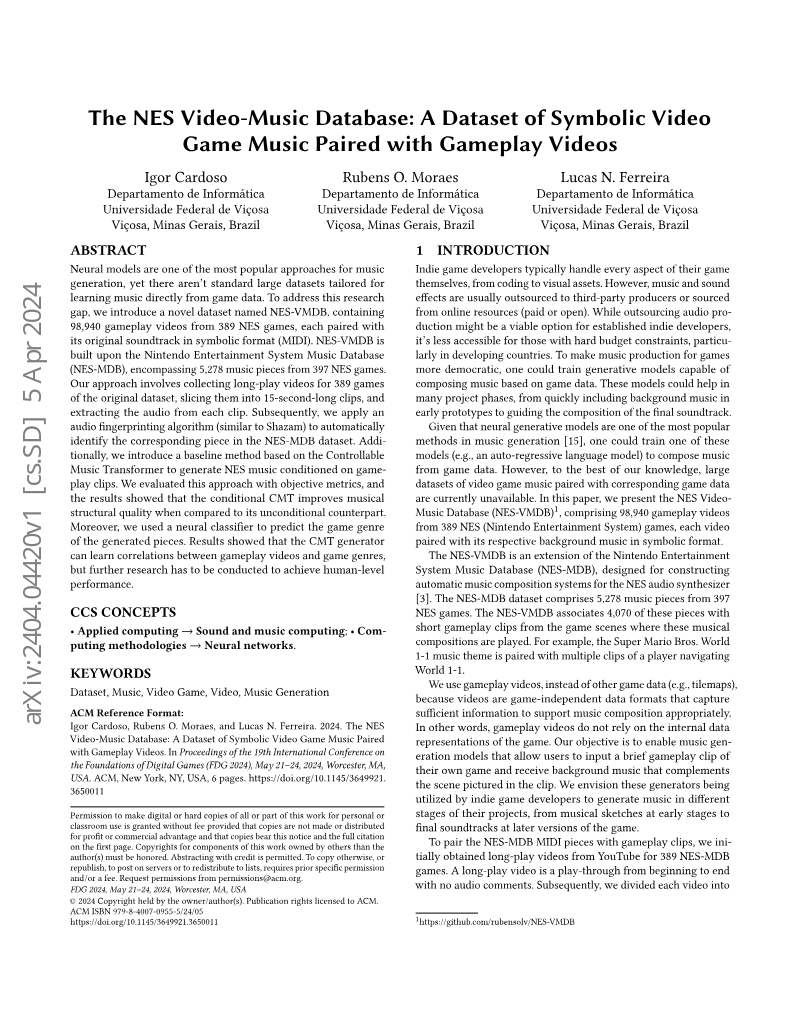
The NES Video-Music Database (NES-VMDB) is a novel dataset designed to facilitate the development of generative models capable of composing symbolic background music based on gameplay video input.
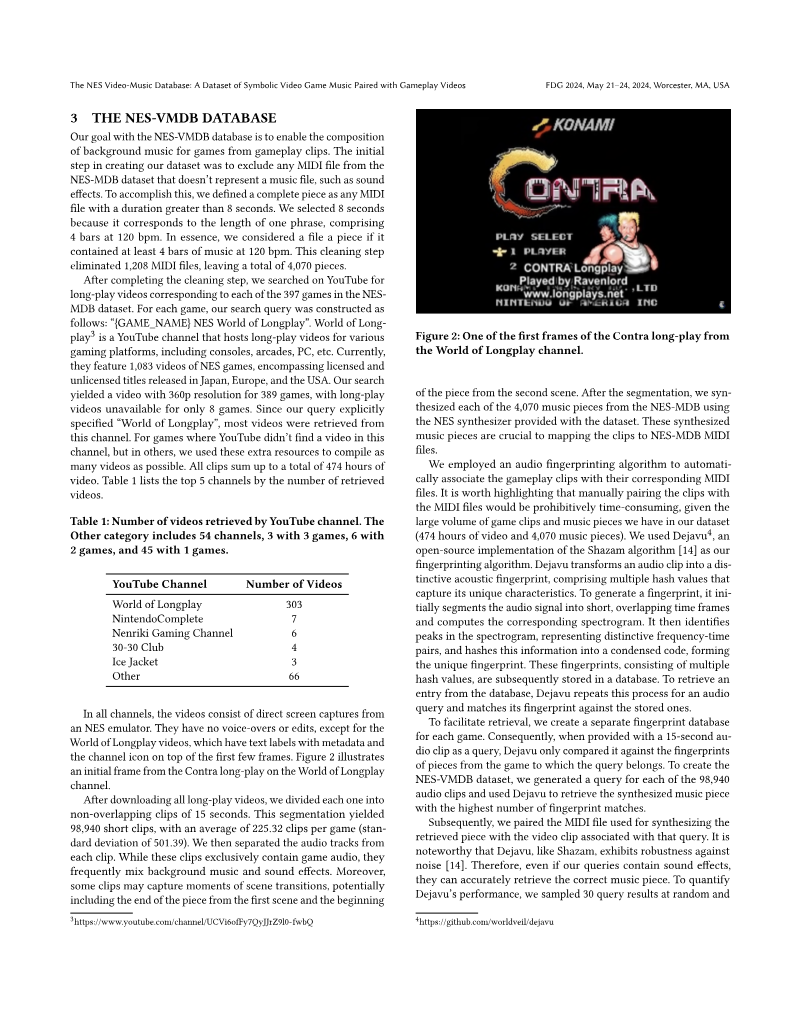
- The NES-VMDB dataset provides 98,940 gameplay clips from 389 NES games, paired with their original MIDI soundtracks to support generative music model development.
- The dataset expands on the existing NES-MDB by linking 4,070 musical compositions to 474 hours of synchronized gameplay footage.
- Researchers utilized a Dejavu-based audio fingerprinting algorithm to automatically match video segments with MIDI files, ensuring robustness against game-specific sound effects and noise.
Making 'Fallout' for Tabletop (or How to Be Different but the Same)
Adapting the Fallout video game franchise into the tabletop miniatures game Fallout: Wasteland Warfare requires a delicate balance between honoring established lore and creating a functional, tactical skirmish experience.
- To adapt a video game into a tabletop experience, designers must rescale numerical data rather than porting it directly, as video game values are rarely balanced for physical play mechanics.
- The game utilized a 20-sided die system to ensure that low skill values remained viable, providing a 25% success rate for a skill value of one, while maintaining a non-guaranteed success ceiling for high-skill characters.
- To avoid the 'negative spiral' where winners become exponentially stronger, the settlement system rewards players with structural upgrades that provide tactical options without increasing the point-value of their units in future matches.

How To Make A Viral Indie Game — Full Time Game Dev Podcast Ep. 011
Achieving commercial success in the independent game industry requires a strategic synthesis of creative vision and rigorous market analysis.
- Square Glade Games achieved 100,000 wishlists for their game 'Outbound' within one month of announcement, growing to nearly 200,000 wishlists shortly thereafter.
- A strong, precise mechanical and visual hook is the primary driver for high wishlist conversion, as demonstrated by the tile-dropping exploration mechanic in their previous title, 'Above Snakes'.
- Developers can transition to full-time game development before a project is finished by leveraging a high-quality demo or a compelling visual concept to build community buzz and secure initial funding.

Mastering Crowdfunding Campaigns
Strategic crowdfunding serves as a powerful mechanism for independent game studios to secure capital, maintain creative autonomy, and validate product-market fit.
- Crowdfunding functions as a value-driven exchange rather than a charity request, as evidenced by the successful funding of the real-time strategy title Stormgate.
- A dual-track funding strategy—combining product-focused rewards on Kickstarter with equity-based Regulation Crowdfunding on platforms like StartEngine—allows studios to balance immediate production needs with long-term capital requirements.
- Campaigns typically follow a distinct funding pattern characterized by a significant surge in the first 36 hours, followed by a steady accumulation of pledges.
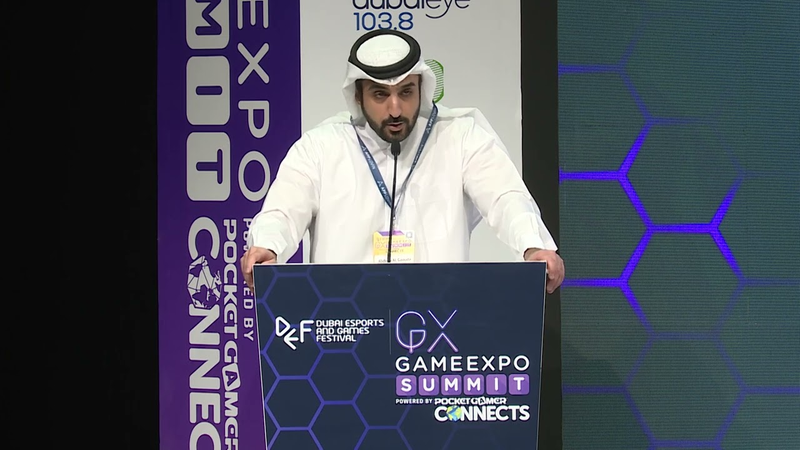
Keynote: Keynote From Dubai Chambers - Abdullah Algaoud, Digital Economy/Dubai Chambers.
Dubai is aggressively positioning itself as a premier global hub for the gaming industry, anchored by the ambitious Dubai Program for Gaming 2033.
- The Dubai Program for Gaming 2033 aims to establish the city as a top-ten global gaming hub, targeting the creation of 30,000 jobs and a $1 billion contribution to the local economy by 2033.
- The MENA region's gaming market is a primary growth engine, with revenues projected to reach $6 billion by 2027, nearly doubling the 2021 figures.
- Dubai is leveraging its digital infrastructure to integrate emerging technologies, including AI, the metaverse, augmented reality, and blockchain, into its gaming ecosystem.
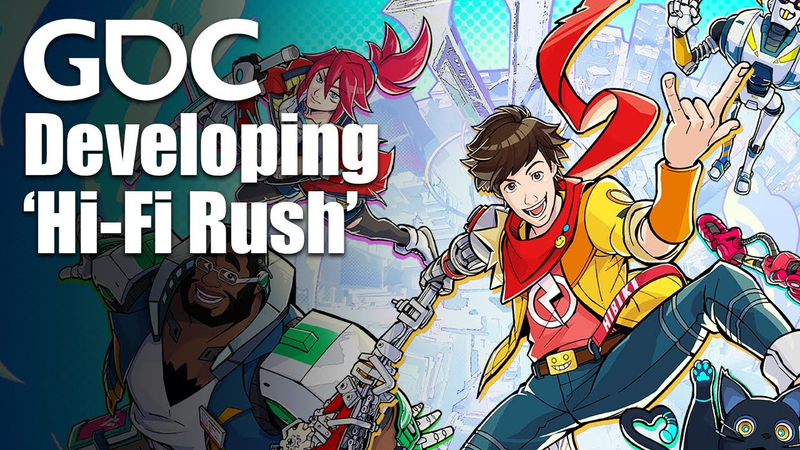
Developing 'Hi-Fi RUSH' Backwards and Finding Our Positive Gameplay Loop
The development of Hi-Fi RUSH represents a strategic departure from traditional horror-centric game design, focusing instead on a rhythm-action framework that synchronizes player inputs with a musical score.
- To maintain player immersion, the development team designed the game's rhythm-action mechanics by working backwards from the desired musical impact, ensuring that gameplay features were built to lead into specific beats rather than trying to force music to fit existing gameplay.
- The team implemented a 'positive feedback loop' where players are rewarded for playing in rhythm through subtle damage bonuses and audio-visual cues, while avoiding negative reinforcement or penalties for off-beat play to keep the experience accessible.
- Level design was structured around song composition, using 'mood graphs' and song structures—such as using choruses for combat and verses for platforming—to define pacing and event timing before physical level layout began.

YOUR GAMES | Game Design Analysis
Effective game design hinges on balancing player agency with intuitive mechanics, a principle that remains consistent across diverse indie titles ranging from puzzle-roguelikes to atmospheric narrative experiences.
- Prioritize player agency by minimizing intrusive hand-holding and excessive exposition, allowing players to discover the game world through self-directed interaction.
- Streamline feedback loops and remove unnecessary complexity to ensure core mechanics remain the primary focus of the player experience.
- Integrate narrative themes directly into gameplay mechanics rather than relying on heavy-handed exposition to maintain immersion.
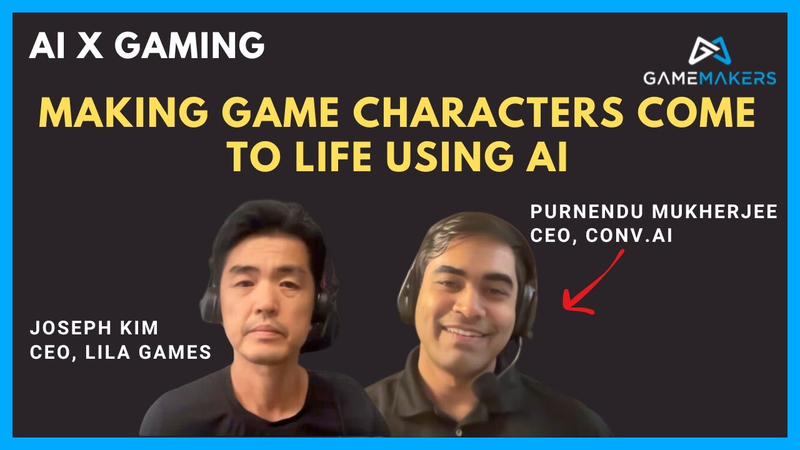
The Frontier of AI NPCs with Convai's CEO | Purnendu Mukherjee
The integration of artificial intelligence into non-player characters represents a fundamental shift in virtual interaction, moving away from rigid, scripted dialogue trees toward dynamic, autonomous agents.
- AI-driven NPCs are transitioning from scripted dialogue trees to autonomous agents that perceive 3D environments, maintain memory, and execute complex, evolving behaviors.
- While initial development labor remains high, the integration of AI agents is estimated to increase gameplay impact and interactivity by a factor of ten to one hundred compared to traditional methods.
- Developers are balancing open-ended AI interactions with narrative consistency by utilizing platforms that integrate LLMs with traditional behavior trees.
Play My Resume: Exploring Resume and CV Differentiation Through Personalized Web-Based Games
Tyler B. Wright, of Central Michigan University, examines resumes and CVs presented as playable web-based games, published in Press Start in 2024.
- All but one of the sampled game resumes were designed to be completed in a short period of time, with most finishing in under five minutes.
- Platformers made up 42.4% of the sample, but more than half of the games belonged to other genres.
- Game resumes almost always come from creators seeking work in the games industry.
Writers
Games and companies
Games