Game Culture reports and market data
Documents


Well Played: A Journal on Video Games, Value and Meaning - Vol. 1, No. 2 (2012)
This is Volume 1, Number 2 (2012) of Well Played, a reviewed journal on video games, value and meaning published by ETC Press at Carnegie Mellon University, edited by Drew Davidson. It contains four essays.
- Egenfeldt-Nielsen reports that Heroes had 3,500 active Danish players in 2009, and that its 90% male player base had an average age of 22.
- The author argues that in Heroes, a strong clan community is the foundation on which strategy rests, and that strategy alone is insufficient to reach the top ten.
- Haimberg reports that BioShock scored 96 out of 100 on Metacritic and Portal scored 90, both released in 2007.
Beyond the "Historical" Simulation: Using Theories of History to Inform Scholarly Game Design
The authors Jerremie Clyde, Howard Hopkins and Glenn Wilkinson, from the University of Calgary and St. Mary's University College, present a theoretical case in the Journal of the Canadian Game Studies Association for a "gamic mode" of history: scholarly historical arguments expressed as interactive games using procedural…
- The authors argue that the epistemology of constructionist history is not mode dependent, so the mode of expression can change without changing how knowledge of the past is established.
- The authors argue that commercial history-themed games base their claims of authenticity on the amassment of facts, assuming that the volume of facts accounted for equals validity.
- The authors argue that simulations propose covering laws, which they describe as a way of knowing something but not history.
Proposal for the 4th Workshop on Mobile Gaming: Mobile Life – Interweaving the Virtual and the Real
The proposal for the 4th Workshop on Mobile Gaming, titled Mobile Life – Interweaving the Virtual and the Real, outlines a forum for exploring the convergence of mobile technology, pervasive gaming, and mixed reality.
- The 4th Workshop on Mobile Gaming, held with the 2012 International Conference on Entertainment Computing, focuses on the convergence of mobile technology, pervasive gaming, and mixed reality.
- The core industry shift identified is the dissolution of boundaries between digital gaming environments and physical reality, driven by the increasing sophistication and ubiquity of mobile devices.
- Key technical design parameters for modern mobile gaming include the integration of location data, user context, and physical player movement.
Cognitive Processes Involved in Video Game Identification
This study explores the cognitive mechanisms underlying video game identification, specifically testing the theory that identification functions as a form of transformed self-perception.
- Video games function as vehicles for temporary self-alteration, where players cognitively adopt character-related traits to reduce self-discrepancies during gameplay.
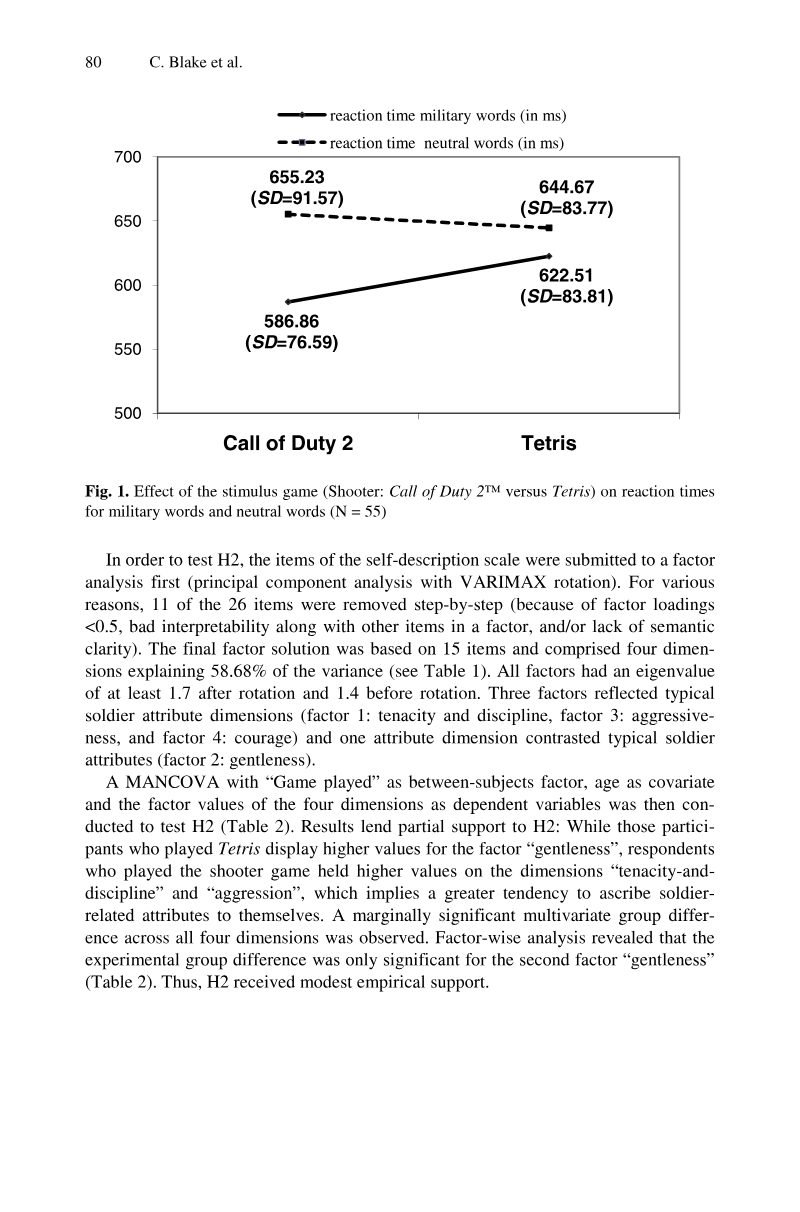
- Players of a military first-person shooter (Call of Duty 2) exhibited significantly faster reaction times to soldier-related concepts compared to a control group playing Tetris, demonstrating increased cognitive salience.
- Participants playing the military shooter reported measurable shifts in self-perception, specifically identifying with higher levels of tenacity, discipline, and aggression.


Well Played: Volume 1, Number 1
Well Played, Volume 1, Number 1 is the inaugural issue of a reviewed journal on video games published by ETC Press (2011), edited by Drew Davidson.
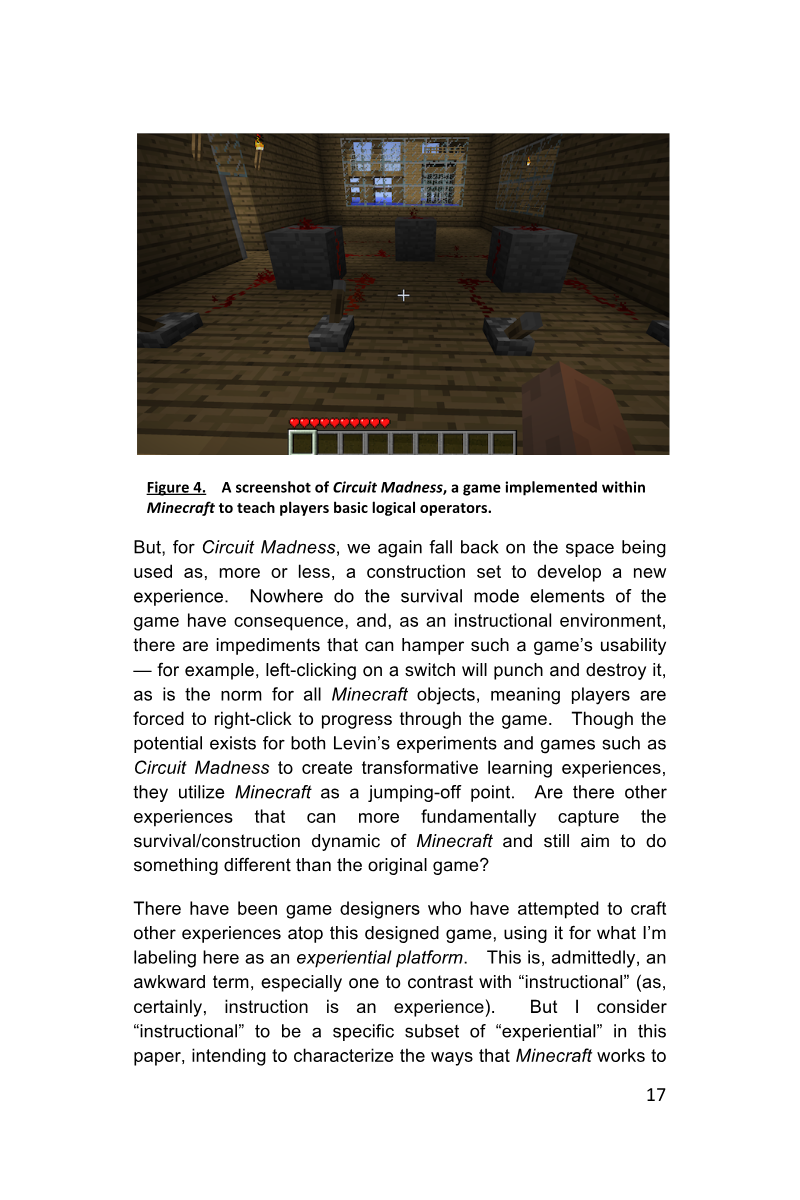
- Minecraft's survival mode is described as a driver of early immersion, while construction pays off by supporting survival.
- Minecraft had over 11,000,000 registered users on its official website at the time of writing, more than 25% of whom had purchased the game.
- Left 4 Dead 2 maps are built as tracks rather than arenas, with players seldom confronted with more than a single fork in their paths.

First-Person Shooters: Immersion and Attention
It is a review-style discussion that draws on theories of presence from virtual reality, research on sensory and psychological immersion, and psychology of attention.
- The authors cite a 2008 UK games market of £4 billion and report that Call of Duty: Modern Warfare 2 was the top UK computer game seller in 2009, grossing over £67 million in its first sales week.
- The authors cite Jennett's 2010 argument that immersion is a result of self-motivated attention enhanced by game feedback, rather than just an extreme form of selective attention.
- Citing Jennett et al. (2008), the authors state that total immersion, the highest of three immersion levels, is rare and rather fleeting.


Well Played 3.0: Video Games, Value and Meaning
This is the third volume of the Well Played series, edited by Drew Davidson and published by ETC Press in 2011.
- Neiburger argues that Pokémon's primary learning task is not memorization but deciding which knowledge to keep in one's head and which to store externally.
- Eli Neiburger describes the type-matchup table in Pokémon as a 3-dimensional knowledge matrix with over 4,600 cells, each holding one of 6 potential values.
- Ferrari argues that Final Fantasy XIII makes the Libra ability a special ability, separating it from other spells, to argue that the game is about finding and exploiting an enemy's weakness.
Monstrous Textuality: Game Fiction between Postmodernism and Structuralism
This analysis challenges the common characterization of computer game narratives as postmodern, "monstrous" texts that defy structuralist classification.
- Game narratives are not inherently chaotic or postmodern but are governed by rigid, rule-based structural prearrangements.
- The perceived 'monstrosity' or nonlinearity of digital fiction is an analytical illusion caused by applying inadequate theoretical frameworks rather than an actual lack of structure.
- Using the 2007 title BioShock as a case study, research confirms that player agency operates strictly within the parameters of the game’s programmed code and narrative architecture.
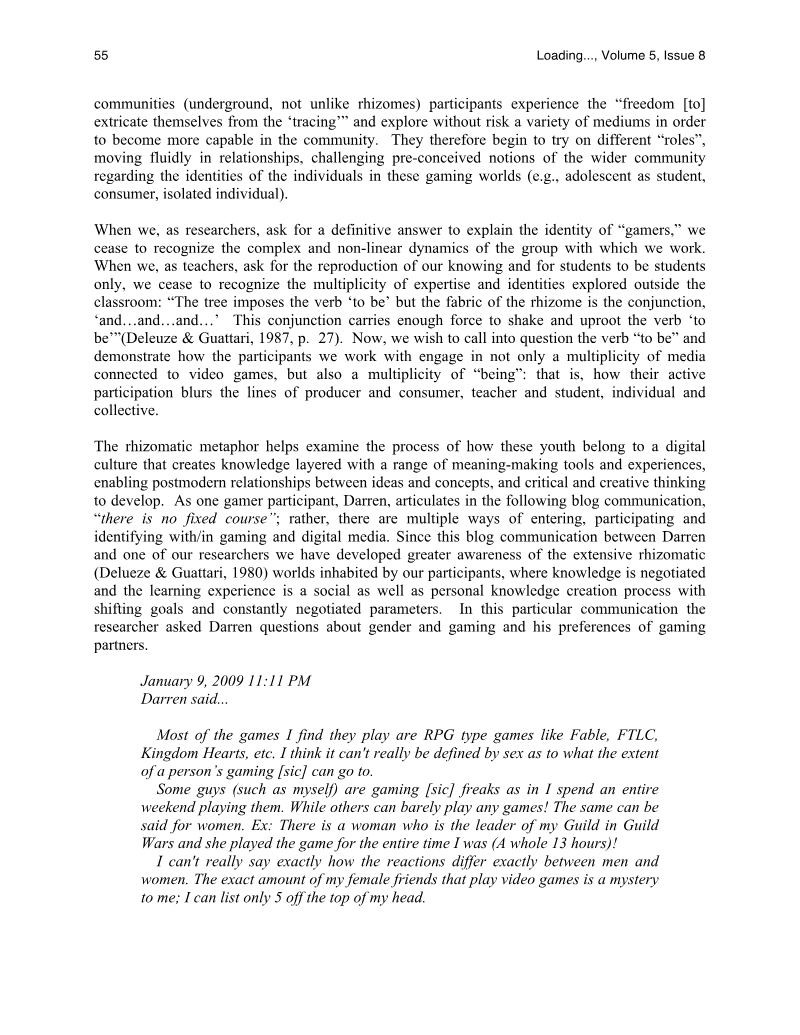
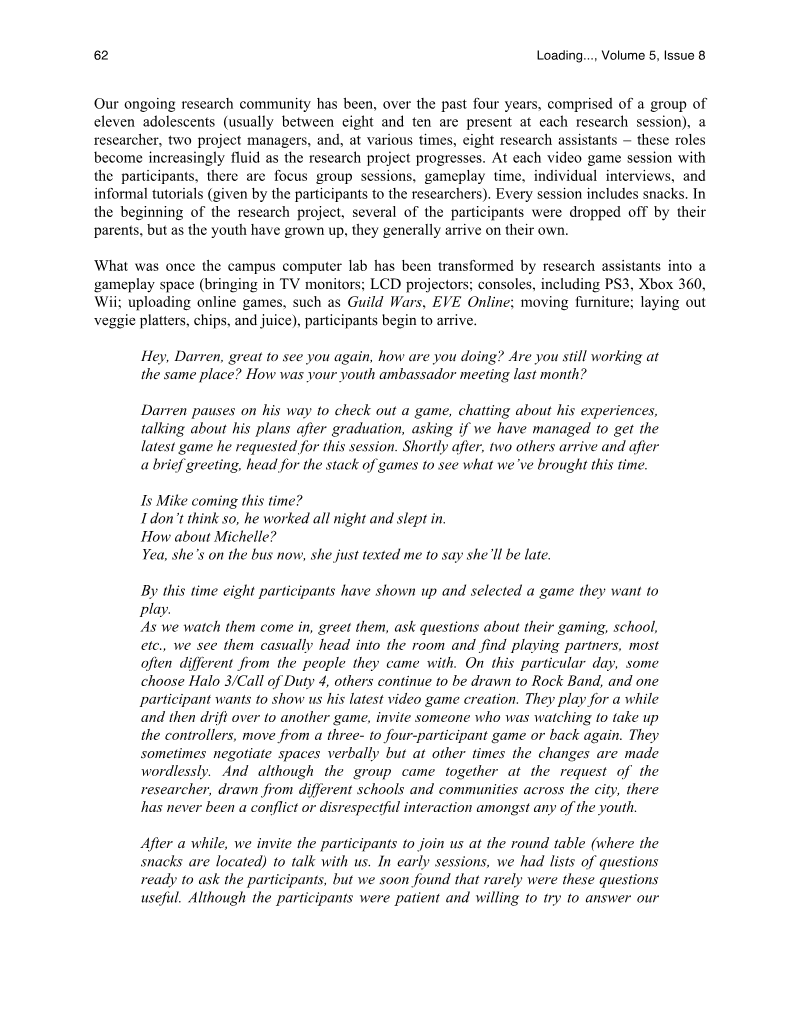
“There’s no fixed course”: Rhizomatic learning communities in adolescent videogaming
This paper, by Kathy Sanford, Liz Merkel and Leanna Madill of the University of Victoria, published in the Journal of the Canadian Game Studies Association (Vol 5, Issue 8), examines how adolescent gamers learn and participate in gaming communities.
- The authors argue that participants blur the boundaries between producer and consumer, teacher and learner, and individual and collective, rather than occupying fixed roles.
- Participants were observed making machinima, which the authors describe as blending gaming with producing new narratives for online consumers.
- In an observed lab session, an experienced player spent over an hour teaching two novices how to play EVE Online, illustrating shifting expert and novice roles.
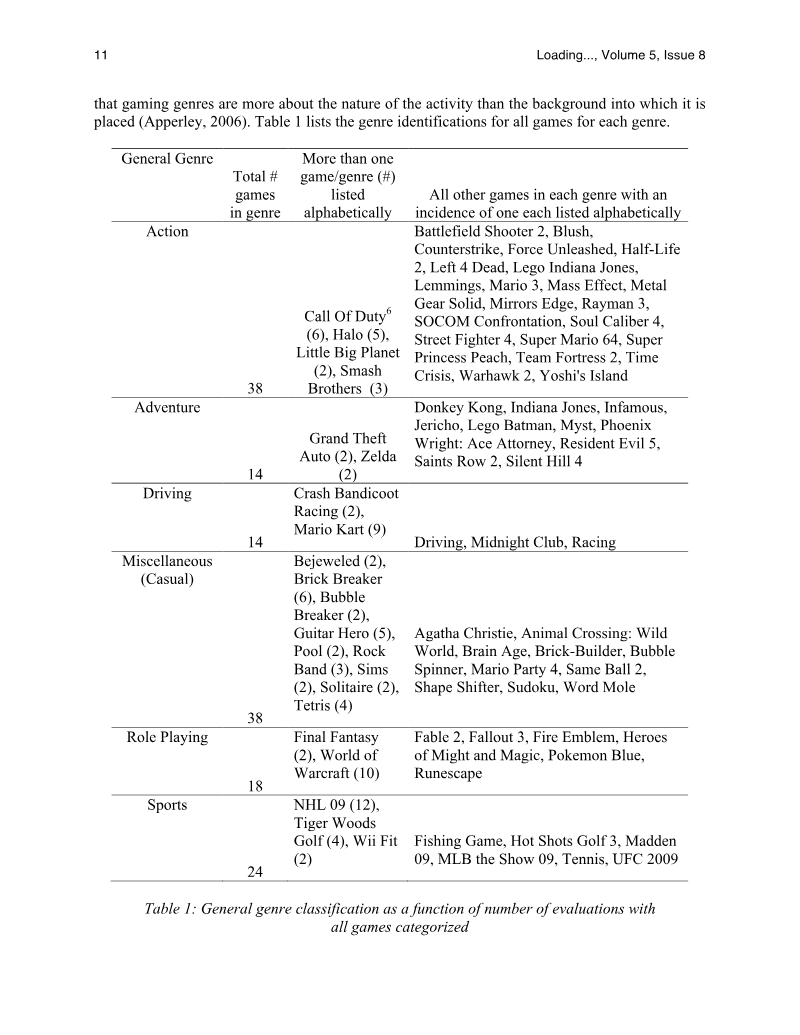
Video Game Presence as a Function of Genre
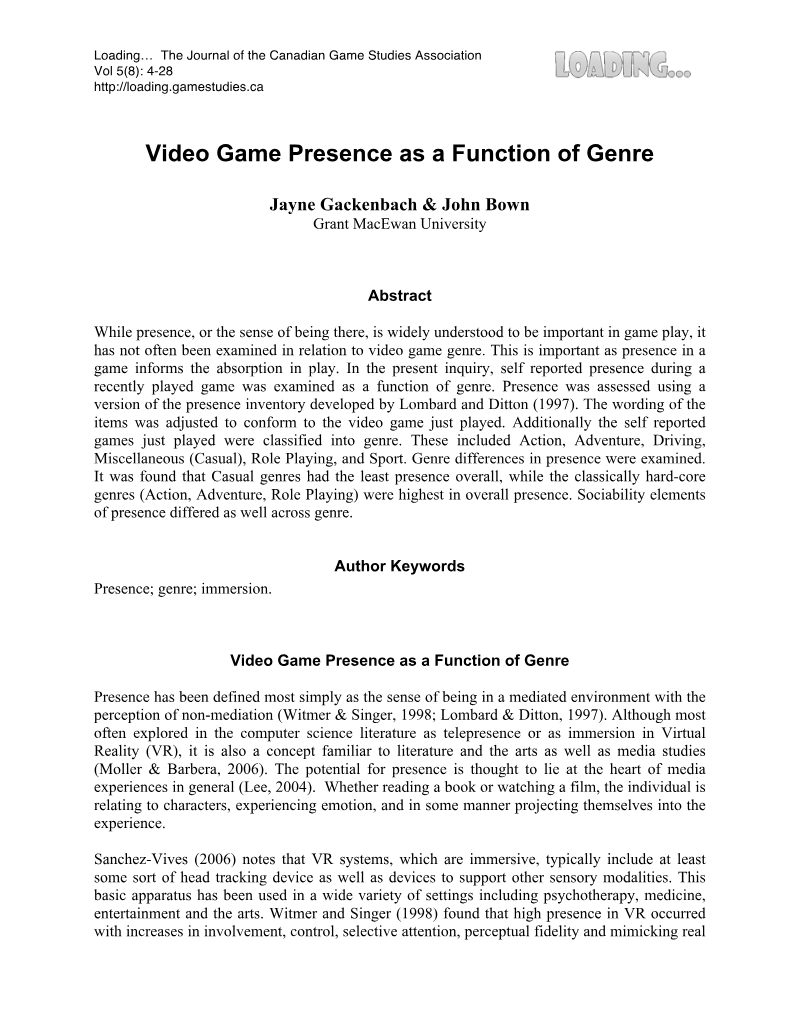
This study by Jayne Gackenbach and John Bown of Grant MacEwan University examines whether self-reported sense of presence during video game play varies by genre.
- Before covariate adjustment, the classically hard-core genres of Action, Adventure and Role Playing had the highest overall presence, while Miscellaneous (Casual) had the lowest.
- Adjusting for hardware differences changed the ranking at the top, with Adventure becoming the highest-presence genre, though the same three hard-core genres remained highest.
- The Miscellaneous (Casual) genre was played on significantly smaller screens than all other genres, and it benefited most from the hardware adjustment.
What Defines Video Game Genre? Thinking about Genre Study after the Great Divide
The essay begins with the 'narrative vs. ludology' debate and its effect on videogame studies, then reviews the current state of videogame genre theory, surveys genre theory in other fields, and closes with recommendations for future genre study.
- The author argues that the 'narrative vs. ludology' debate produced a significant hesitance to consider resemblances between videogames and other media, especially film and literature.
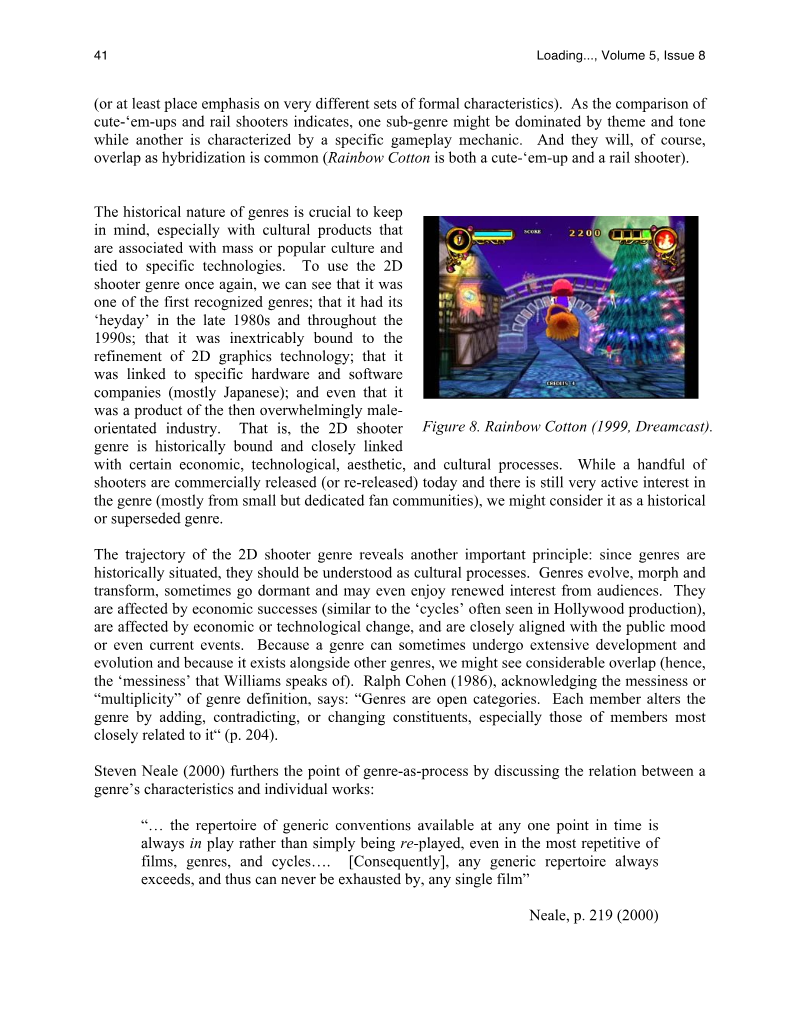
- The author rejects separating gameplay from other elements, arguing that gameplay, setting, story and theme are tethered to form the larger experience of each game.
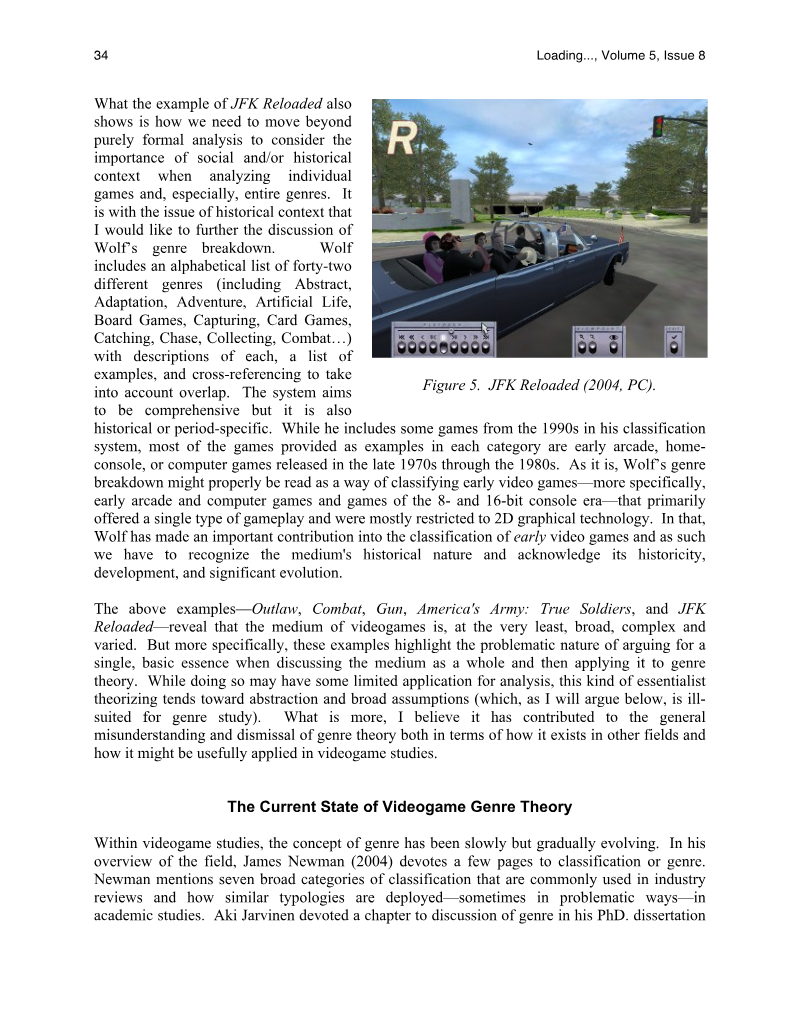
- Wolf's genre breakdown lists forty-two genres, and most of its example games are early arcade, home-console or computer titles from the late 1970s through the 1980s.
Sadomasochist Role-Playing as Live-Action Role-Playing: A Trait-Descriptive Analysis
Harviainen, a researcher at the University of Tampere, examines sadomasochist role-playing, the role-play component of sadomasochism, and compares it with live-action role-playing (larp).
- The author concludes that physically performed sadomasochist role-playing is, by its traits alone, indistinguishable from larping, with the sole significant difference being its framing as part of sadomasochism.
- Sexual role-playing is described as performed for sexual pleasure, a goal existing outside the fantasy, whereas a larp may not have any clear goals.
- The author states that BDSM role-play is not defined as a game by its participants but fits the definitions of such activities, exemplifying Suits' definition of a game.
Writers
Games and companies
Games