Game Culture reports and market data
Documents
The Consecration of Musical Incoherence
The analysis explores how music compilations, specifically those organized by a single calendar year, function as historiographical projects that assign value to periods of stylistic uncertainty.
- Year-based music compilations, such as 'Meridian 1970,' function as historiographical tools that legitimize periods of stylistic uncertainty rather than tracing clear musical genealogies.
- The lack of aesthetic unity in these collections is a deliberate mechanism that frames historical moments as systems of variation rather than coherent movements.
- Physical compact discs serve as essential boundaries that curate and limit the infinite nature of digital archives, forcing listeners to engage with a fragmented representation of a historical 'cusp'.
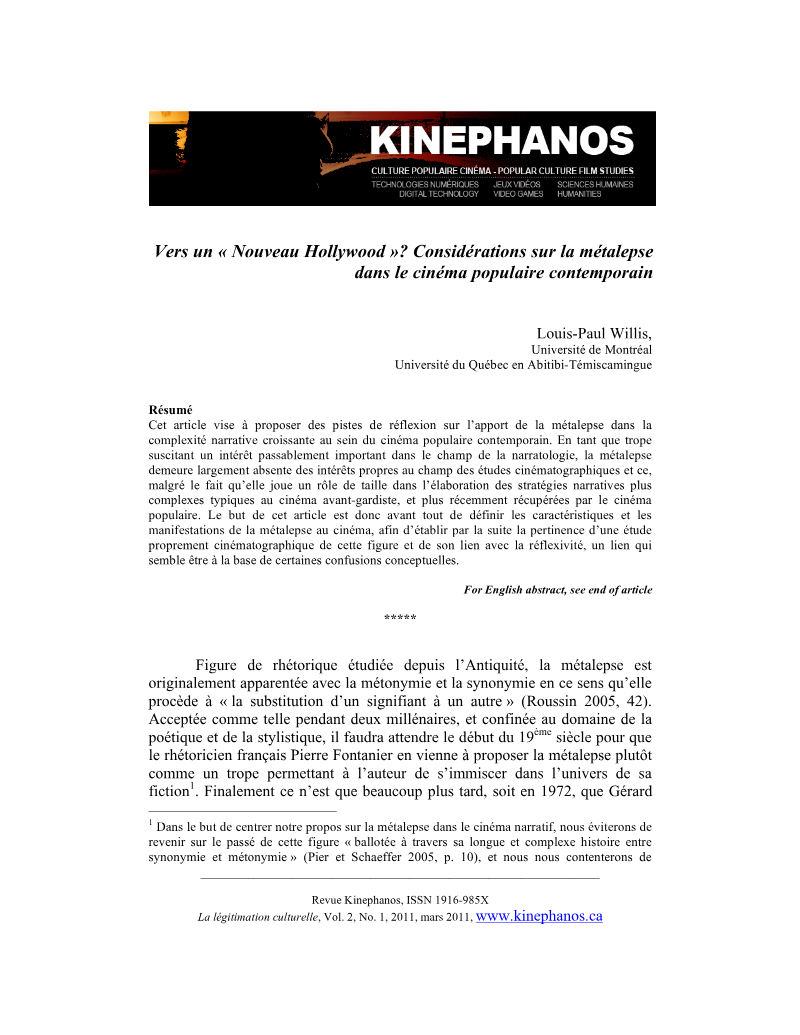
Vers un « Nouveau Hollywood »? Considérations sur la métalepse dans le cinéma populaire contemporain
Louis-Paul Willis, a doctoral student at the Université de Montréal, published this article in the Revue Kinephanos.
- The author argues that metalepsis is largely absent from film studies despite its role in narratology, and that its confusion with reflexivity has caused conceptual problems.
- Willis notes that Campora argues narrative pleasures formerly reserved for knowing audiences are now available to everyone.
- The article cites Denby as observing a growing presence of complex narrations in mass cinema, with Pulp Fiction (1994) noted as an example of audiences enjoying more complex narrative forms from the 1990s.
« Ils n'en font qu'à leur tête »: Les lycéens français face au cinéma enseigné
Barbara Laborde, a doctoral student in film studies at Université Paris III-Sorbonne Nouvelle and an agrégée teacher, published this 2011 article in the journal Kinephanos.
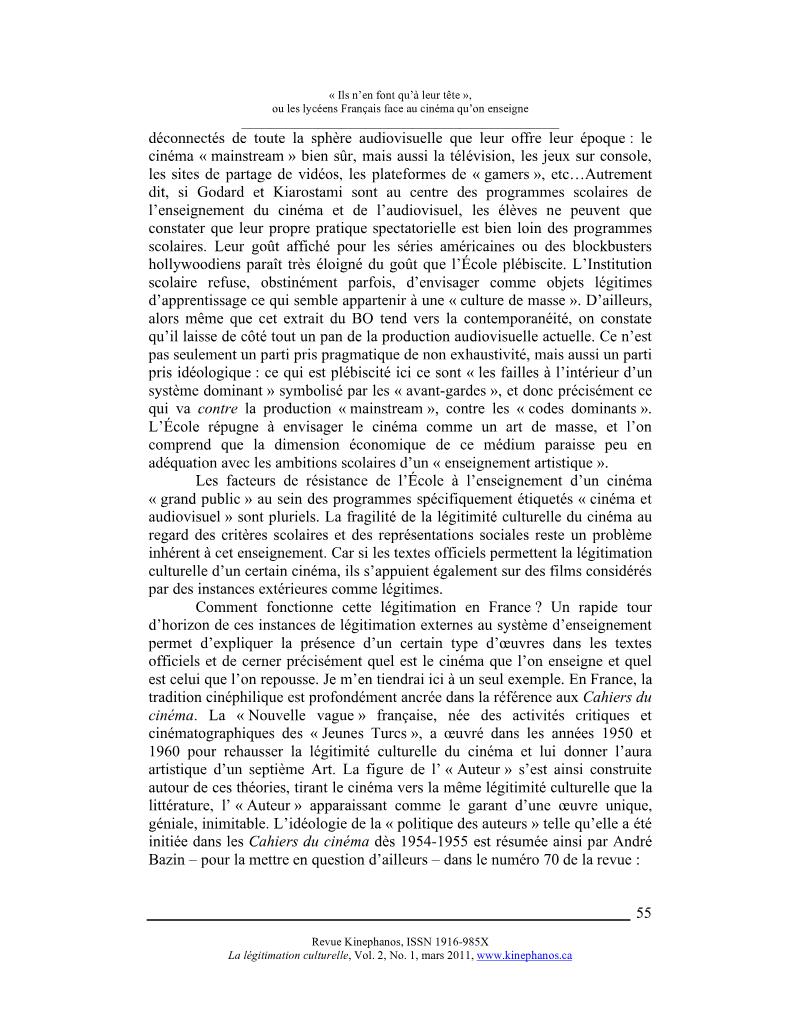
- The official 2001 bulletin favours auteur cinema, which the author says reflects the Cahiers du cinéma canon, while mainstream genres are largely absent from the curriculum.
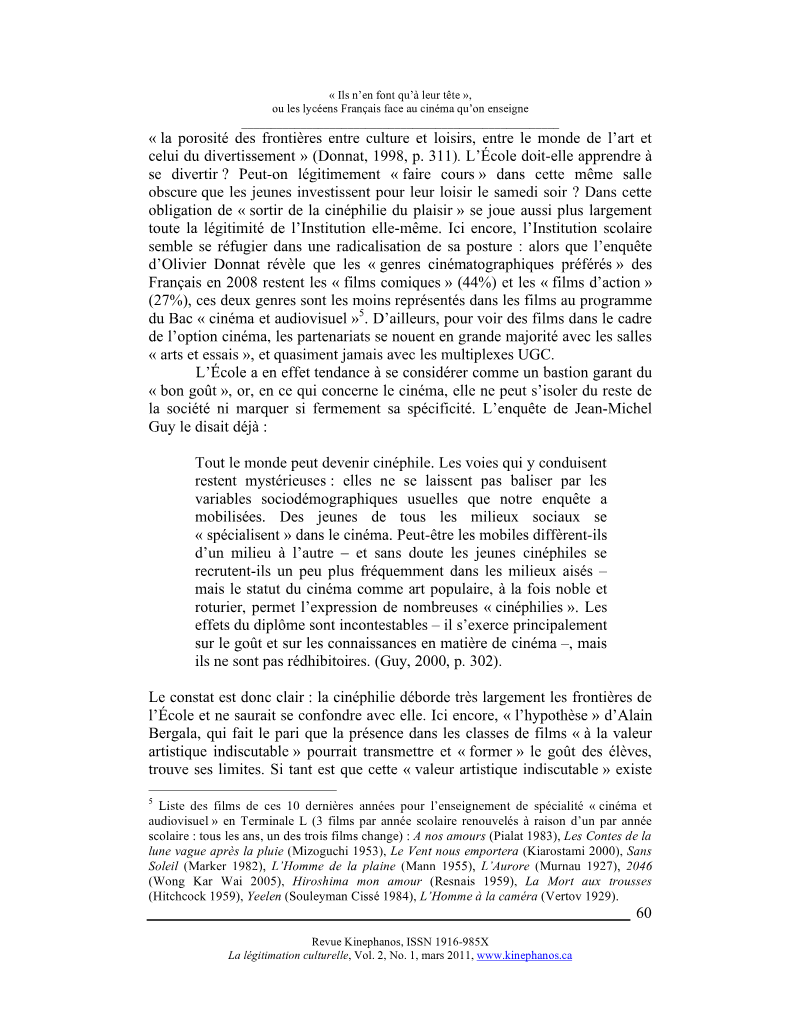
- Donnat's 2008 data shows young people aged 15 to 24 attend cinemas more than any other age group, but French people's preferred genres (comedy and action) are the least represented in the baccalauréat programme.
- Of the films on the Terminale L specialty programme over the past ten years, one changes each school year, with a list of eleven titles provided.

Cover & Remix: Paradigms of Adaptation in Installation Art
Horea Avram, a PhD candidate at McGill University, examines adaptation in installation art through two paradigms borrowed from music: cover and remix.
- The author argues that cover and remix occupy a creative strategy placed between production and reproduction, rejecting both mechanical copy and simulacrum.
- The essay defines adaptation as a process of mutual legitimation, in which the source and the adapted work validate each other aesthetically rather than through institutional or social approval.
- The author identifies installation's internal spatiality, the space structuring the installation's composition, as a feature that shapes how adaptive installations work and is largely unaddressed in existing theory.
Beyond Badges: Gamification for the Real World
Gamification functions as a strategic application of game design principles to non-game environments, aiming to enhance user engagement, loyalty, and community building.
- Effective gamification requires a fundamental shift from superficial aesthetic additions like badges and leaderboards toward the strategic application of core game design principles.
- True gamification focuses on deconstructing and optimizing the underlying engagement loops that drive user behavior rather than applying a decorative layer to existing processes.
- Organizations should reframe real-world tasks to make them more intuitive and efficient by identifying the core challenges and reward structures inherent in interactive design.
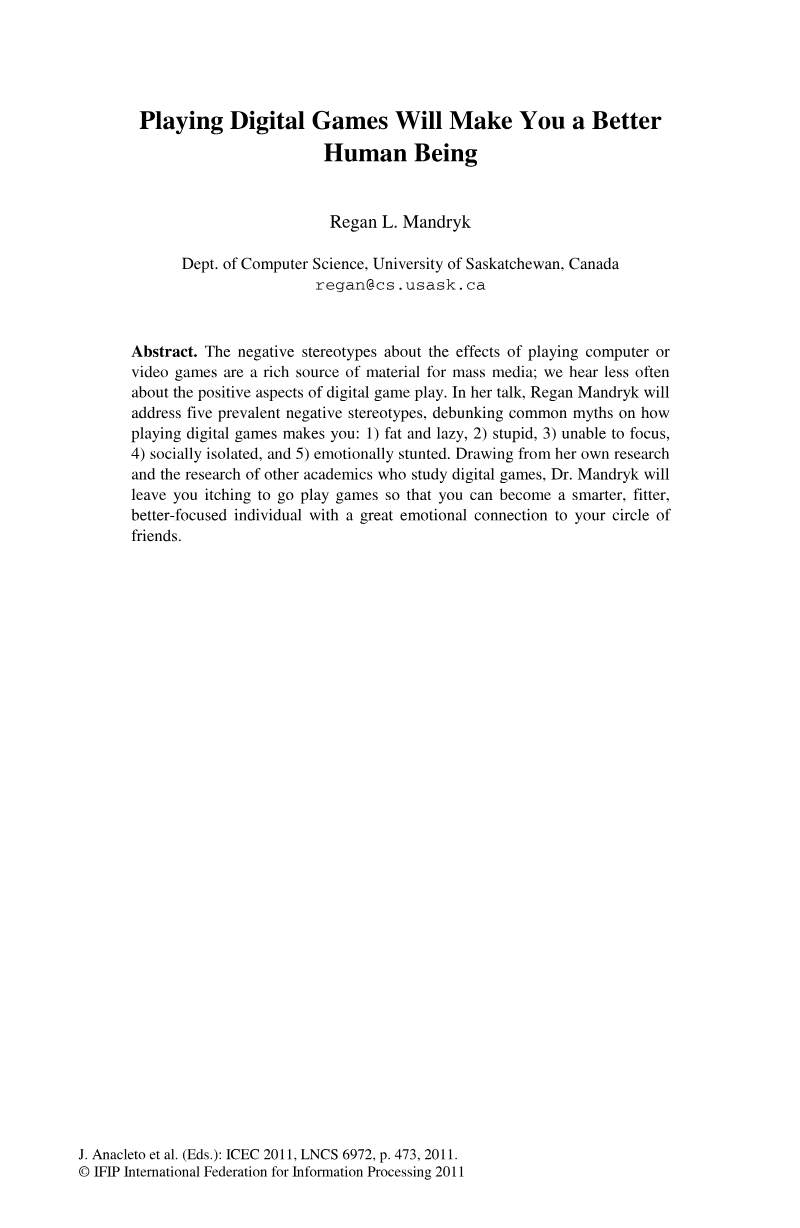
Playing Digital Games Will Make You a Better Human Being
Digital gaming serves as a catalyst for personal development, directly challenging pervasive cultural narratives that frame the medium as inherently detrimental to human health and social functioning.
- Digital gaming functions as a constructive tool for personal development that improves cognitive performance, physical well-being, and the quality of interpersonal relationships when integrated into a balanced lifestyle.
- Strategic and interactive game mechanics actively promote intellectual acuity and focus, refuting the stereotype that gaming leads to cognitive decline or intellectual stagnation.
- Evidence indicates that digital gaming fosters emotional intelligence and social connectivity, countering the narrative that the medium causes social isolation or emotional detachment.
Bringing Empathy into Play: On the Effects of Empathy in Violent and Nonviolent Video Games
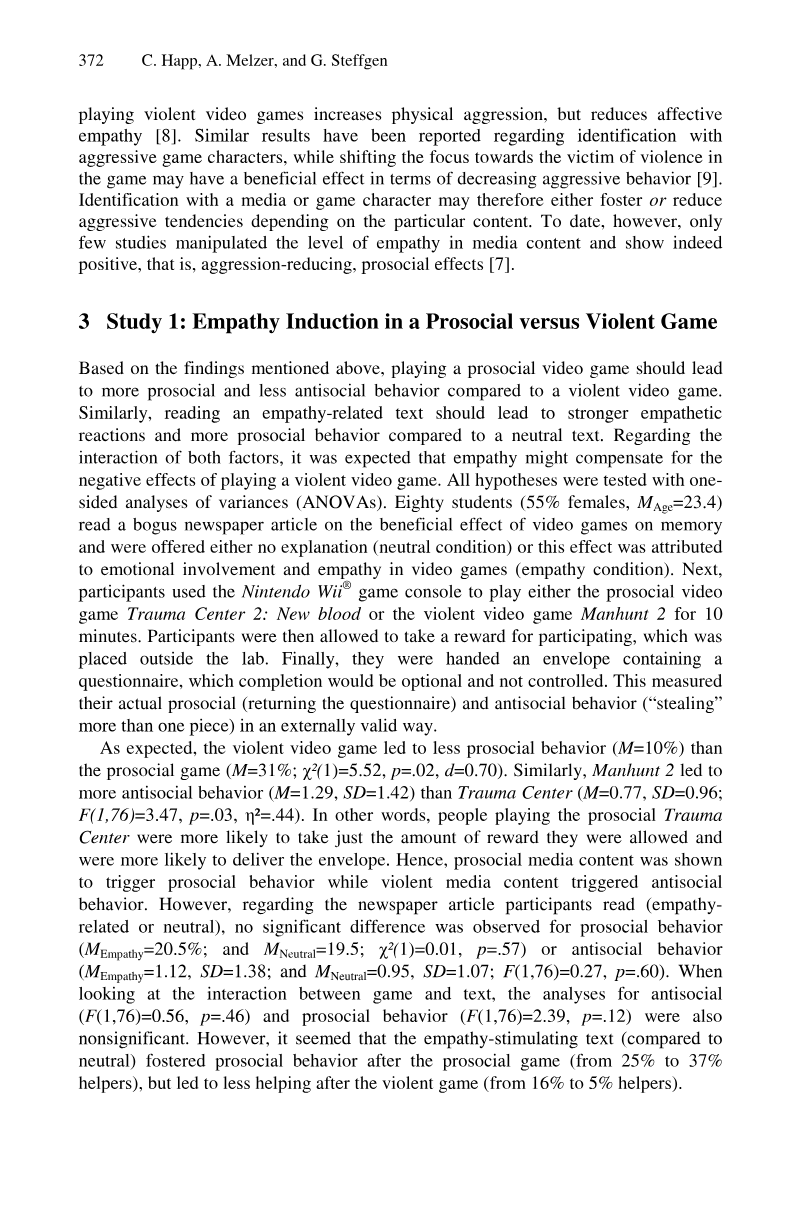
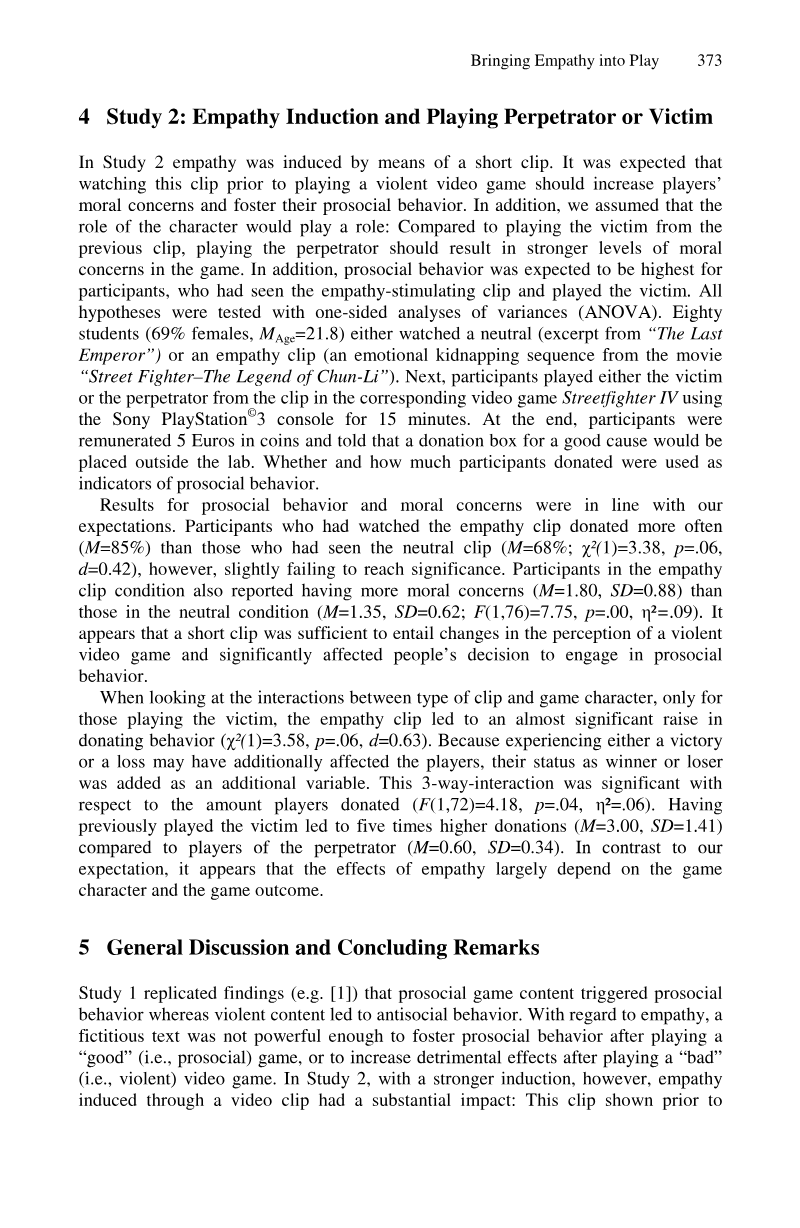
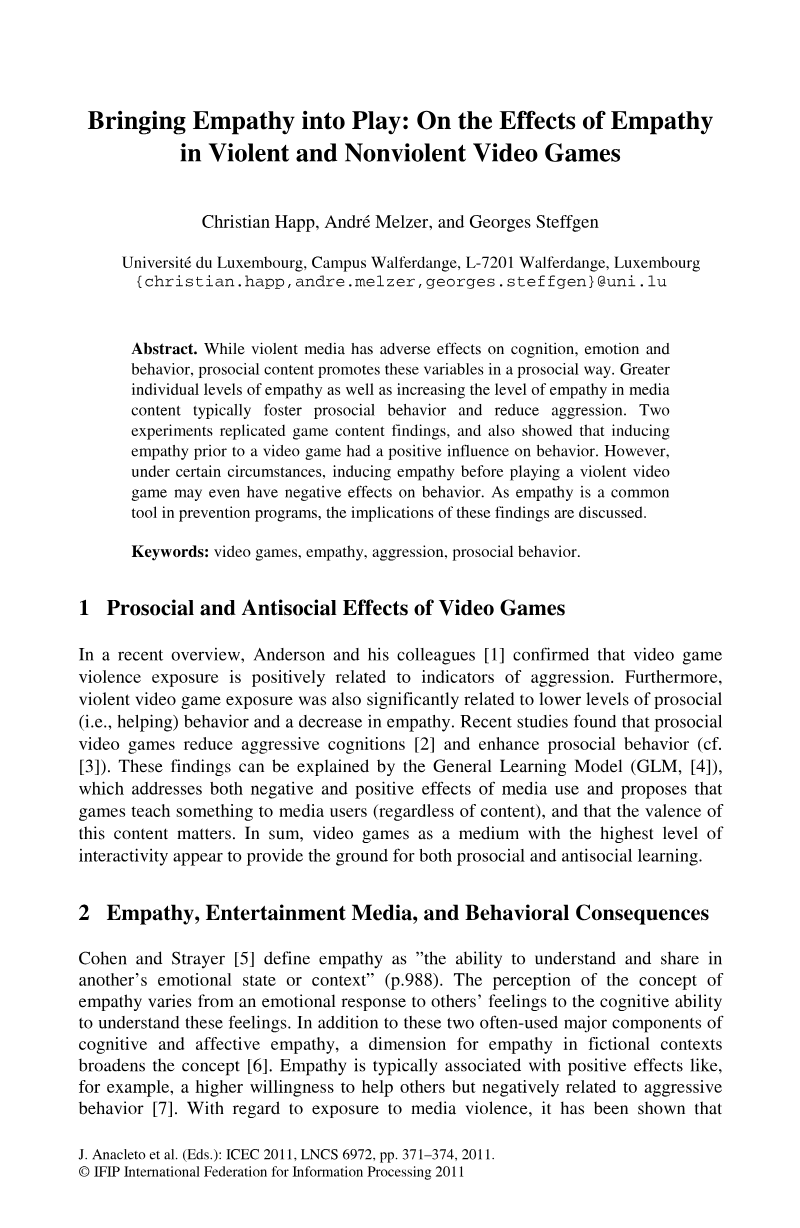
This research investigates the complex relationship between empathy, video game content, and behavioral outcomes, specifically examining whether empathy induction can mitigate the negative effects of violent media or enhance the positive effects of prosocial games.
- Prosocial game content consistently promotes prosocial behavior, while violent content correlates with increased antisocial behavior.
- Empathy induction is not a universal solution for mitigating aggression, as its effectiveness depends heavily on the intensity of the stimulus and the player's context.
- Immersive empathy-inducing stimuli, such as emotional video clips, successfully increased moral concerns and real-world donation rates, whereas simple text-based prompts failed to produce significant behavioral changes.
Influencing Experience: The Effects of Reading Game Reviews on Player Experience
Livingston, Nacke, and Mandryk of the University of Saskatchewan and University of Ontario Institute of Technology report a between-subjects study of 20 participants (8 female, aged 18-25, mean 21.8 years) who read either positive or negative game review text before playing Tag: The Power of Paint for 15 minutes.
- Players who read positive review text rated the game significantly higher than those who read negative text.
- Review valence did not produce a significant main effect on any objective physiological measure.
- The positive-review group's post-play arousal rose significantly after playing, while the negative-review group's rise was only marginal.
Jane Fonda's Wii Fit: Continuity, Contingency, and Concordance in Fitness Gaming
This paper examines Nintendo's Wii Fit (2007) through a historical and discursive comparison with Jane Fonda's Workout video (1982), arguing that the two products share structural parallels in how they were adopted by consumers and promoted by their producers.
- The paper argues that exercise content, rather than novelty alone, turned Wii Fit and Jane Fonda's Workout from fleeting entertainment into regular routines, and that this shift drove both products' economic and cultural success.
- Using Celeste Condit's concept of concordance, the author treats new technology adoption as a negotiated process in which producers, existing users, and wider publics contest what a device means and whether it is useful.
- Both products reached audiences broader than their predecessors and relied heavily on women for market penetration, despite the media being typically associated with men.
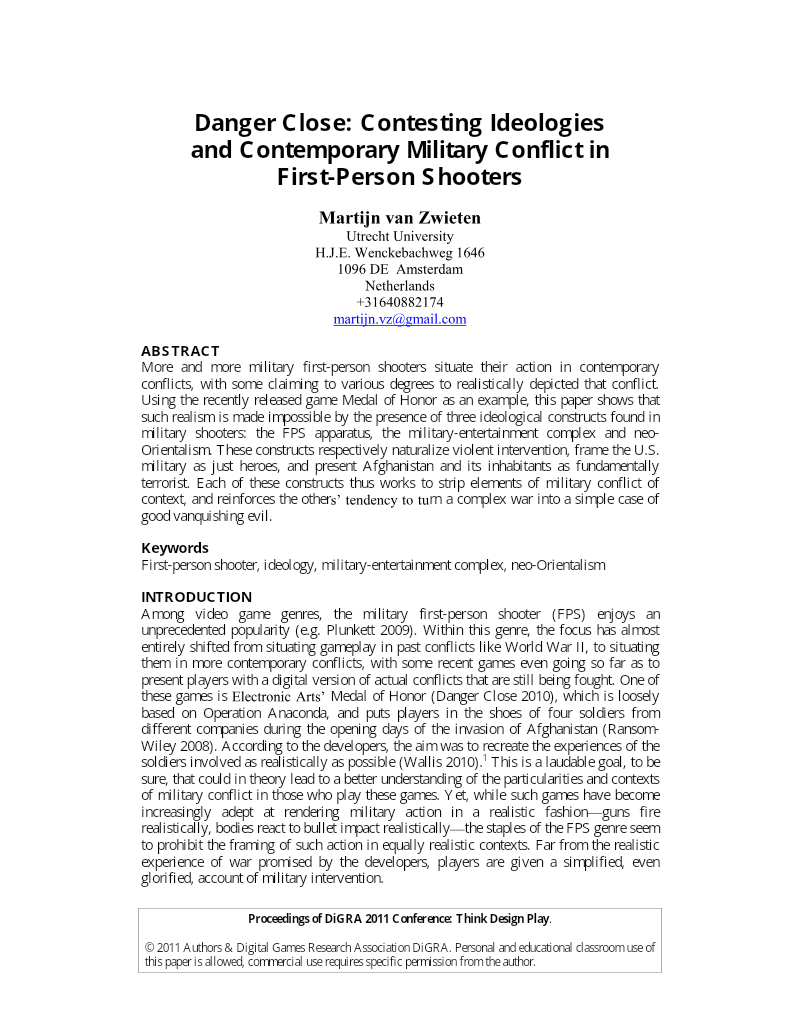
Danger Close: Contesting Ideologies and Contemporary Military Conflict in First-Person Shooters
Danger Close examines how the military first-person shooter Medal of Honor (2010) embeds ideological assumptions within its gameplay and presentation, despite its developers' claims of realism.
- The report argues that Medal of Honor (2010) embeds ideological assumptions despite its developers' claims of realism, driven by three interlocking forces: first-person shooter genre conventions, the military-entertainment complex, and neo-Orientalist framings of Afghans as a generic enemy Other.
- These forces strip the Afghan conflict of historical and political context, recasting the invasion of Afghanistan as a simple contest between good and evil.
- Gameplay mechanics such as the first-person gun perspective, invincible player avatars, headshot bonuses, and repetitive kill sequences (exemplified by the sniper mission "Friends from Afar") position the player as a super-human warrior and naturalize domination through destruction.
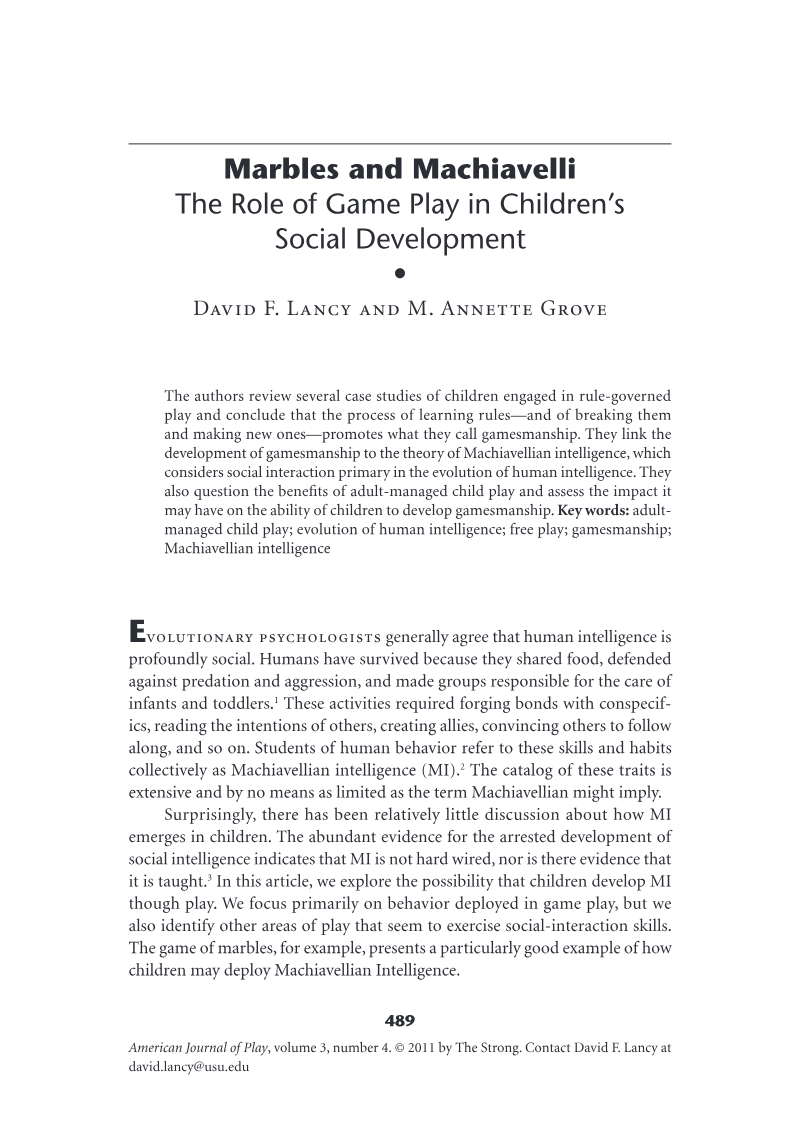
Marbles and Machiavelli: The Role of Game Play in Children’s Social Development
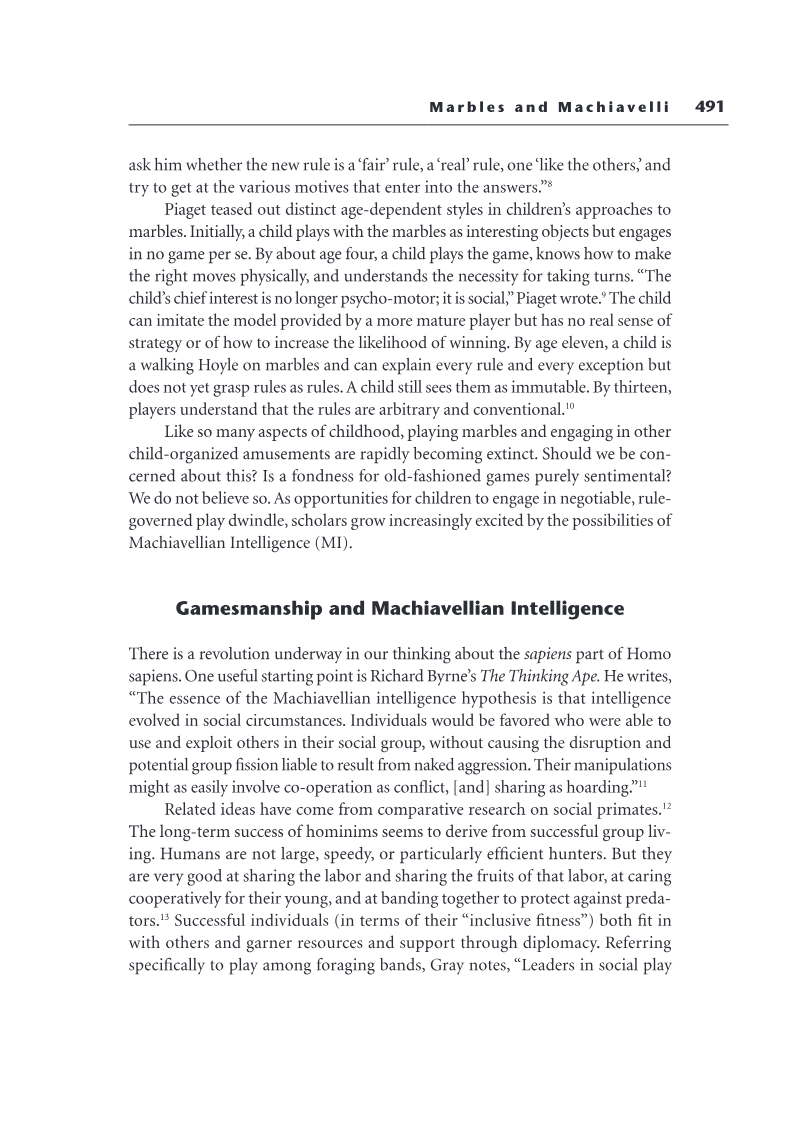
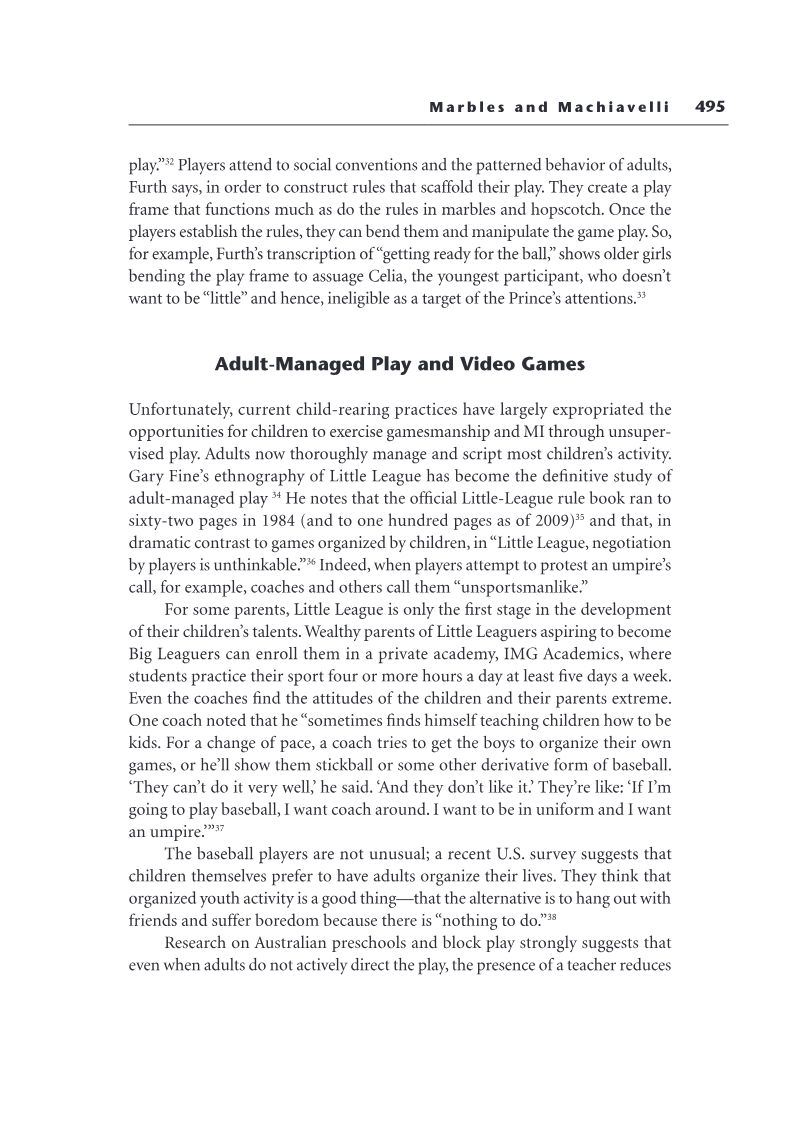
Lancy and Grove argue that children develop Machiavellian intelligence (MI), the social skills of alliance-building, negotiation, and strategic influence, through rule-governed, self-directed play such as marbles, hopscotch, jump rope, and make-believe.
- Lancy and Grove argue that children build "Machiavellian intelligence" (alliance-building, negotiation, and strategic influence) through rule-governed, self-directed play such as marbles, hopscotch, and jump rope, and call the resulting diplomatic competence "gamesmanship."
- The authors contend that as adult-managed activities and video games displace free play, children lose a key training ground for social intelligence.
- The argument draws on evolutionary theory, which holds that human intelligence evolved in response to the demands of group living, and on Piaget's account of children moving from motor play to seeing rules as conventional and negotiable.
Discourse Engines for Art Mods
It reviews four interpretive discourses: open authorship, alternative media, folk practice, and fine art.
- Poremba frames art mods through four interpretive discourses: open authorship, alternative media, folk practice, and fine art.
- Engeli's typology of shooter-game mods lists eight design strategies, and the paper notes that Engeli lists Adam Killer as an example of overload.
- Adam Killer is described as a series of eight mods created between 1999 and 2001 by Brody Condon using Half-Life.
Writers
Games and companies
Games