Kinephanos
Bilingual (French/English) open-access journal on media, video games and popular culture, based in Québec.
Documents
Vaccin vidéoludique: Les jeux comme remède à l'isolement, à l'anxiété et à la désinformation
Video games functioned as a critical therapeutic resource during the COVID-19 pandemic, providing a necessary buffer against the psychological distress caused by prolonged social isolation, anxiety, and a pervasive sense of powerlessness.
- Video games served as a critical therapeutic buffer during the COVID-19 pandemic by mitigating psychological distress, social isolation, and anxiety.
- Games provided users with a sense of personal agency and control through structured environments and clear objectives, compensating for the loss of real-world interaction.
- Procedural rhetoric in gaming helped players model complex epidemiological processes and identify the mechanics of misinformation, increasing resistance to conspiracy theories.
Les Modalités de Captation d’Attention dans l’Art Immersif à l’ère de l’Anthropocène
Contemporary immersive art functions as a critical intervention against the systemic de-individuation and fragmentation inherent in hyper-industrialized capitalism during the Anthropocene.
- Contemporary immersive art functions as a counter-strategy to the attention economy by disrupting the passive consumption patterns enforced by algorithmic control.
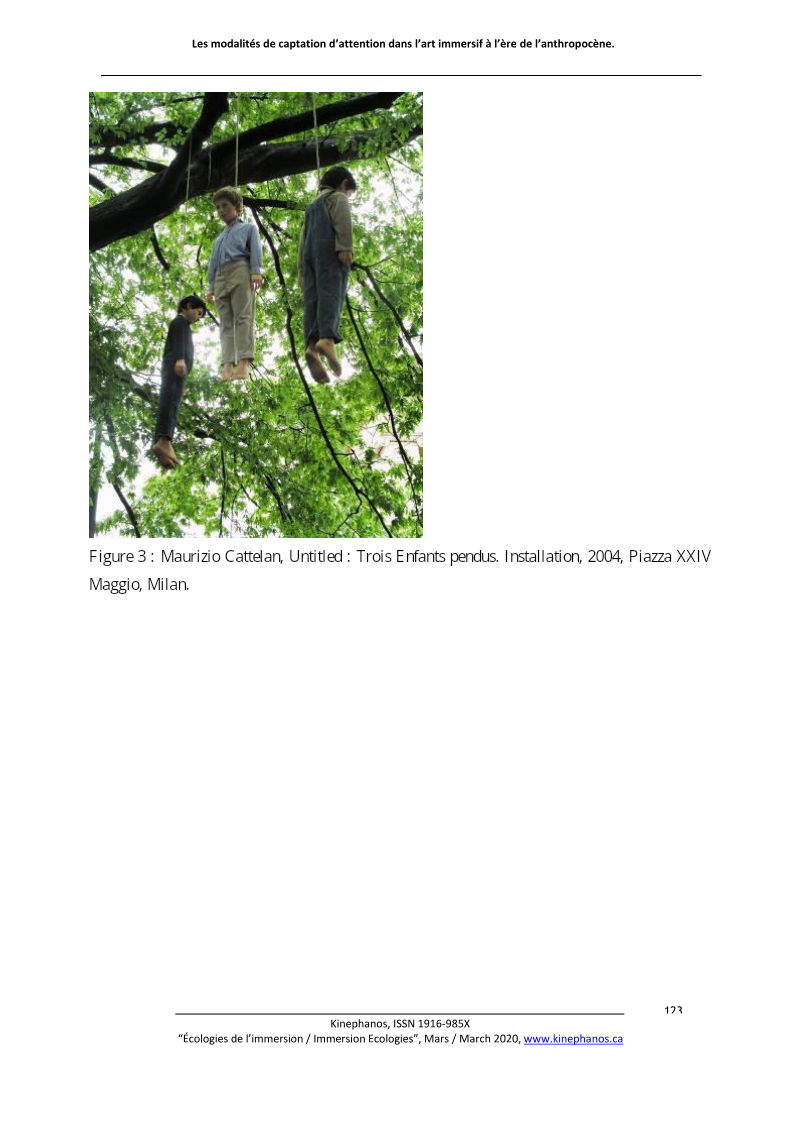
- Artists like Tino Sehgal and Maurizio Cattelan utilize methodologies such as perceptual traps and immaterial participation to force viewers to reclaim cognitive autonomy.
- Immersive art serves as a 'negentropic' intervention designed to counteract the societal fragmentation and de-individuation caused by hyper-industrialized capitalism.
Éléments naturels et espaces immersifs dans les œuvres de Doug Aitken à l’ère de l’Anthropocène
Contemporary visual and plastic arts increasingly engage with the Anthropocene, a geological era defined by human-induced environmental transformation.
- Contemporary art is shifting toward immersive, sensory-based installations that use natural elements to force viewers to confront the environmental impacts of the Anthropocene.
- Doug Aitken’s work since the 1990s utilizes multi-screen, non-linear audiovisual installations to explore the tension between industrialization and geological change.
- Aitken’s trilogy—comprising Monsoon, Diamond Sea, and Eraser—serves as a primary model for transforming museum spaces into sites of phenomenological inquiry regarding human presence in a globalized world.
Incorporation et écologie sonore vidéoludiques: La marche sonore comme outil d’analyse
Sound walks, a methodology traditionally rooted in acoustic ecology, serve as a rigorous analytical framework for evaluating the immersive soundscapes of contemporary video games.
- Sound walks serve as a rigorous analytical framework for evaluating how video game soundscapes communicate complex social structures, cultural reconstruction, and historical narratives.
- In Horizon Zero Dawn, developers use acoustic hierarchies—specifically the distribution of anthropogenic sounds—to map the power dynamics and societal structures of the Carja tribe.
- Sound design functions as a critical tool for narrative clarity and spatial immersion by synthesizing mechanical and natural elements into a cohesive, organic environment through manipulated sound propagation.
Immersion sous contrainte et écologie des territoires hostiles dans la série Metro
The Metro video game series leverages a sophisticated economy of constraint to foster deep player immersion within its post-apocalyptic setting.
- The Metro series utilizes an 'economy of constraint' to transform the game environment from a passive backdrop into an active, hostile antagonist.
- By restricting navigational freedom and spatial accessibility, the design forces players into a state of perpetual transit that denies the respite found in traditional open-world games.
- Survival horror mechanics, specifically resource scarcity and limited visibility, are used to cultivate persistent feelings of vulnerability, anxiety, and claustrophobia.
Shimmer et Chimère: Genre, Transe et Rimes à l’Ère de l’Anthropocène dans Annihilation
Alex Garland’s Annihilation functions as a subversive synthesis of science fiction and horror, reconfiguring established genre tropes to confront the ontological uncertainties of the Anthropocene.
- Annihilation redefines science fiction and horror by replacing traditional monster narratives with the ontological uncertainties of the Anthropocene.
- The film utilizes the Ship of Theseus paradox as a central metaphor to explore cellular replacement and the dissolution of individual identity.
- The narrative structure employs a methodology of 'rhyme and echo,' using intermedial citations to recontextualize motifs from foundational genre works like Alien and The Thing.
Immersion for Entangled Audiences: The Nonhuman World and Affective Patterning in Narrative Experiences
Traditional models of narrative immersion often rely on a spatial metaphor of containment, which erroneously positions the audience as a separate entity transported into a discrete storyworld.
- Traditional narrative immersion models are flawed because they rely on a 'container' metaphor that falsely separates the audience from the storyworld.
- Effective narrative immersion should be redefined as a process of 'affective entanglement,' where boundaries between human subjectivity and the environment are blurred.
- Narrative experiences can be designed to destabilize anthropocentric perspectives by emphasizing the agency and interconnectedness of the nonhuman world.
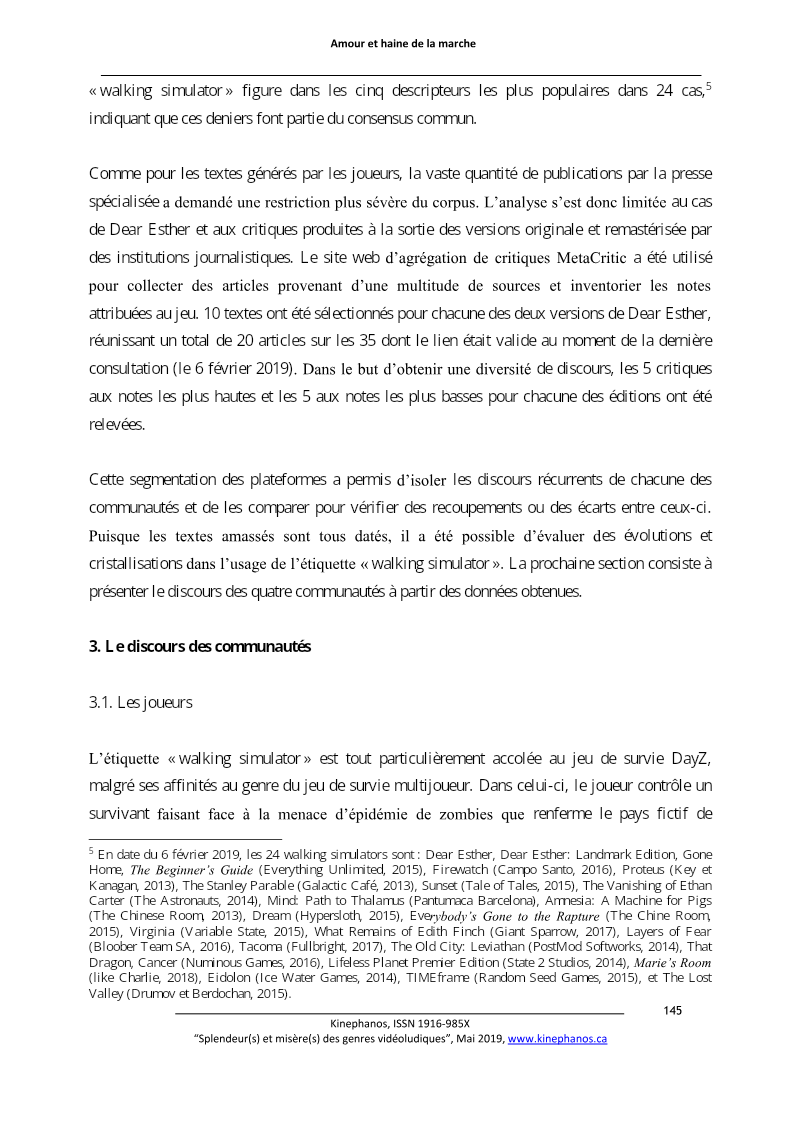
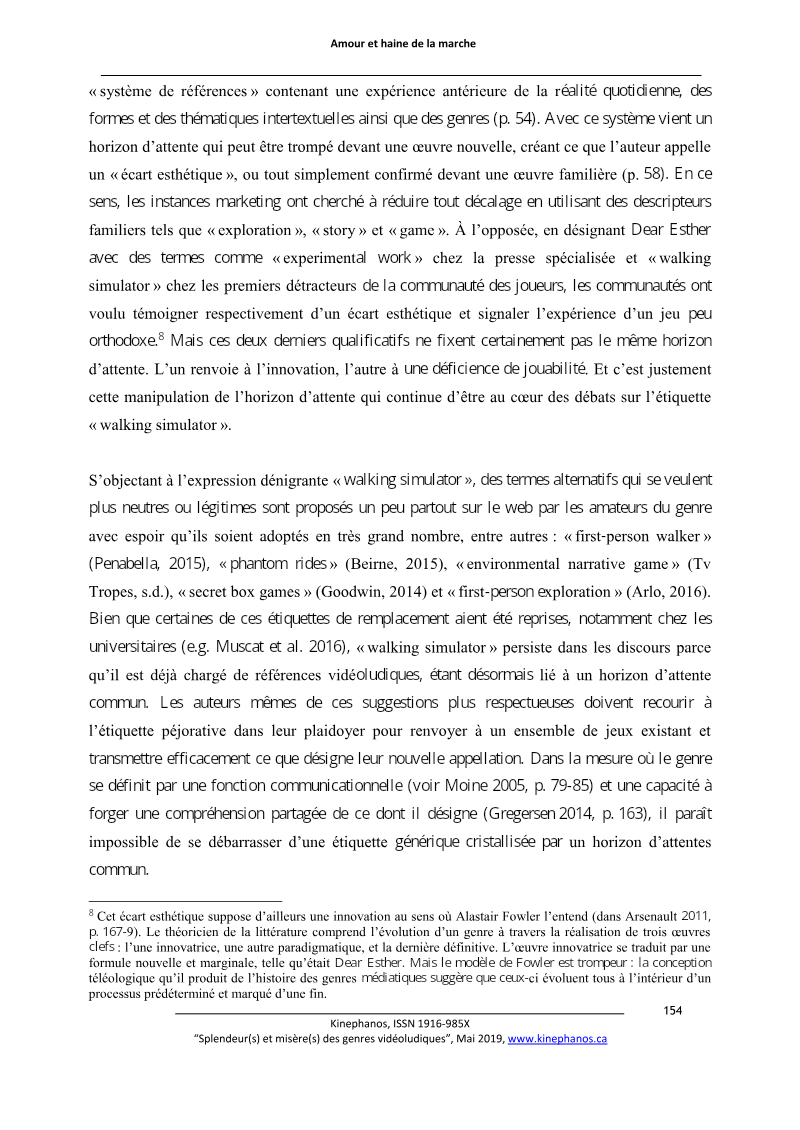
Amour et haine de la marche: Évolution et cristallisation discursives sur le walking simulator
The walking simulator represents a complex case study in how gaming terminology evolves from a derogatory label into a legitimate, albeit contested, genre descriptor.
- The term 'walking simulator' originated as a pejorative critique following the 2012 release of Dear Esther, used to dismiss games perceived as lacking traditional mechanical depth.
- The genre label has undergone discursive crystallization, successfully transitioning from a weaponized insult into a functional, neutral shorthand for narrative-driven, first-person exploration.
- Research based on 177 entries across gaming communities confirms that the term has become an entrenched generic category that is now impossible to discard from the video game lexicon.
The Ambiguity of Casual Game Parodies
Casual game parodies, exemplified by titles such as Cow Clicker, Progress Wars, and A.V.G.M., frequently fail to achieve their intended critical objectives.
- Casual game parodies like Cow Clicker, Progress Wars, and A.V.G.M. failed to achieve their critical objectives because their reliance on the same addictive feedback loops as their targets caused players to engage with them earnestly rather than ironically.
- The attempt to satirize casual gaming by stripping away aesthetic fluff inadvertently provided the blueprint for the modern idle and incremental game genres, effectively commercializing the mechanics they intended to critique.
- These parodies often fail to communicate irony without explicit paratextual guidance, leading to the unintended normalization of the very monetization strategies and repetitive mechanics they sought to dismantle.
Wargame, Strategy, Action, and Multiplayer in the Early 1980s
Early 1980s strategy gaming represents a distinct era of experimentation that should be analyzed on its own terms rather than as a mere precursor to the modern real-time strategy genre.
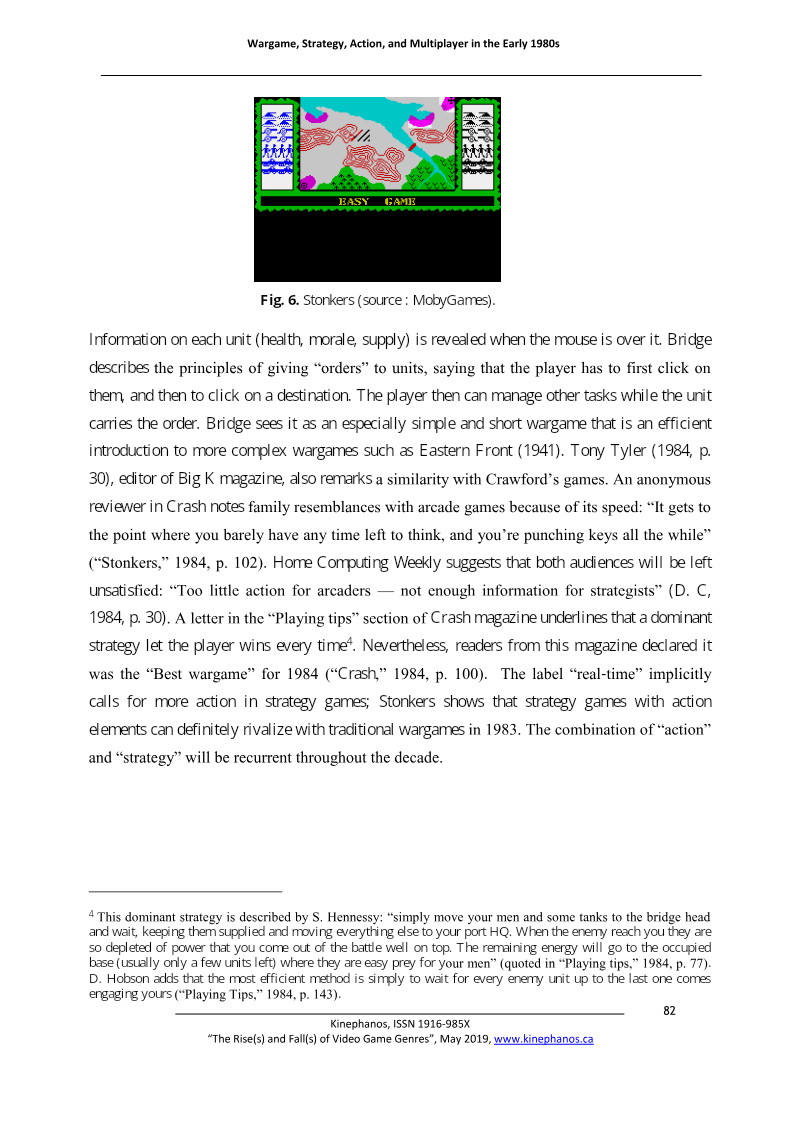
- Early 1980s strategy games like Eastern Front (1941) and Legionnaire were designed as solo tactical simulations rather than precursors to modern real-time strategy, prioritizing individual problem-solving over base-building or resource loops.
- The industry frequently hybridized traditional wargaming with arcade-style action, using terms like 'real-time' to describe continuous game flow rather than the high-intensity mechanics of contemporary standards.
- Multiplayer titles such as Commbat, Cytron Masters, and M.U.L.E. shifted the gameplay paradigm from solving static, pre-programmed puzzles to anticipating human opponent behavior.
The Interplay of Thematic and Ludological Elements in Western-Themed Games
The Western genre in video games functions as a versatile framework that has evolved significantly between 1990 and 2017.
- An analysis of 463 titles released between 1990 and 2017 reveals that Western-themed games predominantly utilize the genre as a superficial aesthetic overlay for action-oriented structures like shooters and action-adventure games.
- High-fidelity titles distinguish themselves by moving beyond standard shooting mechanics to incorporate specialized systems such as dueling, lassoing, horseback riding, and card-based progression.
- Successful thematic integration in the Western genre is achieved when developers embed narrative-consistent mechanics directly into the core gameplay loop rather than relying solely on visual styling.
Genre Troubles in Game Studies: Ludology, Agonism, and Social Action
Game studies currently faces a persistent analytical impasse rooted in the historical tension between ludology and narratology.
- Game studies should transition from viewing genre as a fixed taxonomy to treating it as a site of ongoing social contestation and evolution.
- The historical focus on ludology and rule-based formalist analysis has limited the field's ability to address the cultural and social dimensions of interactive media.
- Adopting an agonistic approach allows researchers to redefine genre as a form of social action shaped by the interplay of technology, player agency, and cultural discourse.