Skip to main content
Game Industry
Library
Library
Search
Ask AI
News
Connect your AI
Browse
The Catch Up
Topics
Collections
Writers
Help
Subscribe
Game Industry
Library
Library
Search
Ask AI
Saved
Library
1 report matching your filters
All Types
Reports
Articles
Presentations
Whitepapers
Financial
Legal
Other
Search
AR
VR
Global
Market Analysis
Diversity & Inclusion
Game Development
Southeast Asia
AI
Australia
Clear
Filters
1
AR
Report
15 pages
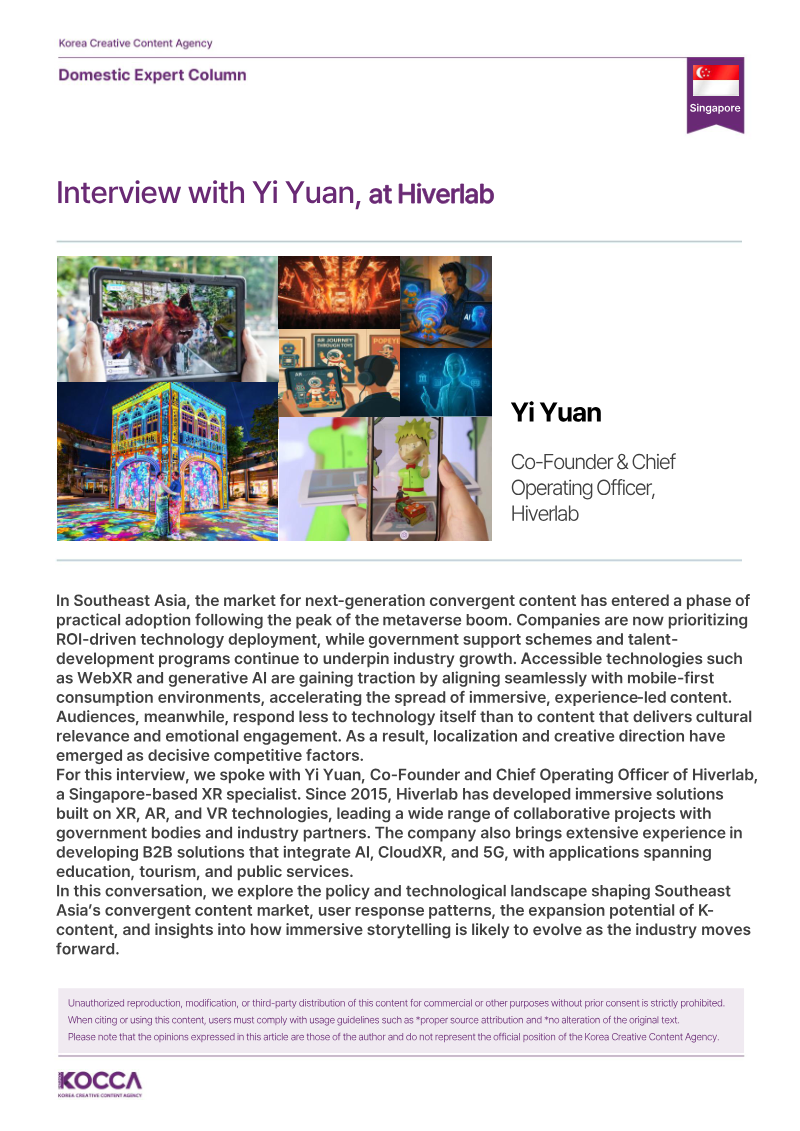
Interview with Yi Yuan, at Hiverlab: Southeast Asia
Southeast Asia’s convergent-content market has shifted from speculative metaverse projects to a pragmatic, ROI-driven focus on augmented reality for marketing and tourism.
Success in the region is measured by quantitative metrics including dwell time, interaction density, and social-virality indicators rather than technological novelty.
Large-scale AR deployments are currently anchored by government funding and mobile-first infrastructure, utilizing WebXR and 5G networks to ensure scalability.
Market Analysis
AI
AR
+1
KOCCA – Korea Creative Content Agency
Jan 2025
Recently added
Newest first
Oldest first
Title A–Z
Title Z–A